Indian equity markets ended higher on Friday, October 30, 2026, with the Nifty 50 moving back above the 23,000 mark as buying in information technology, banking and pharmaceutical stocks supported the benchmark indices. The recovery came despite weak global market signals, rising crude oil prices and continued uncertainty surrounding geopolitical developments in the Middle East.
The gains in frontline indices, however, did not reflect the broader market's performance. Midcap and smallcap stocks witnessed significant selling pressure, while declining market breadth indicated that losses outweighed gains across a large number of NSE-listed companies.
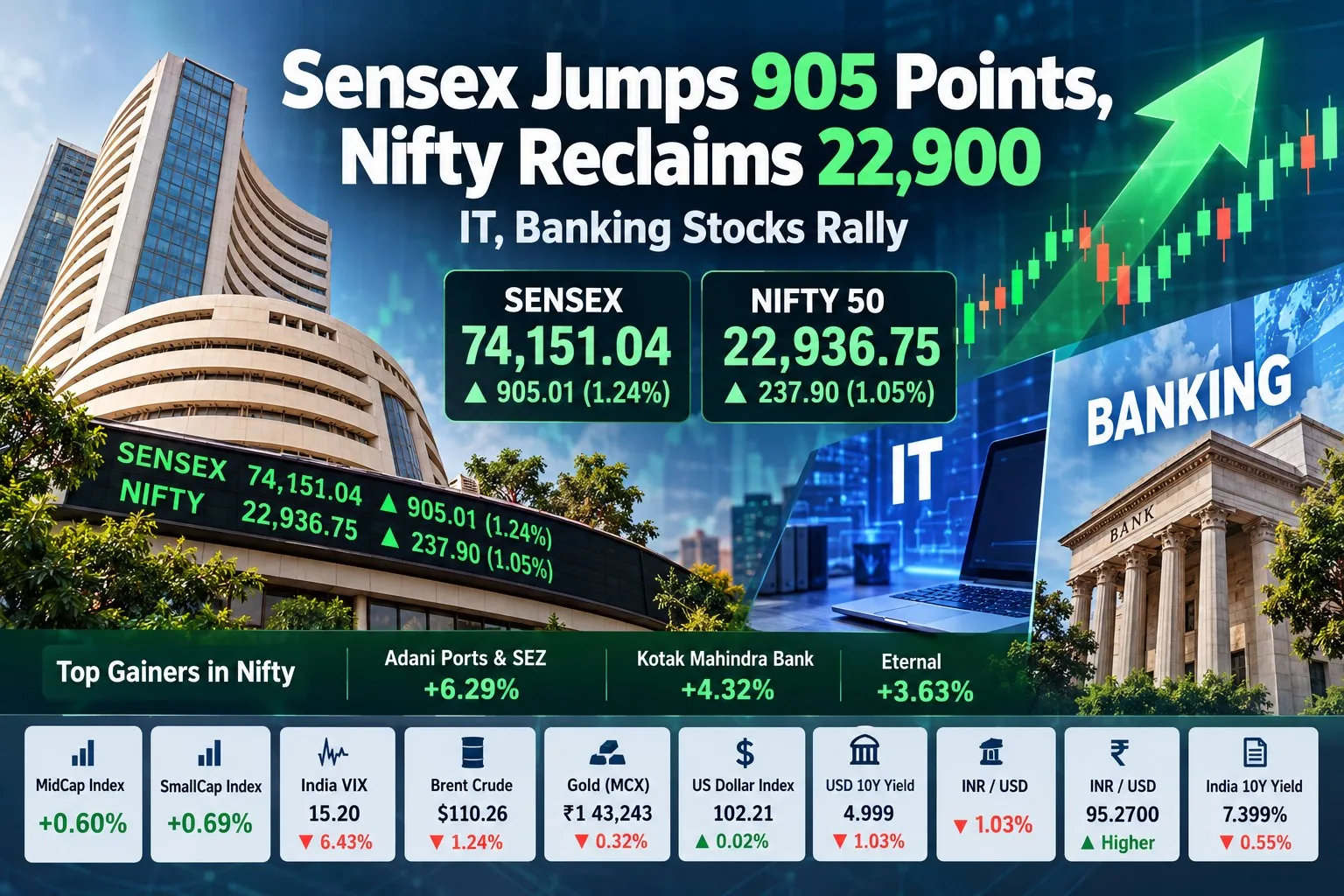
The BSE Sensex advanced 308.49 points, or 0.42%, to close at 74,459.93. The NSE Nifty 50 gained 116.35 points, or 0.51%, to settle at 23,053.10.
Investors continued to monitor quarterly corporate earnings, movements in crude oil prices, foreign exchange trends and developments in international markets. Brent crude trading above $117 per barrel remained a major concern for the Indian economy, particularly because of its implications for inflation, the rupee and the country's oil import expenditure.
IT stocks lead sectoral gains; pharma also advances
Information technology stocks emerged as the strongest performers during Friday's session. The Nifty IT index climbed 2.32% to 32,606.90, extending its gains to 3.34% over two consecutive trading sessions.
Buying interest was visible across several major IT companies:
Stock | Closing change |
|---|---|
Wipro | +4.32% |
Coforge | +4.23% |
LTIMindtree | +3.39% |
Infosys | +3.36% |
Persistent Systems | +2.86% |
HCL Technologies | +1.72% |
Tech Mahindra | +1.20% |
TCS | +0.99% |
Oracle Financial Services | +0.56% |
Mphasis | -1.39% |
Infosys was among the biggest contributors to the Nifty's advance. HDFC Bank and ICICI Bank also supported the benchmark through their gains of 1.39% and 0.82%, respectively.
Pharmaceutical and healthcare stocks also attracted buying interest. The Nifty Pharma index advanced around 1.7%, while the Nifty Healthcare index gained approximately 1.6%.
However, the recovery was not broad-based. Selling pressure affected several other sectoral indices, including auto, FMCG, metals, realty, PSU banks and oil and gas stocks. The Nifty Auto index declined 0.82%, while Nifty PSU Bank fell 1.15%.
The Nifty Media index also ended lower, losing 1.58%.
Midcap and smallcap stocks underperform
Despite the gains in the Sensex and Nifty, the broader market remained under selling pressure.
The Nifty MidCap 150 index declined 0.93%, while the Nifty SmallCap 250 index dropped 1.97%.
Market breadth on the NSE was distinctly negative:
Advances: 1,013 shares
Declines: 2,511 shares
Unchanged: 109 shares
This indicated that the benchmark recovery was concentrated in a relatively small group of heavyweight stocks rather than reflecting widespread buying across the market.
The India VIX, which measures expected near-term market volatility, increased 2.21% to 15.45. The rise in volatility alongside gains in the benchmark indices indicated that investors remained cautious about the near-term market environment.
According to the broader weekly market data, the Sensex and Nifty had gained approximately 1.4% and 1.5%, respectively, during the week. However, the midcap and smallcap indices continued to face pressure over the month.
Rising crude oil prices remain a concern for Indian markets
Crude oil prices remained one of the most important external factors influencing investor sentiment.
Brent crude futures for December 2026 delivery advanced $2.48, or 2.16%, to $117.36 per barrel. The international benchmark was on course for its fourth consecutive monthly gain.
The latest increase came amid escalating security concerns in the Middle East, including an attack involving a tanker in the Strait of Hormuz and renewed concerns about disruptions to regional oil supplies.
The Strait of Hormuz is a strategically important shipping route for global energy supplies. Any prolonged disruption in the region could affect crude oil transportation and increase volatility in international energy markets.
Reuters reported that Brent crude had gained approximately 13% during October, while US West Texas Intermediate crude was also heading for a substantial monthly increase.
For India, higher crude prices carry implications beyond the energy sector.
India imports a substantial portion of its crude oil requirements. A sustained increase in international oil prices can raise the country's import expenditure, increase pressure on the current account deficit and influence domestic fuel prices.
Higher energy costs can also feed into transportation, manufacturing and logistics expenses. If these costs are passed on to consumers, they can add to inflationary pressures.
The rupee, government finances and the profitability of oil-dependent businesses are among the areas investors monitor when crude prices rise sharply.
Rupee strengthens slightly against the US dollar
The Indian rupee registered a modest recovery against the US dollar during Friday's trading session.
The partially convertible rupee was trading at 94.9250 against the dollar, compared with the previous session's closing level of 95.2650.
The currency's movement came at a time when international oil prices remained elevated and geopolitical uncertainty continued to influence emerging-market currencies.
The US Dollar Index declined 0.38% to 101.65, providing some support to other currencies.
Meanwhile, India's 10-year government bond yield increased to 7.425%, compared with 7.387% in the previous session.
In the commodities market, MCX Gold futures for December 4, 2026, delivery declined 0.80% to Rs 1,41,453.
Global markets remain under pressure following technology earnings
International equity markets presented a mixed picture on Friday.
Most Asian markets ended lower as investors reacted to disappointing earnings from major US technology companies. Concerns over the scale of artificial intelligence investments and the returns generated from those investments weighed on technology stocks.
European equities, meanwhile, traded mostly higher, supported by gains in energy companies and selected heavyweight stocks.
US markets had ended Thursday's session lower.
US index | Closing level | Change |
|---|---|---|
Dow Jones | 52,342.56 | -0.25% |
S&P 500 | 7,720.39 | -0.30% |
Nasdaq Composite | 26,184.72 | -1.38% |
The Nasdaq recorded the steepest decline among the three major US indices, reflecting selling pressure in technology shares.
Alphabet suffers sharp decline after quarterly results
Alphabet, Google's parent company, experienced a significant sell-off after reporting its September-quarter financial results.
Its shares plunged 12.64% on Thursday, marking the company's steepest single-session decline on record at the time.
Alphabet reported revenue of $127.58 billion for the third quarter of 2026, representing 25% year-on-year growth. However, the figure was slightly below market expectations of approximately $127.97 billion.
Earnings per share came in at $2.12, below analyst expectations of around $3.
Google Cloud remained a major growth driver, with revenue increasing 103% year-on-year to $30.7 billion. The cloud division benefited from demand for artificial intelligence infrastructure and enterprise cloud services.
Despite the strong cloud performance, investors focused on the company's substantial AI-related expenditure, weaker-than-expected advertising performance and concerns about the returns on infrastructure investments.
Alphabet's results highlighted a growing concern across the technology industry: whether the enormous investments being made in artificial intelligence infrastructure will translate into sufficient revenue and profitability.
Intel and Amazon shares decline after earnings updates
Intel shares fell more than 17% in extended trading after the semiconductor company issued a weaker-than-expected fourth-quarter outlook.
The company reported third-quarter revenue of $16.5 billion, representing 21% year-on-year growth. Non-GAAP earnings per share stood at $0.52.
However, its fourth-quarter revenue guidance of $15 billion to $16 billion and expected non-GAAP earnings per share of $0.25 disappointed investors.
Amazon shares also declined more than 5% in extended trading despite reporting strong growth in its cloud business.
The company's third-quarter net sales increased 12% year-on-year to $201.94 billion. Amazon Web Services revenue rose 39% to $46 billion.
Operating income increased to $28.08 billion from $17.42 billion in the corresponding quarter last year.
However, Amazon's trailing 12-month free cash flow turned negative at $42.36 billion, compared with positive free cash flow of $14.79 billion a year earlier.
The company maintained its 2026 capital expenditure forecast of approximately $220 billion. Its fourth-quarter revenue guidance of $240 billion to $247 billion also failed to satisfy investor expectations.
US economic growth accelerates, but inflation remains elevated
US economic data released during the week provided another important signal for global financial markets.
According to the advance estimate from the Bureau of Economic Analysis, the US economy expanded at an annualised rate of 3.4% in the third quarter of 2026.
This was higher than the 2.2% growth recorded in the second quarter and exceeded the market expectation of approximately 3%.
Consumer spending increased at an annualised rate of 3.8%, while business investment also contributed to economic expansion.
Investment in information-processing equipment increased sharply, reflecting continued expenditure on artificial intelligence infrastructure.
However, the inflation data presented a more complicated picture.
The Personal Consumption Expenditures price index, the Federal Reserve's preferred inflation indicator, increased 0.5% month-on-month in September, compared with 0.3% in August.
Annual PCE inflation accelerated to 3.6% from 3.4%.
Core PCE inflation, which excludes food and energy prices, increased 0.3% month-on-month and 3.1% year-on-year, compared with 3% in August.
Personal consumption expenditure increased 0.5% in September, but inflation-adjusted consumer spending remained unchanged.
The combination of stronger economic growth and elevated inflation could complicate the Federal Reserve's monetary policy decisions.
For international investors, US interest-rate expectations are important because they influence bond yields, the dollar, global liquidity and capital flows into emerging markets such as India.
Bank of Japan keeps interest rates unchanged
The Bank of Japan (BOJ) maintained its short-term policy interest rate at 1.25% at its October monetary policy meeting, in line with market expectations.
The central bank, however, revised its inflation projections higher, indicating continued concerns about price pressures in Japan.
The BOJ raised its fiscal 2027 inflation forecast to 2.6% from 2.4%. Its forecast for core-core inflation, which excludes fresh food and energy, was also increased to 2.7% from 2.6%.
The decision came after the central bank raised interest rates to 1.25% in September, taking borrowing costs to their highest level in decades.
The BOJ's decision was closely monitored by international investors because changes in Japanese interest rates can influence global bond yields and currency movements.
Stocks in focus: Equitas SFB, IndiGo, Trent and Deepak Nitrite
Several companies attracted attention on Friday following their September-quarter earnings announcements and corporate developments.
Equitas Small Finance Bank falls despite record quarterly profit
Shares of Equitas Small Finance Bank declined 6.26% on Friday, even after the lender reported its highest-ever quarterly net profit of Rs 218.04 crore for Q2 FY27.
The selling pressure followed the resignation announcement of managing director and chief executive officer P. N. Vasudevan, which raised concerns about leadership succession and corporate governance.
The issue relates to perceived conflict-of-interest concerns involving a financial services business founded by his daughter. Vasudevan has maintained that there was no actual conflict of interest and that the relationship had been disclosed.
The bank's board requested him to continue in his position until a successor is appointed. The lender also initiated the process of identifying a new chief executive.
According to a report published on Friday, the bank expected to identify a potential successor within approximately one month.
Financially, Equitas reported a substantial improvement in quarterly profitability:
Financial metric | Q2 FY27 |
|---|---|
Net profit | Rs 218.04 crore |
Net profit in Q2 FY26 | Rs 24.14 crore |
Total income | Rs 2,357.51 crore |
Year-on-year profit growth | 803.23% |
The bank's net profit increased 18.75% compared with Rs 183.61 crore in the June 2026 quarter.
The sharp difference between the company's reported earnings performance and its share-price movement highlighted how management changes and governance-related concerns can influence investor sentiment independently of quarterly financial results.
IndiGo shares gain after narrowing quarterly losses
Shares of InterGlobe Aviation advanced 4.33% after the airline reported an improvement in its September-quarter financial performance.
The company reported a consolidated net loss of Rs 1,878.6 crore in Q2 FY27, compared with a net loss of Rs 2,581.7 crore in the corresponding quarter of the previous financial year.
Revenue from operations increased 25.91% year-on-year to Rs 23,363.8 crore for the quarter ended September 30, 2026.
The improvement in revenue was attributed in the reported results to disciplined capacity deployment and yield management.
Although the airline continued to report a quarterly loss, the reduction in the loss compared with the previous year formed an important part of the earnings update.
Trent rises 5.44% after reporting Q2 results
Shares of Trent gained 5.44% after the Tata Group retail company announced its September-quarter financial results.
The company reported standalone net profit of Rs 489.65 crore, an increase of 8.63% compared with Rs 450.75 crore in Q2 FY26.
Standalone revenue from operations increased 22.51% year-on-year to Rs 5,787.64 crore from Rs 4,724.06 crore.
However, profit declined 7.92% sequentially from Rs 531.77 crore in Q1 FY27. Revenue increased 2.14% compared with Rs 5,666.30 crore in the previous quarter.
The company's store expansion remained an important development during the quarter.
Trent opened its 1,000th Zudio store and added 10 Westside stores and 19 Zudio stores. It also consolidated two Zudio outlets.
The expansion reflects the company's continued focus on its value-fashion retail business through Zudio and its established Westside format.
Deepak Nitrite gains after 235% profit growth
Shares of Deepak Nitrite advanced 2.91% after the specialty chemicals manufacturer reported strong September-quarter earnings.
Consolidated net profit increased 235% year-on-year to approximately Rs 398 crore in Q2 FY27, compared with Rs 119 crore in the corresponding period last year.
Revenue from operations increased 61.73% to Rs 3,076 crore from Rs 1,902 crore.
The company's revenue also increased 19% sequentially from Rs 2,578 crore in Q1 FY27.
EBITDA increased to approximately Rs 643 crore from Rs 224 crore a year earlier. The EBITDA margin improved to around 20.9%, compared with 11.8% in the corresponding quarter last year.
The Phenolics business was a major contributor to the improvement in financial performance. Its revenue increased to Rs 2,291 crore from Rs 1,333 crore in the year-ago quarter.
The results indicated improvement in both revenue and operating profitability during the September quarter.
Greaves Cotton advances after revenue growth
Shares of Greaves Cotton gained 6.75% after the company reported a 44.2% year-on-year increase in consolidated revenue from operations to Rs 1,175.91 crore in Q2 FY27.
Revenue increased from Rs 974.12 crore in the June 2026 quarter, representing sequential growth of 20.72%.
The company's EBITDA increased 43% year-on-year to Rs 73 crore from Rs 51 crore.
However, adjusted net profit declined 34.44% to Rs 17.53 crore from Rs 26.74 crore in Q2 FY26.
EBITDA margin stood at 6.2%, compared with 6.3% in the corresponding quarter last year.
The company also reported exceptional and one-off items of Rs 60 crore during the quarter.
IPO market: M. K. Sons Fine Jewels and Bombay Coated & Special Steels
Activity in the primary market remained in focus as two public issues continued their subscription periods.
M. K. Sons Fine Jewels IPO
The initial public offering of M. K. Sons Fine Jewels received bids for 5,99,83,833 shares against 1.19 crore shares on offer, resulting in an overall subscription of 5.04 times as of 4:33 PM on October 29.
The issue opened on October 28 and is scheduled to close on October 30, 2026.
The company fixed the price band at Rs 153–162 per share. The minimum application size was 91 equity shares, with additional bids in multiples of 91 shares.
Bombay Coated & Special Steels IPO
Bombay Coated & Special Steels received bids for 6,16,76,160 shares against 1,65,33,012 shares on offer.
The issue was subscribed 3.73 times as of 4:36 PM on October 29.
The IPO opened on October 29 and will close on November 2, 2026.
The price band has been fixed at Rs 78–82 per share, with a minimum application size of 182 equity shares.
These subscription figures represent exchange data available on October 29 and should not be interpreted as the final subscription numbers.
Foreign investor flows and the October market performance
Foreign institutional investor activity remained an important factor influencing Indian equities during October.
According to Reuters, Indian benchmark indices ended October with monthly gains, breaking a two-month losing streak.
The Nifty 50 gained approximately 1.9% during October, while the Sensex advanced around 2.7%.
However, foreign investors continued to withdraw money from the Indian cash equity market during the month.
Foreign institutional investors recorded net selling of approximately Rs 47,817 crore in October, while domestic institutional investors remained net buyers with purchases of around Rs 61,113 crore, according to the reported monthly figures.
Domestic institutional buying helped absorb part of the selling pressure from overseas investors.
The information technology sector was among the strongest performers during the month. The Nifty IT index gained approximately 17.7%, marking its strongest monthly performance in more than six years.
The performance of IT stocks, corporate earnings and domestic institutional participation helped support the benchmark indices despite elevated crude oil prices and geopolitical uncertainty.
Midcap and smallcap indices, however, remained weaker on a monthly basis, with declines of approximately 3.4% and 4.2%, respectively.
Key market indicators: October 30, 2026
The following indicators captured the broader market environment at the end of Friday's session.
Indicator | Closing value | Change |
|---|---|---|
Sensex | 74,459.53 | +0.42% |
Nifty 50 | 23,053.10 | +0.51% |
Nifty IT | 32,606.90 | +2.32% |
Nifty MidCap 150 | 21047.50 | -0.93% |
Nifty SmallCap 250 | 16764.55 | -1.97% |
India VIX | 15.45 | +2.21% |
Brent crude | $117.36 | +2.16% |
USD/INR | 94.9250 | Rupee strengthened |
US Dollar Index | 101.65 | -0.38% |
India 10-year bond yield | 7.425% | Higher |
MCX Gold futures | Rs 1,41,453 | -0.80% |
What investors will watch in the coming sessions
Several developments are likely to remain important for Indian equity markets as November trading begins.
Crude oil prices: Further increases in Brent crude could create additional pressure on India's inflation outlook, import bill and currency.
Quarterly earnings: Investors will continue tracking September-quarter results for information on corporate revenue growth, margins and profitability.
Foreign investment flows: Continued foreign institutional selling and domestic institutional purchases will remain important indicators of market liquidity.
US inflation and interest rates: Changes in inflation expectations and Federal Reserve policy could influence global bond yields and emerging-market capital flows.
Geopolitical developments: Developments in the Middle East, particularly around energy supply routes, could influence commodity prices and investor sentiment.
Broader market participation: The performance of midcap and smallcap stocks will be important in determining whether the benchmark recovery extends beyond heavyweight companies.
The Nifty's return above 23,000 and the Sensex's second consecutive session of gains provided support to the benchmark indices. However, the decline in broader markets, negative NSE market breadth and rising crude oil prices showed that the recovery remained uneven.
Disclaimer: The content published on candlesticks.in is strictly for educational, research, and informational purposes only and does not constitute financial, investment, or legal advice. Equities investments carry high market risk. Always consult a SEBI-registered financial advisor before executing investment decisions.