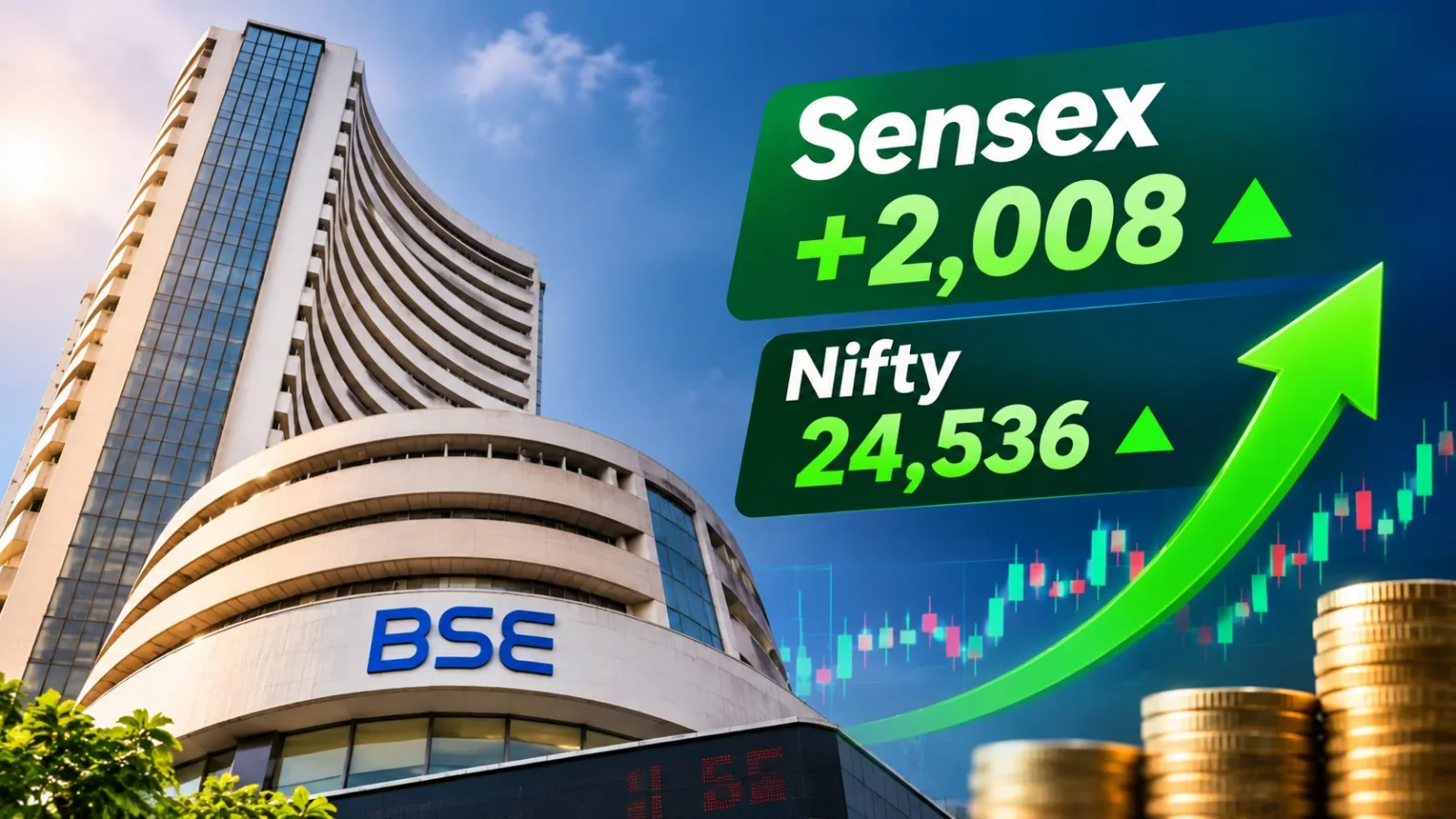
Indian equity markets witnessed a strong rally on Thursday, November 5, with benchmark indices recording substantial gains for the sixth consecutive trading session. Buying across banking, automobile and real estate stocks lifted the broader market, while improving global sentiment and a decline in government bond yields provided additional support. The Nifty 50 moved above the 24,500 mark, while the Sensex gained more than 2,000 points.
The S&P BSE Sensex advanced 2,008.61 points, or 2.60%, to close at 79,310.01. The NSE Nifty 50 climbed 576 points, or 2.40%, to finish at 24,536.60. Over the six-session rally, the Sensex has gained 8.28%, while the Nifty has advanced 8.10%, reflecting sustained buying interest across the domestic equity market.
Midcap and Smallcap Stocks Participate in Market Rally
The upward movement extended beyond large-cap stocks, although gains were comparatively stronger among midcap companies. The Nifty MidCap 150 index increased 1.93%, while the Nifty SmallCap 250 index advanced 0.79%.
Market breadth remained positive, indicating that buying activity was spread across several segments rather than being concentrated exclusively in heavyweight index constituents. The difference in performance between midcap and smallcap indices also reflected varying levels of participation across market capitalisation categories.
Auto, Realty and Banking Stocks Lead Sectoral Gains
Automobile stocks emerged as the strongest performers among the major sectoral indices. The Nifty Auto index gained 4.14%, supported by broad-based buying in the automobile segment. The Nifty Realty index advanced 3.52%, while the Nifty Private Bank index rose 3.44%, outperforming the benchmark Nifty 50.
Other sectors recorded more moderate movements. The Nifty FMCG index gained 0.45%, while the Nifty Oil & Gas index edged higher by 0.34%. The Nifty Media index was the notable underperformer, declining 0.84% during the session.
Bond Yields and Currency Movements
Government bond yields moved lower during Thursday's session. The yield on India's 10-year benchmark government security declined to 7.152%, compared with the previous session's closing level of 7.192%. Lower yields formed part of the broader improvement in sentiment across financial markets.
In the foreign exchange market, the Indian rupee traded marginally stronger against the US dollar. The partially convertible currency was quoted at 94.4475 per dollar, compared with its previous close of 94.4600.
The US Dollar Index, which measures the dollar against a basket of major international currencies, declined marginally by 0.02% to 101.51. The US 10-year Treasury yield also moved lower by 0.37% to 4.875%.
Gold and Crude Oil Prices Remain in Focus
Commodity markets recorded gains in selected contracts. MCX gold futures for December 4, 2026 delivery advanced 1.13% to Rs 1,44,850, reflecting continued activity in the domestic bullion market.
Brent crude futures for December 2026 delivery increased by $1.42, or 1.50%, to $96.04 per barrel. The movement in crude prices remained an important factor for investors assessing inflation, energy costs and the potential impact on India's import bill.
European and Asian Markets Show Diverging Trends
European equities traded higher on Thursday as investors assessed developments in US politics, bond yields and the outlook for energy markets. Expectations of reduced political uncertainty and the possibility of diplomatic progress in the Middle East contributed to improved risk appetite.
Asian markets presented a mixed picture. South Korean technology and semiconductor stocks faced selling pressure, resulting in a temporary trading curb as the market experienced a sharp decline. Weakness in technology shares offset gains in other parts of the region.
South Korea's current account surplus increased to a record $61.46 billion in September 2026, compared with $46.11 billion in August, according to Bank of Korea data. The latest figures highlighted the improvement in the country's external account balance.
US stock index futures moved higher during Thursday's Asian and European trading hours. Dow futures gained 276 points, indicating a positive opening outlook for Wall Street.
Wall Street Records Strongest Dow Rally Since April 2025
US equities ended Wednesday, November 4, with substantial gains following the Democratic Party's victories in the midterm elections, which gave it control of both chambers of Congress. The Dow Jones Industrial Average climbed 1,569.40 points, or 3.03%, to 53,356.12, marking its strongest single-day percentage gain since April 2025.
The S&P 500 advanced 1.58% to 7,688.62, while the Nasdaq Composite gained 1.44% to settle at 25,736.51. Falling Treasury yields and changing expectations surrounding US political and economic policy were among the factors influencing investor positioning.
Among major technology companies, Microsoft shares rose 6.68%, Amazon gained 6.12% and Apple advanced 5.31%. However, semiconductor stocks delivered a mixed performance, with Nvidia declining 3.17% and Micron falling 7%.
Companies associated with data-centre infrastructure also faced selling pressure. CoreWeave dropped 9.9%, while Tesla declined 3.34%. Trump Media recorded a particularly steep fall of 24.54%.
AMD Reports Strong Revenue Growth as Chip Stocks Remain Mixed
Advanced Micro Devices (AMD) reported third-quarter revenue of $13.38 billion, representing a 45% increase compared with the corresponding period last year. The company also projected fourth-quarter revenue of approximately $17 billion, with a margin of plus or minus 3%.
AMD's data-centre business generated revenue of $8.55 billion, an increase of 97% year on year. Its shares gained around 1% following the earnings announcement.
Qualcomm moved in the opposite direction, falling 4.8% in after-hours trading following its quarterly results and financial outlook. Elsewhere, McDonald's shares increased 6.5% after the company reported higher quarterly revenue and profit. Uber advanced 4.9% after reporting revenue and adjusted earnings above market expectations.
US Employment and Services Activity Data
US private-sector employment increased by 86,000 jobs in October, according to data published by ADP. This followed an increase of 90,000 jobs in September, indicating that private-sector employment continued to expand, although the latest monthly addition was lower.
The Institute for Supply Management's Services PMI declined to 54.5 in October from 54.9 in September. The reading was also below the market expectation of 54.8. Despite the moderation, the index remained above the 50-point threshold, indicating continued expansion in the services sector.
The US Treasury market also remained sensitive to expectations surrounding Federal Reserve policy. Investors continued to assess the implications of economic data, political developments and inflation trends for the future direction of interest rates.
Disclaimer: This article is intended for informational and educational purposes only. The market data, index movements, company announcements and economic figures are based on the information available at the time of writing. Nothing in this article should be interpreted as investment advice, a recommendation to buy or sell securities, or a guarantee of future market performance. Stock market investments are subject to market risks. Readers should conduct their own research and consult a SEBI-registered investment adviser before making investment decisions.