

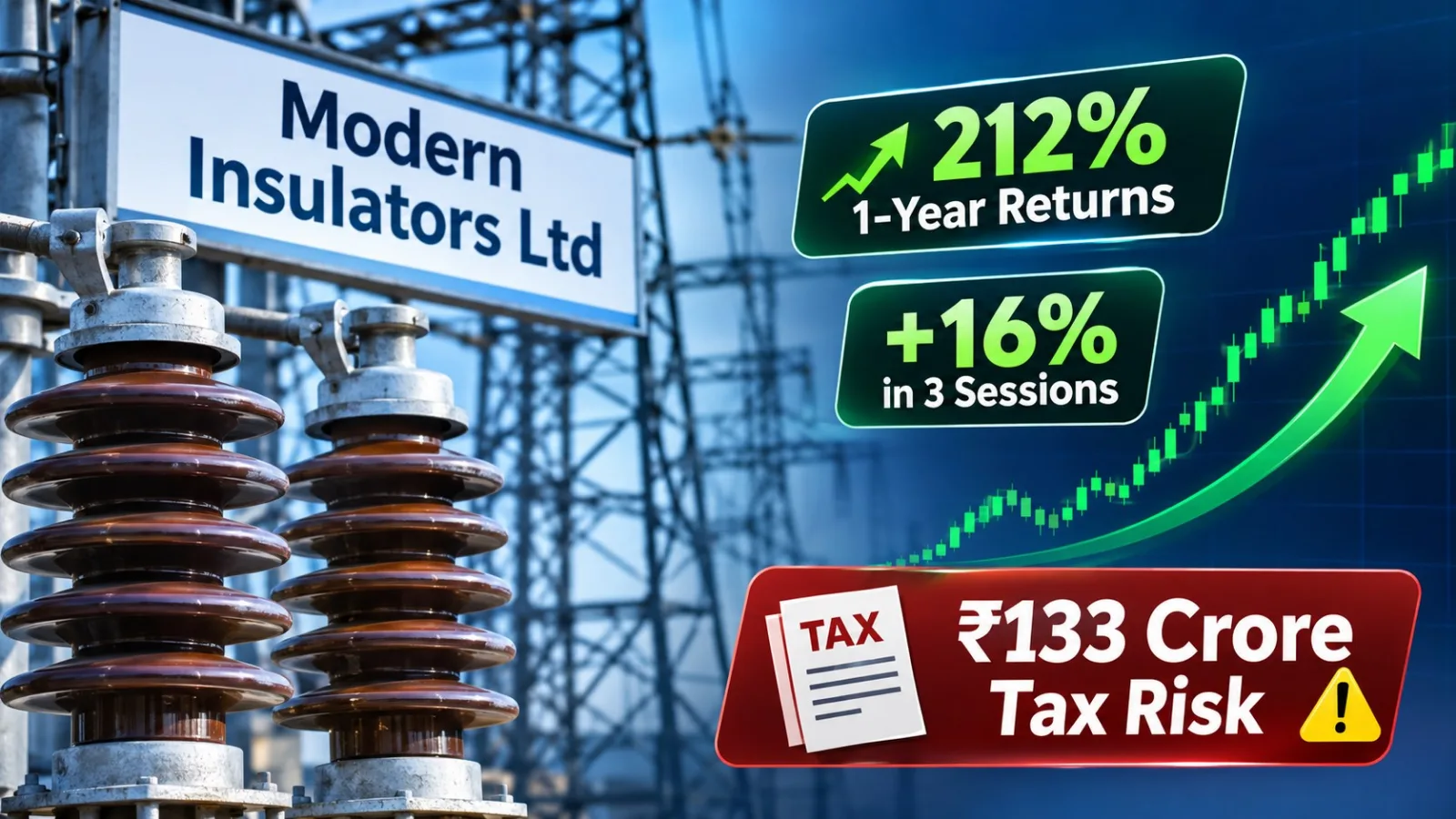
Modern Insulators Ltd (BSE: 515008) has attracted fresh investor attention after its shares gained nearly 16% in three consecutive trading sessions following the announcement of its Q2 FY27 results. The stock moved from ₹461.45 on November 13, 2026, to ₹534.10 on November 18, with the shares hitting their 5% upper circuit in each of the three sessions.
Modern Insulators shares have delivered approximately 212% returns over the past one year, highlighting the stock's sharp re-rating in the market. The share price has moved from around ₹171.80 in November 2025 to ₹534.10 on November 18, 2026. Despite the impressive rally, the company's pending tax liability, auditor qualification and cash flow conversion remain important factors for investors to monitor
Modern Insulators Share Price: What Triggered the 16% Rally?
Modern Insulators closed at ₹461.45 on November 13, before rising to ₹484.50 on November 16, ₹508.70 on November 17 and ₹534.10 on November 18. The three consecutive advances represented a gain of approximately 15.7%, with the stock trading at its upper price band throughout the rally.
The movement followed the company's November 14 announcement of unaudited standalone and consolidated financial results for the second quarter and first half of FY27. The earnings improvement attracted buying interest, although the consecutive upper circuits and relatively thin trading volumes also increased the possibility of sharp price movements.
The stock has already delivered a substantial return over the past year. Its 52-week low stands at ₹142.15, while the 52-week high is ₹579. The November 18 closing price was still below the recent high, but significantly above its previous year's trading levels.
Modern Insulators Q2 FY27 Results: Revenue and Profit Nearly Triple
Modern Insulators reported strong financial performance for the quarter ended September 30, 2026. Standalone revenue from operations increased to ₹239.31 crore from ₹176.51 crore in the corresponding quarter last year, registering growth of approximately 35.6%.
Standalone net profit increased to ₹51.65 crore from ₹17.53 crore, representing growth of around 194.6%. Earnings per share also improved to ₹10.96 from ₹3.72, reflecting the significant improvement in quarterly profitability.
Modern Insulators Standalone Financial Performance
Particulars | Q2 FY27 | Q2 FY26 | YoY growth |
|---|---|---|---|
Revenue from operations | ₹239.31 Cr | ₹176.51 Cr | 35.6% |
Profit before tax | ₹70.90 Cr | ₹22.49 Cr | 215.1% |
Net profit | ₹51.65 Cr | ₹17.53 Cr | 194.6% |
EPS | ₹10.96 | ₹3.72 | 194.6% |
The consolidated performance was also strong, with revenue from operations reaching ₹249.46 crore compared with ₹176.49 crore in Q2 FY26. Consolidated net profit increased to ₹52.55 crore from ₹16.60 crore, while consolidated EPS improved to ₹11.15 from ₹3.52.
For the first half of FY27, consolidated revenue reached ₹437.76 crore against ₹317.86 crore in the corresponding period last year. Consolidated net profit increased to ₹82.15 crore from ₹31.82 crore, indicating that the improvement was not limited to a single quarter.
Insulators Division Drives the Earnings Growth
Modern Insulators operates through two principal business segments: Insulators and Terry Towels. The high-voltage porcelain insulator business remains the company's largest revenue contributor, while the terry towel division represents a much smaller part of its operations.
During Q2 FY27, the Insulators division generated approximately ₹219.98 crore in revenue compared with ₹162.18 crore in the corresponding quarter last year. The Terry Towels division contributed approximately ₹19.33 crore, against ₹14.33 crore a year earlier.
The growth in the insulator business is linked to demand for power transmission infrastructure, electricity grid expansion and investments in renewable energy evacuation networks. Modern Insulators manufactures high-voltage porcelain insulators used in transmission and electrical infrastructure projects, giving it exposure to domestic and international power-sector demand.
The company has also benefited from improved operating leverage. Standalone operating margin expanded to approximately 22.26% in Q2 FY27 from 10.82% in Q2 FY26, indicating that operating profitability increased faster than revenue.
₹23.20 Crore Other Income: How Much of the Profit Is Operational?
One important aspect of the September-quarter results is the sharp increase in other income. Modern Insulators reported standalone other income of approximately ₹23.20 crore in Q2 FY27, compared with ₹7.10 crore in the corresponding quarter last year.
Other income accounted for nearly 32.7% of the reported standalone profit before tax of ₹70.90 crore. This means that a significant portion of the reported pre-tax earnings came from activities outside the company's core manufacturing operations.
Removing the entire ₹23.20 crore from reported PBT gives an estimated pre-tax profit of approximately ₹47.70 crore. This is not a company-reported adjusted profit figure, but it helps investors understand the contribution of non-operating income to quarterly earnings.
Even after this adjustment, the operating performance remains strong. Revenue grew by 35.6%, while operating margin more than doubled compared with the year-ago quarter. The improvement suggests that the earnings growth was supported by manufacturing operations rather than depending entirely on other income.
The sustainability of other income nevertheless deserves attention. Modern Insulators' FY26 annual report showed that foreign exchange fluctuations, interest income, investment gains, dividends, rent and miscellaneous income contributed to the annual figure. The company has not provided sufficient quarterly detail to establish how much of Q2 FY27's unusually high other income is recurring.
Modern Denim Amalgamation: Why the ₹133.35 Crore Tax Liability Matters
The proposed amalgamation between Modern Denim Ltd and Modern Insulators Ltd is one of the most important issues investors need to understand before assessing the company's reported profitability and book value.
The long-pending scheme involves the proposed merger of Modern Denim into Modern Insulators. The arrangement has been pursued through the NCLT process, with the objective of combining the businesses and addressing the accumulated losses and other financial matters associated with the transferor company.
However, the scheme has not received final approval. The NCLT Jaipur Bench disposed of the company's petition on January 22, 2026, granting liberty to approach the tribunal again after completing the required regulatory and procedural compliances, including obtaining the necessary stock exchange approvals.
The company's subsequent disclosures indicate that it has been pursuing the exchange clearance and addressing the clarifications required for the modified scheme. Until the necessary approvals are obtained and the scheme becomes legally effective, the merger-related accounting treatment remains an important uncertainty.
Why auditors have qualified the financial results
The statutory auditors, R.B. Verma & Associates, issued a qualified limited review report on the September 2026 financial results. The qualification relates to the company's decision not to provide for certain tax liabilities and associated interest in view of the proposed amalgamation.
The unprovided amount stood at approximately ₹2.79 crore for Q2 FY27 and ₹5.55 crore for the first half of FY27. The cumulative unprovided tax liability, including interest, was approximately ₹133.35 crore, as disclosed in the results-related notes.
The issue is material because the proposed amalgamation has not yet received final NCLT sanction. If the scheme does not proceed, the company would need to reassess the tax position and account for any liability that becomes payable under the applicable tax provisions.
Potential impact on book value per share
Modern Insulators had approximately 4.71 crore equity shares outstanding. A hypothetical recognition of the entire ₹133.35 crore liability would translate into an impact of approximately ₹28.29 per share.
The company's reported net worth is approximately ₹630 crore. A ₹133.35 crore adjustment would therefore reduce net worth by roughly 21%, assuming the entire amount is ultimately recognized as an additional liability without offsetting adjustments.
This is an illustrative calculation rather than a prediction of an immediate accounting adjustment. The final impact will depend on the amalgamation outcome, tax assessments, applicable interest and the manner in which the liability is recognized.
Potential impact on EPS
The unprovided Q2 tax and interest amount of ₹2.79 crore represents approximately ₹0.59 per equity share. Recognizing this amount alone would reduce the reported quarterly EPS from ₹10.96 to approximately ₹10.37, before considering any other tax adjustments.
For the first half, the unprovided amount of ₹5.55 crore represents approximately ₹1.18 per share. Investors should distinguish this ongoing tax-provision issue from the cumulative ₹133.35 crore exposure, which represents a much larger balance-sheet uncertainty.
The final resolution of the Modern Denim scheme could therefore have a significant effect on the company's reported net worth and future earnings.
Modern Polytex Demerger: What Shareholders Need to Know
Modern Insulators has also undergone a separate corporate restructuring involving the transfer of its yarn division to Modern Polytex Ltd. The demerger covers the yarn division undertaking located at Surat, separating this business from the principal insulator manufacturing operations.
Under the approved arrangement, eligible Modern Insulators shareholders were entitled to receive one fully paid-up Modern Polytex share of ₹10 face value for every two Modern Insulators shares held. October 31, 2025, was fixed as the record date for determining shareholder eligibility.
The separation is intended to leave Modern Insulators more focused on its electrical insulator business and the smaller Terry Towels division. Modern Polytex represents a separate investment exposure for shareholders eligible under the scheme.
The BSE notice specifies that the resulting company's shares would be listed subject to completion of the required formalities. Shareholders should verify the allotment and final listing and trading status through their demat accounts and subsequent exchange announcements rather than assuming that allotted shares are immediately tradable.
Working Capital and Cash Flow: A Concern Despite Strong Profits
Another area that deserves attention is the difference between reported accounting profits and actual cash generated from operations. Modern Insulators reported consolidated first-half FY27 net profit of approximately ₹82.15 crore, but operating cash flow was considerably lower at around ₹21.42 crore.
The gap indicates that a substantial portion of reported earnings had not yet translated into operating cash. The cash flow disclosures point to working capital absorption, particularly through trade and other receivables and inventories, as an important reason for the difference.
The company's business involves supplying industrial and infrastructure customers, where order execution, inspection, dispatches and payment cycles can influence the timing of collections. As revenue expands, additional funds may remain tied up in raw materials, work-in-progress, finished goods and customer payments.
This does not automatically indicate a deterioration in the business. However, investors need to monitor whether the company can convert its growing profits into cash over subsequent quarters, particularly as its manufacturing activity expands.
Receivables collection, inventory movement and operating cash flow will be important indicators in assessing the quality of future earnings. A continued rise in profits without a corresponding improvement in cash generation would require closer examination.
Modern Insulators Balance Sheet and Debt Position
Modern Insulators has maintained relatively low financial leverage compared with many businesses in capital-intensive industrial segments. The reported debt-to-equity ratio is approximately 0.11, indicating that the company has not relied heavily on debt to support its operations.
However, low leverage does not eliminate all balance-sheet concerns. The proposed Modern Denim amalgamation, the associated unprovided tax liability and interest-free advances to related entities are important considerations when evaluating the quality of reported net worth.
The company's cash and investment position also needs to be assessed alongside working capital requirements. Investments and cash balances may provide liquidity, but their availability and realization should be evaluated against borrowing obligations and ongoing business requirements.
Modern Insulators Valuation: Is the Stock Still Attractive?
At ₹534.10, Modern Insulators was valued at approximately ₹2,518 crore based on its outstanding equity share count of around 4.71 crore shares. Its trailing price-to-earnings multiple was approximately 19 times, while the price-to-book ratio was around four times.
The valuation appears moderate compared with some larger electrical equipment businesses. However, Modern Insulators operates at a different scale and has a different business mix compared with multinational electrical equipment manufacturers such as ABB India, Siemens India and Hitachi Energy India.
Skipper, Transrail Lighting, Bharat Bijlee and Rishabh Instruments provide additional reference points within the wider electrical equipment and power infrastructure space. However, differences in product mix, EPC exposure, technology, working capital and business scale make direct valuation comparisons difficult.
Modern Insulators' operating margin improvement is a positive factor, but valuation should also reflect the sustainability of recent profitability. Investors need to consider whether the unusually strong quarterly margins can be maintained and whether earnings growth will translate into stronger operating cash flows.
The approximately 4-times book value multiple also deserves attention because the company's reported net worth is exposed to the unresolved tax issue. A successful resolution of the amalgamation and clarity on the liability could reduce uncertainty, while an adverse outcome could materially affect reported book value.
Key Risks Investors Should Monitor
Modern Denim tax exposure: The cumulative unprovided tax liability of approximately ₹133.35 crore remains one of the largest balance-sheet uncertainties. The stock's valuation could be affected by the final outcome of the amalgamation and the resulting tax treatment.
Dependence on other income: Q2 FY27 other income of ₹23.20 crore contributed substantially to reported pre-tax earnings. Investors should examine future quarterly disclosures to determine whether this income can be sustained.
Cash flow conversion: Consolidated H1 FY27 operating cash flow of approximately ₹21.42 crore was significantly lower than net profit of ₹82.15 crore. Receivables and inventory movements need to be monitored closely.
Low trading liquidity and upper circuits: Consecutive 5% upper-circuit sessions can create sharp price movements in relatively thinly traded stocks. Price discovery may become difficult when trading interest changes direction.
No dividend distribution: The company did not recommend a dividend for FY26, despite reporting a substantial improvement in profitability. Investors primarily looking for regular dividend income should consider this aspect.
What Lies Ahead for Modern Insulators?
Modern Insulators has reported a substantial improvement in its financial performance, supported by stronger revenue from the Insulators division and a significant expansion in operating margins. Its Q2 FY27 results indicate that the underlying manufacturing business has gained profitability, even after accounting for the contribution from other income.
However, the next stage of the company's financial performance will also depend on developments outside its quarterly sales and profit growth. The Modern Denim amalgamation, the ₹133.35 crore unprovided tax exposure, cash flow conversion and the Modern Polytex listing process remain important developments for shareholders.
The December quarter and subsequent financial disclosures will help determine whether the September-quarter operating margins can be sustained and whether cash generation improves alongside profits. The recent share price rally has already reflected considerable optimism, making earnings quality, balance-sheet clarity and liquidity important factors in evaluating the stock at current levels.
Disclaimer: This article is intended for informational and educational purposes only. The financial information, share price movements, earnings figures and corporate developments discussed are based on publicly available company disclosures, stock exchange filings and other sources believed to be reliable. Readers should independently verify the information before making any investment decisions.
This article does not constitute investment advice, a recommendation to buy, sell or hold any securities, or a solicitation to invest. Stock market investments are subject to market risks, and past returns do not guarantee future performance. Readers are advised to consult a SEBI-registered investment advisor before making investment decisions.