

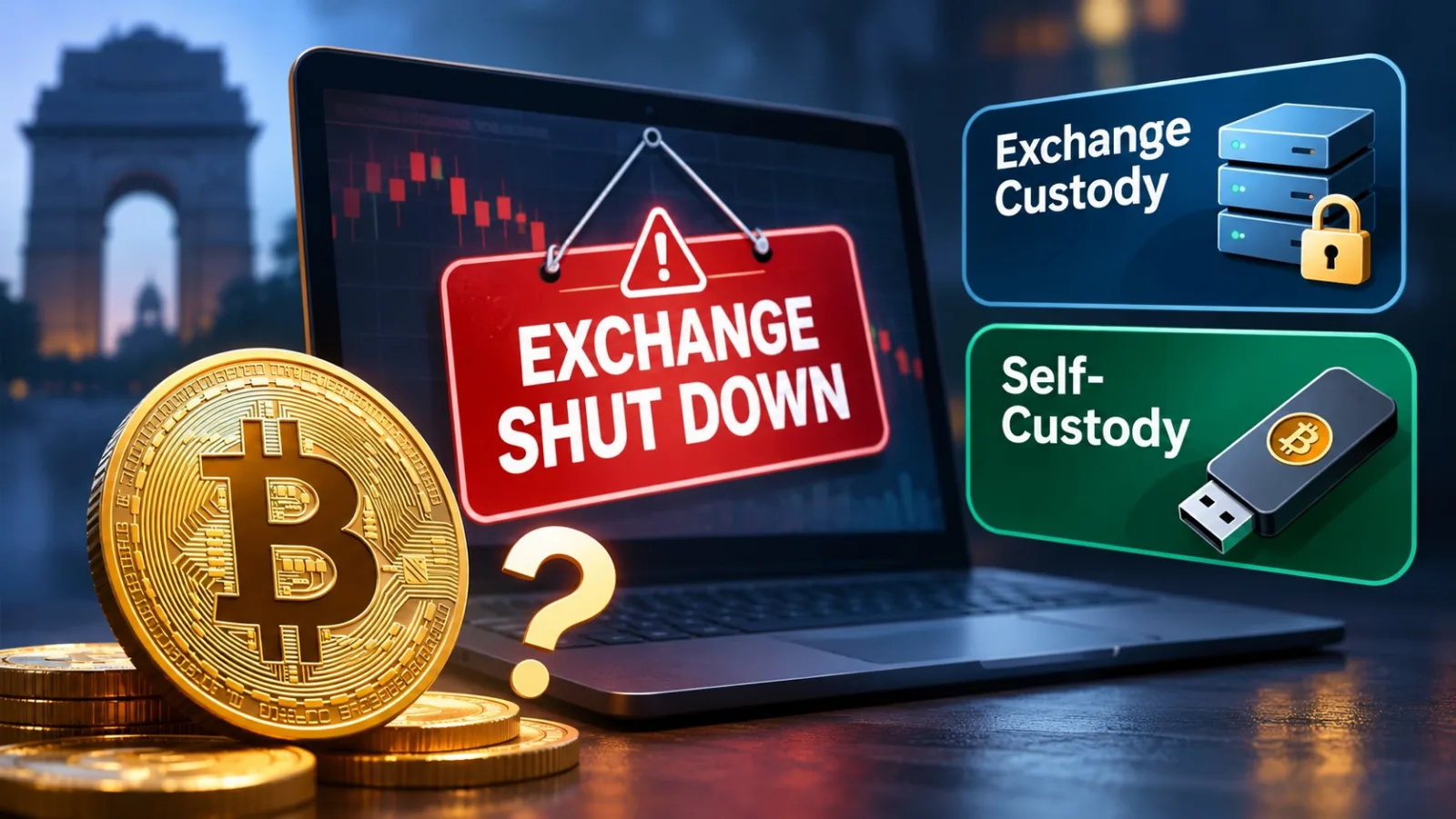
An Indian cryptocurrency investor may believe that the Bitcoin purchased on an exchange belongs entirely to them. However, the legal and practical position can become complicated when the exchange controls the private keys, holds customer assets in pooled wallets or operates through an offshore legal entity.
Unlike a bank deposit, cryptocurrency holdings on a centralised exchange do not automatically carry deposit insurance or a guaranteed recovery mechanism. If an exchange suddenly suspends withdrawals, enters insolvency or disappears, investors may discover that having Bitcoin in an exchange account is not the same as directly controlling the underlying cryptocurrency.
The distinction between exchange custody and self-custody becomes particularly important during a financial crisis. The outcome may depend on the exchange's legal structure, customer agreement, asset segregation practices, insolvency proceedings and the jurisdiction in which the relevant assets are held.
For Indian investors, the question goes beyond whether Bitcoin prices will recover. It is whether they can establish ownership of their holdings and legally recover those assets when the exchange responsible for holding them is no longer operational.
Buying Bitcoin Does Not Always Mean Controlling It
When an investor purchases Bitcoin through a cryptocurrency exchange, the platform generally displays the quantity of cryptocurrency held in the customer's account. For example, an investor may see a balance of 0.25 BTC on the exchange dashboard.
However, the Bitcoin may not be sitting in a separate blockchain wallet controlled by that investor. Many centralised exchanges maintain custody of customer cryptocurrencies through wallets controlled by the exchange or its appointed custodians.
The exchange manages the private keys required to authorise blockchain transactions. Customers can request withdrawals, but they generally cannot independently move the cryptocurrency without the exchange processing the transaction.
This arrangement is known as custodial ownership or exchange custody. The investor may retain beneficial ownership under the contractual arrangement, while the exchange controls the private keys and the operational ability to execute transactions.
That distinction becomes important when the platform stops operating. An investor may have evidence of a Bitcoin balance in their account but may not have direct access to the underlying blockchain assets.
Exchange custody versus self-custody
There are two common ways to hold cryptocurrency: custodial wallets and self-custody wallets. The difference is not simply where Bitcoin is stored, but who controls the private keys and who has the authority to transfer the assets.
Exchange custody: In this arrangement, the platform manages wallets and private keys on behalf of its customers. Investors access their cryptocurrency through exchange accounts, while the platform handles blockchain transactions and withdrawal processing.
Some exchanges maintain separate wallets for different purposes, such as customer deposits, withdrawals and cold storage. Others use omnibus wallets, where cryptocurrency belonging to several customers is held at shared blockchain addresses.
An omnibus wallet does not automatically mean that the exchange owns every customer's Bitcoin. Internal accounting records and contractual arrangements may establish individual customer entitlements even when several customers' assets are held at shared addresses.
However, if an exchange fails to maintain accurate customer records or mixes customer assets with its own funds, establishing individual ownership can become considerably more difficult.
Self-custody: Self-custody means the investor independently controls the private keys required to access and transfer cryptocurrency. The assets are held in a wallet where the investor, rather than an exchange, has control over transaction authorisation.
A hardware wallet is one common method of self-custody. It stores private keys in a dedicated device and allows users to sign transactions without handing control of those keys to a centralised exchange.
If an exchange shuts down, Bitcoin already transferred to a self-custody wallet is generally outside the exchange's custody. However, the investor remains responsible for protecting the recovery phrase and private keys.
Feature | Exchange custody | Self-custody |
|---|---|---|
Private keys | Controlled by exchange or custodian | Controlled by investor |
Withdrawals | Depend on platform operations | Initiated independently |
Exchange failure risk | Direct exposure | Generally lower |
Recovery phrase | Usually controlled by platform infrastructure | Must be protected by investor |
Transaction access | Subject to exchange restrictions | Subject to blockchain network |
The important distinction is that exchange custody introduces an additional counterparty risk. Self-custody reduces dependence on the exchange but transfers security and recovery responsibilities to the investor.
What Happens to Customer Bitcoin When an Exchange Becomes Insolvent?
An exchange shutdown does not necessarily mean that all customer cryptocurrency has disappeared. The outcome depends on whether the platform still controls the assets, whether customer holdings are properly recorded and how the applicable insolvency law treats those assets.
When an exchange enters insolvency proceedings, an insolvency professional or liquidator may take control of the company's affairs and examine its assets, liabilities and financial records.
The central question is whether customer cryptocurrency belongs to the customers or forms part of the company's assets available to repay creditors.
Case 1: Customer assets are properly segregated
Suppose an exchange holds 100 BTC on behalf of customers and maintains reliable records showing the individual ownership of those holdings.
If the assets are legally recognised as customer property or are held under an enforceable trust or custody arrangement, customers may argue that the Bitcoin should be returned to them rather than distributed among the exchange's creditors.
India's Insolvency and Bankruptcy Code, 2016 (IBC), provides an important distinction here. Section 36(4) excludes certain third-party assets, including assets held in trust for another person, from the liquidation estate.
However, this does not automatically guarantee the return of cryptocurrency. Customers must establish their ownership rights, and the treatment of digital assets will depend on the contractual structure, applicable law and decisions of the relevant authority.
Case 2: Customer assets are mixed with company funds
Consider another situation where an exchange holds customer cryptocurrency but also uses those assets for lending, trading, collateral arrangements or other business activities.
If the exchange loses a significant portion of those assets, the remaining cryptocurrency may be insufficient to meet customer balances.
For example, assume customers collectively have recorded balances of 100 BTC, but the exchange controls only 60 BTC when insolvency proceedings begin.
Illustrative exchange insolvency scenario
Particulars | Bitcoin |
|---|---|
Total customer balances | 100 BTC |
Cryptocurrency available | 60 BTC |
Asset shortfall | 40 BTC |
In this situation, customers cannot simply assume that the available 60 BTC will automatically be divided equally or proportionately among them. The outcome depends on ownership arrangements, insolvency law, asset tracing and the decisions of the relevant authorities.
If customers have only contractual repayment claims rather than identifiable proprietary rights, they may have to participate in the insolvency process as creditors. Depending on the applicable legal framework and priority of claims, recovery could be partial or even negligible.
Case 3: The exchange has lost the private keys
A different problem arises when an exchange loses access to its wallets because of poor key management, internal misconduct or a security incident.
Even if customer ownership is recognised, an insolvency professional cannot return cryptocurrency that cannot be accessed or recovered.
The exchange may face contractual or other legal claims, depending on the circumstances. However, establishing liability and obtaining compensation are separate from actually recovering the missing Bitcoin.
This is why legal ownership, wallet control and the availability of assets must be examined separately.
Does an exchange's bankruptcy erase customer ownership?
No. Insolvency does not automatically convert every customer asset into company property. At the same time, an account balance displayed on a website does not automatically establish an enforceable proprietary claim to specific cryptocurrency.
The customer's agreement, custody documentation, wallet arrangements, transaction records and applicable law become important in determining whether the investor owns the underlying assets or has a contractual right to receive an equivalent quantity.
The distinction can decide whether a customer seeks the return of property held on their behalf or has to submit a monetary or cryptocurrency claim in the insolvency process.
Can Indian Investors Recover Bitcoin from an Offshore Exchange?
This is one of the most important questions for Indian cryptocurrency investors because several international exchanges operate through companies incorporated outside India.
An investor may access an exchange website from India, complete KYC verification using Indian documents and deposit money through supported payment channels. However, the legal entity providing the exchange or custody service may be registered in another country.
If that offshore company becomes insolvent, Indian customers may have to deal with insolvency proceedings in the country where the relevant legal entity is incorporated or where the insolvency process is conducted.
Which country's law applies?
The answer generally depends on several factors:
The legal entity named in the customer's agreement.
The governing law specified in the terms of service.
The jurisdiction where the exchange is incorporated.
The location of the custodian and relevant wallet arrangements.
The jurisdiction in which insolvency proceedings are initiated.
Whether the customer has enforceable ownership or contractual rights.
For example, an Indian resident may use an international exchange whose customer agreement identifies a Singapore-incorporated company as the service provider.
If that company becomes insolvent in Singapore, the customer may need to follow the applicable Singapore insolvency process and its rules for submitting claims.
An Indian customer does not automatically receive priority simply because the investment was made from India. The exchange's corporate structure and the legal entity responsible for the customer's assets become central to the recovery process.
Does FIU-IND registration protect customers?
India brought specified virtual digital asset activities under the Prevention of Money Laundering Act (PMLA) framework in March 2023.
The notified activities include exchange between virtual digital assets and fiat currencies, exchange between different virtual digital assets, transfers, and safekeeping or administration of virtual digital assets or instruments enabling control over them.
Offshore service providers carrying out covered activities for users in India are also subject to applicable requirements. These obligations are activity-based and do not depend solely on whether the company maintains a physical office in India.
The Financial Intelligence Unit-India (FIU-IND) requires applicable service providers to register as reporting entities and comply with relevant anti-money laundering obligations, including customer due diligence, record-keeping and reporting.
However, FIU-IND registration should not be confused with a banking licence, deposit insurance or a government guarantee of customer cryptocurrency balances.
It does not automatically establish that customer assets are segregated, that the exchange has sufficient reserves or that investors will recover their holdings during insolvency.
The distinction became particularly relevant on September 9, 2026, when the Ministry of Finance announced FIU-IND compliance notices against 15 virtual digital asset service providers. The government reiterated that the applicable obligations cover both offshore and domestic service providers operating in the Indian market.
Registration is an important compliance requirement, but it should not be treated as proof of financial strength or guaranteed investor protection.
What can Indian customers do if an offshore exchange collapses?
If an offshore exchange becomes insolvent, Indian investors should first identify the exact legal entity responsible for their accounts and custody services.
They should then examine the official insolvency announcement, claims procedure, submission deadlines and requirements for supporting documents. Some proceedings may require overseas customers to submit claims through a designated portal or an appointed liquidator.
A customer may also need to establish the quantity of cryptocurrency held immediately before withdrawals were suspended or the insolvency process began.
The evidence could include account statements, deposit transaction hashes, withdrawal records, trade history, KYC documents and copies of the exchange's terms and conditions.
In certain situations, Indian investors may have legal remedies under Indian law, particularly where there is evidence of fraud, misrepresentation, breach of contract or other actionable misconduct. However, obtaining an order in India and enforcing it against an offshore company or overseas assets are separate challenges.
Cross-border recovery can involve additional legal costs, translation requirements, foreign counsel and procedural deadlines. For substantial holdings, investors may need professional advice in both India and the jurisdiction where the exchange is incorporated.
What Does Proof of Reserves Actually Prove?
After major cryptocurrency exchange failures, proof of reserves has become an important transparency feature. Several exchanges publish reserve reports or cryptographic verification systems to demonstrate that they hold cryptocurrency corresponding to customer balances.
But investors need to understand what these reports actually establish. A proof-of-reserves statement is not the same as a complete financial audit, and it does not automatically establish that an exchange is financially healthy.
How does proof of reserves work?
A proof-of-reserves exercise generally attempts to demonstrate that an exchange controls certain cryptocurrency holdings at a particular point in time.
The exchange identifies wallets containing assets, and the verification process examines whether the platform controls those wallets. Depending on the methodology, control may be demonstrated through cryptographic signatures or other verification procedures.
The exchange also produces a record of customer account balances. Some platforms use a cryptographic structure called a Merkle tree to organise these balances into a combined data structure.
A Merkle tree allows individual customers to verify whether their account balances were included in the published dataset without exposing the complete account information of other users.
Some systems also use zero-knowledge proofs to provide additional cryptographic verification while protecting customer privacy.
For an investor, this can provide useful evidence that the exchange included their reported balance in a particular reserve assessment.
What proof of reserves can establish
A properly designed proof-of-reserves process can provide evidence of the following:
1. Cryptocurrency held at a particular time
It can show that specified wallet addresses contained certain quantities of cryptocurrency at the time of the assessment.
2. Control over selected wallets
The verification process can provide evidence that the exchange or its custodian controls the private keys associated with identified wallets.
3. Inclusion of customer balances
A Merkle tree or similar mechanism can allow customers to verify that their account balances were included in the reported customer-liability dataset.
4. A comparison between reported assets and reported customer balances
When the asset and liability calculations are independently checked and use consistent methods, the report can provide an indication of whether identified reserves cover the customer balances included in the assessment.
These checks improve transparency. However, they should be viewed as specific pieces of evidence rather than a complete assessment of the exchange's financial condition.
What proof of reserves does not establish
This is where investors need to exercise caution.
1. It does not automatically establish complete liabilities
A reserve report may show the assets held by an exchange without identifying every financial obligation. The company may have loans, unpaid liabilities, legal claims, operating expenses or other obligations that are not included in a basic proof-of-reserves calculation.
2. It does not guarantee that assets are unencumbered
An exchange may control cryptocurrency that has been borrowed, pledged as collateral or otherwise subject to competing claims. Simply demonstrating control over a wallet does not establish that the assets are free from third-party obligations.
3. It does not guarantee future availability
Proof-of-reserves reports are generally based on snapshots. The exchange's financial position may change immediately after the assessment, particularly if it transfers assets, incurs new liabilities or experiences a sudden increase in withdrawals.
4. It does not establish that customer assets are legally segregated
An exchange may demonstrate sufficient cryptocurrency holdings while still maintaining pooled wallets or arrangements that create uncertainty about individual customer ownership.
5. It does not guarantee solvency
An exchange can hold cryptocurrency worth more than its reported customer balances and still face financial difficulties because of undisclosed liabilities, contingent obligations or problems elsewhere in its business.
6. It does not provide automatic compensation
A proof-of-reserves report does not create deposit insurance, guarantee reimbursement after a hack or provide customers with an automatic legal right to recover assets during insolvency.
A complete financial assessment needs to examine both sides of the balance sheet, the exchange's liabilities, asset ownership, encumbrances, liquidity and governance arrangements.
Proof of reserves versus a financial audit
Particulars | Proof of reserves | Financial statement audit |
|---|---|---|
Primary focus | Selected cryptocurrency reserves | Financial statements |
Customer balances | May use cryptographic verification | Examined within the financial reporting framework |
Exchange liabilities | May be limited or excluded | Examined within the scope of the audit |
Time coverage | Often a point-in-time snapshot | Covers a financial reporting period |
Business solvency | Not established by itself | Provides broader financial information, but not a guarantee |
Customer compensation | Not provided | Not provided automatically |
Investors should also examine who conducted the verification, the level of assurance provided, the scope of the engagement and whether the report follows recognised professional standards.
The presence of a well-known auditor's name does not automatically mean that a proof-of-reserves exercise is equivalent to a comprehensive financial statement audit.
The Difference Between Proof of Reserves and Proof of Liabilities
One of the most important aspects of evaluating an exchange is checking whether the reported cryptocurrency assets are compared against a complete and reliable calculation of customer liabilities.
Suppose an exchange publishes a report showing that it holds 10,000 BTC in identified wallets. That figure alone does not tell investors how much Bitcoin the exchange owes to customers or whether the assets are available to meet withdrawals.
Consider a hypothetical example:
Particulars | Bitcoin |
|---|---|
Cryptocurrency reported in reserves | 10,000 BTC |
Recorded customer balances | 9,500 BTC |
Apparent reserve surplus | 500 BTC |
At first glance, the exchange appears to have sufficient Bitcoin to cover customer balances.
However, the calculation becomes less meaningful if certain customer accounts were excluded, liabilities to other entities were omitted or some of the reported assets were pledged as collateral.
A more comprehensive verification process should therefore examine the completeness of customer liabilities, the ownership and availability of reserve assets, and whether there are obligations that could reduce the assets available to customers.
Investors should look for regular, independently verified reporting rather than relying on a single reserve snapshot published after a market crisis.
A Merkle-tree verification is useful because it allows customers to check their individual inclusion in a reported balance dataset. However, it does not independently prove that the exchange included every liability in the first place.
India's Insolvency Framework Still Has Questions Around Crypto Ownership
India's cryptocurrency framework has developed through taxation and anti-money laundering requirements. However, rules specifically dealing with the custody, segregation and insolvency treatment of customer cryptocurrency remain an important area of legal uncertainty.
The Insolvency and Bankruptcy Code, 2016 provides a framework for resolving corporate insolvency and distributing assets. But the application of traditional insolvency concepts to cryptocurrency held by exchanges creates questions around property rights, pooled wallets, valuation and cross-border custody.
For instance, how should an insolvency professional treat cryptocurrency held in a pooled wallet if the exchange's internal records identify separate customer balances? How should the customer's entitlement be established if the blockchain does not record individual ownership?
These are not merely technical questions. They can determine whether customer holdings are treated as third-party property or whether investors must pursue contractual claims against the insolvent company.
An October 2026 research paper published by the Insolvency and Bankruptcy Board of India highlighted these gaps and recommended recognising virtual digital assets as property under the IBC, separating customer holdings from exchange-owned assets and developing clearer valuation and cross-border insolvency rules.
Importantly, these recommendations are not the same as enacted legal amendments. They indicate areas where the existing framework may require clarification rather than establishing new statutory protections for cryptocurrency investors.
The distinction matters because investors should not assume that proposed reforms have already created mandatory customer-asset segregation or a guaranteed recovery mechanism.
Practical Steps Indian Investors Should Take Before an Exchange Fails
Investors do not need to wait until an exchange freezes withdrawals to examine the risks associated with custody. Several checks can help establish the legal and practical position of their cryptocurrency holdings.
Check the legal entity behind the exchange
An exchange's brand name may be different from the legal company that operates the platform. Investors should examine the terms of service and identify the exact entity responsible for account management and custody.
For offshore platforms, the country of incorporation and governing-law provisions deserve particular attention. The legal entity matters more during insolvency than the website's branding or the location from which the investor accessed the platform.
Read the customer asset and custody terms
Investors should examine whether the exchange holds cryptocurrency as custodian, whether customer assets are segregated and whether the platform has contractual rights to lend, stake, pledge or otherwise use customer holdings.
Terms describing ownership, title transfer, rehypothecation and withdrawal restrictions can materially affect the investor's legal position.
A platform that allows the use of customer assets for lending or other activities may expose users to risks beyond ordinary exchange custody.
Examine proof-of-reserves reports
Investors should check the date of the latest report, the assets included, the method used to establish wallet control and whether customer liabilities were independently examined.
A report that covers only selected wallets or provides no meaningful information about liabilities should not be treated as comprehensive financial assurance.
Maintain independent transaction records
Investors should regularly download account statements, trade histories, deposit records and withdrawal confirmations. Keeping copies outside the exchange account can become important if the platform suddenly becomes inaccessible.
Blockchain transaction hashes, deposit addresses and withdrawal addresses can help establish that cryptocurrency moved between wallets. However, blockchain evidence alone may not establish the complete contractual ownership relationship.
Consider self-custody for long-term holdings
Investors who intend to hold Bitcoin for an extended period may consider transferring suitable holdings to a self-custody wallet.
This reduces direct dependence on an exchange for access to the cryptocurrency. However, it also introduces the responsibility of securely managing private keys, recovery phrases and transaction approvals.
Losing access to a self-custody wallet can be permanent, so investors should understand wallet recovery procedures before transferring substantial amounts.
What Should Investors Do If an Exchange Suddenly Stops Withdrawals?
A withdrawal suspension does not always mean that an exchange is insolvent. Platforms may temporarily restrict withdrawals during maintenance, security incidents, wallet upgrades, liquidity problems or regulatory action.
Investors should first establish whether the restriction is temporary or part of a formal insolvency or restructuring process.
The next step is to preserve evidence before account access becomes unavailable.
Important records include:
Complete exchange account statements and screenshots of cryptocurrency balances.
Deposit and withdrawal transaction hashes.
Trade history and purchase confirmations.
KYC verification records and registered email details.
Customer agreements and terms of service applicable to the account.
Withdrawal requests, support tickets and communications from the exchange.
Announcements concerning suspension, restructuring or insolvency.
Investors should also identify whether the company has appointed an administrator, liquidator, insolvency professional or restructuring adviser.
If a formal claims process has been announced, customers should follow the prescribed process and submit supporting documents within the specified deadline. They should not assume that simply contacting customer support constitutes a valid insolvency claim.
Where there is suspected fraud, unauthorised transfer or criminal activity, investors can consider reporting the matter to the appropriate law-enforcement authorities. For suspected Indian cyber financial fraud, the National Cyber Crime Reporting Portal and helpline 1930 are relevant reporting channels.
For substantial holdings, legal advice may be necessary to identify the correct entity, jurisdiction and appropriate recovery procedure. Investors should also be cautious about unofficial recovery agents promising guaranteed refunds in exchange for advance payments or private-key information.
Are Bitcoin Holdings on Exchanges Protected Like Bank Deposits?
No. Cryptocurrency balances maintained with an exchange should not be confused with deposits held in an insured Indian bank.
Eligible bank deposits are covered by the Deposit Insurance and Credit Guarantee Corporation (DICGC), subject to the applicable rules and a maximum insurance limit of ₹5 lakh per depositor per bank, including principal and interest.
That protection does not extend to Bitcoin, Ethereum or other cryptocurrency balances maintained on trading platforms.
Similarly, cryptocurrency exchanges do not automatically receive the same customer-asset protection framework that applies to regulated banks and other financial institutions.
The PMLA framework creates anti-money laundering compliance obligations for applicable virtual digital asset service providers. It does not provide a deposit insurance scheme or guarantee the repayment of customer cryptocurrency.
Therefore, the risks associated with holding cryptocurrency on an exchange are materially different from keeping money in a bank account.
Who Actually Owns Your Bitcoin When an Exchange Fails?
The answer depends on the legal arrangement under which the exchange holds customer cryptocurrency. An investor may remain the beneficial owner even when the exchange controls the private keys, but that ownership must be established through relevant agreements, records and applicable legal principles.
Where customer assets are clearly identifiable and legally segregated, investors may have a stronger basis to seek their return. Where cryptocurrency has been mixed with company funds, lent to third parties or lost, the recovery process can become considerably more complicated.
For Indian users of offshore platforms, the legal entity and the country governing the insolvency process can be just as important as the exchange's brand name.
Proof of reserves can provide useful evidence about cryptocurrency holdings at a particular time, but it cannot replace complete liability verification, asset segregation or enforceable customer protections.
The central issue for cryptocurrency investors is not simply how much Bitcoin an exchange claims to hold. It is whether the platform can demonstrate that customer assets are properly accounted for, legally protected and available when investors request their return.