

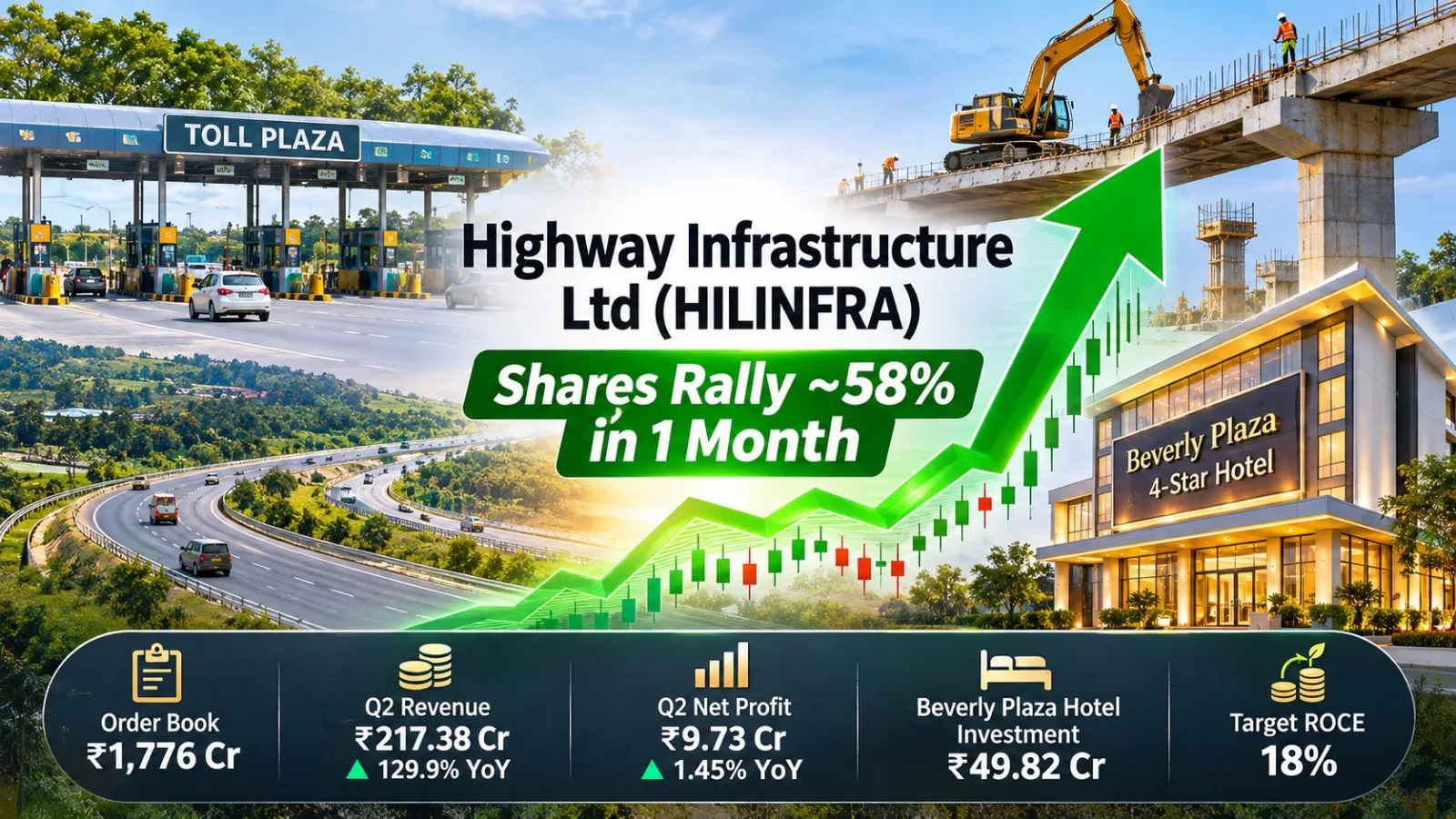
Highway Infrastructure Ltd has witnessed a sharp re-rating in the stock market, with its shares rising from ₹53.25 on October 19, 2026, to ₹84.12 on November 18. The approximately 58% appreciation took the stock to a fresh 52-week high of ₹84.50, bringing its market capitalisation to around ₹603 crore.
The rally has coincided with several major business developments. The company secured toll collection assignments worth approximately ₹652.52 crore from UPEIDA and NHAI, followed by a ₹198.31 crore Central Public Works Department (CPWD) construction contract. Its reported order book reached ₹1,776.19 crore as of October 31, 2026.
At the same time, Highway Infrastructure's September-quarter results show a significant difference between revenue growth and profit growth. Consolidated revenue increased nearly 130% year-on-year to ₹217.38 crore, while net profit increased only 1.45% to ₹9.73 crore.
Another important development is the proposed ₹49.82 crore preferential warrant issue to promoter-group entities. Unlike the company's August 2025 IPO, which was primarily directed towards working capital, the new fundraising proposal is intended to support a four-star hotel at Beverly Plaza and the existing commercial real estate business.
The combination of a rising share price, expanding contract portfolio, volatile segment margins and a new hospitality investment makes Highway Infrastructure a more complicated investment story than its recent stock-market performance alone suggests.
Highway Infrastructure Share Price: From ₹53 to ₹84 in One Month
Highway Infrastructure shares (NSE: HILINFRA; BSE: 544477) closed at ₹84.12 on November 18, compared with ₹53.25 on October 19. The gain of approximately ₹30.87 per share represents a return of nearly 58% over the period.
The most significant part of the movement occurred during the final week of October. The share price closed at ₹61.53 on October 26, rose to ₹72.18 on October 27 and reached ₹76.35 on October 28.
These three sessions produced a sharp upward move, with the October 27 session alone recording an increase of approximately 17.31%.
HILINFRA market snapshot
Metric | Value |
|---|---|
November 18 closing price | ₹84.12 |
October 19 closing price | ₹53.25 |
One-month appreciation | Approximately 58% |
Intraday 52-week high | ₹84.50 |
52-week low | ₹40.10 |
Market capitalisation | Approximately ₹603 Cr |
Trailing P/E | Approximately 22–23x |
Indicative industry P/E | Approximately 19.3x |
Book value per share | ₹33.37 |
Price-to-book ratio | Approximately 2.51x |
Debt-to-equity | Approximately 0.45–0.52x |
The stock is trading at a premium to the indicative industry P/E, while its price-to-book ratio is approximately 2.5 times. At ₹84.12, the market price is also substantially above the reported book value of ₹33.37 per share.
This valuation reflects expectations of continued business expansion, but it also makes the company's ability to convert new contracts into earnings more important.
The promoter holding stood at 70.04% in the September 2026 shareholding pattern. Public shareholders accounted for 29.57%, while domestic institutional ownership was approximately 0.39%, with foreign institutional ownership effectively nil.
The limited institutional presence and relatively small public float can amplify share-price volatility when trading interest increases. However, the shareholding pattern alone does not establish who drove the recent rally.
Three Major Contract Wins Add Approximately ₹850 Crore to Recent Order Announcements
New toll collection mandates and civil construction assignments are among the clearest business developments supporting the recent share-price movement.
In September 2026, Highway Infrastructure received a ₹220.66 crore contract from the Uttar Pradesh Expressways Industrial Development Authority for toll collection and allied operations on the Gorakhpur Link Expressway.
The contract covers an initial period of two years, with an option for an extension of up to six months. The first-year amount is approximately ₹105.08 crore, followed by a 10% annual escalation in the second year.
The company subsequently received two NHAI assignments in October.
Contract | Awarding authority | Contract value | Initial tenure |
|---|---|---|---|
Gorakhpur Link Expressway | UPEIDA | ₹220.66 Cr | 2 years |
Palayam Fee Plaza, Tamil Nadu | NHAI | ₹340.08 Cr | 1 year |
Baiti Kala Fee Plaza, Uttar Pradesh | NHAI | ₹91.78 Cr | 1 year |
Total tolling assignments | ₹652.52 Cr |
The ₹340.08 crore Palayam contract and ₹91.78 crore Baiti Kala contract together represent approximately ₹431.86 crore of NHAI assignments.
These contracts increase the scale of the company's toll collection portfolio. However, their values should not be interpreted as the amount available for shareholders as profit. Toll collection contracts involve contractual payment arrangements, operating costs, manpower requirements and other obligations.
₹198.31 Crore CPWD Order Adds an EPC Component
On November 4, the company disclosed a ₹198.31 crore CPWD project for residential and non-residential infrastructure for the CISF 12th Reserve Battalion in Madhya Pradesh.
The project is located at Jamunia Talab village in Sehore district and will be executed under the EPC Mode-I framework. The stipulated execution period is two years.
Following the addition of the project, Highway Infrastructure reported an order book of ₹1,776.19 crore as of October 31, 2026.
The three toll contracts and the CPWD project together represent approximately ₹850.83 crore in recently disclosed contract awards. This is a meaningful addition, although the combined value spans different execution periods and business models.
The distinction between the two activities is important. Tolling can generate high reported turnover but may operate on relatively thin contract margins. EPC projects involve construction revenue, procurement and execution costs, with profitability depending on project pricing and cost control.
The CPWD assignment therefore adds an opportunity to expand the construction business, but the actual contribution to profit will become clearer as project execution progresses.
Q2 FY27 Results: Revenue Grows 130%, Net Profit Increases Only 1.45%
Highway Infrastructure's consolidated financial results for the quarter ended September 30, 2026, show a substantial increase in revenue from operations.
Revenue rose to ₹217.38 crore from ₹94.57 crore in Q2 FY26, representing growth of approximately 129.9%.
However, consolidated profit after tax attributable to shareholders increased only from ₹9.59 crore to ₹9.73 crore, a year-on-year rise of approximately 1.45%.
Consolidated financial metric | Q2 FY26 | Q1 FY27 | Q2 FY27 |
|---|---|---|---|
Revenue from operations | ₹94.57 Cr | ₹303.28 Cr | ₹217.38 Cr |
Profit before tax | ₹12.66 Cr | ₹1.54 Cr | ₹11.09 Cr |
Net profit after NCI | ₹9.59 Cr | ₹1.07 Cr | ₹9.73 Cr |
Finance costs | ₹0.46 Cr | ₹2.58 Cr | ₹1.47 Cr |
Other income | ₹0.95 Cr | ₹1.04 Cr | ₹0.32 Cr |
Amounts rounded. NCI refers to non-controlling interest.
The quarter also recorded a sequential decline in revenue. Q1 FY27 revenue was ₹303.28 crore, compared with ₹217.38 crore in Q2, representing a quarter-on-quarter reduction of approximately 28.3%.
The sequential movement is worth watching because the company is expanding its toll collection portfolio and reporting a larger order book. Contract awards and revenue recognition do not necessarily occur evenly across quarters.
Why Did Profit Not Grow Alongside Revenue?
The relationship between the reported profit before tax and net profit provides an additional explanation.
Q2 FY27 profit before tax declined approximately 12.4% year-on-year, from ₹12.66 crore to ₹11.09 crore. However, the total tax expense reduced from approximately ₹2.99 crore to ₹1.34 crore.
Consequently, the lower tax charge helped net profit remain almost unchanged despite the decline in reported pre-tax profit.
There is also an important accounting distinction concerning investment property. The company reported a separate ₹5.20 crore gain from the remeasurement of investment property upon conversion during Q2 FY27. This amount was not included in the reported other-income figure of ₹0.32 crore.
The corresponding quarter of the previous year included a ₹19.79 crore gain from remeasurement of inventory upon conversion into investment property.
These entries arise from property-accounting transactions rather than routine toll collection or EPC revenue. They make year-on-year comparisons of reported profit before tax more complicated and should not be interpreted as recurring operating income.
The segment reporting also shows that the combined result of the three operating segments was approximately ₹4.79 crore in Q2 FY27. Other unallocable income and expenditure contributed another ₹6.30 crore to arrive at consolidated profit before tax of ₹11.09 crore.
The composition of earnings therefore deserves as much attention as the headline revenue increase.
Tolling vs EPC: Where Is Highway Infrastructure Actually Making Its Money?
The company's segment disclosures provide a more useful picture of profitability than total revenue alone.
In FY26, toll collection generated ₹471.44 crore in revenue, while work contracts and machinery and equipment hire generated ₹126.44 crore.
Together, these two businesses accounted for more than 98% of the company's reported FY26 segment revenue. Tolling was the larger business by turnover, but the work contract and machinery hire segment reported a higher segment-result margin.
FY26 segment performance
Segment | Revenue | Segment result | Segment result margin |
|---|---|---|---|
Toll division | ₹471.44 Cr | ₹30.92 Cr | 6.56% |
Work contracts and machinery hire | ₹126.44 Cr | ₹16.02 Cr | 12.67% |
Real estate | ₹10.13 Cr | ₹4.60 Cr | Not comparable |
Q2 FY27 segment performance
Segment | Revenue | Segment result | Segment result margin |
|---|---|---|---|
Toll division | ₹177.70 Cr | ₹0.43 Cr | 0.24% |
Work contracts and machinery hire | ₹37.58 Cr | ₹4.45 Cr | 11.85% |
Real estate | ₹2.10 Cr | -₹0.09 Cr | Negative |
Segment result margin is calculated as segment result divided by segment revenue. It is not the same as EBITDA margin, net margin or ROCE.
The FY26 figures show that the work contracts and machinery hire business generated a segment-result margin of approximately 12.67%, nearly twice the toll division's 6.56%.
The difference was more pronounced in Q2 FY27. Toll revenue accounted for approximately 81.7% of consolidated revenue, but its reported segment-result margin was only 0.24%. The work contract and machinery hire segment reported a margin of approximately 11.85%.
The half-year FY27 figures show a similar divergence. Toll division revenue was ₹451.65 crore against a segment result of ₹5.92 crore, representing a margin of approximately 1.31%. The work contract and machinery hire segment generated ₹65.44 crore of revenue and ₹8.72 crore of segment result, giving a margin of approximately 13.33%.
These figures suggest that the company is generating substantially higher segment profitability from construction-related activities than from toll operations in the latest reporting period.
However, segment results are affected by contract mix, allocation of costs and the timing of execution. A single quarter's margin should not be treated as a permanent margin assumption for either business.
The real estate segment also remains relatively small in the revenue mix. Its Q2 FY27 revenue was approximately ₹2.10 crore, accompanied by a segment loss of ₹0.09 crore. The proposed hotel would therefore introduce a hospitality operation that has yet to establish its own operating history within the company.
IPO Fund Utilisation: ₹82.88 Crore Went Primarily Into Working Capital
Highway Infrastructure raised funds through its IPO in August 2025. The total public issue size was ₹130 crore, but the company received only the fresh issue proceeds of ₹97.52 crore. The remaining ₹32.48 crore represented an offer for sale by existing shareholders.
After IPO expenses of approximately ₹14.64 crore, the net proceeds available to the company were ₹82.88 crore.
The original prospectus had earmarked ₹65 crore for working capital and ₹17.88 crore for general corporate purposes. The subsequent revised allocation increased the working-capital component to ₹80.94 crore and reduced general corporate purposes to ₹1.94 crore.
IPO proceeds | Original allocation | Revised allocation |
|---|---|---|
Working capital | ₹65.00 Cr | ₹80.94 Cr |
General corporate purposes | ₹17.88 Cr | ₹1.94 Cr |
Total net proceeds | ₹82.88 Cr | ₹82.88 Cr |
The monitoring report recorded approximately ₹22.45 crore of deployment towards EPC working capital and ₹58.50 crore towards tolling working capital. The separate general corporate purpose allocation was also recorded as utilised.
The company had earlier reported a delay in utilisation due to operational reasons, with a board resolution in May 2026 specifying a May 31 utilisation target. The August monitoring report covering June 30, 2026, recorded full utilisation of the net proceeds, with no balance remaining in the monitoring account.
This history is relevant because the IPO funds supported the company's established operating businesses. The capital was primarily required to finance toll collection operations, EPC execution and the associated working-capital cycle.
The November 2026 warrant proposal has a different purpose.
The ₹49.82 Crore Beverly Plaza Hotel Project Changes the Capital Allocation Story
Highway Infrastructure's November 2026 fundraising proposal involves up to one crore convertible warrants at ₹49.82 each, representing a maximum issue value of ₹49.82 crore.
The amended EGM disclosure identifies a proposed four-star hotel at Beverly Plaza and the company's existing commercial real estate business as the intended recipients of the funds.
Beverly Plaza is an integrated development situated at Tillore-Khurd in Indore, Madhya Pradesh. The company's earlier real estate disclosures identify it as an existing development project rather than a completely unrelated new property purchase.
The revised use-of-proceeds statement allocates the money as follows:
Proposed utilisation | Amount | Percentage |
|---|---|---|
Building civil works | ₹39.86 Cr | 80% |
Interior and building facade | ₹1.00 Cr | 2% |
Landscaping and external development | ₹1.00 Cr | 2% |
Furniture, fixtures and equipment | ₹0.50 Cr | 1% |
Other identifiable business-related expenses | ₹7.47 Cr | 15% |
Total | ₹49.82 Cr | 100% |
The company has indicated that the proposed hotel will be implemented within two years from the date of raising the funds. Its corrigendum also identifies the Town and Country Planning Certificate, Colony Development Permission, colony completion certificate and Gram Panchayat building permit among the approvals obtained.
An important distinction is that the entire ₹49.82 crore is not exclusively allocated to hotel construction. The disclosed object also covers the existing commercial real estate business, and ₹7.47 crore is classified under other identifiable business-related expenses.
The Existing Beverly Plaza Asset Also Matters
Highway Infrastructure's FY26 annual report records the Beverly Plaza Project at approximately ₹53.41 crore under investment property as of March 31, 2026.
This is important when calculating the hotel's return on capital. The proposed warrant proceeds represent new funding, but they may not represent the complete economic capital committed to the project if previously developed land or property is used for the hotel.
The annual report does not establish what proportion of the ₹53.41 crore property value will form part of the hotel footprint. Therefore, that amount should not automatically be added to the hotel project cost.
Nevertheless, the company needs to provide greater clarity on the hotel site, the existing property value attributable to it and the total capital employed. Without those details, a return calculation based only on the new warrant proceeds may overstate the actual return on the full project.
Beverly Plaza Hotel: Room Count, ADR and Occupancy Needed for 18% ROCE
A four-star hotel requires a different financial model from a toll collection contract or an EPC project. Its revenue depends on available rooms, room rates, occupancy and additional income from food and beverages, events and other services.
The proposed ₹49.82 crore warrant proceeds can be used as a starting point for estimating the return hurdle.
Assuming the full ₹49.82 crore represents capital employed for the hotel, an 18% return on capital employed would require annual operating profit before interest and tax of approximately ₹8.97 crore.
Required annual EBIT = ₹49.82 crore × 18% = ₹8.97 crore
The important question is how many rooms and what operating performance would be needed to generate this amount.
Indore hotel market provides a useful reference point
Horwath HTL's India Hotel Market Review 2025 reported average occupancy of approximately 76.5% and an average daily rate of around ₹5,300 for Indore.
The report also identified approximately 2,100 existing hotel rooms and a pipeline of additional rooms equivalent to the existing inventory. It noted the city's growing business and regional importance, while questioning whether the market could sustain the planned increase in higher-end hotel supply.
The ₹5,300 ADR is a city-level market reference, not a forecast for Beverly Plaza. A four-star property could charge more, but that premium would depend on the property's location, operator, service offering, business demand and competition.
Illustrative hotel operating model
The following scenarios use different combinations of average daily rate, occupancy and operating profitability.
Assumptions:
Additional hotel revenue is estimated at 15%–20% of room revenue.
EBIT margin ranges from 25% to 30% in the mature operating stage.
The model assumes 365 operating days and does not include pre-opening losses.
The entire ₹49.82 crore is treated as hotel capital employed for this first calculation.
Scenario | ADR | Occupancy | Additional revenue | EBIT margin | Estimated rooms required |
|---|---|---|---|---|---|
Indore market reference | ₹5,300 | 76.5% | 15% | 25% | 211 |
Moderate premium | ₹6,500 | 70% | 20% | 25% | 180 |
Higher ADR | ₹7,500 | 68% | 20% | 25% | 161 |
Strong operating case | ₹8,500 | 70% | 20% | 30% | 115 |
Illustrative scenarios, not company guidance or an actual room-count forecast.
At the Indore market reference of ₹5,300 ADR and 76.5% occupancy, the hotel would require approximately 211 rooms to achieve the assumed return.
At an ADR of ₹6,500 and occupancy of 70%, the required room inventory falls to around 180 rooms. A higher ADR of ₹7,500 with 68% occupancy reduces the requirement to approximately 161 rooms.
The strongest scenario requires around 115 rooms, but it assumes an ₹8,500 ADR and a 30% EBIT margin. Such an outcome would require the property to establish a stronger-than-average market position and maintain good operating efficiency.
What if Beverly Plaza has only 100 rooms?
A smaller property would require significantly higher room rates under the same assumptions.
With 100 rooms, 70% occupancy, additional revenue equal to 20% of room sales and a 25% EBIT margin, the required ADR would be approximately ₹11,700 per night.
The corresponding ADR requirements under the same assumptions are:
Number of rooms | ADR needed for 18% ROCE |
|---|---|
80 | ₹14,624 |
100 | ₹11,699 |
120 | ₹9,750 |
150 | ₹7,800 |
180 | ₹6,500 |
200 | ₹5,850 |
This demonstrates why the company's room inventory disclosure is commercially important. The same ₹49.82 crore capital base produces very different return requirements depending on how many rooms are available for sale.
A More Important Issue: Should Existing Property Value Be Included?
The FY26 annual report records approximately ₹53.41 crore against the Beverly Plaza Project under investment property.
If the entire amount were attributable to the hotel site, the combined capital base from the existing property and the proposed funding would be approximately ₹103.23 crore.
An 18% return on that combined amount would require annual EBIT of approximately ₹18.58 crore, rather than ₹8.97 crore.
Under the moderate-premium scenario of ₹6,500 ADR, 70% occupancy, 20% additional revenue and 25% EBIT margin, the required inventory would rise from approximately 180 rooms to about 373 rooms.
This is a sensitivity illustration, not a conclusion that the entire existing property value belongs to the hotel. The company needs to clarify which portion of the Beverly Plaza investment property is being deployed for hospitality.
Until the room count, hotel operator, land allocation, total project cost and operating assumptions are disclosed, an 18% ROCE target cannot be independently validated.
Promoter Warrants at ₹49.82: Pricing, Cash Inflow and Dilution
The proposed warrant issue was approved by shareholders at the extraordinary general meeting held on November 13, 2026.
The issue covers one crore convertible warrants at ₹49.82 each, to be issued to promoter and promoter-group entities. Each warrant carries the right to subscribe to one equity share with a face value of ₹5.
The proposed allottees are Anoop Agrawal, Riddharth Jain and Tirth Agrawal.
Warrant term | Highway Infrastructure |
|---|---|
Number of warrants | 1 crore |
Issue price per warrant | ₹49.82 |
Maximum issue value | ₹49.82 Cr |
Initial payment | 25% |
Initial proceeds on full subscription | ₹12.46 Cr |
Balance payable upon exercise | 75% |
Balance proceeds | ₹37.37 Cr |
Exercise period | 18 months |
The payment structure means that the entire ₹49.82 crore does not become available immediately upon shareholder approval. At the time of subscription and allotment, 25% is payable. The remaining amount is received when the warrants are exercised.
This distinction is relevant because the hotel project has a two-year implementation timeline, while the warrant conversion period is 18 months from allotment.
The availability and timing of the remaining 75% will therefore matter for construction funding and project cash flow.
Is the ₹49.82 Warrant Price at a Discount?
The relevant date for calculating the regulatory floor price was October 14, 2026.
The disclosed 90-day VWAP was ₹47.09, while the 10-day VWAP was ₹49.07. The higher figure became the floor price under the applicable preferential issue pricing formula.
Highway Infrastructure proposed the warrants at ₹49.82, approximately 1.53% above the disclosed floor price.
At the November 18 market price of ₹84.12, however, the warrant price was approximately 40.8% lower. The market price moved sharply after the relevant pricing date, so these two prices should not be treated as equivalent valuation benchmarks.
The regulatory pricing calculation and the subsequent stock-market appreciation are separate considerations.
Potential Equity Dilution
The company had approximately 7.17 crore existing equity shares. Full conversion of one crore warrants would increase the share count to approximately 8.17 crore.
Particulars | Share count |
|---|---|
Existing equity shares | 7.17 Cr |
Potential new shares | 1.00 Cr |
Post-conversion equity | 8.17 Cr |
Increase over existing share count | 13.94% |
New shares as percentage of enlarged capital | 12.24% |
The proposed warrants are being issued to the promoter and promoter group. Assuming full conversion and no other changes in ownership, promoter-group ownership could increase from approximately 70.04% to around 73.7%.
For existing public shareholders, the dilution is not simply a share-count issue. The relevant question is whether the hotel and other funded activities can generate enough additional operating profit to compensate for the larger equity base.
How Does HILINFRA's Warrant Structure Compare With Other Infrastructure Companies?
Preferential convertible warrants are used by several Indian infrastructure companies to raise capital without requiring the entire issue price to be paid immediately.
Highway Infrastructure's structure can be compared with recent issues by SPML Infra, Likhitha Infrastructure and GMR Power and Urban Infra.
Company | Issue price | Warrants | Indicative issue value | Payment structure |
|---|---|---|---|---|
Highway Infrastructure | ₹49.82 | 1 crore | ₹49.82 Cr | 25% upfront; 75% on exercise |
SPML Infra | ₹186 | 95.39 lakh | ₹177.43 Cr | 25% upfront; 75% on exercise |
Likhitha Infrastructure | ₹240 | 25 lakh | ₹60 Cr | 25% upfront; 75% on exercise |
GMR Power & Urban Infra | ₹120.88 | 3.31 crore | Approximately ₹400 Cr | 25% upfront; 75% on exercise |
The comparator transactions use similar 25:75 payment structures and an 18-month warrant exercise period.
SPML Infra's ₹186 preferential warrant issue included promoter-group and non-promoter investors. Its November 2026 monitoring report showed that ₹44.36 crore, representing 25% of the warrant value, had been received by September 30, 2026.
Likhitha Infrastructure approved a ₹60 crore warrant fundraising proposal at ₹240 per warrant in June 2026. GMR Power and Urban Infra allotted approximately 3.31 crore warrants to promoter shareholders at ₹120.88 each in January 2026.
Absolute issue prices cannot be compared directly because these companies have different market prices, face values, capital structures and regulatory pricing dates.
The more useful comparison is the payment structure, exercise period, investor category and eventual dilution.
Highway Infrastructure's issue is notable because the entire proposed allotment is directed to promoter-group entities. This can provide a capital commitment from existing promoters, while also increasing their ownership concentration after full conversion.
Working Capital and Borrowings: What Happens if Debtor Days Remain Above 40?
Highway Infrastructure's working-capital position deserves attention because its existing businesses already require significant operating finance.
Debtor days increased from approximately 28.5 days in FY25 to 38.9 days in FY26. Working-capital days expanded from 53.6 days to 78.2 days over the same period.
This means a larger amount of operating capital is tied up in the business cycle. Receivables, project-related advances and other working-capital items can create a requirement for additional borrowing even when reported revenue is growing.
The cash-flow statement also shows that the company generated negative operating cash flow of approximately ₹66.40 crore in FY26. For the first half of FY27, operating cash flow remained negative at approximately ₹1.42 crore, although the deficit was considerably lower than the previous full financial year.
Finance costs and borrowings are already rising
Consolidated finance costs increased to ₹1.47 crore in Q2 FY27 from ₹0.46 crore in Q2 FY26. For the first half of FY27, finance costs reached ₹4.05 crore, compared with ₹2.23 crore in the corresponding period last year.
The balance sheet also recorded borrowings of approximately ₹123.82 crore as of September 30, 2026, against ₹103.67 crore as of March 31, 2026.
This indicates that the company's financing requirements increased during the first half of FY27. Additional borrowings to fund receivables or new projects could place further pressure on interest expenses.
Debtor-day sensitivity model
To estimate the possible impact, assume the Q2 FY27 revenue of ₹217.38 crore continues at the same quarterly level. This produces an annualised revenue run rate of approximately ₹869.52 crore.
At this revenue level, each additional debtor day represents approximately ₹2.38 crore of receivables. The following model assumes the incremental receivables are entirely debt-funded.
Debtor days | Additional receivables vs 39 days | Annual interest at 10%–12% | After-tax profit reduction* |
|---|---|---|---|
40 | ₹2.38 Cr | ₹0.24–0.29 Cr | ₹0.18–0.22 Cr |
45 | ₹14.29 Cr | ₹1.43–1.72 Cr | ₹1.07–1.29 Cr |
50 | ₹26.21 Cr | ₹2.62–3.14 Cr | ₹1.97–2.36 Cr |
55 | ₹38.12 Cr | ₹3.81–4.57 Cr | ₹2.86–3.43 Cr |
Assumes a 25% tax rate and full tax deductibility of additional interest. This is a sensitivity analysis, not a prediction of future borrowings.
The impact on net profit margin becomes more noticeable as debtor days rise.
At 45 days, the additional finance expense could reduce the annualised net profit margin by approximately 0.12–0.15 percentage points. At 50 days, the reduction could reach approximately 0.23–0.27 percentage points.
At 55 days, the margin impact could rise to approximately 0.33–0.39 percentage points, even before considering other increases in project costs or working-capital requirements.
The model also highlights why a hotel construction project must be evaluated alongside the funding needs of the existing infrastructure business.
If receivables grow, the company may need additional bank finance just as it begins committing funds to an asset that will not produce hotel revenue until construction and opening activities are completed.
Hotel vs Tolling vs EPC: Where Should the Next ₹49.82 Crore Be Invested?
The Beverly Plaza proposal creates an important capital allocation question for shareholders.
Highway Infrastructure already operates in toll collection and EPC construction. Both businesses have established operating histories, while the proposed hospitality project will introduce a new operating model.
The reported FY26 and Q2 FY27 segment margins show that construction-related activities generated higher segment-result margins than toll collection in the periods examined.
A hotel could offer recurring room revenue and create a long-term property asset. However, it also requires upfront construction spending, staff recruitment, maintenance, marketing, hotel management and sufficient occupancy to cover fixed costs.
Three possible uses of incremental capital
Beverly Plaza hotel
The investment could diversify the company away from short-duration toll collection assignments and government construction contracts. Once operational, the hotel could generate income from rooms, food and beverages, events and related services.
Its principal risks are the actual room count, achievable ADR, occupancy, operating margins and capital invested in the underlying property. A hotel achieving an 18% ROCE would provide a meaningful additional return, but the current disclosures do not establish that outcome.
Toll collection expansion
Additional capital could support tender participation, contract deposits, collection operations and the working capital required to service new toll plazas.
However, tolling's large reported revenue base does not automatically produce high segment profitability. The FY26 segment-result margin was 6.56%, while Q2 FY27 reported only 0.24%.
The company will therefore need to maintain contract economics rather than pursue larger collection values at the expense of profitability.
EPC construction expansion
The work contract and machinery hire division generated a 12.67% segment-result margin in FY26 and 11.85% in Q2 FY27.
This suggests that the company's construction-related activities have delivered stronger reported segment profitability. Additional EPC capital could support larger projects, procurement and execution capacity.
The risks include construction delays, material-price escalation, subcontracting costs and receivable cycles. Higher EPC revenue can also increase funding requirements before milestone payments are received.
Capital allocation comparison
Factor | Beverly Plaza hotel | Tolling | EPC |
|---|---|---|---|
Main revenue source | Room and hospitality services | User-fee collection contracts | Construction project execution |
Revenue visibility | Depends on hotel demand | Contract tenure and collection terms | Order book and execution schedule |
Reported margin history | Not yet established | Variable and relatively thin in Q2 FY27 | Higher segment-result margin in recent periods |
Working-capital needs | Construction and pre-opening capital | Deposits and operating requirements | Project expenditure and receivables |
Major risk | ADR and occupancy | Contract economics and renewals | Cost overruns and delayed payments |
Asset life | Long-term property | Contract-based | Project-based |
The comparison is not a direct ROCE calculation. Segment-result margins measure profitability against segment revenue, while ROCE measures operating returns against capital employed.
Nevertheless, the existing financial data shows why shareholders may ask management to explain the expected return from hospitality relative to additional investment in the core EPC and tolling businesses.
ESM Stage I, Institutional Ownership and Technical Levels
Highway Infrastructure was included under the NSE's Enhanced Surveillance Measure Stage I framework in October 2026, with the applicable requirements coming into effect from November 2.
Stage I requires a minimum 100% margin and shifts the security from the normal rolling settlement segment to trade-for-trade settlement. The 2% price-band restriction is associated with Stage II, not Stage I.
ESM inclusion is an exchange surveillance measure and does not, by itself, indicate an adverse finding against the company.
The share-price structure also deserves attention after the sharp rally. The November 18 high of ₹84.50 is the immediate reference level, while the ₹75–₹76 area represents a recent post-breakout trading zone to monitor.
The stock's rapid movement from ₹53.25 to ₹84.12 has increased its valuation and volatility. A sustained move above the previous high would need to be supported by continued buying interest and business developments, while any correction would bring the relationship between price and earnings back into focus.
What the Next Few Disclosures Need to Establish
Highway Infrastructure's recent share-price rally has been supported by genuine business developments. Its ₹1,776.19 crore order book, new NHAI and UPEIDA toll assignments and ₹198.31 crore CPWD project provide an expanded operating pipeline.
However, the next stage of the company's growth story depends on how much of this business translates into segment profitability and cash flow. The Q2 FY27 results show that a 129.9% increase in revenue did not translate into comparable net profit growth, while toll division profitability was particularly low during the quarter.
The Beverly Plaza investment adds another question. The company needs to disclose the proposed room inventory, expected ADR, occupancy assumptions, hotel operating arrangements, total project cost and capital employed. Those details will make it possible to assess whether the ₹49.82 crore funding commitment can generate the required return.
The IPO monitoring report shows that the earlier public issue proceeds were directed primarily towards working capital in EPC and tolling. The new warrant proposal is different: it introduces a longer-term hospitality investment while the existing business continues to require operational funding.
For shareholders, the critical test is whether Highway Infrastructure can execute its larger order book, improve core operating profitability, manage borrowings and develop Beverly Plaza without weakening the returns from its established infrastructure businesses.
The company's next set of disclosures will therefore need to demonstrate not just higher revenue and a larger order book, but also stronger cash conversion and measurable returns on the capital being deployed.
Disclaimer: This article is for informational and educational purposes only and does not constitute investment advice or a recommendation to buy, sell or hold any security. The hotel room-count, ADR, occupancy, ROCE and borrowing-cost calculations are illustrative scenarios based on stated assumptions and are not company guidance. Stock market investments are subject to market risks. Readers should undertake independent research and consult a SEBI-registered investment adviser before making investment decisions.