

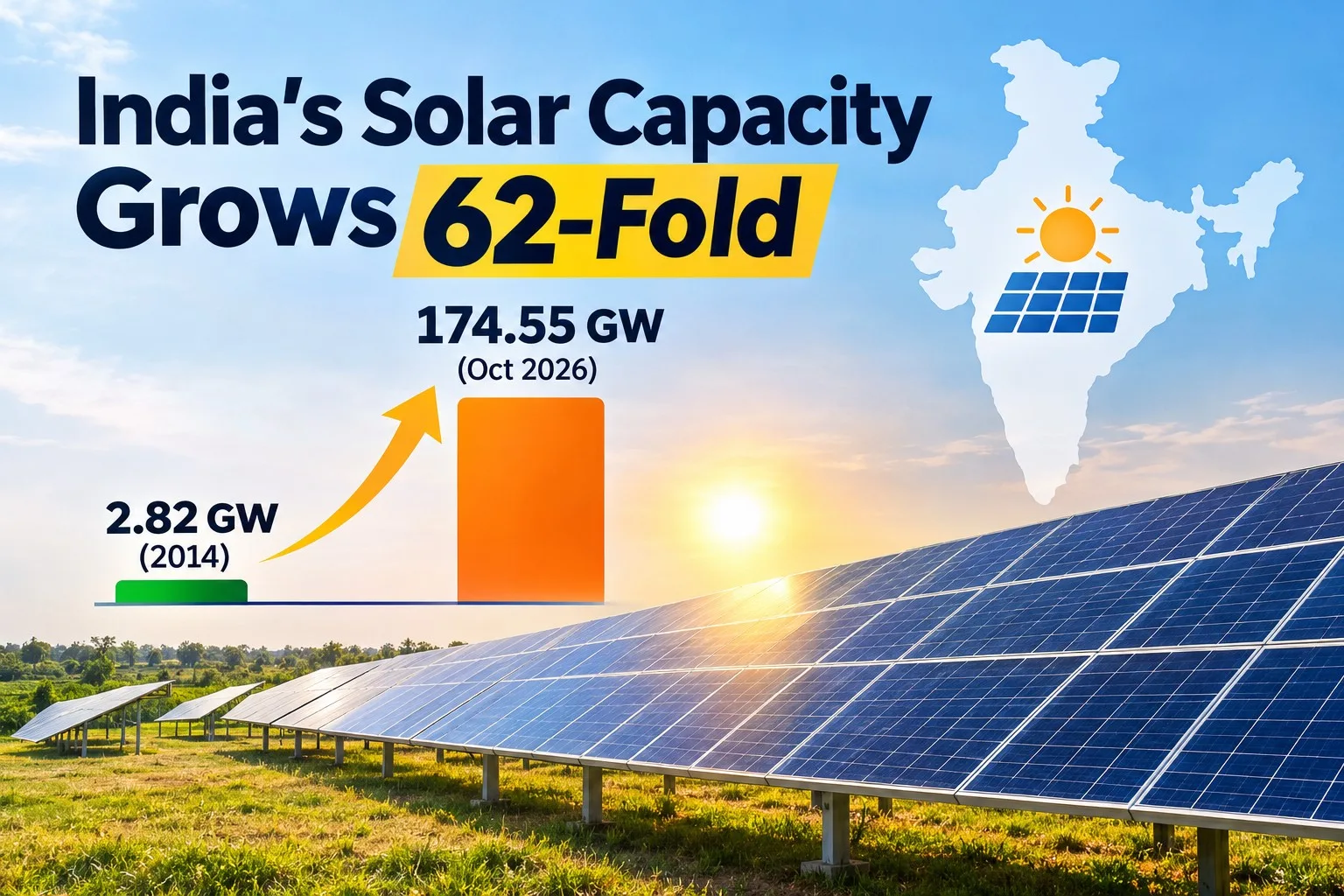
India's installed solar capacity has increased from 2.82 GW in 2014 to 174.55 GW as of October 31, 2026. Solar power has emerged as the largest component of the country's renewable energy capacity, supported by large-scale projects, rooftop installations and solarisation of agricultural infrastructure.
India's solar energy sector has recorded a remarkable expansion over the past 12 years, with installed capacity rising approximately 62-fold to 174.55 GW as of October 31, 2026. The capacity stood at just 2.82 GW in 2014, highlighting the rapid transformation of the country's renewable energy landscape.
According to a government backgrounder released by the Press Information Bureau (PIB) on November 17, solar power now accounts for the largest share of India's renewable energy capacity. Policy support, infrastructure development, domestic manufacturing and increasing participation from households and farmers have contributed to the sector's expansion.
Large-Scale Solar Projects Drive Capacity Expansion
India's solar deployment includes utility-scale projects, rooftop installations and off-grid systems. Large-scale solar projects account for approximately 133 GW of installed capacity, including the solar component of hybrid projects, while grid-connected rooftop systems contribute another 34.97 GW. The remaining capacity comes from off-grid solar installations.
Several states have emerged as important centres for solar power generation, including Rajasthan, Gujarat, Karnataka, Tamil Nadu, Andhra Pradesh and Maharashtra. Major projects such as Bhadla Solar Park in Rajasthan, Pavagada Solar Park in Karnataka and Kurnool Solar Park in Andhra Pradesh have strengthened India's large-scale solar infrastructure.
Under the Solar Parks Scheme, 56 solar parks with a combined sanctioned capacity of 39,461 MW have been approved across the country as of October 2026. These parks provide supporting infrastructure, including land development and power evacuation facilities, helping developers establish large solar projects.
Solar Capacity Additions Gain Momentum
The pace of solar capacity additions has accelerated in recent financial years. India added 44.61 GW of solar capacity during FY2025-26, almost double the 23.83 GW added in the previous financial year.
The momentum has continued into the current financial year. India added approximately 24.29 GW of solar capacity between April and October 2026, according to the government update, indicating sustained expansion in the sector.
Distributed solar installations have also become an important contributor to capacity additions. During FY2025-26, distributed solar solutions accounted for 16.3 GW, representing around 36% of the total 44.61 GW added during the year. This included 8.7 GW from rooftop solar installations and 7.6 GW under the PM-KUSUM scheme.
Rooftop Solar and Agricultural Schemes Expand Adoption
Government programmes are encouraging solar adoption beyond large power generation companies. The PM-Surya Ghar: Muft Bijli Yojana, launched in February 2024 with an outlay of ₹75,021 crore, aims to support rooftop solar installations in one crore households across the country.
Around 65 lakh households had been solarised under the programme as of November 2026, while more than 21 lakh households had received zero electricity bills, according to the government backgrounder. The scheme is aimed at increasing household participation in renewable energy generation.
The PM-KUSUM scheme is also supporting solar adoption in the agricultural sector through standalone solar pumps, decentralised power plants and feeder-level solarisation. As of September 30, 2026, nearly 11.91 lakh off-grid solar pumps had been installed, while more than 17.18 lakh agricultural pumps were covered through feeder-level solarisation.
Domestic Solar Manufacturing Capacity Increases
Alongside installations, India has expanded its domestic solar equipment manufacturing capacity. Solar module manufacturing capacity increased from approximately 2.3 GW in 2014 to around 172 GW as of March 31, 2026, and further rose to approximately 192 GW by June 2026.
The Production Linked Incentive (PLI) scheme for high-efficiency solar PV modules and the Approved List of Models and Manufacturers (ALMM) framework are among the measures supporting domestic manufacturing. These initiatives are intended to strengthen the solar supply chain and encourage greater domestic production of solar equipment.
Solar Power Strengthens India's Renewable Energy Transition
India's solar expansion is taking place alongside investments in transmission infrastructure and energy storage. The Green Energy Corridor programme is intended to improve the movement of renewable electricity from generation centres to consumption hubs, supporting the integration of additional solar and wind power into the grid.
With installed solar capacity reaching approximately 175 GW, the sector has become a central part of India's renewable energy expansion. The growth of utility-scale projects, household rooftop installations, agricultural solarisation and domestic manufacturing has broadened the country's solar ecosystem over the past decade.