Stablecoins are often considered a less volatile alternative to cryptocurrencies such as Bitcoin and Ethereum. Unlike traditional cryptocurrencies, which can experience sharp price movements, stablecoins are designed to maintain a relatively stable value by tracking currencies such as the US dollar.
Two of the most widely used dollar-backed stablecoins are Tether (USDT) and USD Coin (USDC). Both aim to maintain a value close to $1, but they differ in their reserve structures, transparency practices, redemption policies and regulatory approaches. For Indian investors, understanding these differences is important before using either stablecoin to trade, transfer or hold digital assets.
What Are USDT and USDC?
USDT is a dollar-pegged stablecoin issued by Tether, while USDC is issued by Circle. Both are designed to represent approximately one US dollar and are available across several blockchain networks, including Ethereum and Solana.
Indian cryptocurrency investors commonly use these stablecoins as trading pairs against Bitcoin, Ethereum and other digital assets. Instead of converting crypto holdings into Indian rupees after every trade, investors can move into USDT or USDC to maintain dollar-linked exposure within the crypto market.
However, holding a stablecoin is not the same as holding dollars in an Indian bank account or a US dollar deposit. Investors hold a blockchain-based digital token whose value depends on the issuer, its reserves, redemption arrangements and the functioning of the underlying blockchain.
How Do USDT and USDC Maintain Their $1 Peg?
Both stablecoins attempt to maintain their dollar peg through reserve-backed issuance and redemption mechanisms. In a simplified arrangement, an eligible customer provides dollars to the issuer, which creates an equivalent amount of stablecoins. When tokens are redeemed through the issuer, the corresponding tokens are taken out of circulation.
Market trading also plays an important role in keeping prices close to $1. If USDT or USDC trades below $1, traders may purchase it at a discount, expecting its price to recover. If it trades above $1, eligible participants may have an incentive to acquire newly issued tokens and sell them in the market.
These mechanisms help maintain price stability, but they do not guarantee that a stablecoin will always trade at exactly $1. Market disruptions, banking problems, reserve concerns or a loss of confidence can push its market price away from the dollar peg.
USDT vs USDC: Understanding the Differences
Although both tokens target the same dollar value, their issuers follow different approaches to reserves, disclosures and institutional operations.
Feature | USDT | USDC |
|---|---|---|
Issuer | Tether | Circle |
Target value | $1 | $1 |
Reserve composition | Cash, cash equivalents, US Treasury bills and other disclosed assets | Primarily cash and short-duration US Treasury-related assets |
Reserve reporting | Regular reserve reports and independent assurance | Regular reserve disclosures and independent assurance |
Direct redemption | Subject to eligibility and issuer conditions | Subject to eligibility and issuer conditions |
Major use | Global crypto trading and liquidity | Crypto trading, payments and institutional transactions |
One important distinction is that reserve disclosures and redemption arrangements are not identical. Investors should examine the latest reserve reports rather than assume that every stablecoin holds its backing assets in the same form.
USDT has established a large presence in global cryptocurrency trading, particularly across international exchanges. USDC has focused heavily on institutional use, payment infrastructure and regulatory compliance in supported jurisdictions.
Neither issuer structure eliminates the possibility of losses. The quality, liquidity and accessibility of reserve assets matter just as much as the total amount of assets reported by the issuer.
What Happens If a Stablecoin Loses Its Dollar Peg?
A stablecoin losing its dollar peg is commonly known as a depegging event. It happens when the token's market price moves significantly away from $1, either temporarily or for an extended period. For example, if USDC falls to $0.90, an investor holding 1,000 USDC would see its market value decline to approximately $900.
A depegging event can happen because of concerns about the issuer's reserves, problems with banking partners, restrictions on withdrawals or a sudden loss of investor confidence. Heavy selling pressure can make the situation worse, particularly when investors rush to exit their positions at the same time.
USDC experienced a notable depegging event in March 2023 after Circle disclosed that a portion of its reserves was held at Silicon Valley Bank, which had been shut down by US regulators. USDC briefly traded well below $1 before recovering after the US authorities announced measures to protect depositors.
A similar situation involving USDT or USDC could create losses for Indian investors who use these tokens as a temporary store of value. Even if the token eventually returns to $1, investors who sell during the depegging period may permanently realise a loss.
Can Indian Investors Redeem USDT and USDC Directly for US Dollars?
A common misconception among cryptocurrency investors is that every USDT or USDC token can be exchanged directly for one US dollar through the issuer. In practice, direct redemption is subject to eligibility requirements, identity verification, minimum transaction amounts and other issuer-specific conditions.
Tether generally provides direct issuance and redemption services through its platform for eligible verified customers, subject to its minimum transaction requirements and fees. Circle also offers direct USDC redemption through its Circle Mint services, which are primarily intended for eligible businesses and institutional customers.
An Indian retail investor purchasing USDT or USDC through a cryptocurrency exchange should not assume that the issuer will accept a direct redemption request from them. Many retail investors depend on cryptocurrency exchanges or other market participants to sell their stablecoins and receive the proceeds.
This creates an additional layer of risk. If an exchange suspends withdrawals, faces banking restrictions or experiences liquidity problems, converting stablecoins into usable money may become difficult even when the issuer continues to maintain its dollar peg.
Indian Tax Implications of Exchanging Bitcoin for USDT or USDC
One important tax issue for Indian cryptocurrency investors is that exchanging Bitcoin for a stablecoin may itself qualify as a transfer of a Virtual Digital Asset (VDA). Investors sometimes assume that tax becomes applicable only when cryptocurrency is converted into Indian rupees, but the Indian tax framework does not work that way.
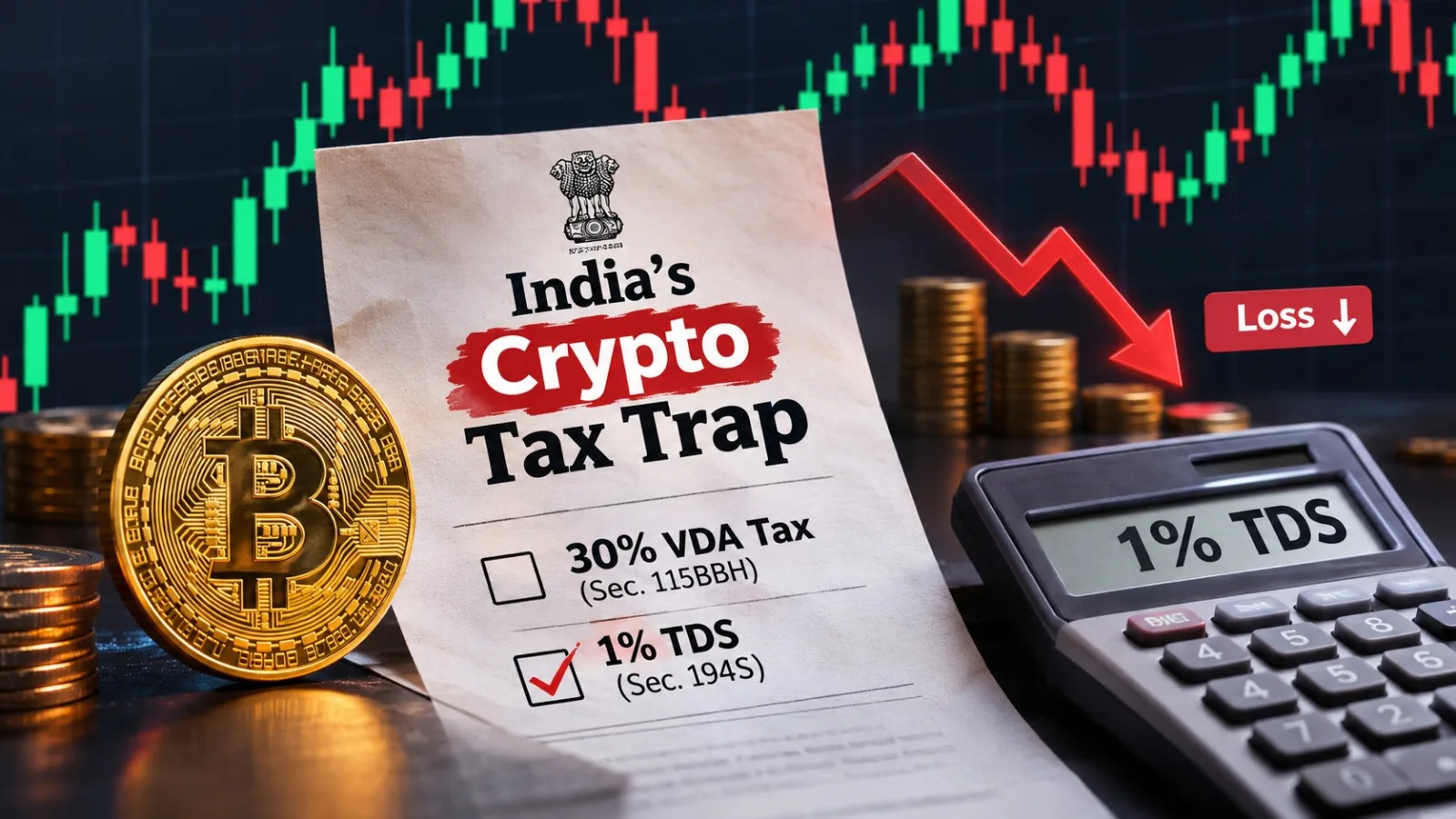
Under Section 115BBH of the Income Tax Act, income arising from the transfer of VDAs is generally taxed at a flat rate of 30%, along with applicable surcharge and cess. The deduction is restricted, with the cost of acquisition being the principal permitted deduction. Losses from VDA transfers cannot be set off against other income or carried forward under this provision.
Consider an investor who purchases Bitcoin for Rs. 5 lakh and later exchanges it for USDT when its market value reaches Rs. 7 lakh. The transaction may result in a taxable gain of Rs. 2 lakh, even though the investor has not withdrawn any money into an Indian bank account.
The fact that the investor continues holding the proceeds in USDT rather than converting them into rupees does not automatically postpone the tax event. The exchange transaction should be properly valued in INR, with supporting records of the acquisition cost, transaction date, exchange rate and consideration received.
Does 1% TDS Apply to Crypto-to-Stablecoin Transactions?
Section 194S of the Income Tax Act provides for 1% TDS on consideration paid for the transfer of a VDA, subject to specified thresholds. The general threshold is Rs. 10,000 during a financial year, while a higher threshold of Rs. 50,000 applies to specified persons.
For example, when an investor sells Bitcoin for USDT through an Indian exchange, the transaction may attract TDS requirements. The exact deduction and reporting treatment depend on the transaction structure and the applicable provisions.
Investors should also understand that TDS is not an additional 1% tax on top of the 30% tax rate. It is a tax deduction mechanism, and eligible TDS credit can be claimed while filing the income tax return.
For crypto-to-crypto transactions, the valuation and TDS treatment can become complicated, especially when transactions involve offshore exchanges or peer-to-peer platforms. Maintaining transaction-level records is important for calculating the correct tax liability.
How USDT and USDC Reserves Differ
The most important factor behind a dollar-backed stablecoin is the quality and availability of its reserves. These reserves are intended to support the value of tokens in circulation and provide liquidity when eligible holders request redemption.
Tether reports reserves that include US Treasury bills, cash and cash equivalents, secured loans and other disclosed asset categories. The composition can change over time, so investors should review the latest published reserve breakdown instead of relying on older figures or general descriptions.
Circle's USDC reserve structure is primarily based on cash held at regulated financial institutions and short-duration US Treasury-related investments through its reserve arrangements. Circle publishes reserve information and provides independent assurance reports concerning the backing of USDC.
There is also a difference between an issuer publishing reserve information and an investor having an unconditional right to redeem tokens. Reserve reports provide information about backing assets, but they do not remove counterparty, banking, legal or operational risks.
For investors, the relevant questions are not simply how much money an issuer claims to hold. They should also consider where the assets are held, how quickly they can be converted into cash, who has access to redemption facilities and what happens if a financial institution or service provider becomes unavailable.
What Should Indian Investors Know About Stablecoins and Banking?
India does not treat USDT or USDC as legal tender. Their use in cryptocurrency transactions does not give them the same status as money deposited with an Indian bank. Investors should also distinguish between cryptocurrency exchange activity and foreign currency transactions permitted under India's foreign exchange framework.
Indian banks may apply their own compliance checks when customers receive or transfer money connected to cryptocurrency exchanges. Transactions involving international exchanges, peer-to-peer transfers or unidentified counterparties can attract additional scrutiny, particularly where the source of funds is unclear.
The Financial Intelligence Unit-India (FIU-IND) registration framework is another important consideration. Virtual Digital Asset service providers operating within the scope of India's anti-money laundering requirements must comply with applicable registration and reporting obligations. However, FIU registration should not be mistaken for government approval or a guarantee that a platform is safe.
Investors should retain exchange statements, bank records, transaction IDs and details of counterparties. They should also understand that moving funds through an offshore platform does not automatically remove Indian tax obligations or other applicable legal requirements.
Which Stablecoin Should Indian Investors Choose?
The choice between USDT and USDC depends largely on how an investor intends to use stablecoins. USDT has extensive liquidity across cryptocurrency exchanges and is widely used for trading Bitcoin and other digital assets. Investors who frequently trade across different exchanges may find its market availability useful.
USDC offers a different proposition, with an emphasis on reserve transparency, institutional infrastructure and compliance-oriented operations. However, these characteristics do not make it risk-free or guarantee that investors will always be able to redeem their holdings immediately at $1.
Indian investors should evaluate exchange liquidity, issuer redemption conditions, blockchain network support, transaction fees and the availability of reliable withdrawal channels before choosing either token. They should also consider whether holding a dollar-linked crypto asset is consistent with their tax and regulatory obligations in India.
Ultimately, USDT and USDC are not substitutes for insured bank deposits or risk-free dollar savings accounts. Both carry issuer, market, liquidity, technology and regulatory risks. Understanding these risks is particularly important for Indian investors who use stablecoins to hold trading profits or move funds between cryptocurrency exchanges.
Editorial note: The tax discussion above reflects the general Section 115BBH and Section 194S framework. Tax treatment can depend on transaction structure and subsequent legal changes. Investors should verify the applicable rules for the relevant financial year with a qualified tax professional.