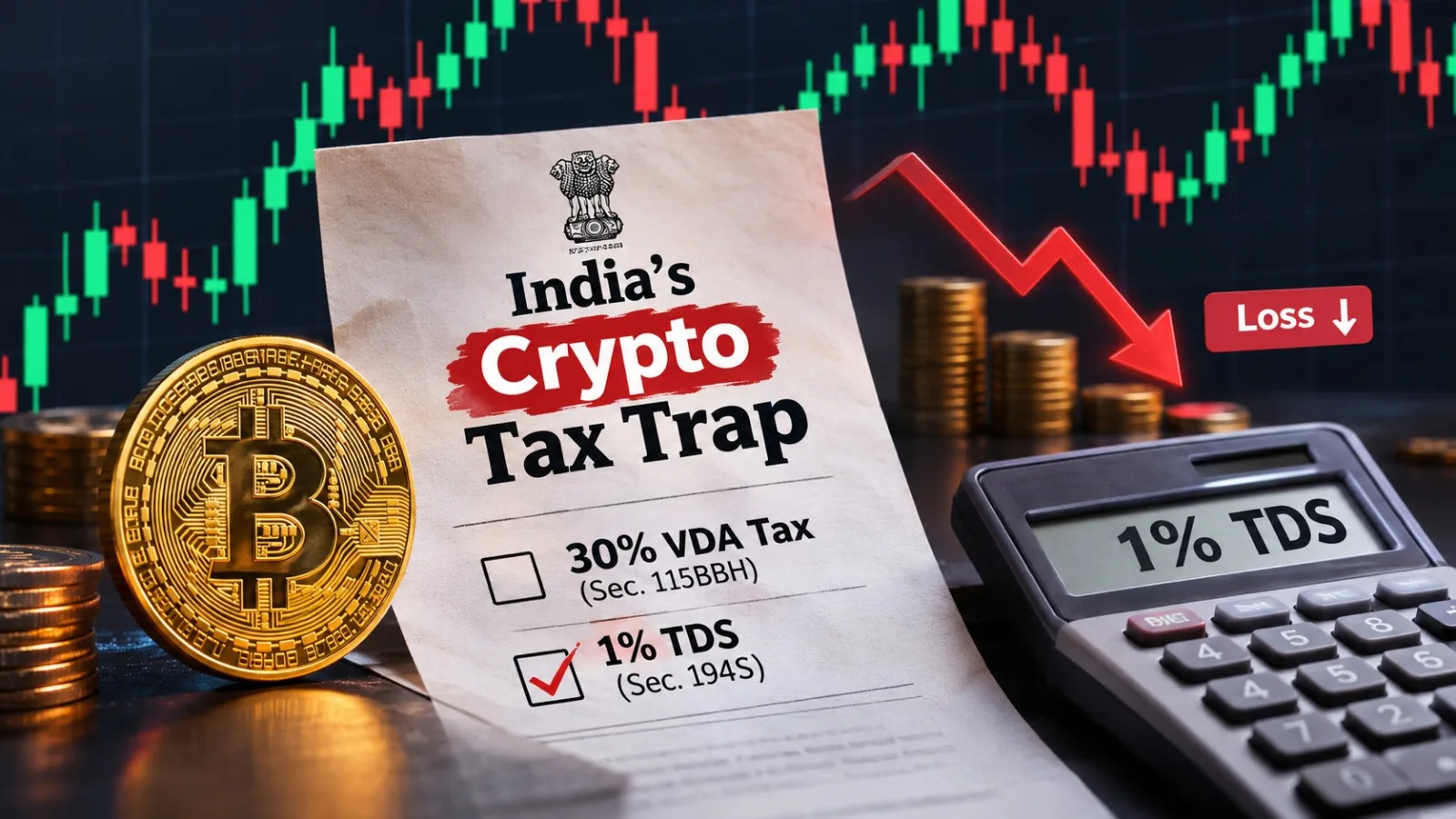
India's cryptocurrency tax system has created an unusual situation for investors and traders. A person can sell Bitcoin, Ethereum or another Virtual Digital Asset (VDA) at a loss and still face a 1% Tax Deducted at Source (TDS) deduction on the transaction. This means money can be deducted from the sale proceeds even when the investor has not earned any profit.
The confusion arises because India's crypto taxation framework has two separate provisions governing cryptocurrency transactions. Section 115BBH of the Income Tax Act deals with taxation of income from transferring Virtual Digital Assets, while Section 194S deals with TDS on consideration paid for such transfers.
Many investors assume that tax deductions should apply only when they make a profit. However, the 1% TDS mechanism is linked to the transaction value rather than the profit earned. Consequently, frequent traders can experience repeated deductions even when their overall trading performance is poor.
Understanding these provisions is important for anyone trading cryptocurrency through Indian exchanges, international platforms or other channels. It is equally important to understand how TDS credits are reported in Form 26AS and the Annual Information Statement (AIS).
Understanding the Difference Between 30% VDA Tax and 1% TDS
India introduced a special taxation framework for Virtual Digital Assets through the Finance Act, 2022. Section 115BBH establishes a 30% basic tax rate on income arising from the transfer of VDAs, subject to applicable cess and surcharge. Section 194S separately requires TDS at 1% on the consideration for eligible VDA transfers.
Although both provisions relate to cryptocurrency transactions, they serve different purposes. Section 115BBH determines the tax applicable to taxable income, whereas Section 194S collects tax at the transaction stage. The amount deducted under Section 194S is generally available as tax credit against the taxpayer's final liability.
Particulars | Section 115BBH | Section 194S |
|---|---|---|
Purpose | Tax on VDA income | Tax deducted at source |
Rate | 30% basic tax | 1% TDS |
Calculation basis | Taxable income from transfer | Transaction consideration |
Profit required? | Positive taxable income | No |
Tax treatment | Final income-tax liability | Credit against tax liability |
Consider an investor who purchases Bitcoin for ₹1,00,000 and later sells it for ₹1,20,000. The difference between the selling price and eligible acquisition cost is ₹20,000, assuming no other relevant adjustments. The basic tax under Section 115BBH would be ₹6,000, calculated at 30%.
The exchange may separately deduct ₹1,200 as TDS under Section 194S, representing 1% of the ₹1,20,000 consideration. This ₹1,200 is not an additional tax on top of the 30% tax. It is a tax credit that can be adjusted against the investor's final tax liability.
The important distinction is that the 30% tax is calculated on taxable VDA income, while the 1% TDS is calculated on the applicable transaction consideration. This difference explains why an investor can face TDS deductions even when a cryptocurrency transaction produces a loss.
Why Investors Pay 1% TDS Even When Selling Cryptocurrency at a Loss
The situation becomes particularly confusing when an investor sells cryptocurrency below its purchase price. Unlike the 30% tax provision, which applies to positive taxable income, Section 194S does not require the transaction to generate a profit before TDS is deducted.
Suppose an investor purchases Ethereum for ₹2,00,000 and later sells the entire holding for ₹1,80,000 following a market correction. The investor has suffered a loss of ₹20,000, but the transaction still has a selling consideration of ₹1,80,000.
If the applicable TDS threshold has been crossed, the transaction can attract a deduction of ₹1,800 at 1%. The investor therefore receives ₹1,78,200 before any other applicable charges, despite having already incurred a market loss.
Illustrative calculation:
Particulars | Amount |
|---|---|
Ethereum purchase price | ₹2,00,000 |
Ethereum selling price | ₹1,80,000 |
Trading loss | ₹20,000 |
TDS at 1% | ₹1,800 |
Proceeds after TDS | ₹1,78,200 |
There is no positive taxable income from this particular transfer because the selling price is lower than the eligible acquisition cost. However, the ₹1,800 deducted as TDS does not automatically disappear. The investor can claim the eligible TDS credit while filing the income-tax return, subject to the deduction being correctly reported and reflected in the tax records.
If the investor has no other tax liability against which the credit can be adjusted, the eligible excess TDS may become refundable after processing of the income-tax return. This is why checking TDS records is important even for investors who have lost money in cryptocurrency trading.
How Frequent Cryptocurrency Trading Increases TDS Deductions
The 1% TDS mechanism becomes more noticeable when someone trades cryptocurrency frequently. An investor who purchases and sells digital assets several times a month may generate substantial transaction turnover even when the initial investment is relatively small.
For example, a trader may begin with ₹5 lakh and repeatedly buy and sell different cryptocurrencies. During the financial year, the cumulative value of eligible selling transactions could reach ₹15 lakh because the same capital is being used multiple times.
If the entire ₹15 lakh represents consideration subject to Section 194S, the total TDS could reach ₹15,000. The deduction is based on eligible transaction consideration, not on whether the trader generated ₹15 lakh in profits.
This creates a cash-flow problem for active traders. Money deducted as TDS is not immediately available for another trade, even though it may eventually be credited against the investor's income-tax liability or refunded if eligible.
Example: Five Cryptocurrency Transactions During a Financial Year
Consider an investor who executes five cryptocurrency trades during a financial year. Some transactions generate profits, while others result in losses. The investor's total trading outcome and the TDS deducted can look very different.
Cryptocurrency | Purchase cost | Selling price | Profit/Loss | TDS at 1% |
|---|---|---|---|---|
Bitcoin | ₹1,00,000 | ₹1,10,000 | +₹10,000 | ₹1,100 |
Ethereum | ₹1,00,000 | ₹90,000 | -₹10,000 | ₹900 |
Solana | ₹80,000 | ₹85,000 | +₹5,000 | ₹850 |
Bitcoin | ₹1,20,000 | ₹1,05,000 | -₹15,000 | ₹1,050 |
Ethereum | ₹50,000 | ₹60,000 | +₹10,000 | ₹600 |
Total | ₹4,50,000 | ₹4,50,000 | ₹0 | ₹4,500 |
In this example, the investor has generated ₹4,50,000 in selling consideration and ₹4,500 in TDS deductions. The profitable transactions have generated ₹25,000 in gains, while the losing transactions have generated ₹25,000 in losses.
Although the combined economic result is zero before charges, the investor cannot simply use the losses to eliminate the taxable income from profitable VDA transfers. Section 115BBH restricts the set-off of VDA losses against income computed under other provisions, and losses from VDA transfers cannot be carried forward.
Under the restrictive treatment applicable to VDA losses, the positive income from profitable transfers remains relevant for taxation. In this illustration, the taxable positive VDA income is ₹25,000, assuming the stated costs are eligible and the transactions are correctly classified.
Tax calculation | Amount |
|---|---|
Positive VDA income | ₹25,000 |
Basic tax at 30% | ₹7,500 |
Health and education cess at 4% | ₹300 |
Total tax before surcharge | ₹7,800 |
TDS credit | ₹4,500 |
Illustrative remaining tax | ₹3,300 |
This example highlights an important feature of India's cryptocurrency taxation framework. An investor can have zero combined economic profit from multiple trades and still face tax on profitable VDA transfers because losses cannot be used to offset those gains.
At the same time, TDS is deducted on eligible selling transactions regardless of whether they generated profits or losses. This creates two separate financial effects: tax on positive VDA income and TDS deductions on transaction consideration.
What Happens When an Investor Makes Multiple Transactions at a Loss?
A common assumption among cryptocurrency investors is that profits and losses from all trades can be combined to calculate the final taxable amount. However, the special provisions under Section 115BBH impose restrictions that make this approach unsuitable for VDA transactions.
Consider an investor who buys Bitcoin for ₹2,00,000 and sells it for ₹2,50,000. The transaction generates a profit of ₹50,000. During the same financial year, the investor purchases Ethereum for ₹2,00,000 and sells it for ₹1,50,000, resulting in a loss of ₹50,000.
The combined economic outcome is zero before expenses. However, the investor cannot automatically use the Ethereum loss to eliminate the taxable income arising from the Bitcoin transfer.
Particulars | Amount |
|---|---|
Bitcoin profit | ₹50,000 |
Ethereum loss | -₹50,000 |
Combined economic result | ₹0 |
Positive VDA income considered | ₹50,000 |
Basic tax at 30% | ₹15,000 |
Health and education cess | ₹600 |
Tax before TDS credit | ₹15,600 |
The example demonstrates why cryptocurrency taxation can produce a tax liability even when the investor has not made an overall economic profit. The positive income from the Bitcoin transfer remains relevant, while the Ethereum loss cannot be used to cancel it under the restrictive VDA loss treatment.
Can Cryptocurrency Losses Be Carried Forward?
Section 115BBH does not allow losses from VDA transfers to be carried forward to subsequent assessment years. This is important for investors who experience substantial losses during a market correction and expect to recover their investments in later years.
Suppose an investor incurs a loss of ₹1 lakh from cryptocurrency transfers during one financial year. If the same investor earns a profit from VDA transfers in the following financial year, the earlier loss cannot be carried forward to reduce the subsequent year's taxable VDA income.
The restrictions also prevent investors from using VDA losses to reduce salary income, interest income or eligible capital gains from other investments. Consequently, maintaining transaction-wise records is important even when the overall cryptocurrency portfolio has declined in value.
Does the 1% TDS Apply to Every Cryptocurrency Transaction?
Section 194S includes annual aggregate consideration thresholds. Therefore, TDS is not necessarily required from the first rupee of every cryptocurrency transaction.
For a specified person, the annual threshold is ₹50,000. For other persons, the threshold is ₹10,000. A specified person generally includes an individual or HUF without business or professional income, or one whose preceding financial year's business turnover or professional receipts do not exceed the prescribed limits of ₹1 crore and ₹50 lakh respectively.
These thresholds are based on aggregate consideration during the financial year, not simply the value of an individual trade. Investors should therefore consider their annual transaction activity rather than checking each sale independently.
Once the applicable threshold is crossed, the statutory TDS requirements apply. The threshold should not be interpreted as a separate tax-free allowance for every cryptocurrency sale.
The Income Tax Department has also clarified that TDS is generally calculated on consideration after excluding GST and charges levied by the deductor for providing its services. Investors should verify the exchange's TDS calculation and applicable transaction treatment rather than assuming that every displayed amount represents the same deduction base.
What Happens When You Exchange Bitcoin for Ethereum?
Another area that cryptocurrency investors sometimes overlook is crypto-to-crypto trading. An investor may exchange Bitcoin for Ethereum without converting the proceeds into Indian rupees or transferring money to a bank account.
However, the absence of a bank withdrawal does not automatically mean that no taxable transfer has occurred. Exchanging one VDA for another can constitute a transfer for the purposes of Section 115BBH, with the consideration and eligible acquisition cost determining the taxable result.
For example, suppose an investor transfers Bitcoin valued at ₹2,00,000 in exchange for Ethereum of equivalent value. If the eligible acquisition cost of the Bitcoin was ₹1,50,000, the transaction could generate taxable VDA income of ₹50,000.
Section 194S also addresses transactions where consideration is wholly in kind or partly in kind. The person responsible for paying the consideration must ensure that the required tax has been deducted and paid before releasing the consideration, in accordance with the applicable statutory provisions.
This is particularly relevant for investors using international cryptocurrency exchanges, decentralised exchanges and crypto-to-crypto trading pairs. Investors should maintain records of the date, quantity, value and acquisition cost of each cryptocurrency involved in an exchange.
How to Reconcile Cryptocurrency Exchange Statements With Form 26AS and AIS
Paying 1% TDS does not automatically complete an investor's income-tax obligations. Investors must ensure that the transactions are correctly reported in their income-tax returns and that eligible TDS credits are reflected in the relevant tax records.
Three records are particularly important for this process: cryptocurrency exchange transaction statements, Form 26AS and the Annual Information Statement (AIS). Each document serves a different purpose and helps identify missing transactions, incorrect reporting or TDS mismatches.
Cryptocurrency Exchange Statements
Exchange statements provide transaction-level information needed to calculate VDA income and reconcile TDS. Depending on the platform, downloadable reports may include purchase dates, sale dates, cryptocurrency quantities, purchase values, sale consideration, trading fees and TDS deductions.
Investors should download the complete transaction history for the financial year from every exchange they have used. Relying only on screenshots, bank statements or a summary showing total profits and losses may result in missing information when preparing the income-tax return.
Form 26AS
Form 26AS is the tax credit statement that helps taxpayers verify whether tax deducted at source has been reported against their PAN. Investors should check the relevant entries for Section 194S, including the deductor's details, transaction amounts and tax deducted.
If an exchange statement shows TDS deductions but the corresponding amount does not appear in Form 26AS, the investor should contact the exchange or relevant deductor. The discrepancy may arise because of delayed reporting, incorrect PAN details or an error in the TDS statement.
Annual Information Statement (AIS)
AIS provides a broader view of financial information reported to the Income Tax Department. It includes TDS and TCS information, specified financial transaction information and other information received from reporting entities.
Investors can download AIS from the official income-tax portal and compare the available information with their exchange records. If any reported information appears incorrect, the AIS feedback facility can be used to communicate the discrepancy to the department.
Form 26AS and AIS should not be treated as interchangeable documents. From Assessment Year 2023-24 onwards, Form 26AS primarily displays TDS and TCS information, while broader reported financial information is available through AIS.
Step-by-Step Reconciliation Before Filing Your Income-Tax Return
Download complete exchange records: Collect transaction statements, trade history, deposits, withdrawals, fees and TDS information for every exchange used during the financial year. Keep separate records for different platforms and wallets wherever relevant.
Prepare a transaction-wise VDA calculation: Match each sale or transfer with its acquisition cost and calculate the positive income or loss from individual transfers. Do not assume that a portfolio-wide net profit or loss is automatically the taxable amount.
Calculate total TDS deducted: Add the TDS amounts reported in the exchange records and compare them with the eligible transaction consideration. Check the applicable annual threshold and whether the exchange has correctly applied the statutory deduction requirements.
Download Form 26AS: Log in to the official income-tax portal and access your tax credit statement. Verify that the TDS reported by the exchange corresponds with the amounts shown in your transaction records.
Compare the AIS information: Review the reported financial information and investigate missing, duplicate or incorrect entries. Use the feedback facility where necessary, while retaining supporting documents for the actual transactions.
Report the transactions in the income-tax return: Complete the applicable Schedule VDA with the required transaction details and claim eligible TDS credit. Choose the appropriate ITR based on the nature of your income and other applicable filing requirements.
What If the Exchange Deducted TDS but Form 26AS Does Not Show It?
This is a discrepancy that cryptocurrency investors should investigate before filing their income-tax returns. Suppose an exchange statement shows ₹8,000 in TDS deductions during a financial year, but Form 26AS displays only ₹6,000.
The difference of ₹2,000 should not be ignored. The investor should verify whether all deductions were reported under the correct PAN and whether the exchange or responsible deductor deposited and reported the tax correctly.
If the exchange has made an error in its TDS reporting, it may need to file a correction statement. Investors should contact the exchange's official support channel and retain transaction statements, TDS certificates and correspondence as supporting evidence.
Claiming a TDS credit that is not supported by the tax records can create problems during return processing. Investors should therefore reconcile the discrepancy and follow the prescribed correction process instead of assuming that every amount shown in an exchange statement will automatically be accepted as tax credit.
What If AIS Shows a Higher Transaction Value Than the Exchange Statement?
A difference between AIS and exchange statements does not automatically mean that the investor has underreported income. The two records may display information differently depending on the reporting entity, transaction classification and information received by the Income Tax Department.
For example, AIS may contain information reported by a source, while the exchange statement provides detailed transaction-level records. Investors should identify the reporting entity, relevant financial year and nature of the amount before concluding that the information is incorrect.
AIS provides a facility to submit feedback on reported information that taxpayers believe is inaccurate. However, submitting feedback does not remove the obligation to report actual taxable cryptocurrency transfers correctly in the income-tax return.
The objective should be to maintain a consistent record supported by exchange statements, transaction histories, acquisition records and tax documents. Investors should not modify their actual transaction calculations merely to make them match an incorrect third-party entry.
Can Investors Get a Refund of the 1% TDS?
Yes. The 1% TDS deducted under Section 194S is not necessarily the final tax payable on cryptocurrency transactions. It is a tax credit that can be adjusted against the investor's applicable income-tax liability when the income-tax return is processed.
For example, suppose an investor has ₹5,000 in eligible TDS credits but the final tax liability is only ₹2,000. The remaining ₹3,000 may be refundable after adjustment, subject to the correctness of the return and the availability of the tax credit in the department's records.
Similarly, an investor who has incurred cryptocurrency losses may still have TDS credits available even when there is no positive taxable income from those particular transactions. The investor must report the relevant information correctly and claim the eligible credit through the income-tax return.
A refund is not automatic merely because an exchange has deducted TDS. The deduction must be correctly deposited and reported, the taxpayer must file the applicable return, and the refund must be accepted after the department's processing and verification.
Official Sources Investors Should Check Before Filing
Cryptocurrency taxation involves specific statutory provisions and reporting requirements. Investors should refer to the official Income Tax Department website and the applicable sections of the Income Tax Act rather than relying entirely on exchange blogs, social media posts or unofficial tax calculators.
The following official resources are useful when checking the applicable rules and reconciling tax records:
Section 115BBH: Income-tax provisions relating to income from the transfer of Virtual Digital Assets.
Section 194S: Provisions relating to TDS on consideration for the transfer of Virtual Digital Assets.
Income Tax Department: Official guidance on VDA taxation and TDS requirements.
Form 26AS: Tax credit statement available through the income-tax e-filing portal.
Annual Information Statement: Financial information and reporting details available through the AIS section of the income-tax portal.
Investors should verify the relevant assessment year, applicable amendments and current filing instructions before submitting their returns. For complicated cases involving multiple exchanges, international platforms, crypto-to-crypto transfers or substantial transaction volumes, consulting a qualified chartered accountant familiar with VDA taxation can help prevent reporting errors.
Why Cryptocurrency Investors Need to Track More Than Their Portfolio Value
India's cryptocurrency taxation framework makes transaction-level recordkeeping particularly important. An investor who looks only at the current portfolio value or the overall profit-and-loss figure may overlook TDS deductions, taxable transfers and restrictions on loss adjustments.
The 1% TDS mechanism can reduce the money available for repeated trading, even when transactions generate losses. Meanwhile, Section 115BBH can create a tax liability on profitable transfers without allowing losses to cancel those gains under the applicable restrictive treatment.
Investors should therefore maintain complete records of every purchase, sale and crypto-to-crypto exchange, along with the corresponding acquisition cost and TDS details. Reconciling these records with Form 26AS and AIS before filing the income-tax return is an important step in avoiding unnecessary tax-credit mismatches.
Disclaimer: This article is for educational and informational purposes only and should not be treated as tax or investment advice. Cryptocurrency taxation depends on the nature of the transaction, applicable statutory provisions and the taxpayer's individual circumstances. Readers should verify current provisions through the official Income Tax Department website and consult a qualified tax professional before making tax-filing decisions.