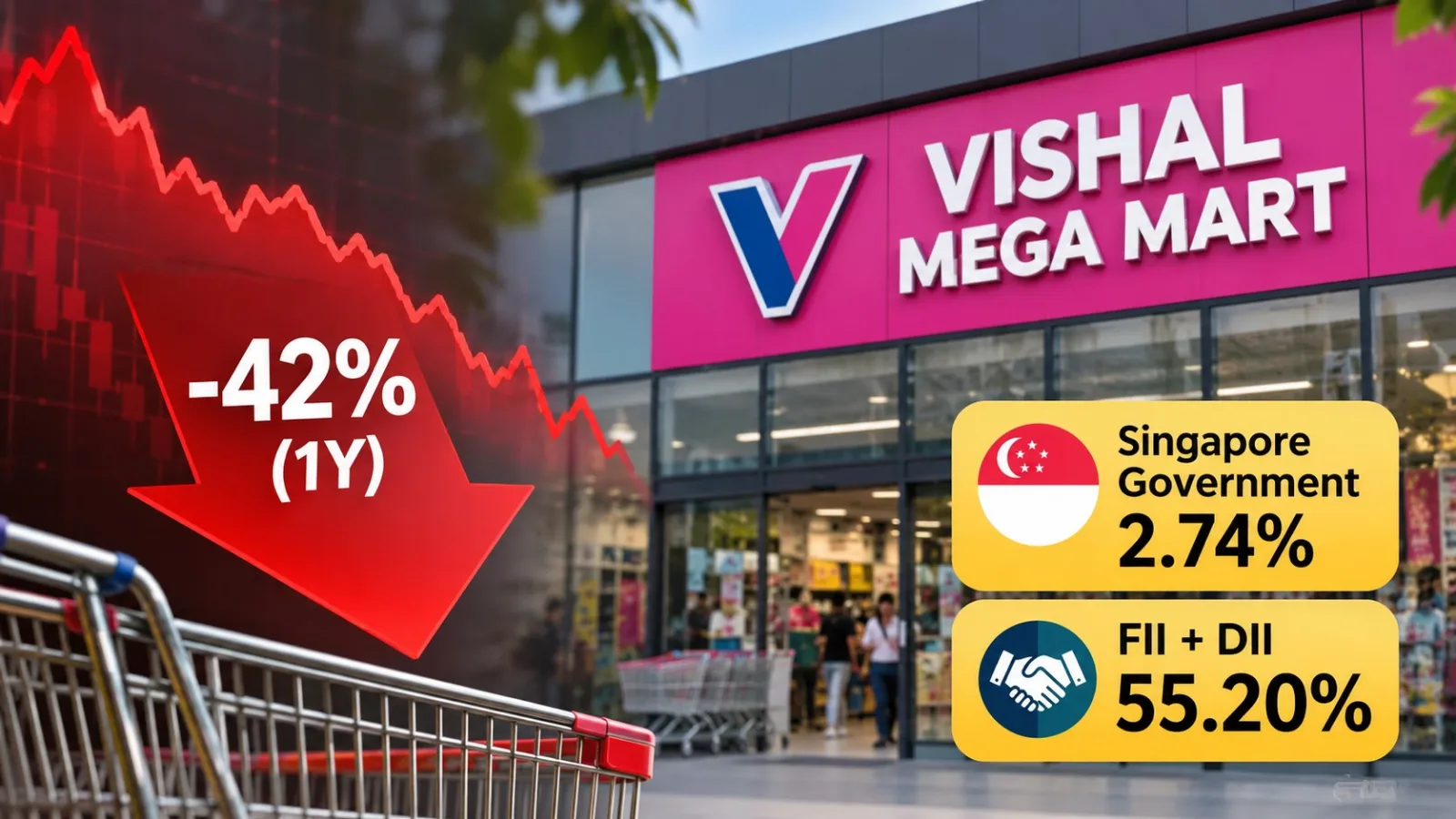
A sharp correction in a listed retail company's share price has brought its financial performance, institutional ownership and business expansion strategy into focus. The stock has declined more than 42% over the past year and recently touched a fresh 52-week low, even as foreign and domestic institutional investors collectively hold more than 55% of its equity. The latest September-quarter results show that revenue continues to grow at a double-digit rate, but slower profit growth and declining operating margins have emerged as concerns for investors.
The company under discussion is Vishal Mega Mart Limited, one of India's prominent value-focused retail chains. Its share price closed at ₹84.40 on October 30, 2026, down ₹2.20 or 2.54% for the session. The stock's decline has continued despite a growing presence of domestic mutual funds and foreign portfolio investors in its shareholding structure. The Government of Singapore and the Monetary Authority of Singapore are also among its disclosed shareholders.
Share Price Falls 42% in One Year, Hits Fresh 52-Week Low
Vishal Mega Mart shares have witnessed sustained selling pressure during 2026. The stock has declined across multiple timeframes, with the recent correction becoming particularly pronounced.
At ₹84.40, the share price is trading at a fresh 52-week low.
Period | Share Price Return |
|---|---|
1 Week | -3.38% |
1 Month | -16.44% |
Year-to-Date | -37.85% |
1 Year | -42.05% |
3 Years | 0.00% |
5 Years | 0.00% |
The 16.44% decline over one month indicates that selling pressure has intensified recently. The stock has lost nearly 38% in calendar year 2026, making it one of the notable underperformers in the retail space.
The correction has attracted attention because the company continues to report revenue growth and expand its store network, while institutional investors maintain substantial ownership.
Q2 FY27 Results: Revenue Grows 14%, Net Profit Increases 3.7%
Vishal Mega Mart reported consolidated revenue from operations of ₹3,398.5 crore for the September 2026 quarter, compared with ₹2,981.5 crore in the corresponding quarter last year.
Revenue increased 14% year-on-year. However, net profit grew at a considerably slower pace.
Consolidated profit after tax increased to ₹157.9 crore from ₹152.3 crore, representing growth of 3.7%.
The company's key financial figures are:
Financial Metric | Q2 FY26 | Q2 FY27 | YoY Growth |
|---|---|---|---|
Revenue | ₹2,981.5 Cr | ₹3,398.5 Cr | 14.0% |
Gross Profit | ₹843.1 Cr | ₹950.1 Cr | 12.7% |
Reported EBITDA | ₹394.6 Cr | ₹412.0 Cr | 4.4% |
Profit Before Tax | ₹204.4 Cr | ₹211.3 Cr | 3.4% |
Net Profit | ₹152.3 Cr | ₹157.9 Cr | 3.7% |
The difference between revenue growth and earnings growth is an important aspect of the latest results.
While revenue increased by ₹417 crore year-on-year, net profit increased by only around ₹5.6 crore.
Reported EBITDA increased 4.4%, considerably below the 14% revenue growth. This reflects the pressure on operating profitability during the quarter.
Operating Margins Decline Despite Higher Revenue
The company's operating profitability also requires attention.
Reported EBITDA increased to ₹412 crore from ₹394.6 crore. However, the reported EBITDA margin declined from 13.2% to 12.1%.
The company's operating EBITDA, calculated before Ind AS 116 and ESOP charges, stood at ₹262.2 crore, compared with ₹252.9 crore in the corresponding period last year.
This represented growth of 3.7%.
The operating EBITDA margin declined to 7.7% from 8.5%.
Similarly, adjusted profit after tax, excluding ESOP charges, increased 6.4% to ₹172 crore from ₹161.7 crore.
Operating Metric | Q2 FY26 | Q2 FY27 |
|---|---|---|
Reported EBITDA Margin | 13.2% | 12.1% |
Operating EBITDA Margin | 8.5% | 7.7% |
Gross Profit Margin | 28.3% | 28.0% |
Adjusted PAT Margin | 5.4% | 5.1% |
The decline in operating margins indicates that the company is currently experiencing slower growth in operating earnings relative to its sales.
Festive Calendar Shift Affects September Quarter Performance
Management attributed part of the weaker operating performance to a shift in the festive calendar.
In 2026, the festive calendar shifted by approximately 18 days, moving Puja and Dussehra-related demand from the September quarter into the December quarter.
This affected the company's same-store sales growth and fixed-cost absorption.
Same-store sales growth (SSSG), which measures sales growth from existing stores, stood at 5.4% during Q2 FY27.
However, management estimated that the festive calendar shift affected SSSG by approximately 3–4 percentage points. After adjusting for this impact, the company indicated underlying SSSG of approximately 9%.
The December quarter will therefore be important in determining whether the delayed festive demand translates into stronger sales and improved operating performance.
First-Half Performance Shows 16% Revenue and Profit Growth
Although the September quarter reported relatively modest profit growth, the company's first-half performance remained stronger.
For the six months ended September 2026, consolidated revenue increased 16.4% to ₹7,125.5 crore from ₹6,121.8 crore.
Net profit increased 16.3% to ₹416.6 crore compared with ₹358.4 crore in the corresponding period last year.
Financial Metric | H1 FY26 | H1 FY27 | Growth |
|---|---|---|---|
Revenue | ₹6,121.8 Cr | ₹7,125.5 Cr | 16.4% |
Gross Profit | ₹1,734.4 Cr | ₹2,018.9 Cr | 16.4% |
Reported EBITDA | ₹853.7 Cr | ₹956.7 Cr | 12.1% |
Net Profit | ₹358.4 Cr | ₹416.6 Cr | 16.3% |
Operating EBITDA | ₹577.3 Cr | ₹649.2 Cr | 12.5% |
Adjusted PAT | ₹377.2 Cr | ₹436.7 Cr | 15.8% |
The first-half numbers indicate that the business continues to expand its revenue base while maintaining growth in profitability.
However, the difference between the first-half performance and the September-quarter numbers will remain an important area of focus for investors.
Store Network Expands to 844 Stores Across 582 Cities
Vishal Mega Mart continues to expand its physical retail network.
As of September 30, 2026, the company operated 844 stores across 582 cities, covering approximately 1.41 crore square feet of retail area.
During the September quarter, it added 26 gross new stores and 25 net new stores.
For the first half of FY27, the company added 53 gross stores and 49 net stores.
Its retail business is spread across three major categories:
Business Category | H1 FY27 Revenue Contribution |
|---|---|
Apparel | 44.1% |
General Merchandise | 28.4% |
FMCG | 27.3% |
Apparel remains the largest contributor to revenue, followed by general merchandise and FMCG.
The company also reported that its own brands accounted for 73.9% of revenue during the first half of FY27.
A large own-brand portfolio allows the retailer to maintain a differentiated product offering across categories while targeting value-conscious consumers.
Quick Commerce Reaches 781 Stores
The company is also strengthening its digital retail operations through its quick-commerce initiative.
As of September 2026, the service had expanded to 781 stores across 532 cities, with approximately 1.5 crore registered users.
The strategy combines its physical store network with digital ordering and doorstep delivery.
The expansion provides an additional channel for reaching customers, although its contribution to incremental revenue and profitability will be important to monitor.
During the September quarter, the company also launched its first pilot store under Belong & Co., a new apparel format targeting young, affluent urban consumers.
Government of Singapore Holds 2.74% Stake
One of the notable developments in the company's shareholding pattern is the presence of the Government of Singapore among its major shareholders.
According to the September 2026 shareholding data, the Government of Singapore held 2.74% of Vishal Mega Mart.
The Monetary Authority of Singapore separately held another 1.23%.
Together, these two disclosed Singapore-based institutional holdings account for approximately 3.97% of the company's equity.
The Government of Singapore's holding declined marginally from 2.75% in June 2026 to 2.74% in September 2026. The Monetary Authority of Singapore's stake declined from 1.57% to 1.23% over the same period.
Both investors are part of the company's foreign institutional ownership structure.
FIIs and DIIs Hold 55.20% of the Company
The September 2026 shareholding pattern shows that institutional investors collectively hold a majority stake in Vishal Mega Mart.
Shareholder Category | September 2026 |
|---|---|
Promoters | 40.02% |
Foreign Institutional Investors | 18.75% |
Domestic Institutional Investors | 36.45% |
Public | 4.77% |
Combined FII and DII ownership stands at 55.20%, higher than the promoter holding of 40.02%.
Domestic institutional investors account for the largest institutional ownership, with mutual funds alone holding 31.75%.
The increase in institutional ownership becomes more evident when compared with December 2024.
Quarter | Promoters | FIIs | DIIs |
|---|---|---|---|
December 2024 | 76.02% | 6.58% | 9.90% |
March 2025 | 74.55% | 7.03% | 12.22% |
June 2025 | 54.22% | 12.85% | 27.31% |
September 2025 | 54.11% | 15.40% | 25.42% |
December 2025 | 54.09% | 15.52% | 25.47% |
March 2026 | 40.12% | 22.01% | 32.74% |
June 2026 | 40.09% | 20.43% | 34.80% |
September 2026 | 40.02% | 18.75% | 36.45% |
The data shows a substantial change in the company's ownership structure over the past two years.
Promoter ownership declined from 76.02% in December 2024 to 40.02% in September 2026. The major reductions occurred during 2025 and February 2026, when promoter stake sales increased the public shareholding base.
Meanwhile, DII ownership increased from 9.90% to 36.45%.
However, foreign institutional ownership has moderated after reaching 22.01% in March 2026. FIIs reduced their holding to 18.75% by September 2026, even as domestic institutions continued to increase their exposure.
The latest figures also show that the number of shareholders increased to 6,43,004 in September 2026 from 6,25,567 in June 2026.
Importantly, higher institutional ownership does not automatically indicate that a stock is undervalued or likely to recover. Investors need to assess the underlying business performance, earnings growth and valuation alongside ownership trends.
What Could Influence the Stock's Next Move?
The December 2026 quarter could be particularly important for Vishal Mega Mart because of the shift in festive demand from the September quarter.
Investors will be monitoring several developments:
Festive sales recovery: Whether delayed Puja and Dussehra demand contributes to stronger December-quarter revenue.
Same-store sales growth: Whether existing stores deliver improved sales growth.
Operating margins: Whether higher sales volumes improve fixed-cost absorption.
Profitability: Whether earnings growth accelerates after the relatively weak Q2 performance.
Store expansion: Whether new outlets generate sufficient revenue and operating returns.
Institutional ownership: Whether FIIs continue reducing exposure or domestic institutions maintain their accumulation.
The company has continued to expand its retail network and reported healthy first-half revenue and profit growth. However, the September-quarter margin compression and the sharp decline in its share price have brought attention to the relationship between business expansion and earnings growth.
The next set of quarterly results will provide a clearer picture of whether the recent weakness was largely caused by the festive calendar shift or whether the company is facing more persistent pressure on operating profitability.
Disclaimer: This article is for informational and educational purposes only. It is based on publicly available company disclosures, financial results and shareholding data. It should not be construed as investment advice or a recommendation to buy, sell or hold any securities. Investors should conduct their own research and consult a SEBI-registered investment adviser before making investment decisions. Past performance and institutional shareholding do not guarantee future stock returns.