Iware Supplychain Services Limited (NSE SME: IWARE) has emerged as a rapidly expanding player in India's integrated logistics and supply chain industry. Incorporated in January 2018 and headquartered in Ahmedabad, Gujarat, the company provides road transportation, warehousing, third-party logistics, containerised cargo movement and railway rake-handling services.
The company listed on the NSE Emerge SME platform on May 6, 2025, at an IPO issue price of ₹95 per share. Since listing, its business has expanded through new customer relationships, fleet additions, warehouse development and partnerships with infrastructure operators.
The latest half-year results for FY27 indicate that demand for its services remains strong. However, the company's financial position requires closer examination because the growth in reported revenue has not translated into comparable operating cash generation.
Iware Supplychain Services Share Price and Valuation
Iware Supplychain Services shares closed at ₹400.20 on November 13, 2026, giving the company a market capitalisation of approximately ₹461 crore. The stock has traded between ₹182.10 and ₹539.40 over the previous 52 weeks, placing the latest closing price around 26% below its yearly high.
At ₹400.20, the share price is more than four times its IPO issue price of ₹95. The stock's strong performance has reflected the company's rapid financial expansion and growing presence in the logistics sector, although its price movement has also been volatile.
Stock snapshot
Particulars | Details |
|---|---|
NSE symbol | IWARE |
Listing platform | NSE Emerge |
IPO issue price | ₹95 |
Share price (Nov 13, 2026 close) | ₹400.20 |
Market capitalisation | Approx. ₹461 crore |
52-week high | ₹539.40 |
52-week low | ₹182.10 |
P/E ratio | Mid-20s to around 30x, depending on earnings basis |
Book value per share | Approx. ₹72.2, based on September 2026 net worth |
ROE | Around 40% |
ROCE | Around 28% |
Dividend | ₹1 per share proposed for FY26 |
The valuation reflects expectations of continued business growth. However, the stock is not inexpensive when compared with several smaller logistics companies. Investors also need to account for its working-capital requirements, relatively high leverage and weak credit rating before assessing the earnings multiple.
Trading liquidity is another consideration. The stock recorded volume of only 9,600 shares on November 13. Lower liquidity can result in wider bid-ask spreads and sharper price movements, particularly when larger shareholders decide to sell.
Business Model: Road Transportation, Warehousing and Multimodal Logistics
Iware operates an asset-augmented logistics model that combines its own fleet and infrastructure with hired vehicles and third-party operating arrangements. Its network extends across more than 50 branches, with operations in Gujarat, West Bengal, Uttar Pradesh, Rajasthan, Punjab, Haryana and Delhi.
The company provides several services within the supply chain, allowing customers to use a single logistics partner for different transportation and storage requirements.
Its major business activities include:
Road transportation: Full truckload movement, containerised transportation and freight services.
Warehousing and 3PL: Storage, inventory handling and third-party logistics solutions.
Rake handling: Railway cargo movement and BCN rake-related services.
Carrying and forwarding: Distribution, handling and logistics support for industrial and consumer companies.
Business auxiliary and rental income: Other operational and property-related services.
The company has expanded its operational fleet significantly, with CARE Ratings referring to a fleet of approximately 285 vehicles in its October 2026 assessment. This is a substantial increase from the 47-vehicle fleet reported around FY25.
This expansion provides greater control over transportation capacity and the ability to serve larger customers. At the same time, fleet additions increase depreciation, maintenance, financing costs and the amount of capital required to operate the business.
The company is also expanding its warehouse infrastructure in Gujarat, including locations around Samakhiyali and Bhimsar in the Gandhidham region. These facilities and the Kandla port connection could help it increase the contribution from warehousing and integrated logistics services over time.
Iware Supplychain Services Financial Performance
The company's financial performance changed considerably in FY26, when revenue increased from ₹85.82 crore in FY25 to ₹257.66 crore. This represented year-on-year growth of approximately 200%, supported by higher transportation volumes and the expansion of its logistics operations.
Net profit also increased, but at a slower rate than revenue. FY26 profit after tax reached ₹15.06 crore, compared with ₹8.02 crore in FY25, representing growth of approximately 88%.
The difference between revenue growth and profit growth is important. It indicates that the company is handling substantially more business, but the additional revenue is not generating profit at the same margin as in earlier years.
Annual financial performance
₹ crore, except margin percentages
Financial year | Revenue | EBITDA / Operating profit | Operating margin | Net profit |
|---|---|---|---|---|
FY23 | 43.55 | 6.21 | 14.3% | 0.42 |
FY24 | 58.71 | 10.88 | 18.5% | 4.17 |
FY25 | 85.82 | 17.00 | 19.8% | 8.02 |
FY26 | 257.66 | 29.10 | 11.3% | 15.06 |
H1 FY27 | 193.96 | Approx. 19.44 | Approx. 10.0% | 9.39 |
H1 FY27 figures are for the six months ended September 30, 2026. The operating profit and margin shown are calculated before finance costs and depreciation, excluding other income.
H1 FY27 Results: Revenue Doubles, but Profit Growth Is Slower
The company reported revenue from operations of ₹193.96 crore in H1 FY27, compared with ₹93.44 crore in the corresponding period of the previous financial year. This represents growth of approximately 107.6% year on year.
Profit after tax increased to ₹9.39 crore from ₹6.43 crore, registering growth of approximately 46%. Earnings per share rose to ₹8.16 from ₹6.00 during the same period.
The results demonstrate that the company has maintained its rapid expansion. However, the relatively slower growth in net profit compared with revenue reflects pressure from operating expenses, depreciation and financing requirements.
Based on FY26 and the reported half-year figures, the approximate trailing 12-month revenue through September 2026 was ₹358 crore, while trailing net profit was around ₹18 crore. These figures are calculated by adding H1 FY27 to FY26 and subtracting H1 FY26.
The company has therefore achieved a much larger revenue base within a short period. The bigger question is whether it can convert this scale into stronger margins and consistent cash generation.
Why Did Iware's Operating Margin Fall From 20% to 10%?
One of the important changes in Iware's financial profile is the decline in operating margin. The company's operating margin was approximately 19.8% in FY25, before falling to around 11.3% in FY26 and approximately 10% in H1 FY27.
This decline suggests that the additional business is being generated at a lower operating spread than the company's earlier revenue base. A major factor to examine is the growing contribution of road transportation, which generally involves high operating expenses and competitive freight pricing.
Higher Contribution From Road Transportation
Road transportation has become the company's dominant business activity. Based on FY26 segment disclosures, transportation revenue was approximately ₹210.4 crore out of total revenue of ₹257.66 crore.
This represents more than 80% of total revenue. Transportation operations can generate significant billing volumes, but a substantial portion of the revenue is absorbed by vehicle hiring, fuel, tolls, maintenance, driver expenses and other operating costs.
Warehousing, carrying and forwarding activities can provide different margin characteristics. If transportation grows much faster than these activities, the company's overall operating margin can remain under pressure even when total revenue increases rapidly.
Fleet Expansion and Operating Costs
The expansion of the fleet from 47 vehicles to approximately 285 vehicles has increased the company's operating capacity. However, new vehicles require financing, insurance, maintenance and depreciation, and their profitability depends on how efficiently they are utilised.
The company may also need to hire additional market vehicles when customer requirements exceed its own fleet capacity. Third-party vehicle hiring can help meet demand without immediate capital investment, but it can limit the margin earned on each transportation assignment.
These costs become particularly important when the company enters new routes or handles larger contracts before achieving sufficient route density. The operating benefit of a larger fleet will depend on vehicle utilisation, return-load availability and the ability to reduce empty running.
Can Margins Recover?
A partial recovery in margins is possible if Iware improves fleet utilisation and increases revenue from warehousing, C&F and port-related services. Commissioning warehouse capacity and expanding integrated services around Kandla could also improve the business mix.
However, a return to the nearly 20% margin recorded in FY25 should not be assumed. The company now operates at a much larger scale, with transportation contributing a substantially greater share of revenue.
For investors, a stable operating margin in the 10–12% range, followed by gradual improvement, may be more meaningful than a short-term jump in reported revenue. CARE Ratings has also identified a sustained decline in the PBILDT margin below 8% as a negative rating sensitivity.
Negative Operating Cash Flow: The Biggest Financial Concern
Despite reporting a net profit of ₹15.06 crore in FY26, Iware generated negative cash flow from operating activities of approximately ₹19.80 crore. This means that the company's operating activities consumed cash rather than generating it during the financial year.
The difference between accounting profit and operating cash flow is largely connected with working-capital requirements. In a logistics business, expenses such as fuel, vehicle hiring, tolls and employee payments must be funded continuously, while institutional customers may take several weeks to settle invoices.
FY26 Cash Flow Performance
Cash flow metric | FY26 |
|---|---|
Net profit | ₹15.06 crore |
Operating profit before working-capital changes | ₹28.78 crore |
Cash flow from operations | -₹19.80 crore |
Cash used in investing activities | -₹44.64 crore |
Cash from financing activities | +₹63.50 crore |
The company's operating profit before working-capital adjustments was approximately ₹28.78 crore. However, changes in trade receivables, loans and advances and other current assets absorbed substantial cash during the year.
Trade receivables alone used approximately ₹45.90 crore of cash in the FY26 cash-flow statement. Other current assets absorbed additional funds, while increases in trade payables and other liabilities provided only a partial offset.
The company also invested approximately ₹37.16 crore in fixed assets during FY26. Consequently, negative operating cash flow and capital expenditure together created a large funding requirement, which was met through a combination of equity proceeds and additional borrowings.
H1 FY27: Operating Cash Flow Remains Negative
The latest half-year statement shows that the cash-flow problem has not yet been resolved. During H1 FY27, Iware reported operating profit before working-capital changes of approximately ₹20.01 crore, but cash flow from operating activities was negative at ₹19.89 crore.
The cash-flow statement shows that trade receivables, loans and advances and other current assets together absorbed approximately ₹47.91 crore during the six-month period. Increases in trade payables and other liabilities offset around ₹10.58 crore of this outflow.
Cash flow metric | H1 FY27 |
|---|---|
Net profit | ₹9.39 crore |
Operating profit before working-capital changes | ₹20.01 crore |
Cash used by working-capital changes, net | Approx. ₹37.33 crore |
Cash flow from operations | -₹19.89 crore |
Cash used in investing activities | -₹11.03 crore |
Cash from financing activities | +₹30.16 crore |
The important point is that the company reported higher profit in H1 FY27 but still consumed almost ₹20 crore in operating cash. The scale of the cash outflow was broadly comparable to the entire FY26 operating cash outflow.
This makes cash conversion a more important monitorable than revenue growth alone. A business can continue reporting higher sales and profits while its liquidity position deteriorates if customer collections and advances do not convert into cash.
Debtor Days and Receivables: Where Is the Cash Getting Stuck?
Debtor days indicate the average time a company takes to collect payments from customers. CARE Ratings reported debtor days of approximately 84 days for FY26, compared with around 66 days in FY25.
An increase in collection time means that a larger amount of working capital remains tied up in unpaid customer invoices. This can become a major burden for a logistics operator because vehicle-related expenses and payments to transport vendors may need to be settled before customers make their payments.
At March 31, 2026, trade receivables stood at approximately ₹59.96 crore. This represented around 23% of FY26 revenue, indicating that a significant amount of the company's annual billing remained outstanding at the year-end.
September 2026 Balance Sheet: Other Advances Also Need Attention
The September 30, 2026 balance sheet provides another important detail. Trade receivables increased only slightly to ₹61.60 crore from ₹59.96 crore in March 2026.
However, short-term loans and advances increased from ₹20.87 crore to ₹53.41 crore. Other current assets also increased from ₹4.78 crore to ₹17.41 crore.
Current asset | March 2026 | September 2026 |
|---|---|---|
Trade receivables | ₹59.96 crore | ₹61.60 crore |
Short-term loans and advances | ₹20.87 crore | ₹53.41 crore |
Other current assets | ₹4.78 crore | ₹17.41 crore |
This distinction matters because the entire working-capital build-up should not be described as unpaid customer invoices. Trade receivables remain high, but the increase in advances and other current assets also needs to be understood through the detailed annual disclosures.
Investors should examine the nature of these advances, their recoverability and the time required for adjustment or settlement. Until these balances translate into cash or are appropriately recovered, the company's ability to fund growth internally will remain limited.
Debt-to-Equity Ratio: Improving Ratios, but Borrowings Are Rising
Iware's debt-to-equity ratio appears to have improved over the last two years. However, the reduction in the ratio should be understood alongside the company's equity fundraising and the increase in absolute borrowings.
The company raised approximately ₹27.13 crore through its May 2025 IPO and another ₹20.17 crore through a preferential allotment in June 2026. These equity proceeds increased shareholders' funds and helped moderate the reported leverage ratio.
At the same time, borrowings increased substantially as the company expanded its fleet, infrastructure and working-capital facilities.
Balance sheet metric | March 2025 | March 2026 | September 2026 |
|---|---|---|---|
Shareholders' funds | Approx. ₹16.2 crore | ₹55.72 crore | ₹83.11 crore |
Total borrowings | Approx. ₹29.7 crore | ₹70.17 crore | ₹85.53 crore |
Simple debt-to-equity | Approx. 1.84x | Approx. 1.26x | Approx. 1.03x |
Debt-to-equity in this table is calculated using total disclosed borrowings divided by shareholders' funds. CARE's overall gearing ratio uses its own credit-analysis methodology and may differ.
The improvement in the ratio is partly due to the expansion of the equity base, rather than a reduction in debt. Total borrowings increased from approximately ₹29.7 crore in March 2025 to ₹85.53 crore by September 2026.
This means the company has become larger, but it has also become more dependent on external financing. Its ability to manage interest expenses and principal repayments will depend on operating cash flow, collection cycles and the profitability of recently added assets.
CARE Ratings Assigns B+; Stable: What Does It Mean for Iware?
CARE Ratings assigned a CARE B+; Stable rating to Iware's ₹73 crore long-term bank facilities in October 2026. The rated facilities included ₹56.41 crore of cash-credit limits and ₹16.59 crore of term loans.
The rating agency recognised the company's revenue growth, fleet expansion and established customer relationships. However, it also highlighted stretched liquidity, negative operating cash flow, high working-capital requirements and instances of delayed loan instalment payments.
CARE reported that cash-credit utilisation averaged around 80%, with peak utilisation reaching approximately 92%. It also noted that the company had experienced EMI servicing delays during the 12 months up to August 2026, with the latest instance in May 2026.
These observations are important because a logistics company needs regular access to working capital to pay drivers, transport vendors, fuel suppliers and other operating expenses. When most of its cash-credit limits are already utilised, it has less flexibility to absorb delayed collections or unexpected operating costs.
Debt Repayment Schedule and Cash Accruals
CARE's assessment indicated expected annual gross cash accruals of approximately ₹21–24 crore over FY27–FY29. Against this, the company has scheduled annual debt repayments of approximately ₹17–18.50 crore.
This leaves a relatively narrow internal funding cushion. A significant delay in customer collections, a decline in operating margins or additional capital expenditure could put pressure on the company's ability to meet its repayment obligations without further borrowing.
For the rating to improve, Iware needs to demonstrate sustained improvement in cash generation and debt coverage. CARE has identified a total debt-to-gross cash accruals ratio of 3.25 times or lower as a positive rating sensitivity.
The B+ rating should therefore not be confused with a healthy liquidity position simply because the outlook is Stable. The rating highlights the company's credit risk and the importance of improving its cash conversion and repayment record.
Customer Concentration Risk: Two Clients Contribute Most of the Revenue
Customer concentration is another major risk in Iware's business model. According to CARE Ratings, the company's top two customers contributed approximately 75–82% of total sales over the three-year period up to FY26.
The company has long-standing relationships with customers from the edible oil, agricultural commodities, manufacturing and industrial sectors. CARE's assessment identifies clients including AWL Agri Business, Jaquar and Emami Agrotech, among others.
Such relationships can provide repeat business and help the company maintain operating volumes. However, depending heavily on a small number of customers creates bargaining-power risks and makes revenue more vulnerable to changes in their procurement, logistics and distribution requirements.
A major customer may negotiate lower freight rates, extend payment periods or shift part of its logistics requirements to another service provider. The absence of minimum-volume commitments in several contracts also means that announced agreements do not necessarily translate into guaranteed revenue.
New Customer Additions and Business Diversification
Iware has been adding customers across different industries, which could gradually reduce its dependence on a small group of existing accounts.
Its recent customer and contract developments include:
Customer / Organisation | Business area or engagement |
|---|---|
Louis Dreyfus Company India | Logistics and distribution support for edible oil operations |
Mitsui Chemicals | Industrial and chemical logistics |
Dhanuka Agritech | Logistics and distribution services |
Shakti Pumps | Dedicated warehousing support |
Tube Investment of India | One-year transportation agreement effective September 2026 |
NCERT | Transportation of books and printing paper |
Emami Agrotech | Twelve-month warehousing, handling and transportation agreement |
The agreements with Tube Investment of India and Emami Agrotech are important because they add business from established corporate customers. The NCERT contract also expands the company's exposure to institutional transportation requirements.
However, investors should distinguish between signing an agreement and generating substantial revenue from it. Some contracts operate on per-trip or per-metric-ton rates, without a disclosed minimum volume or guaranteed aggregate business value.
The real test will be whether these customers contribute a meaningful share of annual revenue. A reduction in top-two customer concentration from the current 75–82% range would be a more reliable sign of diversification than the number of new company names announced.
CWC Kandla SAMO Contract: A Strategic Opportunity
One of Iware's important infrastructure developments is its appointment by the Central Warehousing Corporation as the Strategic Alliance Management Operator at the CWC Container Freight Station in Kandla, Gujarat.
The appointment was made through a competitive process, with an awarded contract value of approximately ₹7.35 crore and an execution period of 2,190 days, or six years.
The contract places Iware in an important logistics location connected to India's western maritime trade. Its responsibilities include managing CFS operations and coordinating cargo handling with transportation and rail logistics.
The strategic opportunity lies in connecting multiple parts of the supply chain. Iware can potentially combine port-related handling, container movement, railway cargo services and road transportation for customers moving goods through the Kandla region.
The disclosed ₹7.35 crore award value should not be interpreted as annual revenue. It is the value associated with the specified six-year contract scope, and the wider business opportunity will depend on actual cargo volumes, operating arrangements and additional services generated around the facility.
The CWC association could strengthen Iware's presence in multimodal logistics. However, the financial contribution of the operation will need to be assessed through future segment revenue, margins and asset utilisation disclosures.
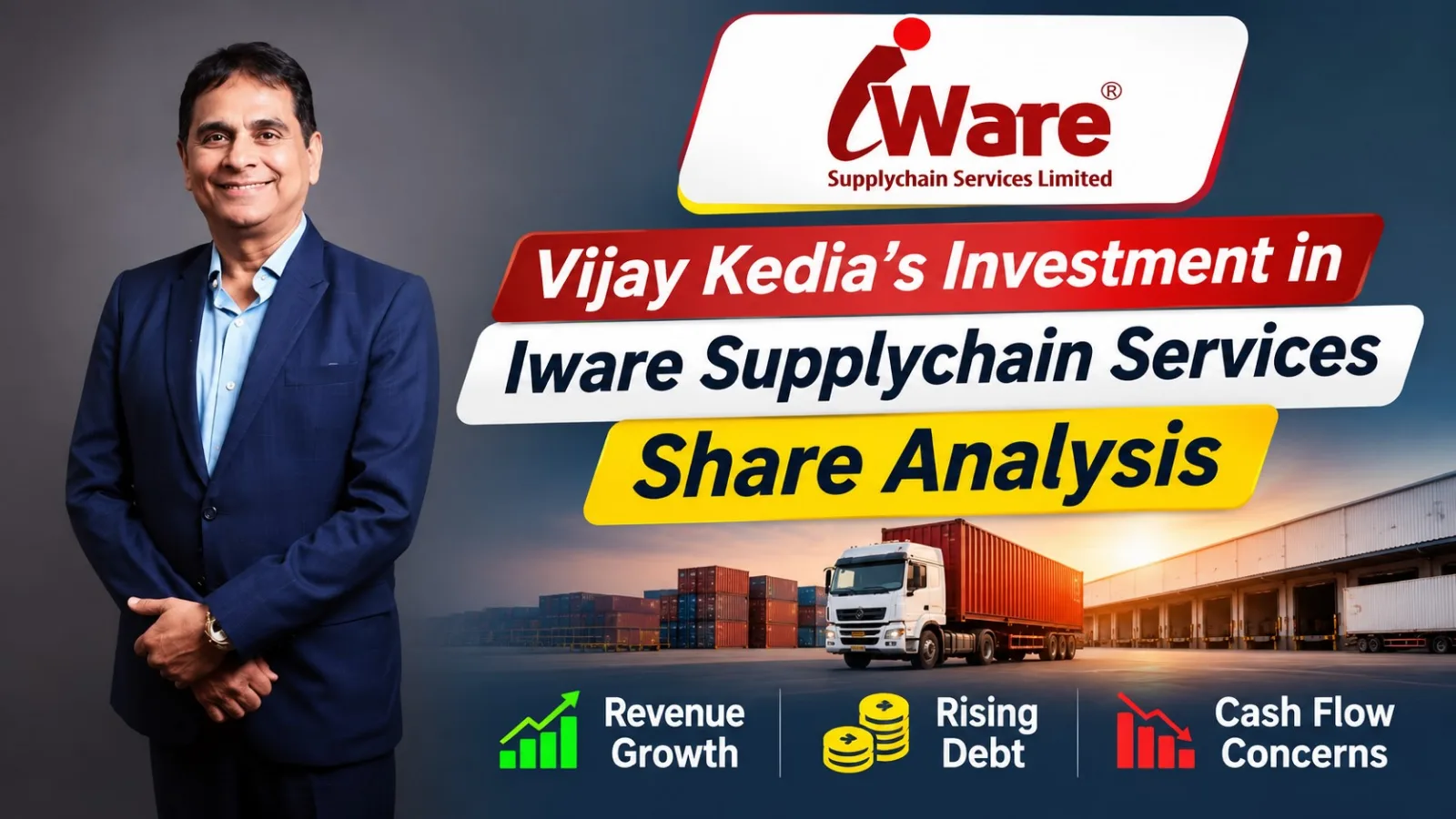
Vijay Kedia's Investment in Iware Supplychain Services
Veteran investor Vijay Kishanlal Kedia became a significant public shareholder in Iware through a preferential allotment and subsequent open-market purchases during 2026.
On June 5, 2026, the company allotted 7,90,800 equity shares at ₹255 per share through a preferential issue. Vijay Kedia and Kedia Securities Private Limited received 3,45,600 shares each, representing a combined allotment of 6,91,200 shares.
Kedia Securities subsequently purchased another 5,00,400 shares through two bulk transactions on July 8, 2026, at average prices of ₹348.25 and ₹348.85.
Based on September 2026 shareholding disclosures, the combined holding of Vijay Kedia and Kedia Securities stood at approximately 11.92 lakh shares, equivalent to around 10.35% of the company.
Investor | Shares held | Approx. stake |
|---|---|---|
Kedia Securities Pvt. Ltd. | 8,46,000 | 7.35% |
Vijay Kishanlal Kedia | 3,45,600 | 3.00% |
Combined holding | 11,91,600 | 10.35% |
Based on the disclosed acquisition transactions, the combined investment cost was approximately ₹35.07 crore, giving a blended acquisition price of around ₹294.30 per share. At the November 13 closing price of ₹400.20, the reported holding would have a market value of approximately ₹47.69 crore.
This represents an indicative unrealised gain of about ₹12.62 crore on the disclosed acquisition cost. It is a market-price calculation based on reported holdings, not a confirmation of the investor's future buying or selling decisions.
December 2026 Lock-in Expiry: Potential Supply Overhang
The shares received through the June 2026 preferential allotment are subject to the applicable statutory lock-in provisions. For non-promoter preferential allottees, the relevant lock-in is generally six months from the date of trading approval.
The preferential shares held by Kedia and Kedia Securities could therefore become eligible for trading around December 2026, depending on the actual exchange approval date. The additional shares bought through open-market bulk deals do not carry the same preferential-allotment lock-in.
The potential release of locked-in shares deserves attention because Iware trades on the SME platform with relatively low daily volumes. A large shareholder's decision to sell after the lock-in period could affect short-term liquidity, although the expiry itself does not mean that shares will necessarily be sold.
Promoter Shareholding and Ownership Structure
The promoter shareholding has declined from approximately 74.09% in March 2026 to 69.01% after the June preferential issue and 62.84% in the September 2026 shareholding pattern.
Part of the reduction came from fresh equity issuance, while promoter entity Inter India Roadways Private Limited also sold shares through the July 2026 bulk-deal transactions. The September shareholding pattern showed Kedia and Kedia Securities as significant non-promoter investors.
The promoter holding remains above 60%, and the company reported no pledged promoter shares in the September 2026 ownership disclosures. Nevertheless, investors should monitor further changes in promoter ownership, related-party transactions and the use of funds raised from shareholders.
The company has also confirmed that the net proceeds from its IPO and June 2026 preferential allotment were fully utilised by September 30, 2026, without reported deviation from the stated objectives. A new wholly owned subsidiary was approved by the board on November 14, 2026, although the financial contribution of this proposed entity will become clearer only through subsequent disclosures.
Iware Supplychain Services Valuation Compared With Logistics Peers
Iware's valuation reflects its faster revenue growth and higher return ratios, but it also carries greater leverage and working-capital risk than many smaller logistics businesses.
A selected peer screen places Iware's P/E at approximately 28.5 times, compared with a peer-group median of around 16.2 times. Its ROE of approximately 40% is higher than the peer median of about 13%, while its debt-to-equity ratio of around 1.27 times is also substantially above the peer median of approximately 0.38 times.
These comparisons are indicative because different logistics companies operate different asset models, customer segments and service mixes. A road transportation operator, a container logistics company and a warehouse-focused business may not deserve identical valuation multiples.
Iware's higher return ratios support part of its valuation premium. However, the premium also assumes that the company can sustain growth without allowing debt, receivables and operating costs to rise faster than earnings.
The key question is whether its return ratios remain strong after the latest expansion. A high ROE can look attractive when the company is growing quickly, but shareholders should also examine how much additional debt and working capital are required to produce each incremental rupee of profit.
Mainboard Migration: Not an Immediate Catalyst
Iware is listed on the NSE Emerge platform, and a migration to the NSE mainboard could eventually improve its access to a wider investor base. However, the process is subject to specific exchange eligibility requirements.
Under the revised NSE criteria effective May 1, 2025, an SME-listed company must have completed at least three years on the SME platform before applying for migration. It must also satisfy conditions relating to paid-up capital, average market capitalisation, revenue, operating profitability and the number of public shareholders.
Since Iware listed on May 6, 2025, it cannot meet the three-year listing-period requirement before May 2028. Even after that period, migration will not be automatic and will depend on meeting all applicable conditions at the time of application.
Therefore, mainboard migration should be viewed as a longer-term possibility rather than a near-term trigger for the share price.
Key Factors Investors Should Monitor in FY27
Iware's next phase of performance will depend on whether it can improve the quality of its growth. The following indicators will be especially important in its subsequent financial statements and exchange disclosures.
1. Operating cash flow: The company needs to demonstrate that rising accounting profits are converting into positive cash flow. The H1 FY27 operating cash outflow of ₹19.89 crore makes the full-year cash-flow statement particularly important.
2. Receivable and advance balances: Investors should track debtor days and examine the recovery or adjustment of short-term loans, advances and other current assets. A reduction in the cash absorbed by these balances would improve liquidity.
3. Operating margin: A sustained margin around 10–12% would indicate that the company is stabilising its cost structure. A further decline towards CARE's 8% sensitivity level would increase credit concerns.
4. Borrowings and repayment record: Total borrowings had reached approximately ₹85.53 crore by September 2026. Investors should monitor whether additional borrowing is required and whether all scheduled instalments are paid on time.
5. Customer diversification: The share of revenue from the top two customers needs to fall meaningfully. New contracts with Tube Investment, NCERT and Emami Agrotech will matter more if they generate repeat business and improve the overall customer mix.
6. Kandla operations and warehouse utilisation: The financial contribution from CWC's Kandla CFS and the company's expanding warehouse infrastructure should become clearer through revenue, margin and utilisation disclosures.
7. Promoter and major shareholder transactions: The December 2026 preferential-share lock-in window and subsequent shareholding disclosures deserve attention, particularly because the stock has limited trading liquidity.
Iware Supplychain Services Share Analysis: Growth Is Strong, but Cash Generation Needs to Catch Up
Iware Supplychain Services has built a significantly larger business in a short period. Revenue increased to ₹257.66 crore in FY26, while H1 FY27 revenue reached ₹193.96 crore. Its expanding transportation network, warehouse infrastructure, CWC association and new enterprise contracts provide opportunities for further growth.
However, the financial risks are equally important. Operating margins have declined from nearly 20% in FY25 to around 10% in H1 FY27, operating cash flow remained negative in both FY26 and H1 FY27, and borrowings increased to approximately ₹85.53 crore by September 2026.
The CARE B+; Stable rating, delayed EMI servicing observations and high cash-credit utilisation make liquidity a central issue for the company. Customer concentration of 75–82% among the top two clients adds another layer of business risk, especially when several newer contracts have no disclosed minimum-volume commitments.
The company may benefit from its expanding scale if it can improve fleet utilisation, increase higher-value warehousing and multimodal revenue, diversify customers and shorten its cash-conversion cycle. Until these improvements appear in reported cash flow and debt-servicing performance, strong revenue growth alone will not fully address the balance-sheet concerns.
For investors tracking Iware Supplychain Services shares, the next set of results should be assessed through operating cash flow, debtor days, advances, margins and borrowings—not revenue growth alone. The stock's valuation also needs to be considered alongside its SME liquidity and credit risks.
Disclaimer: This article is for educational and informational purposes only and does not constitute investment advice or a recommendation to buy, sell or hold any security. The analysis is based on publicly available information and company disclosures. Investors should independently verify financial statements and exchange filings and consult a SEBI-registered investment adviser before making investment decisions.