

Unimech Aerospace Share Price: What Is Behind the Sharp Rally in 2026?
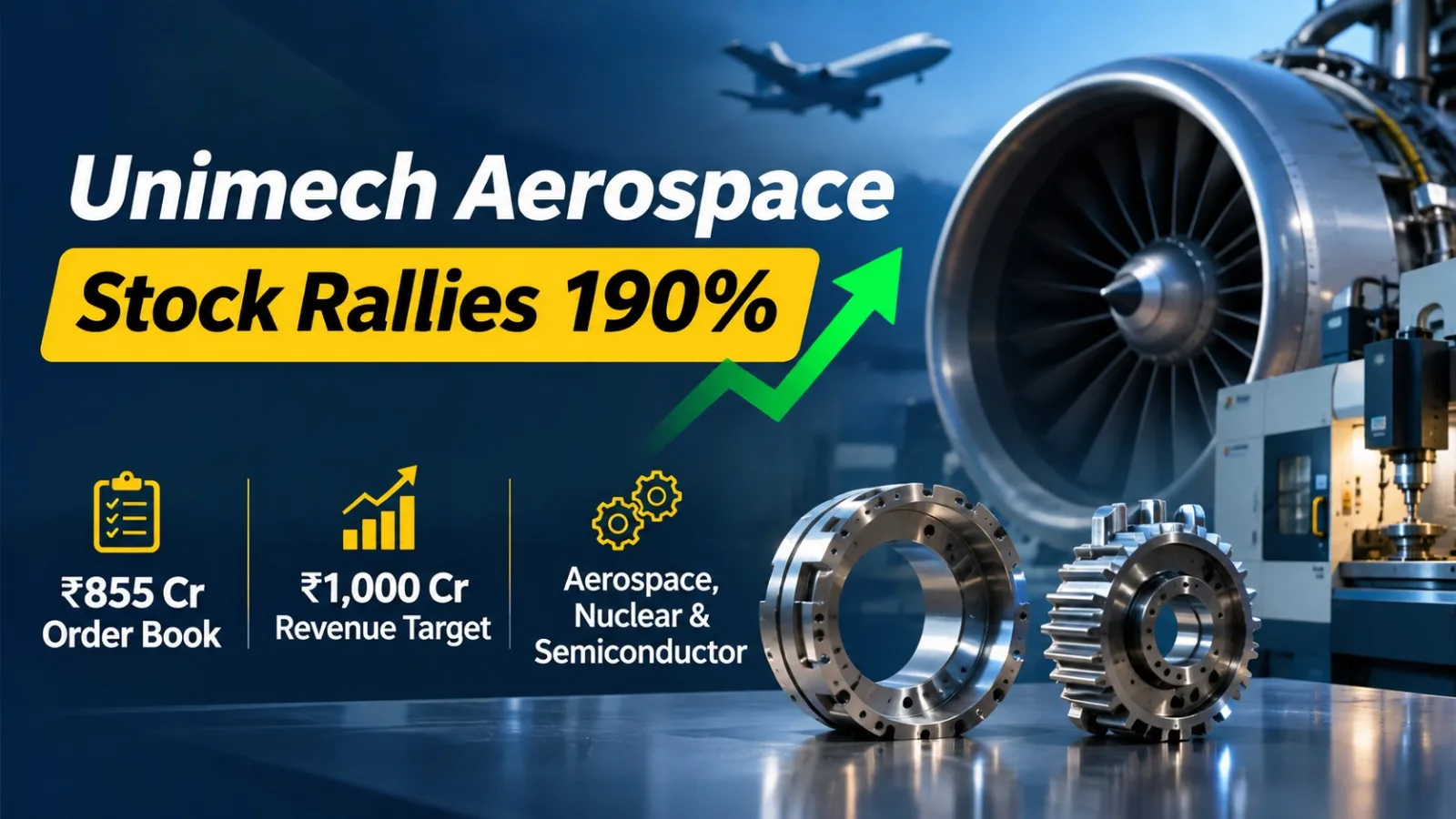
Shares of Unimech Aerospace and Manufacturing Ltd have delivered a remarkable recovery in 2026, moving from a March low of ₹695 to an all-time high of ₹2,025.60 on November 12. The stock has gained approximately 190% from its March intraday low, although the percentage return varies depending on the starting price selected. From a reference level of ₹750, the advance is around 170%.
The rally has coincided with a significant change in the company's business profile. Unimech is moving beyond its traditional aerospace tooling operations and expanding into precision-engineered components, assemblies and long-term manufacturing programmes for global customers.
The company has also completed the acquisition of Hobel Bellows, entered a strategic manufacturing joint venture in Saudi Arabia and increased its investment in propulsion technology company Dheya Engineering Technologies. These developments have widened its addressable markets beyond conventional aerospace tooling.
However, the most important development for investors is the expansion in reported earnings and long-term order visibility. Unimech's consolidated order book reached approximately ₹855 crore by September 2026, while revenue from operations increased 98.4% year-on-year in the September quarter.
1. Unimech's ₹855 Crore Order Book Becomes a Major Growth Catalyst
The increase in the order book has been one of the strongest triggers behind the stock's re-rating. Unimech reported a consolidated order book of approximately ₹855 crore as of September 30, 2026, representing a 715% increase compared with the corresponding period last year.
The headline figure, however, needs to be understood carefully. It includes approximately ₹266 crore of confirmed purchase orders and another ₹589 crore representing long-term agreements and award letters. The latter provides programme visibility but should not be treated as an equivalent amount of executable purchase orders.
The ₹589 crore component is linked primarily to three important international aerospace relationships. These programmes have longer durations than the company's traditional purchase-order-based tooling business and could provide revenue visibility over several years as customer qualifications and production schedules progress.
French aerospace Tier-1 programme: Approximately US$43 million
One of the largest developments is an award for aerostructure components from a French aerospace Tier-1 manufacturer. The programme has an indicated value of approximately US$43 million, with visibility extending over around 10 years.
The components relate to aircraft door systems used across Boeing, Airbus and Embraer platforms. This is an important step in Unimech's transition towards manufacturing precision components that become part of aircraft structures rather than supplying only the tools used in their production.
However, qualification and prove-out activities remain important milestones before the entire programme can move into serial production. The indicated programme value should therefore be viewed as long-term business visibility rather than immediate revenue.
Honeywell Aerospace: Ten-year supply agreement
Unimech has also signed a 10-year long-term supply agreement with Honeywell Aerospace, which can be extended by another two years. The agreement covers aerospace engine components and control-system components supplied for Honeywell engines and auxiliary power units.
The company has not disclosed the specific component details or a separate contract value. Nevertheless, a long-term relationship with a global aerospace technology manufacturer strengthens Unimech's position in the international supply chain.
The significance of this agreement lies in the potential for repeat manufacturing orders. Once components complete customer qualification and enter regular production, the relationship can support a longer revenue cycle than conventional tooling orders.
FACC: US$7.5 million five-year agreement
The third important programme is a five-year agreement with Austria-based FACC, valued at approximately US$7.5 million for aerostructure components.
The contract has entered initial execution, while discussions are ongoing about potentially increasing its tenure and value. These discussions are opportunities rather than confirmed contract extensions.
Together, these three relationships account for a substantial portion of the long-term order visibility disclosed by Unimech. Their eventual contribution will depend on qualification timelines, customer production schedules and the company's ability to scale deliveries.
2. From Aerospace Tooling to Components That Go Into Aircraft
The change in Unimech's business model is arguably more important than the headline order-book number. Historically, the company was primarily known for specialised tooling used in aircraft engine and airframe manufacturing.
This business involves designing and producing complex tools, fixtures and ground-support equipment required during aircraft and engine production, maintenance and repair. Although the business benefits from technical expertise and customer relationships, many orders follow relatively short purchase-order cycles.
The company is now building a larger precision components and assemblies business. These products include engine components, control-system components and aerostructure parts that become part of the equipment or aircraft itself.
This transition could change the nature of revenue generation. A qualified aerospace component can remain part of a customer's production programme for several years, with repeat requirements linked to aircraft and engine manufacturing volumes.
Why aerospace qualification matters
Aerospace manufacturing involves stringent inspection, documentation, material traceability and quality requirements. A supplier must demonstrate that its manufacturing processes can consistently meet customer specifications before components are approved for serial production.
Unimech had completed qualification activities for more than 250 parts by the end of the first half of FY27, with another 340-plus parts in the qualification pipeline. Management expects the total number of qualified parts across its customer ecosystem to exceed 590 by the end of FY27.
The company has indicated that approximately 60-70% of the existing 250 qualified parts could move into serial production. However, qualification does not automatically mean that every part will immediately generate large orders. Production volumes will depend on customer approvals and the rollout schedules of individual programmes.
Management expects the benefits of this qualification pipeline to become more visible from FY28 onwards. This is one of the central reasons investors are attaching greater value to the company's precision components business.
3. Q2 FY27 Results: Revenue Nearly Doubles and EBITDA Margin Expands
The September 2026 quarter provided strong financial support for the stock's rally. Unimech reported consolidated revenue from operations of ₹123 crore, compared with ₹62 crore in the corresponding quarter last year.
EBITDA increased to approximately ₹49 crore from ₹18.5 crore, while net profit rose to ₹31.8 crore from ₹15.7 crore. The improvement was supported by higher revenue, operating leverage and a favourable mix of manufacturing orders.
The more significant development was the expansion in operating profitability. The EBITDA margin increased from approximately 29.9% in Q2 FY26 to 39.8% in Q2 FY27, an improvement of nearly 990 basis points.
Unimech Aerospace Q2 FY27 financial performance
Particulars | Q2 FY26 | Q2 FY27 | YoY change |
|---|---|---|---|
Revenue from operations | ₹62.0 Cr | ₹123.0 Cr | +98.4% |
EBITDA | ₹18.5 Cr | ₹49.0 Cr | +164.3% |
EBITDA margin | 29.9% | 39.8% | +990 bps |
Net profit | ₹15.7 Cr | ₹31.8 Cr | +102.8% |
The increase in EBITDA was substantially faster than revenue growth, indicating that the higher production base was supporting operating leverage. Gross margin also reached approximately 69% in Q2, while subcontracting costs remained around 2% of revenue.
For the first half of FY27, revenue from operations increased 85% year-on-year to ₹230.6 crore. EBITDA grew 130% to ₹88.3 crore, while net profit increased 71% to ₹59.6 crore.
An important comparison is that the company generated approximately 96% of its entire FY26 revenue during the first six months of FY27. It also achieved nearly 94% of its previous full-year net profit within the same period.
Why the improvement in earnings matters
Unimech's FY26 performance had been relatively subdued, with annual revenue from operations at approximately ₹240.5 crore and net profit of around ₹63.7 crore. The decline in profitability during that year had raised questions about the company's growth trajectory.
The first-half FY27 performance has materially changed that picture. Higher deliveries, consolidation of Hobel Bellows and the beginning of contributions from precision components have helped improve the consolidated numbers.
Management has indicated that second-half FY27 revenue should exceed first-half revenue, with similar margins. Higher semiconductor equipment deliveries, execution of nuclear orders and steady performance in other businesses are expected to support the improvement.
4. Hobel Bellows Acquisition Adds a New Industrial Revenue Stream
The acquisition of Hobel Bellows is another important reason behind the re-rating. In April 2026, Unimech completed an investment of up to ₹450 crore to acquire control of Hobel Bellows, a specialised manufacturer of metallic bellows, flexible tubing components and precision-engineered assemblies.
Hobel reported approximately ₹129 crore in revenue during FY26, with EBITDA margins exceeding 50%, according to the acquisition-related investor disclosures. Around 90% of its business was linked to exports, giving Unimech access to additional international customers and industrial markets.
Metallic bellows are used in applications that require flexibility, vibration absorption, thermal expansion management and pressure containment. These products find applications in aerospace, power generation, industrial engines, marine equipment, locomotives and other demanding engineering environments.
Data-centre power demand creates an additional opportunity
One of the opportunities highlighted by management is the rising demand for genset engines used in data-centre infrastructure. Hobel's customers have indicated strong demand for related components and have also sought additional manufacturing capacity.
The company is exploring further business in turbine switchgear bellows, locomotive exhaust systems and industrial engine applications. This provides a route to increase revenue without depending entirely on the commercial aircraft manufacturing cycle.
Cross-selling is another part of the acquisition strategy. Unimech is introducing Hobel's metal-forming and bellows capabilities to its existing aerospace, semiconductor and nuclear customers. At the same time, Hobel's customers are being introduced to Unimech's precision machining and engineering capabilities.
Management has estimated that Hobel could contribute approximately 20% of its ₹1,000 crore revenue aspiration. This would represent a sizeable industrial business alongside the traditional aerospace operations.
Hobel contributed approximately 30% of Unimech's consolidated H1 FY27 revenue, reflecting its importance to the reported growth. The next stage will be to establish cross-selling synergies and qualify its products with additional aerospace customers.
5. Saudi Arabia Joint Venture: A New Entry into the Middle East Energy Market
Unimech is expanding its international manufacturing footprint through a joint venture with Yusuf Bin Ahmed Kanoo Company, a Saudi Arabian business group. The venture is intended to establish an advanced precision machining and remanufacturing facility in Dammam.
Unimech holds a controlling 51% stake, while the Kanoo group owns the remaining 49%. The manufacturing platform is designed to serve upstream and downstream oil and gas customers and allied energy industries in the region.
The project is aligned with Saudi Arabia's In-Kingdom Total Value Add programme and Vision 2030 industrial localisation objectives. These initiatives encourage the development of domestic manufacturing capabilities and local supply chains.
US$80 million cumulative revenue target over five years
The joint venture partners have outlined a cumulative revenue ambition of approximately US$80 million over five years, subject to market conditions, customer qualifications and regulatory approvals.
The revenue plan is expected to ramp up gradually, beginning with approximately US$1 million in the first year and potentially reaching around US$30 million by the fifth year. This is a cumulative five-year opportunity, not an annual revenue commitment of US$80 million.
The project involves a broader phased investment of approximately US$30 million. Separately, the partners have planned total equity capital of SAR 60 million, to be infused in two tranches according to their respective shareholding.
In October 2026, Unimech infused its first equity contribution of SAR 15.3 million, equivalent to approximately ₹39.36 crore. The remaining contribution is expected under the agreed investment schedule.
Commercial production timeline
Management is targeting commercial manufacturing readiness by late March or early April 2027. The facility will initially focus on precision machining and remanufacturing requirements for the Middle East energy sector.
The project could provide access to customers that prefer local manufacturing and service capabilities. However, the actual revenue contribution will depend on customer onboarding, qualification, regulatory requirements and the pace of capacity utilisation.
The Saudi venture is therefore a medium-term expansion opportunity. It is not yet a meaningful contributor to the company's reported operating revenue.
6. Dheya Engineering: Unimech's Entry into Indigenous Gas Turbine Propulsion
Unimech has also increased its exposure to defence and propulsion technologies through its investment in Bengaluru-based Dheya Engineering Technologies.
In September 2026, Unimech acquired an additional 5.08% stake for approximately ₹3 crore, taking its aggregate holding to 35.07%. The investment strengthens an existing relationship under which Unimech has exclusive manufacturing rights for Dheya's indigenous micro gas turbine and propulsion platforms.
Dheya is developing micro gas turbine engines intended for unmanned aerial vehicle and other defence-related applications. The arrangement is strategically different from Unimech's conventional build-to-print business because the technology and engine designs are developed by Dheya, while Unimech provides the manufacturing capability.
Multiple engine variants under development
Dheya is working on a range of micro gas turbine engines with thrust ratings of 20 kg, 40 kg, 50 kg and 100 kg. Management indicated that development of the 40 kg thrust engine had progressed to an advanced stage, with serial manufacturing activities initiated in collaboration with Unimech.
The company has also disclosed progress in the defence certification process. Dheya has received a prototype certification pathway from CEMILAC, the relevant Indian military aviation certification authority, and has completed its preliminary design review.
The next milestones include a critical design review, full-scale engine testing and the targeted final design approval process. Management has indicated targets extending into early 2027, subject to successful testing and certification.
Why the relationship matters to Unimech
The exclusive manufacturing arrangement provides Unimech with an opportunity to participate in propulsion manufacturing without having to develop the entire engine technology independently. If customer platform trials and defence approvals progress successfully, production orders could create another specialised revenue stream.
However, this opportunity is still at a development and qualification stage. Meaningful commercial revenue will depend on successful platform integration, customer orders, certification and the conversion of trials into serial manufacturing programmes.
The 35.07% equity holding also provides Unimech with exposure to Dheya's business performance as an associate investment. The manufacturing opportunity and the financial return from the equity stake should be viewed separately when assessing its potential contribution.
7. Nuclear and Semiconductor Businesses Expand the Addressable Market
Unimech is using its precision engineering capabilities to enter other industries where customers require complex components, specialised machining and strict quality control.
Nuclear power has already become an established opportunity rather than merely a new business proposal. The company reported approximately ₹87 crore of nuclear orders during FY26 and had qualified around 13-15 different sub-assemblies and systems by the October 2026 earnings call.
Unimech is also participating through Tier-1 suppliers in opportunities related to four additional nuclear reactors that were in the bidding stage. The conversion of these opportunities into orders will depend on the outcome of the tenders and subsequent project execution schedules.
Semiconductor equipment manufacturing
The semiconductor opportunity is focused on supplying precision-engineered components to semiconductor capital-equipment manufacturers. These products include machined metallic and plastic components as well as mechanical assemblies that are used in equipment involved in wafer processing and chip manufacturing.
The business is different from manufacturing semiconductor chips. Unimech is participating in the upstream equipment supply chain, where component suppliers must meet demanding requirements relating to precision, surface finish and manufacturing consistency.
Management disclosed that 60 semiconductor parts had completed qualification, with another 20 targeted by the end of calendar 2026. The company had one established semiconductor customer and discussions with two additional customers in the pipeline.
Although semiconductor revenue remained relatively small in H1 FY27, management expects a step-up in the second half as more qualified components move into deliveries. The opportunity is linked to capacity creation in India's semiconductor ecosystem as well as global equipment demand.
8. Special-Process Automation Could Improve Manufacturing Control
Another important investment is the installation of automated special-process cells and assembly lines at Unimech's existing facilities. The company is adding capabilities including anodising, electroless nickel plating, passivation, zinc and cadmium plating, heat treatment, surface finishing and non-destructive testing.
These processes are important in aerospace and precision engineering because components often require specialised finishing and inspection before they can be accepted by customers. Depending on external vendors for such work can increase lead times and complicate quality traceability.
By bringing more of these processes in-house, Unimech expects to improve control over manufacturing schedules, quality standards and process documentation. It could also make the company a more complete supplier for customers looking to consolidate multiple manufacturing stages with fewer vendors.
Trial runs were scheduled during October and November 2026, with commissioning targeted for December 2026. The company is targeting NADCAP certification by March 2027, which remains an important milestone before the full benefits of the expanded capability can be realised.
9. How Unimech Plans to Reach the ₹1,000 Crore Revenue Mark
Management has outlined an ambition to reach approximately ₹1,000 crore in annual revenue. Importantly, the company has not provided a formal revenue guidance for a specific financial year, and investors should treat this figure as a medium-term aspiration.
The plan rests on improving utilisation of existing manufacturing infrastructure, converting qualified components into serial production and adding manufacturing capacity where customer demand supports the investment.
As per the company's FY26 annual disclosures, its manufacturing footprint exceeded 5.63 lakh square feet, with more than 150 specialised machines and installed capacity of over 6.8 lakh machine-hours. This provides the industrial base required to increase output across aerospace tooling, precision components and other applications.
Manufacturing utilisation and machine-hour capacity
Unimech reported approximately 65% manufacturing capacity utilisation in Q2 FY27. However, this figure includes around 15-20% of available capacity being used for new product introduction, prove-outs and customer qualification programmes.
These activities do not immediately generate the same commercial revenue as serial production. Once parts complete customer approvals, some of the machine time used for qualification can gradually be deployed towards repeat manufacturing orders.
This is an important element of the growth strategy. Instead of relying only on fresh machinery purchases, Unimech is attempting to improve the commercial output generated by its existing manufacturing assets.
The company has also indicated that most of the infrastructure investment required for the ₹1,000 crore revenue aspiration is already completed or progressing. Management expects the consolidated gross block to reach approximately ₹500 crore by the end of FY27, including the joint venture business.
At around two times asset turnover, a ₹500 crore gross block provides the broad asset base for a ₹1,000 crore revenue aspiration. The relationship is an operating target rather than a guarantee that the company will achieve the corresponding revenue immediately.
Hobel, precision components and tooling will drive the revenue mix
Management expects the business mix to evolve as the company moves towards its ₹1,000 crore ambition. Aerospace tooling currently remains the largest revenue contributor, but the share of precision components and assemblies is expected to increase.
At the target scale, management indicated that the mix could move towards approximately 50% aerospace tooling and 50% precision components and assemblies. Hobel is expected to account for approximately 20% of the overall revenue aspiration.
Market estimates have also discussed a possible revenue composition involving ₹400-450 crore from core aerospace tooling, ₹250-300 crore from precision components, approximately ₹200 crore from Hobel and an additional contribution from the Saudi joint venture and other new businesses.
These figures are illustrative analyst-led estimates rather than an official company-issued revenue bridge. Some business categories may overlap, particularly where Hobel capabilities contribute to precision components, and should not be added mechanically as separate guaranteed revenue streams.
Why the next expansion could require early investment
Management has indicated that reaching the ₹1,000 crore revenue level will bring existing infrastructure closer to its practical utilisation limits. Any further substantial growth would therefore require additional manufacturing capacity.
Setting up new facilities is not an immediate process. Machinery procurement, installation, prove-outs, customer qualification and production approvals can take approximately 18-24 months.
This is the reason the company is assessing capacity investments ahead of the actual requirement. Customers also tend to evaluate a supplier's available manufacturing infrastructure before allocating large new programmes, making capacity readiness an important part of winning future business.
10. Proposed ₹750 Crore QIP: Funding the Next Expansion Phase
Unimech's board approved an enabling proposal for a Qualified Institutions Placement of up to ₹750 crore in August 2026. The proposal is intended to provide flexibility for the company's longer-term expansion plans, subject to the required approvals and market conditions.
The important distinction is that management has indicated the ₹1,000 crore revenue aspiration does not require the full proposed fundraise. The existing manufacturing infrastructure and internal accruals are expected to support that stage of expansion.
The potential capital raise is being considered primarily for the next phase of growth, including additional facilities, machinery and possible inorganic opportunities. Management has indicated that the proposed equity fundraise could also help the company meet minimum public shareholding requirements.
A QIP would strengthen the company's capacity to invest ahead of future demand, but it could also dilute existing shareholders depending on the size and pricing of the eventual issue. The timing, amount and final terms should therefore be monitored through subsequent exchange disclosures.
11. Institutional Shareholding: FIIs Increase Stake, DIIs Reduce Exposure
The September 2026 shareholding pattern shows that promoter ownership remained high at 79.75%. Foreign institutional investors increased their stake from 0.43% in June 2026 to 1.01% in September.
Domestic institutional investors, on the other hand, reduced their combined holding from approximately 5.60% to 4.66%. Public shareholding increased to 14.59% from 14.16% during the same period.
Shareholder category | June 2026 | September 2026 |
|---|---|---|
Promoters | 79.82% | 79.75% |
FIIs | 0.43% | 1.01% |
DIIs | 5.60% | 4.66% |
Public | 14.16% | 14.59% |
Among the disclosed institutional holders, VQ Fastercap Fund held approximately 1.97%, while ValueQuest SCALE Fund held around 1.64% in September 2026. Mutual funds collectively held approximately 0.44%, with other domestic institutional investors accounting for the remaining DII ownership.
The increase in FII holding is a positive development in terms of institutional participation. However, it does not indicate broad-based institutional accumulation, particularly because overall DII ownership declined during the quarter.
The promoter holding level and proposed fundraise are also relevant. Any eventual equity issuance and changes in public shareholding could alter the ownership structure over the coming quarters.
12. Brokerage Targets: How Much Upside Do Analysts See?
The sharp price appreciation has also changed the relationship between the prevailing market price and brokerage valuation estimates.
Motilal Oswal maintained a Buy recommendation after the Q2 FY27 results and assigned a target price of ₹2,138 in its October 28, 2026 report. Its valuation was based on 60 times estimated FY28 earnings per share, reflecting expectations of continued earnings growth.
Choice Institutional Equities also maintained a Buy rating with a target price of ₹1,950 in its October 28 report. The brokerage highlighted the company's long-term aerospace agreements, rising precision component contribution and expansion into semiconductor equipment, nuclear and industrial applications.
The broader analyst consensus available on November 13 was around ₹1,841, based on three tracked analyst calls. This was below the stock's recent market price near ₹1,950-₹1,980, showing that the rally had already moved ahead of several published valuation estimates.
Brokerage / data source | Report date | Recommendation | Target price |
|---|---|---|---|
Motilal Oswal | October 28, 2026 | Buy | ₹2,138 |
Choice Institutional Equities | October 28, 2026 | Buy | ₹1,950 |
Analyst consensus | November 13, 2026 | Buy consensus | ₹1,841 |
Brokerage targets are based on assumptions about future earnings and valuation multiples. They are not assured market prices, and the estimates can change as new financial results and order developments become available.
13. Valuation: Strong Growth Expectations Are Already Reflected in the Stock
The company's improving operating performance has supported a substantial re-rating. However, the rise in market capitalisation has also increased the earnings growth required to justify the valuation.
At the November 12 closing price of ₹1,980.60, Unimech's market capitalisation was approximately ₹10,082 crore. Against FY26 net profit of approximately ₹63.7 crore, this represents a high valuation relative to its historical earnings base.
Annualising H1 FY27 net profit of ₹59.6 crore gives approximately ₹119.3 crore. On this simplified basis, the market capitalisation is around 84 times annualised first-half earnings.
This is not a forecast or a formal forward price-to-earnings multiple. It assumes the second half can reproduce the first-half profit level and does not account for changes in the share count or future earnings. Nevertheless, it shows that investors are assigning significant value to the company's expected growth.
The market is not valuing Unimech merely on its FY26 performance. The current valuation reflects expectations of higher revenues from aerospace components, Hobel, nuclear, semiconductors and international manufacturing operations.
For the valuation to remain supported, the company will need to convert these opportunities into reported earnings and cash flows. Strong order announcements alone may not be sufficient if production qualification or revenue conversion takes longer than expected.
14. Key Risks Investors Should Monitor
Order-book conversion and customer qualification
The ₹855 crore headline order book provides substantial visibility, but ₹589 crore relates to long-term agreements and award letters rather than confirmed purchase orders. The pace at which these programmes move through qualification and serial production will determine the actual revenue contribution.
Working-capital requirements
Unimech reported working-capital days of approximately 110 days in Q2 FY27. Management expects this figure to increase towards 150-160 days by the end of FY27 as the business shifts towards longer-cycle aerospace and nuclear programmes.
Higher inventory commitments and longer customer acceptance periods can increase the amount of capital tied up in operations. A rise in receivables or short-term borrowings without corresponding operating cash flow would need close monitoring.
Margin normalisation
The Q2 EBITDA margin of approximately 39.8% was supported by a favourable order mix and operating leverage. Management expects the H1 margin performance to remain broadly sustainable during H2 FY27.
However, it has also indicated that the revenue mix could change as precision components become a larger part of the business. At the ₹1,000 crore scale, management has discussed a roughly 50:50 tooling-to-components mix and indicated that increased research and development activity could lead to one to two percentage points of margin pressure.
Acquisition and overseas execution
Hobel's integration, cross-selling and industrial demand will need to translate into sustained growth. The Saudi facility also involves execution risks relating to commissioning, local customer qualifications, regulatory approvals and utilisation.
Both projects require management attention and capital allocation discipline. Their contribution to consolidated performance may take longer than the initial timelines suggest.
Defence propulsion and certification
Dheya's propulsion business offers an opportunity in a specialised segment, but engine testing, certification and platform integration are critical milestones. The commercial potential should not be valued as confirmed production revenue until formal orders and manufacturing schedules emerge.
Export exposure and valuation
Unimech has a substantial export-oriented business. Changes in global aerospace production schedules, customer procurement decisions, currency movements and trade policy can influence demand and profitability.
Management has indicated that customers generally bear duties on most shipments and that the direct duty exposure is relatively small. Nevertheless, export-related risks remain relevant for investors.
The valuation is another major concern after the sharp rise. A high earnings multiple leaves less room for delays in customer approvals, lower margins or slower-than-expected revenue growth.
What the Next Two to Four Quarters Could Reveal
Unimech's next phase will depend on whether the current expansion in customer programmes translates into repeat manufacturing revenue. The number of qualified components entering serial production will be particularly important because this is the foundation of the company's shift towards a recurring revenue model.
Investors will also need to watch the revenue contribution from semiconductor equipment customers, the execution of existing nuclear orders and Hobel's cross-selling progress. The commissioning of the Saudi facility and the certification milestones at Dheya will provide further indications of progress in the company's diversification strategy.
The ₹1,000 crore revenue aspiration provides a useful framework for understanding the scale of management's ambitions. But the more immediate test is whether Unimech can sustain strong earnings growth while maintaining margins, controlling working capital and generating cash from operations.
The sharp rally reflects a market that is beginning to value Unimech as a broader precision-manufacturing platform rather than only an aerospace tooling supplier. Whether that re-rating is sustained will depend on how effectively the company converts its growing programme pipeline into actual production, revenue and profits.
Disclaimer: This article is for informational and educational purposes only. It is not investment advice or a recommendation to buy, sell or hold any security. Stock-market investments are subject to market risks. Readers should conduct their own research and consult a registered SEBI investment adviser before making investment decisions.