

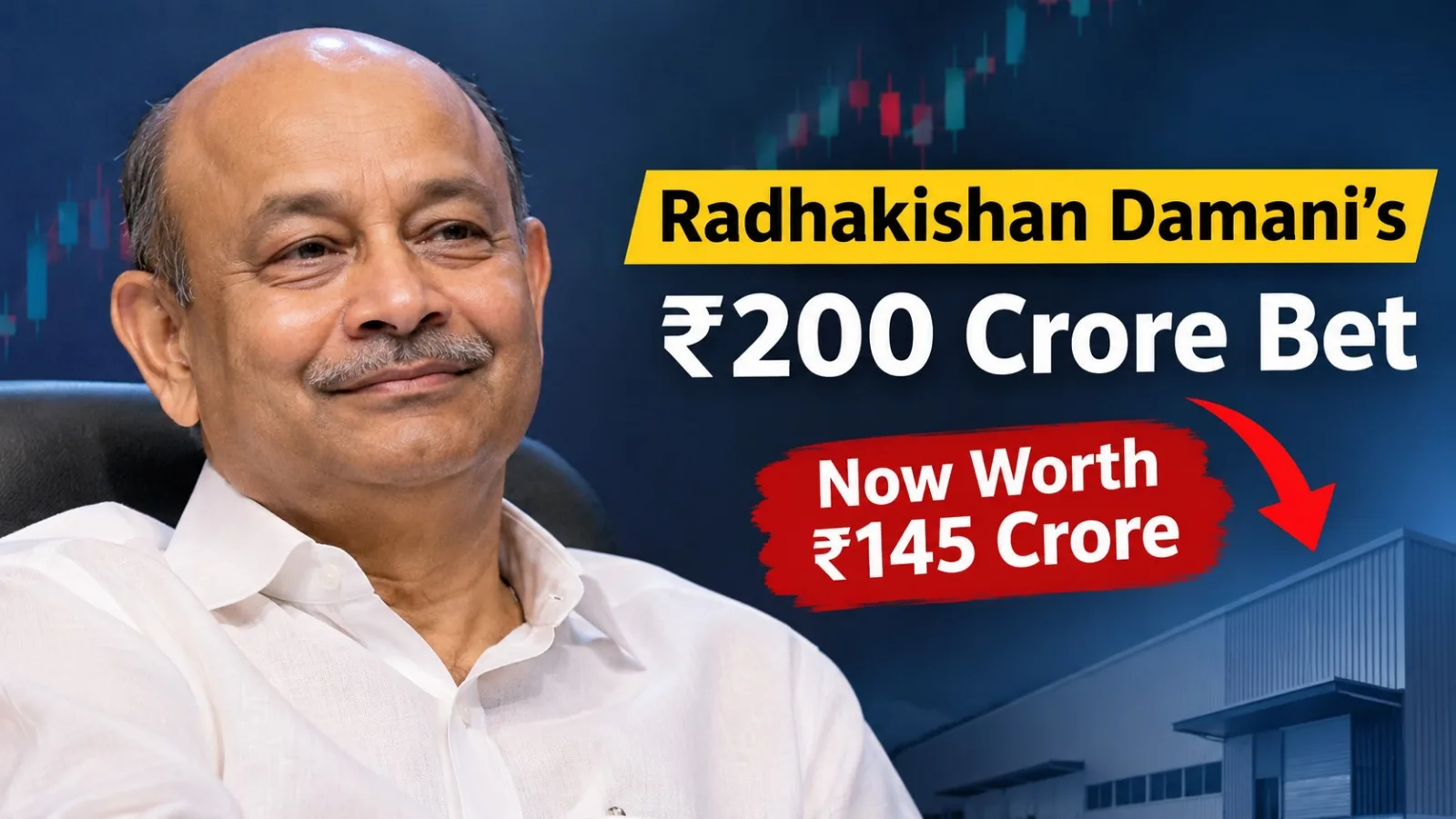
Radhakishan Damani, the founder of Avenue Supermarts, which operates DMart, participated in the pre-IPO fundraising round of Horizon Industrial Parks, an industrial and logistics infrastructure platform backed by global investment firm Blackstone. His investment attracted attention because it provided exposure to India's expanding warehousing, manufacturing and logistics infrastructure sector.
Damani invested approximately ₹200 crore during a ₹1,650 crore pre-IPO fundraising round completed in December 2025. Other investors participating in the fundraising included SBI Life Insurance and funds managed by 360 ONE. The investment was made before Horizon entered the public markets through its initial public offering in August 2026.
However, the company's stock market performance has reduced the market value of Damani's disclosed investment. According to September 2026 shareholding disclosures, he held approximately 3.34 crore shares, representing around 1.16% of Horizon Industrial Parks. At the November 3, 2026 closing price of ₹43.14, the holding was valued at approximately ₹144.86 crore.
Compared with his original investment of approximately ₹200 crore, this represents a notional decline of around ₹55 crore. The difference reflects the change in market value rather than a confirmed realised loss, as the disclosed shares remained part of his reported holding. The investment therefore provides an example of how pre-IPO investments can experience valuation changes after a company becomes publicly traded.
How Much Did Damani Pay for Horizon Industrial Parks Shares?
The December 2025 pre-IPO fundraising round was an important ownership milestone for Horizon Industrial Parks. The company allotted approximately 27.59 crore shares to 25 investors at ₹59.81 per share, raising around ₹1,650 crore. The fundraising brought several institutional and individual investors into the company's ownership structure before its public listing.
Damani received approximately 3.34 crore shares through this private placement. His investment price of ₹59.81 was close to the eventual IPO price, which was fixed at ₹60 per share at the upper end of the issue price band. Consequently, his entry price did not provide a substantial discount compared with the price paid by public investors in the IPO.
The key investment details are:
Investor: Radhakishan Damani
Company: Horizon Industrial Parks
Investment period: December 2025
Investment amount: Approximately ₹200 crore
Shares allotted: 3,34,39,224
Allotment price: ₹59.81 per share
September 2026 disclosed shareholding: Approximately 1.16%
Unlike ordinary stock market purchases, pre-IPO investments are generally completed through private placements or other permitted fundraising structures. Investors receive shares before the company begins trading on the stock exchange. Once listed, the market determines the trading price based on demand, supply, financial performance and investor expectations.
Why Has the Market Value of Damani's Investment Declined?
Horizon Industrial Parks entered the stock market in August 2026 with an IPO price band of ₹57 to ₹60 per share. The company raised ₹2,600 crore through a fresh issue, and its shares were listed on the NSE and BSE on August 24, 2026. The listing brought the company into the public market, allowing investors to trade its shares through the exchanges.
The stock closed its first trading session at ₹58.16 on the NSE, below the upper IPO price of ₹60. It subsequently declined to ₹43.14 at the November 3, 2026 market close. This movement reduced the value of shares held by investors who entered the company during the pre-IPO fundraising round.
At ₹43.14 per share, Damani's disclosed holding of approximately 3.34 crore shares was valued at ₹144.86 crore. At the original investment price of ₹59.81, the same number of shares would have represented an investment value of approximately ₹200 crore. The difference is approximately ₹55.14 crore, equivalent to a decline of around 27.6%.
The comparison is based on the disclosed shareholding and the specified closing price. It does not account for any additional transactions, taxes or other costs, and should not be treated as evidence that Damani has sold his shares. A decline in market value does not automatically mean that an investor has booked a loss.
What Is Horizon Industrial Parks and How Does Its Business Work?
Horizon Industrial Parks is an industrial and logistics infrastructure developer, owner and operator backed by Blackstone's real estate investment business. The company develops and operates warehouses, industrial facilities, fulfilment centres and in-city logistics properties. These facilities are used by businesses that require storage, distribution, manufacturing and supply-chain infrastructure.
Its customers operate across several industries, including e-commerce, retail, fast-moving consumer goods, automotive, renewable energy and manufacturing. Companies in these sectors require strategically located properties to store products, manage inventory and distribute goods to different markets. Horizon provides the physical infrastructure required for these operations.
Unlike a conventional transportation or logistics company, Horizon primarily operates in the industrial real estate segment. Its business revolves around developing properties and leasing the completed facilities to corporate customers. Rental income and related property services form the foundation of its operating model.
Blackstone launched Horizon as a dedicated Indian logistics platform in January 2022. The platform expanded through investments and acquisitions involving businesses such as Embassy Industrial Parks, TARC and Allcargo. These transactions helped establish a portfolio of industrial and logistics properties across several Indian markets.
How Does Horizon Industrial Parks Generate Revenue?
Horizon follows a business model based on industrial property development and leasing. The company acquires land or existing industrial properties, develops warehouses and other facilities, and leases the completed space to corporate customers. Revenue generation depends on the amount of leasable space available and the rental agreements secured with tenants.
Occupancy levels are an important factor because vacant properties do not generate the same rental income as occupied facilities. The company also depends on rental rates, lease renewals and the ability to attract new customers. Higher occupancy and successful leasing activity can improve the utilisation of its existing property portfolio.
New developments provide another source of potential revenue growth. When warehouses and industrial facilities become operational, Horizon can offer additional space to businesses requiring storage and distribution infrastructure. However, development projects involve construction costs, approvals and financing requirements before they begin generating rental income.
Acquisitions can also expand the company's property portfolio and geographic presence. Purchasing existing industrial properties may provide access to operational facilities and established tenants, while new developments can create additional capacity. Both strategies require capital and depend on the company's ability to generate adequate returns from its investments.
Blackstone's Ownership in Horizon Industrial Parks
Blackstone is the controlling shareholder of Horizon Industrial Parks through its affiliated investment entities. Before the December 2025 fundraising round, Blackstone held the entire equity ownership of the platform. Following the private placement, its ownership declined to approximately 88.74%, according to the company's IPO disclosures.
After the public issue, Blackstone's ownership reduced further to approximately 75.4%. The September 2026 shareholding disclosures identified Damani as a minority shareholder with approximately 1.16% ownership. The remaining shares were held by other public shareholders and investors.
Blackstone's majority ownership means it continues to exercise control over the company's strategic direction, subject to applicable corporate governance and regulatory requirements. Its role as the principal shareholder is an important part of Horizon's ownership structure. Damani's investment, meanwhile, represents a minority position rather than a controlling interest.
The presence of a prominent investor alongside institutional shareholders brought additional attention to the company's pre-IPO fundraising round. However, ownership by a well-known investor does not independently establish the company's valuation or future stock market performance. Investors need to examine the company's financial statements and business developments separately.
Horizon Industrial Parks' Expansion Across India
Horizon has expanded its industrial property portfolio since Blackstone established the dedicated platform. According to company disclosures reported ahead of its IPO, the platform had approximately 58.58 million square feet of total network area across 45 assets in May 2026. Its properties were spread across 10 major industrial and consumption hubs.
The company has a presence in markets including Delhi-NCR, Mumbai, Bengaluru, Chennai, Pune, Hyderabad, Ahmedabad and Nagpur. These locations provide access to manufacturing centres, consumer markets, transportation networks and distribution corridors. The geographic spread allows Horizon to serve businesses operating in different regions of India.
Its development potential is larger than its currently operational portfolio. The company had approximately 61 million square feet of total development potential, including properties that were yet to be developed. This pipeline provides opportunities to increase the amount of industrial and warehouse space available for leasing over time.
The expansion strategy involves acquiring existing industrial properties and developing new facilities on land acquired by the company. However, development potential should not be confused with immediately available rental space. Future revenue from these projects depends on construction, completion, leasing activity and occupancy levels.
Horizon Industrial Parks Financial Performance in FY25 and FY26
One of the important aspects of Horizon's investment story is the difference between revenue growth and reported profitability. The company expanded its operations during FY26, but its financial statements also reflected the costs associated with developing and acquiring industrial properties. Interest expenses and depreciation have been important factors affecting its bottom line.
According to the reported financial figures, Horizon's revenue increased from approximately ₹390.3 crore in FY25 to ₹691.4 crore in FY26. This represents year-on-year revenue growth of approximately 77.1%. The increase indicates a significant expansion in the company's reported operating revenue during the financial year.
However, the company reported a net loss of approximately ₹203.6 crore in FY26 compared with a net loss of ₹178.7 crore in FY25. This means that the annual loss widened despite the increase in revenue. The difference highlights the importance of examining expenses and financing costs rather than relying only on revenue growth.
Industrial real estate companies generally require substantial upfront capital to acquire land and construct facilities. Rental income may build gradually as properties are completed and occupied, while interest and depreciation expenses can affect profitability. Investors therefore need to examine operating cash flows, debt obligations, interest costs and property utilisation alongside revenue figures.
September 2026 Quarter: Horizon Reports a Net Profit
Horizon reported an improvement in its September 2026 quarterly performance. According to the company's Q2 FY27 results reported on October 29, revenue increased 30% year-on-year to approximately ₹215 crore. The company also reported a net profit of ₹13.9 crore compared with a net loss of ₹76.1 crore in the corresponding quarter of the previous financial year.
The improvement coincided with increased leasing activity during the quarter. Horizon leased approximately 2.5 million square feet during the September quarter, taking its first-half leasing total to 4.4 million square feet. Leasing activity is an important operating indicator because it shows how successfully the company is converting its available industrial space into occupied properties.
The company had achieved approximately 68% of its full-year leasing target of 6.5 million square feet by the end of September 2026. This progress provides information about its leasing activity during the first half of FY27. However, the actual contribution to revenue and profitability will depend on lease commencement dates, rental rates and the terms of individual agreements.
The quarterly return to profitability is an important development following the annual losses reported in FY26. Nevertheless, one profitable quarter does not establish a long-term trend. Subsequent quarterly results will provide a clearer picture of whether Horizon can maintain profitability while continuing to expand its industrial property portfolio.
How Horizon Industrial Parks Plans to Reduce Its Debt
Debt was one of the significant financial considerations surrounding Horizon's public issue. Before the IPO, the company had substantial borrowings associated with its industrial property portfolio and expansion activities. As of March 2026, its gross debt was approximately ₹6,700 crore, according to IPO-related reporting.
Horizon raised ₹2,600 crore through its August 2026 IPO. Of the issue proceeds, ₹2,250 crore was earmarked for repayment or prepayment of borrowings. The remaining ₹350 crore was not allocated to this debt repayment purpose. The IPO therefore included a substantial component aimed at reducing the company's outstanding borrowings.
According to the monitoring agency report dated November 2, 2026, the company had utilised the full ₹2,250 crore allocation for debt repayment, while ₹350 crore remained unutilised. This provides an update on the utilisation of the funds raised through the public issue.
Debt reduction is relevant because interest expenses can significantly affect the profitability of capital-intensive real estate businesses. Lower borrowings may reduce financing costs and improve the company's financial position. However, the overall impact will also depend on future development expenditure, property occupancy, rental income and the cost of acquiring additional assets.
Why Did Radhakishan Damani Invest in a Warehousing Company?
Damani's investment provides an example of a prominent investor gaining exposure to a business outside conventional retail operations. His best-known business association is Avenue Supermarts, which operates DMart stores. Retail businesses require supply-chain infrastructure, distribution facilities and warehouses to move goods from manufacturers to stores.
Horizon operates in the industrial property segment that supports such supply-chain requirements. Its warehouses and fulfilment centres serve businesses across multiple industries, including retail and e-commerce. The expansion of organised retail and online shopping has increased the importance of distribution infrastructure in India's commercial property market.
However, the investment should not automatically be interpreted as a direct bet on DMart's expansion. The available shareholding disclosures establish Damani's ownership in Horizon, but they do not establish his specific investment rationale. Any connection between the investment and the requirements of his retail business would therefore be speculative without further evidence.
His participation also came alongside institutional investors, suggesting that the pre-IPO fundraising round attracted interest from investors with different investment strategies. The company's exposure to industrial property, warehousing and logistics infrastructure was an important feature of the investment opportunity.
Risks Associated With Horizon Industrial Parks
High Capital Requirements
Developing industrial parks and warehouses requires substantial investment in land, construction, infrastructure and approvals. Expansion can increase borrowings and financing requirements if internal cash generation is insufficient. The company must also ensure that new properties attract tenants and generate adequate rental income after becoming operational.
Interest and Depreciation Expenses
Industrial real estate companies generally carry significant property-related assets on their balance sheets. Depreciation and interest expenses can reduce reported net profit even when rental income and operating earnings increase. Changes in borrowing costs can also affect the company's financial performance.
Occupancy and Tenant Concentration
The company's rental income depends on its ability to attract and retain tenants. Vacant properties, lease expirations or the departure of major customers can affect cash flows and asset utilisation. Investors need to examine occupancy levels, lease terms and customer concentration in the company's disclosures.
Execution of the Development Pipeline
A large development pipeline represents potential future capacity rather than guaranteed revenue. Construction delays, regulatory approvals, financing constraints and weaker leasing demand can affect the pace at which projects become operational. The company must convert planned developments into completed and occupied properties to generate additional rental income.
Share Price and Valuation Risk
The stock's decline below its IPO price demonstrates that public market valuations can differ considerably from the prices paid by pre-IPO investors. Market prices can respond to company results, interest rates, investor expectations and broader stock market conditions. Investors should distinguish between the company's operating performance and short-term movements in its share price.
How Should Investors View Damani's ₹200 Crore Bet?
Damani's ₹200 crore pre-IPO investment brought attention to the company, but his shareholding alone does not determine its future performance. Investors should focus on revenue growth, leasing activity, occupancy, debt reduction and profitability.
The September 2026 quarter showed a return to profitability, while IPO proceeds helped reduce borrowings. The company's ability to sustain profits and generate consistent rental income will remain important for shareholders.
Disclaimer
This article is intended for informational and educational purposes only. It does not constitute investment advice or a recommendation to buy or sell Horizon Industrial Parks shares. Shareholding information, financial results and market prices are based on the cited disclosures and reporting dates. Investors should independently examine company filings, financial statements, valuations and associated risks before making investment decisions.