

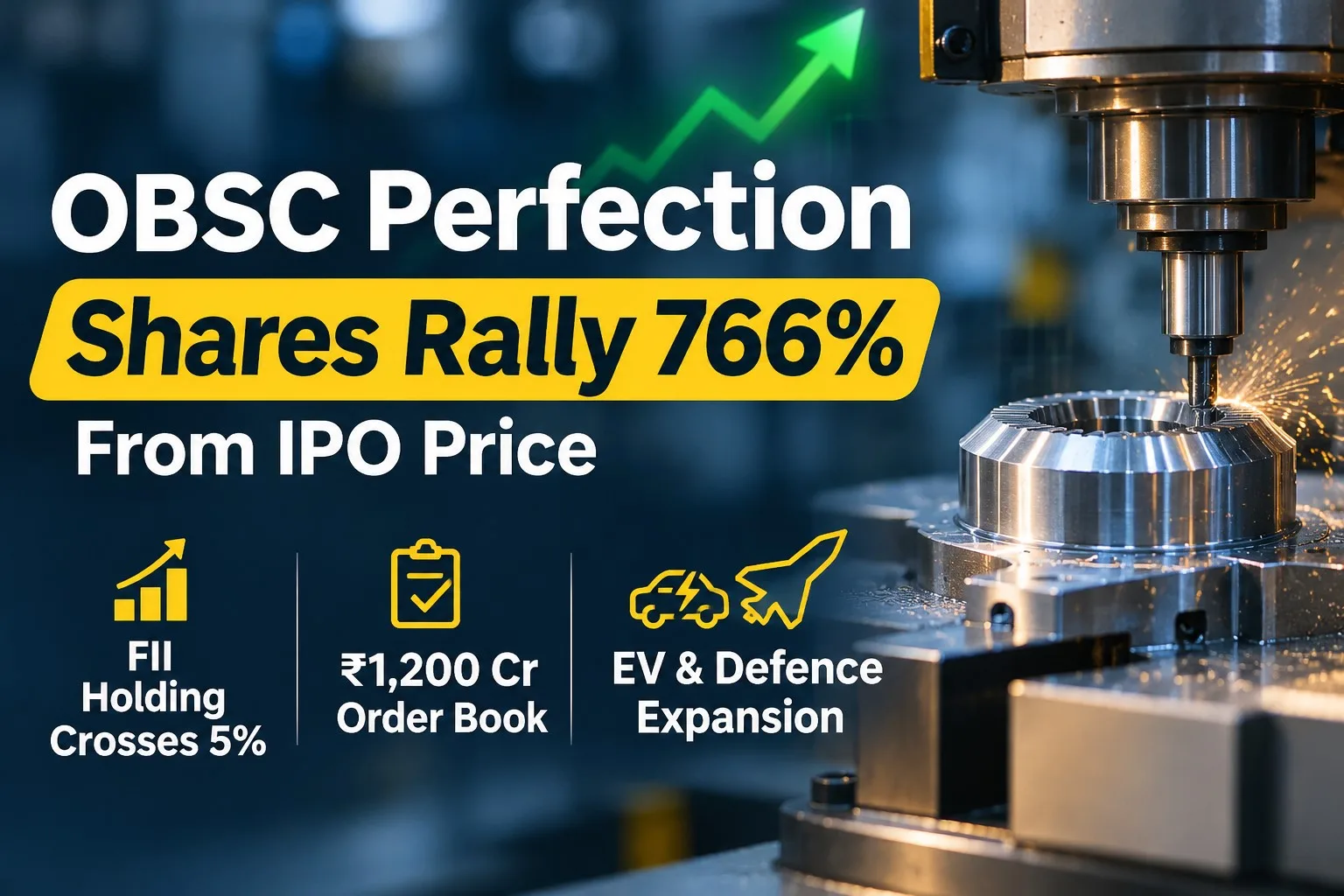
OBSC Perfection Limited (NSE: OBSCP) has attracted fresh institutional attention after foreign portfolio investor ownership increased from 0.64% in June 2026 to approximately 5.03% in September 2026. The change followed a ₹86.52 crore preferential share allotment, in which Singapore-based Sixteenth Street Asian Gems Fund acquired a 4.27% stake.
The company is also reporting strong financial growth. During H1 FY27, revenue from operations increased 91.2% year-on-year to ₹169.41 crore, while profit after tax rose 107.7% to ₹21.83 crore. Export revenue increased 173% to ₹48.99 crore, supported by higher contributions from automotive and marine businesses.
Beyond the latest financial results, the company's ₹1,200 crore order book reveals a significant shift in its business pipeline. Electric vehicle components account for ₹459 crore, while defence, marine and other non-automotive applications together represent ₹211 crore.
The company has also expanded its manufacturing capabilities through forging and stamping, received AS 9100D certification for its aerospace division and secured additional international business nominations. However, rising working-capital requirements, negative operating cash flow, customer concentration and a premium share valuation remain important concerns as it enters the next phase of expansion.
OBSC Perfection Share Price: From ₹100 IPO Price to ₹866 in November 2026
OBSC Perfection entered the public market through its SME IPO in October 2024. The company issued 66.02 lakh equity shares at ₹100 apiece, including a face value of ₹10 and a share premium of ₹90 per share. The public issue raised approximately ₹66.02 crore and the shares commenced trading on the NSE Emerge platform on October 29, 2024. The issue represented approximately 27% of the post-issue paid-up equity capital.
By November 12, 2026, the share price had reached ₹866, significantly above its IPO issue price.
Particulars | Value |
|---|---|
IPO issue price | ₹100 |
IPO issue size | ₹66.02 crore |
Listing date | October 29, 2024 |
Closing price on November 12, 2026 | ₹866 |
Appreciation from IPO price | 766% |
Market capitalisation | Approximately ₹2,363 crore |
A hypothetical investment of ₹1 lakh at the IPO issue price would have been worth approximately ₹8.66 lakh at the November 12 closing price, before taxes and transaction costs, assuming the shares were retained throughout. The company's share-price performance has coincided with substantial growth in its revenue and profits. However, the increase also means that the market is assigning a significantly higher valuation to the business than it did during the IPO.
The 3-year, 5-year and 10-year returns displayed in some market-data panels should not be used as independent historical investment returns. The company only began trading on the NSE in October 2024, so those periods extend beyond its public listing history.
What Does OBSC Perfection Manufacture?
Incorporated in 2017, OBSC Perfection manufactures precision steel and metal components for automotive, defence, marine, telecommunications and other industrial applications. Its manufacturing portfolio includes spline shafts, piston rods, drive shafts, steering shafts, ignition primers and other precision-engineered products. The company has developed a portfolio of more than 100 stock-keeping units, serving different customer requirements and industrial applications.
Unlike manufacturers focused on a single finished product, OBSC Perfection operates across multiple metal-processing activities, including machining, investment casting, hot forging, cold forging and stamping. These capabilities allow the company to manufacture components requiring different production processes and tolerances. Its stated long-term objective is to move further towards integrated assemblies rather than remaining limited to individual machined components.
The company operates manufacturing facilities across Pune, Chennai and Faridabad. Its business model primarily involves supplying components to original equipment manufacturers and Tier-1 suppliers, both in India and overseas.
Major Customers and OEM Relationships
OBSC Perfection's investor presentation identifies several established companies among its customer relationships and business ecosystem. These include Tenneco, ZF, JTEKT, Tata AutoComp, Kongsberg Automotive, Sharda Motor, Bharat Electronics, Faurecia, MAHLE, WABCO, FOMECO, Lear, Teconnex, CommScope and IMI Systems, among others. Such relationships provide access to established automotive and industrial supply chains. They also create opportunities to participate in customer programmes that may continue across several years.
However, the presence of large customers also creates concentration risk. CRISIL reported that the company's five largest customers contribute approximately 50–55% of total revenue, with the largest customer accounting for around 15–20%.
Financial Growth: Revenue Increases From ₹115 Crore in FY24 to ₹220 Crore in FY26
OBSC Perfection has recorded a significant increase in its business scale over the last few financial years. Revenue from operations increased from ₹115.03 crore in FY24 to ₹142.79 crore in FY25 and ₹219.54 crore in FY26. Total income reached ₹223.52 crore in FY26, compared with ₹145.20 crore in the previous year.
Profit after tax also increased consistently during this period. The company reported net profit of ₹12.21 crore in FY24, ₹16.76 crore in FY25 and ₹27.01 crore in FY26.
Three-Year Financial Performance
Financial metric | FY24 | FY25 | FY26 |
|---|---|---|---|
Revenue from operations | ₹115.03 cr | ₹142.79 cr | ₹219.54 cr |
Total income | ₹116.11 cr | ₹145.20 cr | ₹223.52 cr |
EBITDA including other income | ₹21.85 cr | ₹27.81 cr | ₹43.64 cr |
Profit after tax | ₹12.21 cr | ₹16.76 cr | ₹27.01 cr |
EBITDA margin | 18.8% | 19.1% | 19.5% |
PAT margin | 10.5% | 11.5% | 12.1% |
Between FY24 and FY26, the company reported a total-income CAGR of approximately 38.7%. EBITDA and PAT also recorded strong growth over the same period. The improvement in profitability is important because it indicates that the company has expanded its operations without a corresponding decline in its reported EBITDA margin. PAT margin increased from 10.5% in FY24 to 12.1% in FY26.
However, this historical growth has occurred from a relatively small revenue base. Sustaining similar growth rates will require continued customer additions, successful execution of new orders and efficient utilisation of its expanding manufacturing facilities.
H1 FY27 Results: Revenue Grows 91.2%, Net Profit More Than Doubles
The September 2026 half-year results provide a more recent picture of the company's growth trajectory. Revenue from operations increased to ₹169.41 crore in H1 FY27 from ₹88.64 crore in H1 FY26. Total income reached ₹172.75 crore, compared with ₹90.34 crore in the corresponding period.
Operating EBITDA increased 84.3% to ₹29.41 crore, while EBITDA including other income increased 85.5% to ₹32.75 crore. Profit after tax increased 107.7% to ₹21.83 crore from ₹10.51 crore.
Financial metric | H1 FY26 | H1 FY27 | Growth |
|---|---|---|---|
Revenue from operations | ₹88.64 cr | ₹169.41 cr | 91.2% |
Total income | ₹90.34 cr | ₹172.75 cr | 91.2% |
Operating EBITDA | ₹15.96 cr | ₹29.41 cr | 84.3% |
EBITDA including other income | ₹17.65 cr | ₹32.75 cr | 85.5% |
Profit after tax | ₹10.51 cr | ₹21.83 cr | 107.7% |
One important distinction is the difference between operating EBITDA and EBITDA including other income. The company's operating EBITDA margin was 17.4% in H1 FY27, compared with 18% in H1 FY26. When other income is included, the EBITDA margin was 19%, against 19.5% in the previous corresponding period. Therefore, while absolute operating earnings increased considerably, operating margin declined by approximately 64 basis points.
PAT margin, on the other hand, improved to 12.6% from 11.6%. This indicates stronger bottom-line conversion, although future margin sustainability will depend on manufacturing costs, product mix, finance expenses and capacity utilisation.
Q2 FY27: ₹94 Crore Total Income and ₹12.35 Crore Net Profit
The September quarter recorded revenue from operations of ₹92.10 crore, compared with ₹46.79 crore in Q2 FY26. Total income increased to ₹94.03 crore from ₹47.68 crore. Operating EBITDA reached ₹15.57 crore against ₹8.48 crore in the previous corresponding quarter. Net profit increased to ₹12.35 crore from ₹5.48 crore, representing year-on-year growth of 125.5%.
Metric | Q2 FY26 | Q2 FY27 |
|---|---|---|
Revenue from operations | ₹46.79 cr | ₹92.10 cr |
Total income | ₹47.68 cr | ₹94.03 cr |
Operating EBITDA | ₹8.48 cr | ₹15.57 cr |
Operating EBITDA margin | 18.1% | 16.9% |
Net profit | ₹5.48 cr | ₹12.35 cr |
PAT margin | 11.5% | 13.1% |
The quarterly results show that the company's business nearly doubled its revenue from operations year-on-year. However, the operating EBITDA margin declined from 18.1% to 16.9%, despite the increase in sales. The improvement in net profit margin therefore needs to be considered alongside the movement in operating profitability. Investors should watch whether the company can restore its operating margin as production volumes increase and new manufacturing processes begin contributing more revenue.
Export Revenue Jumps 173% as Overseas Business Expands
Exports are becoming a more important part of OBSC Perfection's overall revenue mix. The company reported export revenue of ₹48.995 crore in H1 FY27, compared with ₹17.913 crore in H1 FY26. This represents year-on-year growth of approximately 173%. Export revenue contributed 28.9% of total H1 FY27 revenue from operations, compared with 19.6% in FY26 and 16.9% in FY24.
Geography | H1 FY26 | H1 FY27 | Growth |
|---|---|---|---|
Domestic revenue | ₹70.73 cr | ₹120.42 cr | 70% |
Export revenue | ₹17.91 cr | ₹48.99 cr | 173% |
Total revenue | ₹88.64 cr | ₹169.41 cr | 91.2% |
The United States was the largest disclosed export market during the period, generating approximately ₹29.68 crore, equivalent to 17.5% of total revenue from operations. Italy contributed approximately ₹6.88 crore, while Germany generated around ₹5.57 crore. The company reported business across 16 countries during H1 FY27.
The increasing export contribution provides access to overseas automotive and industrial demand. It also reduces the company's dependence on domestic vehicle production. However, export growth carries additional operational requirements. Longer shipping periods, international payment terms, currency fluctuations and geopolitical uncertainty can affect working-capital requirements and cash collection.
The company must therefore demonstrate that its higher export revenue can be converted into cash without significantly increasing its dependence on bank funding.
Automotive Revenue Remains the Core Business Despite Diversification
OBSC Perfection is attempting to diversify into non-automotive industries, but automotive components continue to represent the largest part of its revenue. Automotive revenue reached approximately ₹134.22 crore in H1 FY27, representing 79.2% of revenue from operations. This was higher in absolute terms than the corresponding period last year, even though its percentage contribution declined.
The reduction in automotive's revenue share was mainly due to faster growth in marine and defence businesses rather than a fall in automotive sales.
Industry | H1 FY26 | H1 FY27 | H1 FY27 contribution |
|---|---|---|---|
Automotive | ₹73.32 cr | ₹134.22 cr | 79.2% |
Marine | ₹5.86 cr | ₹24.44 cr | 14.4% |
Defence | ₹5.78 cr | ₹10.58 cr | 6.2% |
Others | ₹3.17 cr | ₹0.17 cr | 0.1% |
Total | ₹88.64 cr | ₹169.41 cr | 100% |
The company is maintaining its automotive supply relationships while developing additional applications in defence, marine and other specialised industries. This approach could gradually reduce the effect of automotive industry cycles on its overall revenue. However, the diversification strategy is still developing, as nearly four-fifths of H1 FY27 revenue came from automotive components.
₹1,200 Crore Order Book: A Detailed Look at the Company's Future Business Pipeline
The order book is among the most important aspects of OBSC Perfection's recent growth story. In its October 31, 2026 investor presentation, the company disclosed an outstanding order book exceeding ₹1,200 crore as of September 30, 2026. The backlog is divided between conventional automotive programmes, electric vehicle components and non-automotive applications. According to the company, the average order-book life is approximately five to six years.
Segment-Wise Order Book
Business segment | Order book | Contribution |
|---|---|---|
Automotive – Non-EV | ₹530 cr | 44.2% |
Automotive – EV | ₹459 cr | 38.2% |
Defence | ₹113 cr | 9.4% |
Marine | ₹63 cr | 5.3% |
Others | ₹35 cr | 2.9% |
Total | ₹1,200 cr | 100% |
Automotive orders represent approximately ₹989 crore, or 82.4% of the total backlog. Non-automotive orders contribute approximately ₹211 crore, or 17.6%. The order-book mix is important because it shows that the company is not abandoning its existing automotive business. Instead, it is attempting to expand its product portfolio and participate in additional manufacturing applications.
The ₹459 crore EV backlog is particularly significant, representing approximately 46.4% of the automotive order book. Meanwhile, defence and marine together account for ₹176 crore of the non-automotive pipeline.
Export Orders Account for 55% of the Total Backlog
The geographical composition of the order book shows an increasing dependence on overseas programmes.
Order geography | Order value | Contribution |
|---|---|---|
Export orders | ₹666 cr | 55% |
Domestic orders | ₹534 cr | 45% |
Total | ₹1,200 cr | 100% |
Export automotive orders account for approximately ₹587 crore, while export non-automotive orders contribute ₹79 crore. On the domestic side, automotive orders represent ₹402 crore and non-automotive orders approximately ₹132 crore. This indicates that the company's international opportunities are concentrated mainly in automotive applications, while domestic markets contribute a relatively larger share of its non-automotive order pipeline.
The five-to-six-year order-book life provides a useful indication of future business visibility. However, it should not be viewed as guaranteed revenue or profit, because actual execution depends on production schedules, customer demand, programme timelines and contract conditions.
Electric Vehicle Business: ₹459 Crore Backlog Creates a Large Growth Opportunity
The EV segment is one of the most important areas of OBSC Perfection's planned expansion. The company disclosed ₹459 crore of EV-related orders in its September 2026 order-book presentation. This represents 38.2% of total orders and nearly 46.4% of the automotive backlog. Its EV-related product opportunities include motor shafts, thermal-management cold plates and sensor housings. These components require precision manufacturing and are used in applications associated with electric powertrains and vehicle systems.
The company's existing relationships with suppliers such as ZF, Tenneco and JTEKT provide an entry into automotive supply chains that are adapting to changing vehicle technologies. The significance of this business lies in its potential to support the company's product diversification within the automotive sector. Instead of depending entirely on conventional internal-combustion-engine components, it can participate in programmes associated with newer vehicle architectures.
However, EV orders generally involve development, testing, validation and production ramp-up. A nomination or order-book allocation does not translate into immediate revenue, and production volumes may depend on the vehicle manufacturer's market performance. The company will need to demonstrate that its EV programmes can generate repeat business and maintain acceptable margins over their full production cycles.
Tenneco Export Nomination Adds Approximately ₹77.5 Crore
An important automotive development came after the September quarter. On October 13, 2026, OBSC Perfection disclosed an additional export nomination from Tenneco Automotive Operating Company Inc. for approximately ₹77.5 crore over five years.
The programme involves the manufacture and supply of leaf-spring composite suspension components to Tenneco's Reynosa facility in Mexico for a German end-user. Supplies are scheduled to begin in January 2027, with an indicated annual programme value of approximately US$1.65 million. The company had previously disclosed a nomination worth approximately ₹160 crore in June 2025. With the additional nomination, the combined value of the programme increased to approximately ₹237 crore.
This development expands the company's relationship with an established international automotive supplier. It also provides a multi-year export opportunity and increases its participation in the overseas suspension-components supply chain. However, the five-year programme value should not be treated as immediate revenue. Annual deliveries and revenue recognition will depend on customer schedules and the commencement of supplies.
Defence Manufacturing: ₹113 Crore Order Book and International Customer Entry
Defence is becoming an important non-automotive area for OBSC Perfection. The company disclosed a defence order book of approximately ₹113 crore as of September 30, 2026. Its product portfolio includes ammunition-related components, fuzes, artillery shell parts, ignition primers and precision-machined defence products.
The company's investor presentation indicated that it had been onboarded as a vendor for three of seven Defence Public Sector Undertakings. It also reported onboarding two additional DPSU vendors during the period and receiving prototype orders for MK-84 fins and 155mm artillery shell components.
These developments are relevant because defence manufacturing involves product qualification, quality approvals and technical evaluation before regular supply arrangements can begin.
₹8.90 Crore IMI Systems Order
In October 2026, OBSC Perfection received its first purchase order worth approximately ₹8.90 crore from IMI Systems, an Elbit Systems-related defence entity. The order relates to precision fuze components and represents an entry into an international defence supply programme. Although the contract value is modest compared with the overall order book, the development could provide opportunities to build relationships with international defence manufacturers.
The company's ability to complete qualification processes, meet delivery schedules and secure repeat orders will determine whether this business becomes a meaningful contributor to future revenue. Defence procurement also carries risks associated with programme approvals, testing, customer budgets and changes in production schedules.
Marine Business: Revenue Increases to ₹24.44 Crore
Marine has emerged as the fastest-growing major non-automotive segment in H1 FY27. Revenue from marine applications increased to ₹24.44 crore from ₹5.86 crore in H1 FY26. Its contribution to total revenue rose to 14.4%, compared with approximately 6.6% in the corresponding period. The company manufactures marine-related components including cable fittings, steering systems and tubular products. These products require precision manufacturing and appropriate material specifications for use in demanding operating environments.
The marine order book stood at approximately ₹63 crore as of September 30, 2026. The segment's growth has supported the increase in export revenue and helped reduce automotive's contribution to the overall revenue mix. Its future performance will depend on the continuation of overseas demand, repeat programmes and the company's ability to deliver products efficiently.
One important monitorable is whether marine expansion improves profitability or simply increases revenue and working-capital requirements. Segment-level margin disclosures would help investors assess the quality of this growth.
Aerospace, Medical Implants and Humanoid Robotics
OBSC Perfection has also started entering specialised manufacturing applications that require more stringent product and quality requirements. In September 2026, the company received AS 9100D certification for its aerospace division, with TÜV India recommending the certification on September 7, 2026. The standard is used in the aviation, aerospace and defence supply chain and adds sector-specific quality-management requirements. The company has initiated discussions with potential aerospace customers following the certification.
The investor presentation also mentions participation in the humanoid robotics supply chain and fulfilment of its first medical implant order. In addition, the company reported a five-year purchase order worth ₹31.4 crore for machined components under the DaVinci DCx programme in September 2026.
These developments provide opportunities to participate in specialised industrial applications beyond conventional automotive manufacturing. However, aerospace and medical products involve lengthy customer approvals and stringent quality requirements. The company has also appointed a US-based business adviser to pursue opportunities in the oil and gas industry. These emerging initiatives should be treated as potential future business opportunities rather than established material revenue streams.
₹86.52 Crore Preferential Issue: Fresh Equity Capital Strengthens the Balance Sheet
The September 2026 preferential issue was one of the most important corporate developments during the quarter. OBSC Perfection allotted 14,39,600 equity shares at ₹601 per share, raising approximately ₹86.52 crore. The two non-promoter allotment recipients were Sixteenth Street Asian Gems Fund and Mirasol Finance Private Limited.
The company reported net worth of approximately ₹271.93 crore after the issue. Its reported debt-to-equity ratio was approximately 0.26 times in the October 2026 investor presentation. The fresh capital provides additional resources for manufacturing expansion, machinery procurement and the financing of a larger order book.
The issue also reduced the company's dependence on debt-funded expansion. The current ratio was reported at 2.89 times in H1 FY27, compared with 1.90 times in FY26. However, equity fundraising also increases the number of outstanding shares. The 14.396 lakh new shares increased the pre-issue share count by approximately 5.6%, with the new shares representing about 5.28% of the enlarged equity capital.
Existing shareholders therefore need the company to generate enough additional profit from the new capital to support earnings per share and return on equity.
Promoter and Institutional Shareholding Pattern
The September 2026 shareholding pattern shows a significant change in the company's ownership structure.
Shareholder category | June 2026 | September 2026 |
|---|---|---|
Promoters | 69.81% | 66.24% |
FII/FPI | 0.64% | 5.03% |
DII | 1.60% | 2.50% |
Public and others | 27.95% | 26.23% |
Promoter ownership declined by 3.57 percentage points, while FII/FPI ownership increased by 4.39 percentage points. The fall in promoter percentage should be viewed in the context of the enlarged share capital following the preferential issue. It does not, by itself, establish that promoters sold their shares in the market.
The number of shareholders also increased from 2,770 in June to 3,053 in September 2026. One point worth noting is that mutual fund ownership remained at zero in the September shareholding pattern. The increase in institutional participation was therefore primarily associated with foreign portfolio and other institutional or corporate shareholders rather than domestic mutual fund buying.
Future quarterly shareholding filings will show whether this increase represents sustained institutional participation or was largely a one-time development associated with the preferential allotment.
Manufacturing Expansion: 12,000 Tonnes of Forging Capacity
OBSC Perfection has been adding manufacturing capabilities to support its growing automotive, defence and industrial order pipeline. The company installed combined hot and cold forging capacity of approximately 12,000 tonnes per annum. The forging operations are located in Pune and Faridabad. During H1 FY27, annualised forging capacity utilisation was approximately 35%.
The additional forging capabilities allow the company to manufacture larger and more complex components, providing opportunities in defence and aerospace-related applications. However, utilisation of 35% also indicates that a significant portion of the installed capacity remains unused. The company must increase production volumes and attract additional programmes to absorb fixed manufacturing costs efficiently.
Stamping Business Begins Commercial Operations
The company added stamping capabilities during H1 FY27 through the installation of more than 30 pneumatic presses with capacities ranging from 50 tonnes to 500 tonnes. The new operation had utilisation of approximately 13% during the period. The company reported that revenue generation started in H1 FY27 and that the business had access to recurring monthly activity of approximately ₹2 crore.
Stamping, combined with machining and forging, allows OBSC Perfection to participate in a wider range of component manufacturing programmes. The move towards integrated manufacturing can also improve its ability to supply larger component assemblies to customers. However, the low initial utilisation means that the company needs additional production volume to generate adequate returns from the installed machinery.
Machining and Investment Casting Utilisation
Machining and investment casting remain established parts of the manufacturing business.
Manufacturing activity | Period | Installed capacity | Production | Utilisation |
|---|---|---|---|---|
Machining | FY25 | 286.1 lakh units | 249.4 lakh | 87.2% |
Machining | FY26 | 451.5 lakh units | 383.6 lakh | 85.0% |
Machining | H1 FY27, annualised | 757.2 lakh units | 544.4 lakh | 71.9% |
Investment casting | FY25 | 600 tonnes | 450 tonnes | 75.0% |
Investment casting | FY26 | 900 tonnes | 700 tonnes | 77.8% |
Investment casting | H1 FY27, annualised | 900 tonnes | 660 tonnes | 73.3% |
The increase in machining capacity has provided additional manufacturing headroom. However, annualised utilisation declined to 71.9% in H1 FY27 from 85% in FY26. Investment-casting utilisation also declined to 73.3% from 77.8%. The reduction may partly reflect capacity additions and the timing of customer programmes. Nevertheless, the company will need to improve utilisation as new orders move into production.
Mega Factory Expansion Across Maharashtra and Gujarat
OBSC Perfection is also investing in manufacturing infrastructure across Maharashtra and Gujarat. Its October investor presentation describes land acquisitions at Supa in Maharashtra and GIDC Sanand in Gujarat. The combined development is intended to provide additional factory space, consolidate several manufacturing activities and increase the company's ability to manufacture larger assemblies.
The company reported that construction at Sanand had reached its second phase, while ground-breaking for the Supa mega facility was planned during H2 FY27. The proposed facilities are expected to bring more production processes under a consolidated manufacturing structure. Management has indicated that the expansion could provide approximately five times the existing space available for future manufacturing growth.
During H1 FY27, capital expenditure was approximately ₹20.37 crore. The expansion could support the company's long-term growth, but it also creates execution risks. Land development, construction, machinery installation, customer audits and production qualification must all be completed before the additional facilities contribute meaningfully to revenue.
The company will also need to maintain sufficient order flow to absorb the additional fixed costs associated with the new manufacturing infrastructure.
Negative Operating Cash Flow of ₹44.82 Crore Despite Higher Profits
One of the most important issues in OBSC Perfection's H1 FY27 results is the difference between reported profitability and actual cash generation. Despite reporting net profit of ₹21.83 crore during the first half of FY27, the company recorded negative net cash flow from operating activities of ₹44.82 crore.
Its operating cash flow was also negative by ₹1.95 crore in FY26, compared with positive cash flow of ₹8.85 crore in FY25.
Period | Net operating cash flow |
|---|---|
FY24 | ₹5.00 cr |
FY25 | ₹8.85 cr |
FY26 | -₹1.95 cr |
H1 FY27 | -₹44.82 cr |
The company's cash-flow statement shows operating profit before working-capital changes of ₹32.04 crore during H1 FY27. However, the increase in current assets absorbed approximately ₹76.29 crore, while the increase in current liabilities provided only around ₹2.03 crore. After the working-capital movements and taxes, net operating cash flow turned negative by ₹44.82 crore.
This indicates that a substantial amount of money generated through business operations remained tied up in receivables, inventory and other current assets. The issue becomes more important as export revenue increases. Manufacturing companies often need to purchase raw materials, maintain work-in-progress and complete production before receiving payments from customers.
If receivable collection periods remain long, rapid revenue growth can increase the demand for working-capital finance.
Receivables Rise 40% and Inventory Increases 27%
The company's September 2026 balance-sheet figures show an increase in the funds deployed in day-to-day business operations. Trade receivables increased to ₹92.42 crore from ₹66.08 crore at March 31, 2026. Inventory increased to ₹59.77 crore from ₹47.18 crore. Trade payables, meanwhile, declined to ₹47.26 crore from ₹51.09 crore.
Working-capital item | March 2026 | September 2026 | Change |
|---|---|---|---|
Trade receivables | ₹66.08 cr | ₹92.42 cr | +40% |
Inventory | ₹47.18 cr | ₹59.77 cr | +27% |
Trade payables | ₹51.09 cr | ₹47.26 cr | -8% |
Net trade working capital | ₹62.18 cr | ₹104.93 cr | +69% |
The increase in receivables was higher than the growth in inventory, indicating that more funds were tied up in amounts awaiting collection from customers. The company has explained that export customers accounted for approximately 45% of its debtors, while exports represented around 29% of H1 FY27 revenue.
Management said it had undertaken collection initiatives over the previous six to nine months and had improved debtor days to 100 from 110 in FY26. Inventory days also improved from 110 to 91. However, payable days fell from 119 to 72, resulting in an increase in the overall cash conversion cycle.
Cash Conversion Cycle Increases to 119 Days
The company's cash conversion cycle increased to 119 days in H1 FY27 from 101 days in FY26. This movement occurred even though debtor and inventory days improved.
Working-capital measure | FY26 | H1 FY27 |
|---|---|---|
Debtor days | 110 | 100 |
Inventory days | 110 | 91 |
Payable days | 119 | 72 |
Cash conversion cycle | 101 | 119 |
The main reason was the decline in payable days. The company paid suppliers approximately 47 days faster than in FY26, while debtor days improved by 10 days and inventory days by 19 days. Consequently, the improvements in collections and inventory management were outweighed by the reduction in supplier-credit periods.
Management also indicated that geopolitical tensions had affected shipping availability, transit times and freight costs. It increased supplier advances during Q2 to secure critical raw materials for export programmes and manage near-term commodity-price volatility. These advances are linked to procurement requirements and are expected to be adjusted against future supplies. However, the additional cash deployed in supplier advances also increases the funds required to finance the operating cycle.
The ability to bring the cash conversion cycle down while continuing to expand exports will be an important factor in determining the quality of the company's future growth.
CRISIL BBB+/Stable Rating: What the Credit Agency Identified
CRISIL assigned a BBB+/Stable rating to OBSC Perfection's ₹100 crore bank facilities in July 2026. The agency identified the promoters' experience, diversified product portfolio, healthy order book and comfortable financial risk profile as important strengths. At the same time, it highlighted working-capital-intensive operations, customer concentration and exposure to cyclical end-user industries as the principal weaknesses.
Gross current assets stood at 223 days as of March 31, 2026, reflecting the amount of capital tied up in receivables, inventory and other current assets. CRISIL indicated that reducing gross current assets below 210 days, while maintaining the company's financial risk profile, would be an important factor for a possible improvement in the credit assessment.
The agency also reported that the company's five largest customers contributed around 50–55% of revenue, with the largest customer accounting for approximately 15–20%. At March 2026, CRISIL's adjusted gearing was 0.40 times. Its calculation included ₹15.45 crore of unsecured loans from a group company and directors, which were treated as debt because they were expected to be repaid over the long term.
The company's October 2026 investor presentation subsequently reported a debt-to-equity ratio of 0.26 times after the preferential issue. The two figures reflect different dates and calculation bases and should not be treated as directly interchangeable. CRISIL also identified a substantial decline in revenue or profitability, lower net cash accruals and large debt-funded capital expenditure as possible factors that could weaken the company's credit profile.
Valuation at ₹866: Is the Growth Already Reflected in the Share Price?
At the November 12, 2026 closing price of ₹866, OBSC Perfection had a market capitalisation of approximately ₹2,363 crore. The reported market-data snapshot showed a trailing P/E ratio of approximately 58.7 times and a price-to-book ratio of approximately 8.69 times. These valuations are significantly higher than those of several conventional automotive component manufacturers.
The valuation reflects expectations of continued revenue expansion, improved export participation and the conversion of EV and defence opportunities into commercial production. However, investors are paying a substantial premium for the company's expected growth. The premium can become difficult to sustain if order conversion is delayed, margins decline or working-capital requirements increase faster than revenue.
A high P/E does not automatically mean that a stock must decline. However, it increases the importance of meeting earnings expectations because even a profitable company can experience a share-price correction if its valuation multiple contracts.
Comparison With Listed Automotive and Precision Engineering Companies
OBSC Perfection operates in an industry that includes established companies such as RACL Geartech, Rolex Rings, Sansera Engineering, Endurance Technologies and Sona BLW Precision Forgings. These businesses have different product portfolios, manufacturing scales and exposure to EV and export markets.
For a broad valuation comparison, the following are approximate market-screen P/E readings around November 12, 2026. They are indicative rather than a strictly harmonised peer valuation exercise because data providers may use different standalone or consolidated earnings bases.
Company | Approx. market capitalisation | Approx. P/E |
|---|---|---|
OBSC Perfection | ₹2,363 cr | 58.7x |
RACL Geartech | ₹1,849 cr | 37.8x |
Rolex Rings | ₹5,943 cr | 32.7x |
Endurance Technologies | ₹35,444 cr | 37.2x |
Sansera Engineering | ₹29,348 cr | 90.6x |
Sona BLW Precision Forgings | ₹57,766 cr | 74.3x |
OBSC Perfection trades at a higher P/E multiple than RACL Geartech, Rolex Rings and Endurance Technologies in this market snapshot. However, it trades below Sansera Engineering and Sona BLW. This reflects the wide variation in valuations across automotive component manufacturers. Companies with established EV exposure, specialised products, larger customer programmes and different growth expectations can trade at substantially different multiples.
A direct comparison of P/E alone is insufficient. Investors also need to consider revenue growth, operating margins, cash conversion, customer concentration and returns generated on capital.
Return Ratios and Capital Efficiency
OBSC Perfection's investor presentation reported ROE of 15.7% and ROCE of 18% for FY26. For H1 FY27, the corresponding figures were 16.1% and 18.2%. The company's improved earnings have therefore been accompanied by relatively stable reported returns on capital, although these ratios are lower than the FY24 levels of 40.6% ROE and 34.4% ROCE.
The FY24 figures were recorded on a much smaller capital base. Subsequent investments, IPO proceeds, manufacturing additions and the preferential issue have expanded the company's equity and asset base. The next phase of growth will require higher operating earnings from the additional capital. If new facilities take time to reach commercial utilisation, return ratios may remain under pressure even when revenue increases.
Major Risks That Could Affect OBSC Perfection's Future Performance
1. High Customer Concentration
The company depends on a relatively small group of customers for a substantial share of its revenue. CRISIL estimates that the top five customers contribute 50–55% of total revenue, with the largest accounting for 15–20%. Any reduction in orders from a major OEM, changes in supplier arrangements or weaker production at customer facilities could affect OBSC Perfection's revenue.
2. Working-Capital Requirements
Net trade working capital increased 69% between March and September 2026. The increase in receivables, inventory and supplier advances has absorbed a substantial amount of cash. The company needs to improve cash conversion as exports and new customer programmes expand. Persistent negative operating cash flow could increase dependence on external borrowing.
3. Low Utilisation of Newly Installed Capacity
Forging capacity was utilised at approximately 35%, while stamping utilisation was 13% in H1 FY27. The available capacity creates room for new orders, but it also means that the company must achieve higher production volumes to absorb fixed costs and earn adequate returns from the investment.
4. Dependence on the Automotive Industry
Automotive components still contributed approximately 79.2% of H1 FY27 revenue. The company therefore remains exposed to OEM production trends, raw-material costs, changes in vehicle demand and competition from other suppliers. EV-related orders provide diversification within automotive, but they do not eliminate the risk associated with customer production schedules and technology changes.
5. Export and Currency Exposure
Exports represented 28.9% of H1 FY27 revenue and 55% of the September order book. A higher overseas contribution increases exposure to shipping disruptions, currency movements, tariffs, international credit terms and geopolitical uncertainty.
6. Defence and Aerospace Qualification Risks
Defence and aerospace offer additional markets, but these industries generally have strict customer qualification, testing and quality requirements. The company needs to convert prototype work, initial orders and certification milestones into regular commercial supplies. Delays could postpone the expected contribution from these businesses.
7. Capital Expenditure and Expansion Risks
The company is developing facilities at Supa and Sanand while increasing its forging, stamping and machining capabilities. Construction delays, machinery commissioning issues or lower-than-expected capacity utilisation could reduce returns on investment and increase depreciation and fixed operating expenses.
8. Premium Valuation
At approximately 59 times trailing earnings, the stock is valued significantly above several traditional automotive component peers. The current valuation makes sustained earnings growth increasingly important. A slowdown in earnings or a reduction in valuation multiples could affect the share price.
9. Equity Dilution
The September preferential issue added 14.396 lakh shares to the company's equity capital. Although the fundraise strengthened the balance sheet, future profits must grow sufficiently to support the larger number of outstanding shares and maintain healthy per-share earnings.
10. SME Liquidity
OBSC Perfection is listed on the NSE Emerge SME platform. The trading depth of SME shares can be lower than that of larger mainboard companies. A concentrated shareholder base and lower market liquidity can contribute to sharp price movements during periods of buying or selling pressure. The absence of mutual fund ownership also means that domestic institutional participation remains relatively limited.
What Investors Need to Monitor in FY27 and FY28
The next two financial years will be important in evaluating whether OBSC Perfection can convert its expanded manufacturing capacity and order book into sustainable financial performance. The first indicator will be revenue conversion from the ₹1,200 crore backlog. Automotive and EV programmes need to move into scheduled deliveries, while marine and defence orders must generate repeat business.
The second will be working-capital efficiency. Debtor days, inventory days, supplier-payment terms and operating cash flow will indicate whether the company can finance its expansion without excessive borrowing. The third will be capacity utilisation. Higher production at the forging and stamping facilities could improve fixed-cost absorption and support operating profitability.
The fourth will be the non-automotive revenue contribution. A sustained increase in marine, defence, aerospace and other industrial applications could gradually reduce dependence on conventional automotive components. Finally, the company must demonstrate that the ₹86.52 crore equity capital raised in September 2026 is translating into higher earnings and improved returns on capital.
OBSC Perfection: A Fast-Growing Manufacturer Facing the Test of Execution
OBSC Perfection has moved from a relatively small precision-engineering manufacturer to a company reporting more than ₹200 crore in annual revenue, a ₹1,200 crore order book and increasing participation in international supply chains.
Its H1 FY27 performance showed strong growth in revenue and profits, while the rise in FII ownership brought a new institutional shareholder into the company. EV, defence and marine applications provide additional business opportunities beyond its conventional automotive component portfolio.
However, the next stage of expansion will require more than securing orders and increasing installed capacity. The company needs to improve cash conversion, reduce working-capital pressure, expand its customer base and increase utilisation of newly commissioned facilities.
At its November 2026 market valuation, investors are already assigning a substantial premium to expected growth. The company's ability to convert multi-year nominations into profitable deliveries and operating cash flow will be central to evaluating whether that premium can be supported by its future financial performance.
The balance between expansion, capital efficiency and cash generation will therefore remain the most important aspect of OBSC Perfection's financial performance over the coming quarters.
Disclaimer: This article is prepared for informational and educational purposes only. It does not constitute investment advice, a recommendation to buy or sell securities, or a research report under SEBI regulations. Share prices and financial ratios are subject to change. Investors should review company filings, financial statements, risk factors and their individual financial circumstances before making investment decisions.