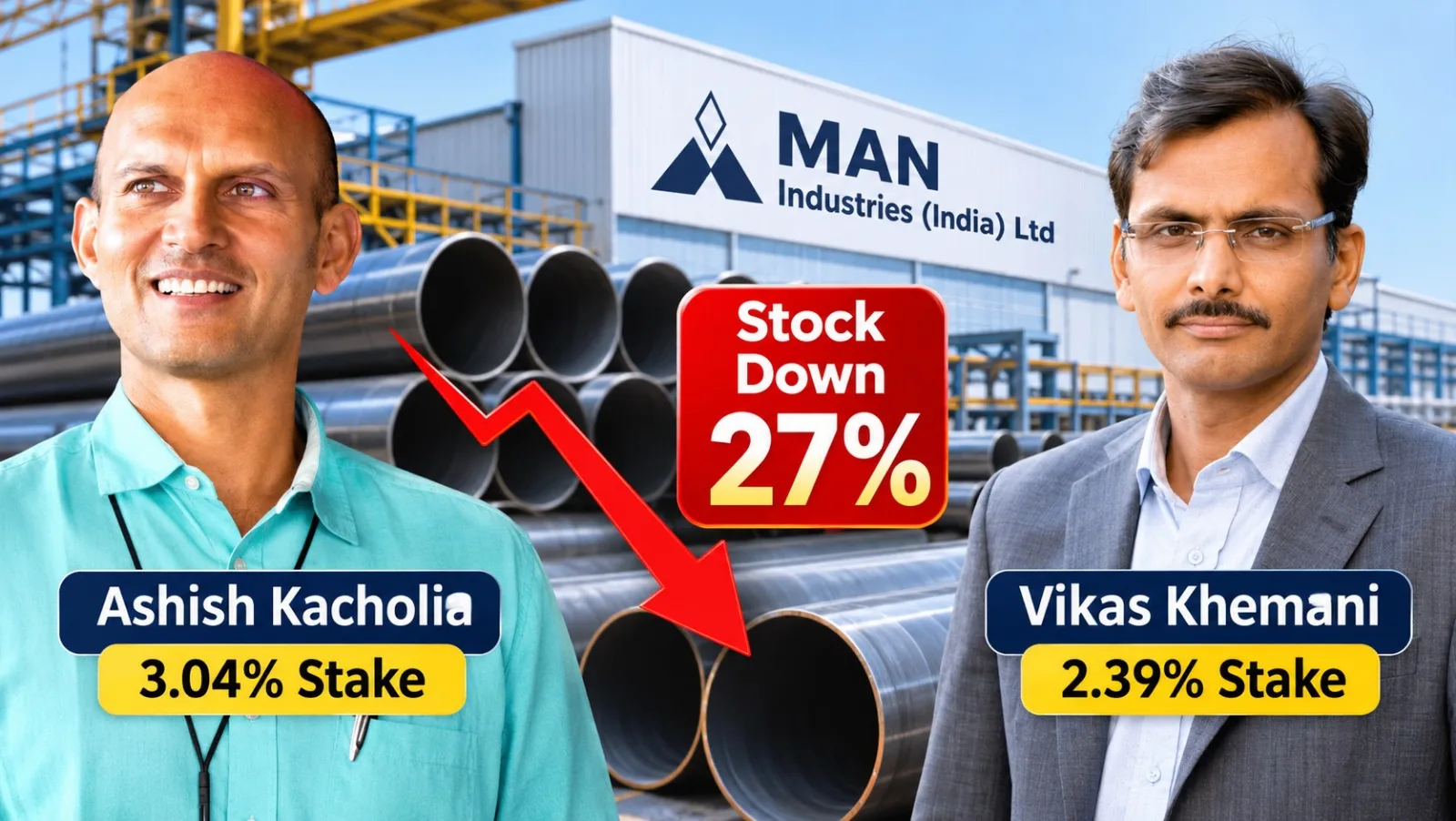
Shares of Man Industries (India) Ltd have corrected more than 27% from their 52-week high, putting the pipe manufacturer's recent financial performance, expansion plans and debt position under investor scrutiny. Despite the correction, ace investor Ashish Kacholia and veteran fund manager Vikas Khemani continued to hold significant stakes in the company, according to the September 2026 shareholding pattern.
Ashish Kacholia held a 3.04% stake, while Vikas Vijaykumar Khemani, founder of Carnelian Asset Management & Advisors, held 2.39%. Their combined shareholding stood at 5.43%, representing more than 40 lakh equity shares. Both investors maintained their reported positions during the September quarter.
The company's latest financial results present a mixed picture. Consolidated revenue and profitability improved substantially following the acquisition of Saudi Arabia-based National Pipe Company (NPC), while standalone revenue declined because of shipping disruptions in West Asia. At the same time, Man Industries is undertaking significant investments in Jammu, Saudi Arabia and the United States, increasing the importance of project execution and balance-sheet management.
Man Industries Share Price Falls 27% From 52-Week High
Man Industries shares touched a 52-week high of ₹1,039.70 on September 25, 2026. However, the stock subsequently witnessed a correction and closed at ₹756.55 on November 16, 2026, representing a decline of approximately 27.2% from its peak.
The stock also witnessed a sharp single-day correction on November 16, falling 7.90% from the previous closing price of ₹821.45. The decline came after the release of the company's Q2 FY27 financial results and investor presentation, which highlighted both strong consolidated profitability and substantial upcoming capital expenditure.
From the 52-week high, the stock has lost more than ₹283 per share. At the November 16 closing price, the company's market capitalisation was approximately ₹5,675 crore.
Ashish Kacholia Holds 3.04% Stake in Man Industries
According to the September 2026 shareholding pattern, Ashish Kacholia held 22,77,029 equity shares in Man Industries, representing a 3.04% stake.
His shareholding increased from approximately 2.03% in June 2025 to 3.04% by September 2025. He subsequently maintained the same disclosed holding across the December 2025, March 2026, June 2026 and September 2026 quarters.
At the November 16 closing price of ₹756.55, the market value of his disclosed holding was approximately ₹172.2 crore. This represents the prevailing market value of the shares and does not indicate his original investment cost.
Vikas Khemani Holds 2.39% Through Individual Shareholding
Vikas Vijaykumar Khemani held 17,91,256 shares of Man Industries as of September 30, 2026, representing a 2.39% stake.
Khemani is the founder of Carnelian Asset Management & Advisors and has more than 27 years of experience in the capital markets. He previously served as CEO of Edelweiss Securities before establishing Carnelian.
His individual shareholding in Man Industries has remained at 2.39% since December 2025, according to the reported quarterly shareholding data. At ₹756.55 per share, his holding was worth approximately ₹135.5 crore as of November 16.
Together, Kacholia and Khemani held 40,68,285 shares, equivalent to 5.43% of the company's equity. Their combined holding was valued at approximately ₹307.7 crore at the November 16 closing price.
Other Major Shareholders and Institutional Ownership
Apart from Ashish Kacholia and Vikas Khemani, several other prominent investors feature in Man Industries' public shareholding pattern.
Suresh Kumar Agarwal held approximately 2.77%, while Anil Laxmichand Shah held around 1.05% as of September 2026. Carnelian Structural Shift Fund also appeared among the disclosed shareholders with approximately 1.02%. This fund holding is separate from Khemani's individual 2.39% shareholding.
Promoter holding remained unchanged at 43.21%. Foreign institutional investors and foreign portfolio investors increased their combined holding from 2.87% to 3.49%, according to the September-quarter ownership data, with participation across 62 funds.
The continued presence of these investors is one aspect of the ownership structure, although quarterly shareholding disclosures do not indicate their individual buying prices or future investment intentions.
Q2 FY27 Results: Consolidated Revenue Rises 45.1%, PAT Jumps 121.7%
Man Industries reported strong consolidated financial performance for the quarter ended September 30, 2026. Consolidated revenue from operations increased 45.1% year-on-year to ₹1,210 crore, compared with ₹834 crore in Q2 FY26.
Total income, including other income, increased 49.3% to ₹1,216 crore. Consolidated EBITDA rose 86.6% to ₹190 crore against ₹102 crore in the corresponding quarter last year, marking the company's highest-ever quarterly consolidated EBITDA.
EBITDA margin expanded to 15.6% from 12.5% in Q2 FY26, an improvement of 310 basis points. Consolidated profit after tax increased 121.7% to ₹82 crore from ₹37 crore, while profit before tax increased 147.6% to ₹122 crore.
The September quarter also reflected the increased contribution of NPC, which Man Industries acquired on May 21, 2026. The Saudi subsidiary added manufacturing capacity, domestic market access and a higher-margin business to the consolidated operations.
H1 FY27 Financial Performance
The company also reported substantial growth during the first half of FY27.
Financial metric | H1 FY27 | H1 FY26 | Growth |
|---|---|---|---|
Revenue from operations | ₹2,263 Cr | ₹1,576 Cr | 43.6% |
EBITDA | ₹345 Cr | ₹182 Cr | 89.2% |
EBITDA margin | 15.1% | 11.5% | +360 bps |
Profit before tax | ₹208 Cr | ₹88 Cr | 137.1% |
Profit after tax | ₹143 Cr | ₹65 Cr | 122.1% |
PAT margin | 6.3% | 4.1% | +220 bps |
The improvement in profitability was significantly stronger than revenue growth, indicating the contribution from the Saudi business and a better consolidated product and geographical mix.
Standalone Results Reveal Pressure From Shipping Disruptions
Unlike the consolidated performance, Man Industries' standalone results showed a decline in revenue during Q2 FY27.
Standalone revenue from operations decreased 7.7% year-on-year to ₹721 crore from ₹782 crore. EBITDA declined 3% to ₹96 crore against ₹99 crore, while EBITDA margin remained broadly unchanged at 12.9%.
Standalone profit after tax, however, increased 12.4% to ₹40 crore from ₹36 crore. For H1 FY27, standalone revenue increased 15.8% to ₹1,731 crore, while EBITDA rose 41% to ₹254 crore.
The difference between consolidated and standalone performance is important because a significant portion of the consolidated growth came from NPC rather than the existing Indian manufacturing operations alone.
The company also reported an exceptional gain of approximately ₹24.69 crore relating to the write-back of a customer advance following the settlement of a sales contract worth ₹37.85 crore. Management clarified that the settlement did not create an additional operating profit from the underlying order.
NPC Acquisition Adds 4.3 Lakh Tonnes of Saudi Pipe Capacity
The acquisition of National Pipe Company has become a significant contributor to Man Industries' consolidated financial performance.
NPC, based in Saudi Arabia, has an installed manufacturing capacity of approximately 4,30,000 MTPA, comprising 2,50,000 tonnes of HSAW pipes and 1,80,000 tonnes of LSAW pipes.
The company is an Aramco-approved vendor and provides both HSAW and LSAW manufacturing capabilities within Saudi Arabia. This gives Man Industries a local manufacturing presence closer to major energy customers and infrastructure projects in the Kingdom.
During July–September 2026, NPC reported revenue of SAR 191 million, equivalent to approximately ₹486 crore. Its EBITDA stood at SAR 34 million, or approximately ₹88 crore, with an EBITDA margin of around 18%. PAT was SAR 30 million, equivalent to approximately ₹77 crore.
From the acquisition date of May 21 to September 30, NPC contributed approximately ₹532 crore in revenue, ₹94 crore in EBITDA and ₹79 crore in PAT to Man Industries' consolidated results.
The acquisition is also expected to reduce the company's dependence on exports from India for Middle Eastern customers by increasing local manufacturing and delivery capabilities.
₹3,500 Crore Order Book Provides Revenue Visibility
Man Industries reported a consolidated order book of approximately ₹3,500 crore across its Indian and Saudi operations as of November 2026. The majority of these orders are expected to be executed over the following six to nine months.
The company has manufacturing operations at Anjar in Gujarat and Pithampur in Madhya Pradesh, with combined Indian pipe manufacturing capacity of more than 1.2 million MTPA.
With the addition of NPC's 430,000 MTPA capacity, the company's existing manufacturing footprint expands to approximately 1.6 million MTPA, before considering the upcoming Jammu and US facilities.
Management indicated that consolidated revenue in H2 FY27 would be approximately similar to H1 FY27. For FY28, it expects consolidated revenue growth of approximately 20–25%, while maintaining EBITDA margins above 15%.
Jammu Stainless Steel Seamless Pipe Plant: ₹600 Crore Investment
One of the major upcoming projects is Man Industries' greenfield stainless steel seamless pipe manufacturing facility at Jammu.
The facility has an annual installed capacity of 22,000 MTPA and represents the company's entry into a higher-value stainless steel seamless pipe segment. These products are intended for applications in the chemical, defence, marine, nuclear, power and refinery industries.
The estimated project cost is approximately ₹600 crore. According to the November 2026 investor presentation, the company had already incurred around ₹350 crore in capital expenditure by the end of Q2 FY27.
Commercial production is expected to begin in April 2027. The company expects the new business to improve its overall product mix through higher-value specialty products rather than depending entirely on conventional carbon steel line pipes.
Expected Revenue and EBITDA Margins From Jammu
During the November 2026 earnings call, management indicated that the stainless steel business could eventually generate peak revenue of approximately ₹1,000–₹1,200 crore.
For the first year of operations, management is targeting capacity utilisation of approximately 25–30%. The expected EBITDA margin for the stainless steel business is in the range of 18–22%.
This is a key development because specialty stainless steel products generally require different manufacturing capabilities and customer qualifications compared with conventional large-diameter carbon steel pipes.
An earlier working estimate based on 40% first-year utilisation and ₹450–₹500 crore of revenue was more aggressive. The latest November management commentary provides a 25–30% first-year utilisation target and should take precedence when assessing the ramp-up.
Dammam Coating and Double-Jointing Facility: Operations From March 2027
Man Industries is also expanding its Saudi manufacturing capabilities through a new coating and double-jointing facility at Dammam.
The proposed facility has an annual coating capacity of approximately 4 million square metres. It will provide 3LPE, FBE and internal coating services, allowing the company to offer additional value-added services alongside pipe manufacturing.
Operations are targeted to commence around March 2027, with management also discussing the April 2027 operating window during the earnings call.
The facility is expected to help Man Industries provide integrated pipeline solutions to Saudi customers, including Aramco-related requirements. Management indicated that the coating business could achieve EBITDA margins above 15%.
The company has already committed substantial investment to the Saudi expansion programme. The upcoming facility is expected to reduce its dependence on external coating providers and improve the value addition on pipes supplied to customers.
New US Pipe Manufacturing Plant: $110 Million Investment
Man Industries has approved a new manufacturing facility in the United States through its wholly owned subsidiary.
The proposed plant will manufacture Helical Submerged Arc Welded (HSAW) pipes with an annual capacity of 3,50,000 metric tonnes. The planned capital expenditure is approximately $110 million, equivalent to around ₹930 crore at the exchange rates used in the company's expansion estimates.
The investment represents an important geographical expansion for Man Industries, extending its manufacturing footprint beyond India and Saudi Arabia into the North American market.
US Plant Funding: Debt and Equity Mix
During the November 13 earnings call, management clarified that the proposed US investment would be funded partly through debt and partly through equity.
The company is considering equity dilution through funding mechanisms such as preferential issuance or a qualified institutional placement, alongside project borrowings. Management indicated that the expected interest rate on US dollar borrowings would be approximately 5.5–6.5%.
The company was targeting financial closure by February 2027, with the facility expected to become operational around December 2027 or January 2028.
Revenue and Profitability Potential From the US Plant
Management indicated that the US facility could generate approximately ₹4,500–₹5,000 crore in revenue at around 75% capacity utilisation.
The company also indicated a tentative PAT margin expectation of 10–15% for the US business. This should not be confused with an EBITDA margin forecast, which is a different profitability measure.
Revenue contribution is expected from FY29 onwards, after construction, commissioning and customer qualification.
The timing means that the US project will initially increase the company's capital requirements without contributing materially to operating revenue during the construction phase.
Merino Shelters: ₹800–₹900 Crore Expected Cash Flows Over 5–6 Years
Man Industries' real estate subsidiary, Merino Shelters Private Limited, is developing a residential real estate project in Navi Mumbai through a joint development agreement with the Paradise Group.
The project is being developed on approximately six acres of land opposite DY Patil Stadium. The development involves approximately 20 lakh square feet, with Man Industries entitled to a 30% share of the profit from the sale of the developed area.
The company had already received an upfront amount of approximately ₹70 crore following the joint development agreement in Q4 FY25. The project was officially launched on October 26, 2026.
During the November 13 earnings call, management indicated that the project could generate total cash flows of approximately ₹800–₹900 crore over the next five to six years, with cash flows expected to commence from Q3 FY27.
The investor presentation also indicated annual cash flows of approximately ₹80–₹120 crore from FY28 onwards. Earlier management commentary had indicated an estimated ₹35–₹50 crore contribution during FY27.
There is a difference between the ₹700–₹800 crore figure in the investor presentation and the ₹800–₹900 crore figure discussed during the subsequent earnings call. The latter is the more recent management commentary.
How Merino Shelters Could Help Reduce Debt
The real estate project provides a potential source of cash flow outside the core pipe manufacturing business. These receipts could be used to repay borrowings, fund working capital requirements or support the company's expansion plans.
Man Industries is expected to face considerable capital expenditure requirements during FY27 and FY28 because of the NPC acquisition, Jammu facility, Dammam expansion and proposed US investment.
Annual inflows of ₹80–₹120 crore from Merino Shelters could provide additional financial flexibility. However, these receipts will be collected over several years and depend on project execution, sales and collection milestones.
The cash flows should therefore be viewed as a gradual deleveraging support rather than an immediate ₹800–₹900 crore reduction in borrowings. Their accounting treatment and actual cash availability will also depend on the joint development agreement and project-level commitments.
Man Industries Debt Position: Gross Borrowings Could Peak at ₹1,700 Crore
The company's expansion programme has increased its borrowing requirements, particularly following the acquisition of NPC and the ongoing capex commitments in India and Saudi Arabia.
As of September 30, 2026, the consolidated balance sheet showed borrowings of approximately ₹1,444 crore, excluding lease liabilities. Cash and cash equivalents, other bank balances and current investments together amounted to approximately ₹1,110 crore.
However, the entire bank balance should not automatically be treated as freely deployable cash because some balances may represent deposits or other amounts required for banking and operational purposes.
During the November 2026 earnings call, the CFO indicated that gross debt could peak at approximately ₹1,700 crore during FY27. Management estimated net debt at approximately ₹200–₹250 crore at that level, excluding the proposed US project.
The US facility is expected to be financed separately through a combination of project debt and equity. Consequently, the eventual consolidated debt position will depend on the final funding structure and the timing of capital expenditure.
FY27 and FY28 Financial Projections: Revenue, EBITDA and Leverage
Based on the financial assumptions in the supplied working model, the company's revenue and profitability could improve as NPC contributes for a full year and Jammu and Dammam begin operations.
The illustrative model assumes FY27 consolidated revenue of approximately ₹5,000 crore. At a projected EBITDA margin of 15–15.5%, EBITDA would be approximately ₹750–₹775 crore.
For FY28, the model assumes consolidated revenue of ₹6,250–₹6,500 crore, with a blended EBITDA margin of 15.5–16%. This translates into projected EBITDA of approximately ₹970–₹1,040 crore.
These are analytical estimates, not a new formal management forecast. Management's November commentary separately indicated 20–25% consolidated growth in FY28 and EBITDA margins above 15%.
Estimated Debt and Cash Position
Financial metric | FY27E | FY28E |
|---|---|---|
Consolidated revenue | ₹5,000 Cr | ₹6,375 Cr |
EBITDA | ₹762.5 Cr | ₹1,005 Cr |
EBITDA margin | 15.25% | 15.75% |
Gross debt | ₹1,700 Cr | ₹1,550 Cr |
Cash and investments assumed | ₹1,000 Cr | ₹950 Cr |
Net debt | ₹700 Cr | ₹600 Cr |
Depreciation | ₹115 Cr | ₹150 Cr |
Estimated finance cost | ₹135 Cr | ₹125 Cr |
The FY27 model assumes cash and investments normalise to approximately ₹900–₹1,100 crore, producing net debt of ₹600–₹800 crore. The FY28 base case assumes scheduled repayments and real estate receipts reduce the company's legacy debt, while the US project is financed through a combination of borrowings and equity.
These net-debt assumptions are deliberately different from management's November earnings-call estimate of ₹200–₹250 crore. The table is a separate conservative analytical scenario and should not be interpreted as the company's disclosed debt forecast.
Net Debt-to-EBITDA Ratio
Net Debt-to-EBITDA is calculated by dividing net borrowings after cash balances by annual EBITDA.
FY27 calculation:
Net Debt = ₹1,700 crore – ₹1,000 crore = ₹700 crore
Net Debt-to-EBITDA = ₹700 crore / ₹762.5 crore = 0.92x
Depending on the year-end cash position, the estimated ratio ranges from approximately 0.77x to 1.07x.
Gross Debt-to-EBITDA = ₹1,700 crore / ₹762.5 crore = 2.23x.
FY28 calculation:
Net Debt = ₹1,550 crore – ₹950 crore = ₹600 crore
Net Debt-to-EBITDA = ₹600 crore / ₹1,005 crore = 0.60x
Gross Debt-to-EBITDA = ₹1,550 crore / ₹1,005 crore = 1.54x.
Under this illustrative base case, net leverage reduces as EBITDA increases and debt repayments progress. The outcome, however, depends on the actual funding requirement for the US project and the conversion of operating earnings into cash.
Interest Coverage Ratio: FY27 Versus FY28
Interest coverage is calculated using earnings before interest and tax (EBIT) divided by interest and finance expenses.
For FY27, the model assumes EBITDA of ₹762.5 crore and depreciation of ₹115 crore, resulting in estimated EBIT of ₹647.5 crore.
At an assumed cash interest expense of ₹135 crore, the interest coverage ratio works out to approximately 4.80 times. Including an additional ₹30 crore of letter of credit and bank guarantee-related charges, total finance charges of ₹165 crore would result in coverage of approximately 3.92 times.
For FY28, EBITDA of ₹1,005 crore and depreciation of ₹150 crore result in estimated EBIT of ₹855 crore. With cash interest of ₹125 crore, interest coverage improves to approximately 6.84 times.
Including additional finance-related charges of ₹30 crore, total finance charges of ₹155 crore would result in interest coverage of approximately 5.52 times.
Metric | FY27E | FY28E |
|---|---|---|
EBITDA | ₹762.5 Cr | ₹1,005 Cr |
Depreciation | ₹115 Cr | ₹150 Cr |
EBIT | ₹647.5 Cr | ₹855 Cr |
Cash interest assumption | ₹135 Cr | ₹125 Cr |
Interest coverage | 4.80x | 6.84x |
Total finance charges assumption | ₹165 Cr | ₹155 Cr |
Coverage including additional charges | 3.92x | 5.52x |
These are modelled ratios using the stated finance-cost assumptions, not management's confirmed future interest-cost guidance. Actual finance costs could differ as the acquisition debt, working capital borrowings and US project funding are reflected in subsequent results.
What Happens If the Entire $110 Million US Project Is Debt-Funded?
The funding mix of the US project is particularly important because a fully debt-funded investment would increase Man Industries' leverage significantly.
Under the illustrative mixed-funding FY28 model, gross debt is assumed at ₹1,550 crore. If the entire US project cost of approximately ₹930 crore is funded through fresh borrowing, and after allowing for the timing of project disbursements and scheduled repayments, gross debt could increase towards ₹2,350–₹2,450 crore.
Using ₹2,400 crore as the midpoint, and assuming cash balances of ₹950 crore, net debt would rise to approximately ₹1,450 crore.
EBITDA remains unchanged at ₹1,005 crore in this scenario because the US plant is not expected to contribute meaningful commercial revenue until FY29.
Revised FY28 Leverage Under 100% Debt Funding
Financial metric | Mixed funding model | Entire US project debt-funded |
|---|---|---|
Gross debt | ₹1,550 Cr | ₹2,400 Cr |
Cash balance | ₹950 Cr | ₹950 Cr |
Net debt | ₹600 Cr | ₹1,450 Cr |
EBITDA | ₹1,005 Cr | ₹1,005 Cr |
Gross Debt/EBITDA | 1.54x | 2.39x |
Net Debt/EBITDA | 0.60x | 1.44x |
In the 100% debt-funded scenario, interest expenses are assumed to increase to approximately ₹175 crore, compared with ₹125 crore in the mixed-funding base case. Including additional letter of credit and bank guarantee charges, total finance costs could reach approximately ₹205 crore.
With depreciation of approximately ₹155 crore, EBIT would be ₹850 crore. Interest coverage would work out to approximately 4.86 times on cash interest and 4.15 times after including the additional finance charges.
Interest coverage calculation | Mixed funding | 100% debt funding |
|---|---|---|
EBIT | ₹855 Cr | ₹850 Cr |
Cash interest | ₹125 Cr | ₹175 Cr |
Coverage on cash interest | 6.84x | 4.86x |
Total finance charges | ₹155 Cr | ₹205 Cr |
Coverage on total charges | 5.52x | 4.15x |
The model indicates that a completely debt-funded US investment would reduce financial flexibility and increase interest costs. This is one reason the company's stated intention to use both debt and equity is important for managing the expansion cycle.
Strait of Hormuz Disruption: ₹320 Crore Revenue Deferred
Another factor behind the standalone revenue decline during Q2 FY27 was the disruption of shipping routes in West Asia, particularly around the Strait of Hormuz.
Man Industries indicated that approximately ₹320 crore of revenue was deferred beyond Q2 FY27 because finished pipes could not be dispatched according to the original shipment schedule. The company clarified that the disruption was a timing and logistics issue rather than cancellation of business.
Customers subsequently nominated alternative ports, and the affected shipments were being executed. Delays in incoming raw materials and outgoing finished goods also affected the operating cycle and working capital requirements.
The disruption is relevant because Man Industries exports large-diameter pipes to customers in international energy and infrastructure markets. Shipment scheduling, availability of specialised vessels, port congestion and changes in delivery arrangements can affect the quarter in which shipments are completed.
The acquisition of NPC provides some geographical diversification because its manufacturing operations in Saudi Arabia allow the group to serve local customers without depending entirely on exports from India.
Over the longer term, the Jammu and US manufacturing facilities are also expected to expand the company's ability to manufacture within major customer markets.
Key Risks: Debt, Cash Flow and Execution of New Facilities
Although Man Industries reported record consolidated EBITDA during Q2 FY27, the coming financial years will involve several simultaneous expansion projects.
The Jammu facility must achieve commercial production and progress towards its targeted 18–22% EBITDA margins. The Dammam unit needs to start operations and convert its coating capacity into profitable orders, while the US project requires financial closure, construction and customer approvals before commercial revenue begins.
Debt servicing will remain another important consideration. Management's FY27 peak gross debt estimate of approximately ₹1,700 crore excludes the additional funding requirement of the US plant. The final debt-equity mix and the ability to generate cash from existing operations will influence the consolidated balance sheet.
Merino Shelters could provide an additional source of funds over five to six years, but its cash flows are milestone-dependent and cannot be treated as an immediate reduction in borrowings.
The company also needs to convert its ₹3,500 crore order book into actual shipments and collections. The difference between EBITDA growth and operating cash generation will be important to monitor, particularly as new projects increase working capital requirements.
For investors tracking the stock, subsequent quarterly results will provide a clearer picture of NPC integration, shipment normalisation, Jammu commissioning, debt levels and the actual pace of cash generation from Merino Shelters.
Disclaimer: This article is for informational and educational purposes only and should not be construed as investment advice, stock recommendations, or a solicitation to buy or sell any securities. The information is based on publicly available sources and company disclosures and is subject to change. Investors should conduct their own research and consult a SEBI-registered investment adviser before making investment decisions. Candlesticks.in does not guarantee returns or accept responsibility for losses arising from investment decisions based on this information. Stock market investments are subject to market risks.