


When the stock market opens every morning, a share does not necessarily begin trading at the same price at which it closed on the previous trading day. Some stocks open higher, others start lower, while a few begin trading almost unchanged. These price differences are influenced by the buying and selling orders placed before regular trading begins.
In India, the National Stock Exchange (NSE) and Bombay Stock Exchange (BSE) use a mechanism called the pre-open session to determine the opening price of eligible stocks. During this period, investors and traders submit orders through their brokers, allowing the exchange to assess the available demand and supply. Based on these orders, the exchange calculates a price at which the maximum number of shares can be traded.
This process is known as the call auction mechanism, and it plays an important role in establishing an organized opening price. Rather than allowing the first buyer or seller to decide the day's initial price, the exchange considers multiple orders and identifies an equilibrium price before regular trading starts.
What Determines the First Trading Price of a Share?
The opening price is the first officially recorded traded price of a stock during a new trading session. It is determined by the orders available in the exchange's pre-open order book, rather than being automatically carried forward from the previous day's closing price. The balance between buyers and sellers plays a central role in this calculation.
Consider a company whose shares closed at ₹500 on Monday. After the market closes, the company announces a major business contract, prompting more investors to place buy orders before Tuesday's opening. If buying demand increases sufficiently compared with selling supply, the stock may open at ₹515 or ₹520 instead of ₹500.
The opposite can happen when a company announces disappointing financial results or faces negative developments. Investors may submit more sell orders, creating greater selling pressure during the pre-open session. Depending on the available orders, the exchange may discover an opening price of ₹480 or ₹490.
Therefore, the previous closing price serves as an important reference, but it does not decide the next session's opening price. The exchange determines the opening price using the eligible buy and sell orders received during the pre-open auction.
How the NSE Pre-Open Session Works
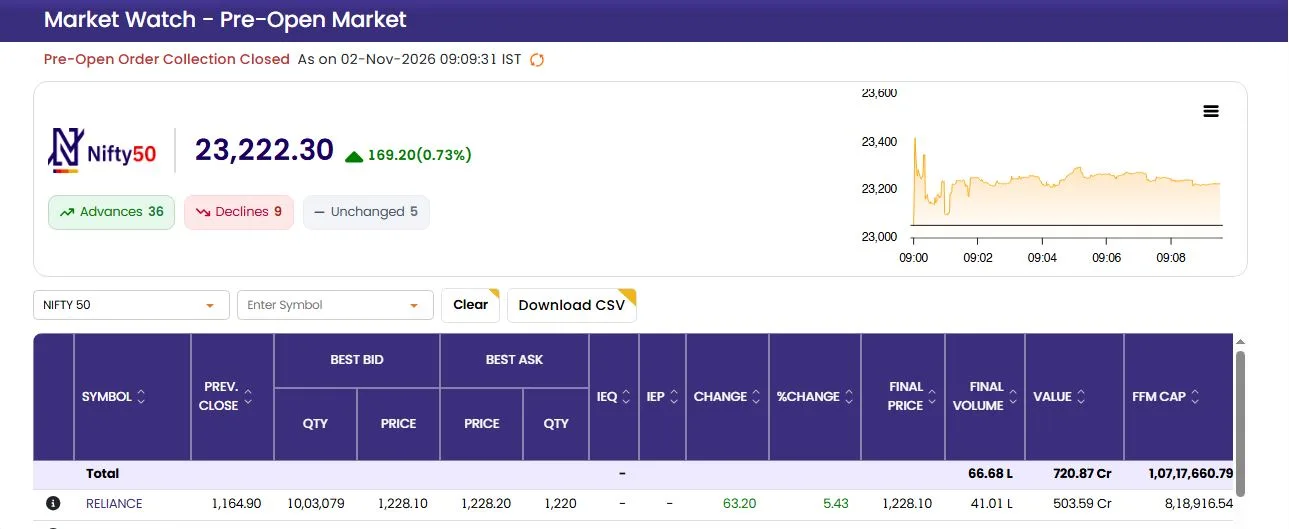
The NSE conducts a pre-open session between 9:00 AM and 9:15 AM on normal trading days for eligible securities. This period allows the exchange to collect orders, calculate the equilibrium price and prepare stocks for regular trading. The session follows a structured process rather than immediately matching every order as it arrives.
The pre-open session has three main stages: order collection, order matching and a buffer period. Each stage has a specific purpose, and the exchange follows defined timings to ensure that the opening price is calculated systematically.
1. Order Collection: 9:00 AM to 9:08 AM
The order collection period allows investors and traders to place buy and sell orders before regular trading begins. These orders are submitted through brokers and added to the exchange's electronic order book. The exchange collects information about the prices at which buyers are willing to purchase shares and sellers are prepared to sell them.
Investors can place limit orders, market orders and eligible special orders during this period. A limit buy order specifies the maximum price a buyer is willing to pay, while a limit sell order specifies the minimum price a seller is willing to accept. Market orders do not specify a particular price and are handled according to the exchange's pre-open auction rules.
Orders can also be modified or cancelled during the permitted order-entry period. As new orders arrive, the indicative equilibrium price and executable quantity may change. This allows the exchange to continuously assess the changing demand and supply situation before the order book is frozen for matching.
2. Order Matching and Price Discovery: 9:08 AM to 9:12 AM
Once the order collection period ends, the exchange moves to the order matching stage. During this period, the system evaluates the accumulated buy and sell orders and calculates the equilibrium price. The objective is to identify a single price at which the maximum possible number of shares can be traded.
The exchange does not simply select the highest buying price or the lowest selling price. Instead, it examines cumulative demand and cumulative supply at different price levels to determine the quantity that can be matched. The price that allows the maximum executable quantity becomes the equilibrium price, subject to additional selection criteria.
Investors cannot freely modify or cancel orders during the matching process. The exchange uses the collected orders to complete price discovery and establish the opening price. This price is subsequently used when regular trading begins.
3. Buffer Period: 9:12 AM to 9:15 AM
After order matching is completed, the exchange enters the buffer period. This stage provides time for the system to complete the necessary processing and prepare the securities for the regular trading session. It acts as a transition between the pre-open auction and continuous market trading.
At 9:15 AM, normal equity trading begins on the NSE and BSE. Stocks for which an opening price has been discovered enter the regular session using the price established through the pre-open mechanism. The remaining eligible orders are handled according to the exchange's prescribed rules.
Note on the exact NSE timings: The order-entry period does not always close at exactly 9:08 AM. Under the NSE's detailed schedule, order entry closes at a randomly selected time between 9:08 AM and 9:10 AM. Order matching takes place from 9:10 AM to 9:12 AM, followed by the buffer period until 9:15 AM.
How the Exchange Calculates the Equilibrium Price
The most important part of the pre-open session is the calculation of the equilibrium price. The exchange examines all eligible buy and sell orders and calculates how many shares can be matched at different price levels. It then identifies the price that allows the largest possible quantity of shares to be traded.
To understand this process, it is useful to look at three quantities: cumulative demand, cumulative supply and executable quantity. Cumulative demand represents the total number of shares buyers are willing to purchase at a particular price or higher. Cumulative supply represents the total number of shares sellers are willing to sell at that price or lower.
The executable quantity is the number of shares that can be matched between buyers and sellers at a particular price. It is calculated by comparing cumulative demand with cumulative supply. The smaller of the two quantities determines how many shares can potentially be traded at that price.
Executable Quantity = Minimum of (Cumulative Demand, Cumulative Supply)The exchange performs this calculation at different price levels and identifies the price with the maximum executable quantity. This becomes the equilibrium price, subject to the additional rules used when more than one price produces the same result.
A Practical Example of Opening Price Calculation
Suppose a company's share closed at ₹100 on the previous trading day. During the pre-open session, buyers and sellers submit orders at different prices, creating the following cumulative demand and supply figures. These numbers are hypothetical and are intended to explain how the exchange identifies the opening price.
Price (₹) | Cumulative buy quantity | Cumulative sell quantity |
|---|---|---|
98 | 50,000 | 10,000 |
99 | 40,000 | 20,000 |
100 | 30,000 | 30,000 |
101 | 20,000 | 40,000 |
102 | 10,000 | 50,000 |
The exchange compares the cumulative demand and supply at every price level. At ₹98, buyers are willing to purchase 50,000 shares, but sellers are offering only 10,000 shares. At ₹100, both sides have 30,000 shares available, allowing a larger quantity to be matched.
Price (₹) | Executable quantity |
|---|---|
98 | 10,000 |
99 | 20,000 |
100 | 30,000 |
101 | 20,000 |
102 | 10,000 |
Equilibrium price: ₹100
In this example, ₹100 produces the maximum executable quantity of 30,000 shares. The exchange therefore discovers ₹100 as the opening price. Although the stock closed at ₹100 on the previous day, the result is based on the orders received during the current pre-open session, not simply on the previous closing price.
What Happens When Multiple Prices Have the Same Executable Quantity?
There are situations where two or more price levels produce the same maximum executable quantity. In such cases, the exchange applies additional criteria to select one equilibrium price. This prevents multiple possible opening prices from remaining after the price-discovery process.
The first consideration is the minimum order imbalance. If multiple prices allow the same maximum quantity to be traded, the exchange looks at the difference between cumulative demand and cumulative supply. The price with the smallest imbalance receives preference because it represents a closer balance between buyers and sellers.
If the imbalance is also identical at multiple prices, the exchange considers the previous day's closing price. The price closest to the previous close is selected as the equilibrium price. If the previous closing price falls exactly halfway between two qualifying prices, the previous closing price itself is selected, subject to the applicable price rules.
Why Does a Stock Open Higher or Lower Than the Previous Close?
The opening price changes when the balance between buying demand and selling supply changes before regular trading begins. Company announcements, financial results, economic developments and changes in global markets can influence the orders investors place during the pre-open session. The final opening price reflects the eligible orders available when the exchange completes its auction.
Gap-Up Opening
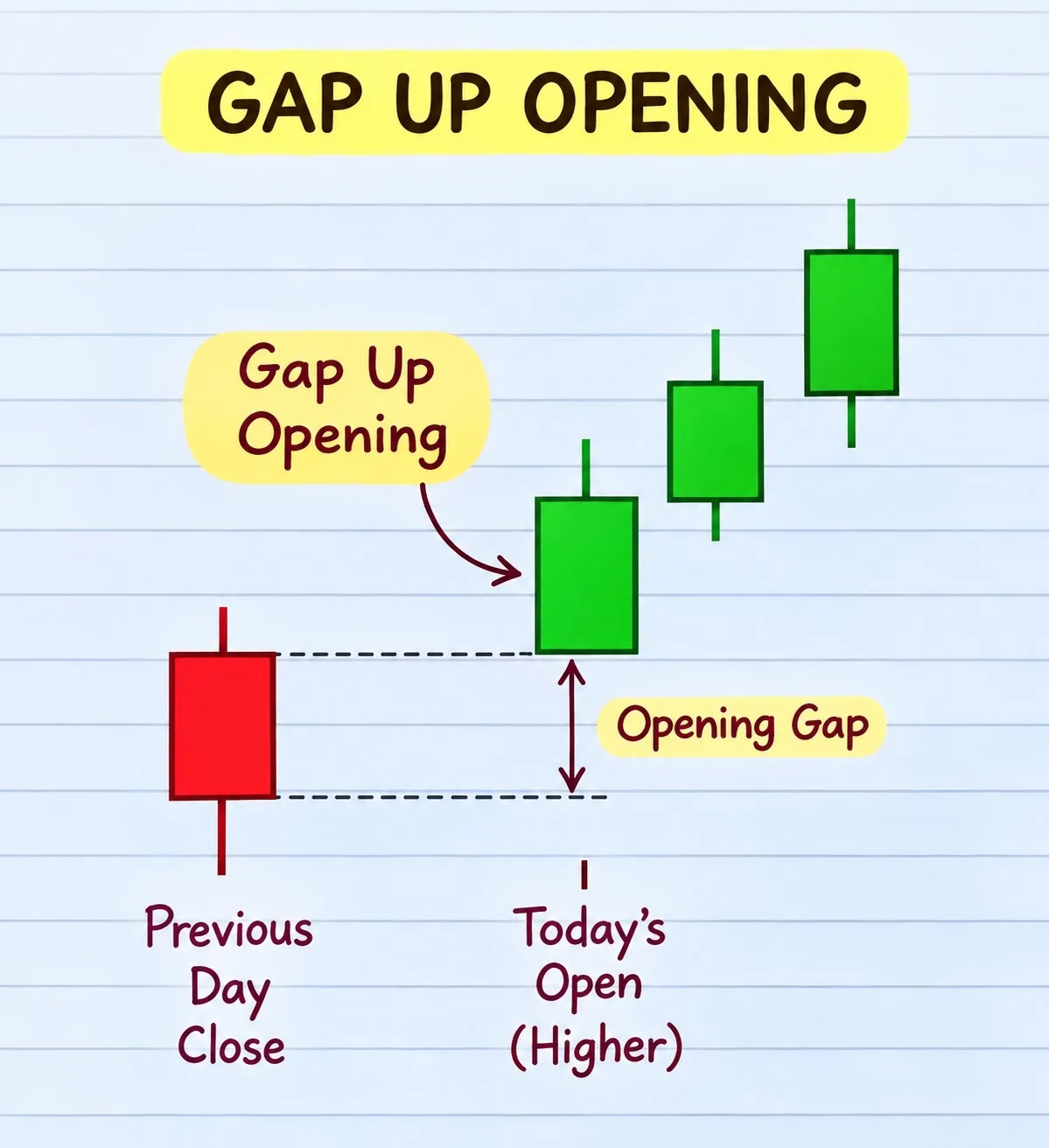
A gap-up opening occurs when a stock begins the trading session at a price higher than its previous closing price. For example, if a share closed at ₹500 on Monday and opens at ₹520 on Tuesday, it has recorded a ₹20 upward gap. This represents a 4% increase compared with the previous closing price.
A gap-up can develop when buyers are willing to purchase shares at higher prices following positive developments. Better-than-expected quarterly results, major business contracts, favourable regulatory announcements or positive sector developments can influence buying interest. The exchange's pre-open auction then determines the price at which the available orders can be matched.
However, a gap-up opening does not guarantee that the stock will continue rising throughout the trading session. Some investors may use the higher opening price to book profits, while fresh sellers may enter the market. The stock's subsequent movement depends on the orders and transactions that occur after regular trading begins.
Gap-Down Opening
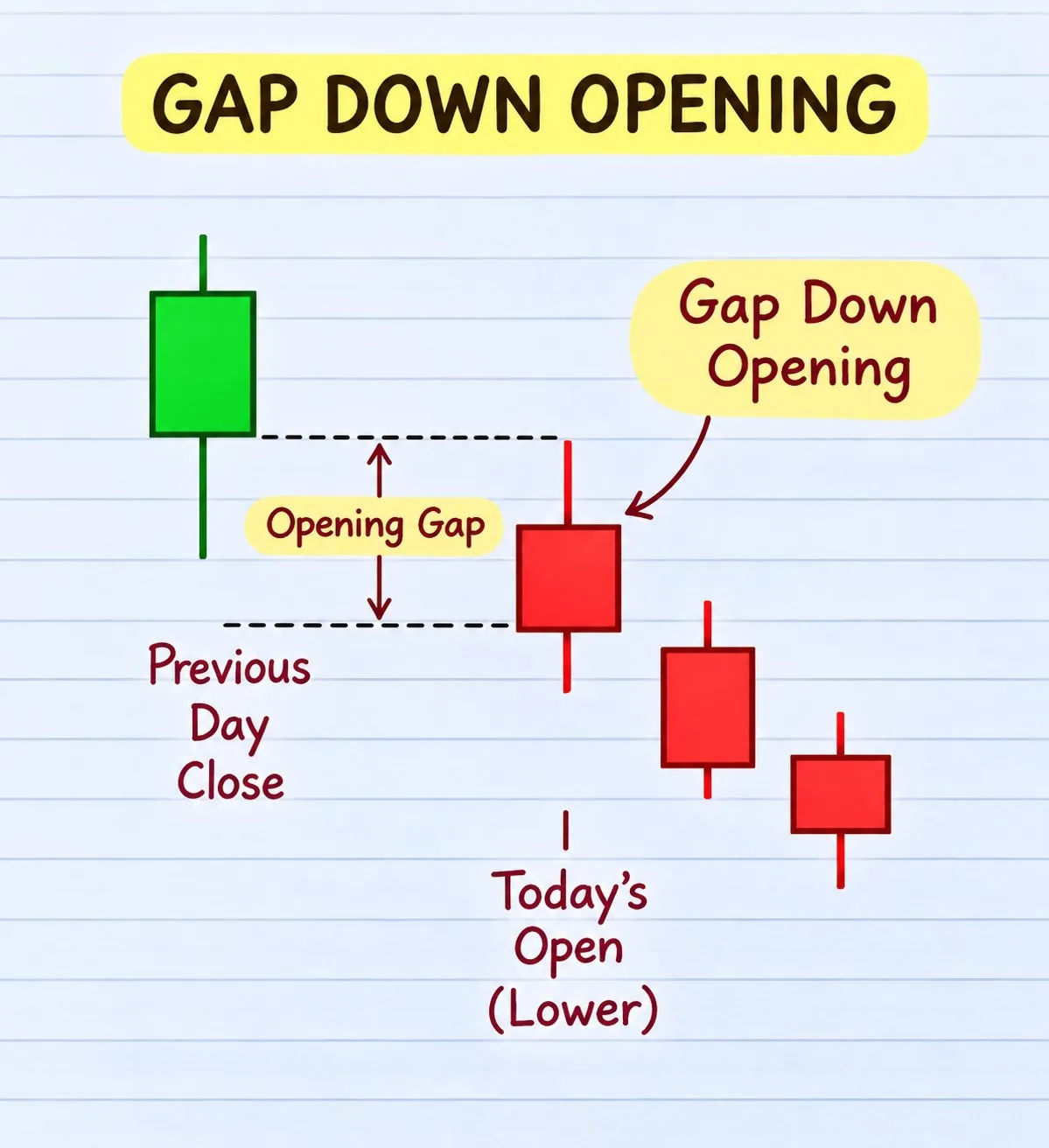
A gap-down opening occurs when a stock starts trading below its previous closing price. For instance, if a share closed at ₹500 on Monday but opens at ₹475 on Tuesday, the opening price is ₹25 lower than the previous close. This represents a downward gap of 5%.
Such openings can occur when investors react negatively to company announcements, disappointing earnings, regulatory developments or unfavourable industry news. Increased selling interest during the pre-open session can push the equilibrium price below the previous day's closing level. The final price depends on the available demand from buyers and the quantity of shares offered for sale.
A gap-down does not necessarily indicate that the stock will continue declining. Buyers may enter after the market opens, particularly if they believe the lower price offers an opportunity. The movement of the stock after 9:15 AM determines whether the initial weakness continues or reverses.
Flat Opening
A stock is considered to have opened flat when its opening price is very close to the previous day's closing price. For example, if a share closed at ₹500 and starts the next session at ₹501, the difference is relatively small. Such an opening suggests that the pre-open auction has discovered a price close to the previous session's final reference price.
A flat opening does not mean that there was no activity during the pre-open session. Buyers and sellers may have submitted substantial quantities of orders, but the exchange's calculation may still produce an equilibrium price near the previous close. The stock can subsequently move sharply in either direction as regular trading develops.
What Is the Indicative Equilibrium Price (IEP)?
During the pre-open session, traders can observe a figure called the Indicative Equilibrium Price (IEP). It represents the estimated opening price calculated by the exchange using the buy and sell orders available at that particular moment. The figure is updated as the order book changes during the permitted order-entry period.
For example, consider a stock that closed at ₹800 on the previous trading day. As investors submit orders before the market opens, its indicative equilibrium price might move from ₹805 to ₹812 and then to ₹818. These changes indicate that the combination of available buy and sell orders is producing different estimated equilibrium prices.
The indicative price is not a guaranteed opening price. Investors can still modify or cancel eligible orders during the order-entry period, which can change the calculation. The final equilibrium price is established only after the exchange closes order entry and completes the matching process.
The NSE also provides information about indicative equilibrium quantity, cumulative buy quantity, cumulative sell quantity and order imbalance. These figures help market participants understand the demand and supply situation before regular trading begins.
What Happens to Orders That Are Not Executed?
Not every order entered during the pre-open session gets executed. For example, a buyer may place an order to purchase shares at ₹490 when the discovered equilibrium price is ₹500. If the order cannot be matched during the auction, it may remain available for the regular trading session, depending on its type and applicable exchange rules.
Unmatched eligible limit orders are carried forward to the normal trading session at their specified prices. Unmatched market orders are converted into limit orders at the discovered equilibrium price under the applicable pre-open rules. This allows eligible orders to participate in regular trading without requiring investors to submit them again.
Once normal trading begins at 9:15 AM, these orders become part of the regular order book. They can be matched against fresh buying or selling orders according to the exchange's matching priorities. Consequently, the stock's price may move away from its opening price within the first few minutes of trading.
Can the Exchange Discover an Opening Price for Every Stock?
There are situations where the exchange may not be able to discover an equilibrium price during the pre-open session. This can happen when there are insufficient matching orders or when eligible buy and sell orders do not produce a price at which a trade can take place. The exchange follows its prescribed procedures to handle such situations.
If an equilibrium price cannot be discovered, the first trade executed during the normal trading session becomes the opening price. This means that the first transaction after 9:15 AM establishes the initial traded price for that stock on that day.
There are also special rules for situations involving only market orders on both sides of the order book. In such cases, the exchange uses the applicable reference price, such as the previous closing price or adjusted closing price, to facilitate matching under its prescribed procedures.
Why Can the Opening Price Differ Between NSE and BSE?
A company listed on both NSE and BSE can sometimes have different opening prices on the two exchanges. This happens because each exchange maintains its own order book and independently conducts its pre-open price-discovery process. The quantity of shares available for buying and selling may not be identical on both platforms.
For example, a stock might discover an equilibrium price of ₹510 on the NSE and ₹512 on the BSE. The difference could arise because buyers on one exchange are willing to pay more, sellers are offering different quantities, or the distribution of orders across price levels is different.
Although the same company is being traded, the opening price on each exchange depends on the orders received by that particular exchange. Both exchanges have their own mechanisms and applicable procedures for determining the opening price.
How Does the Opening Price Affect a Candlestick Chart?
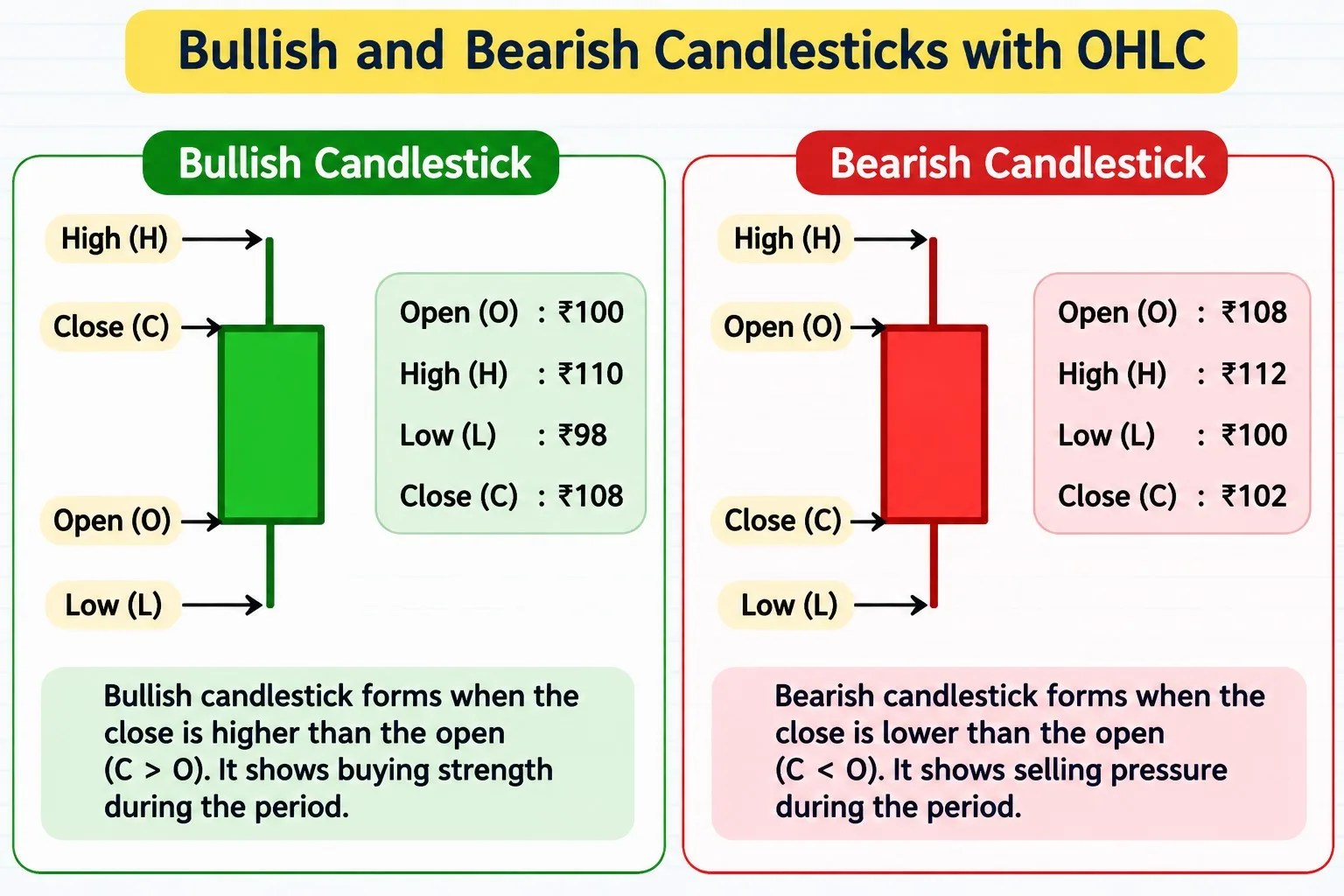
The opening price is one of the four important values used to construct a candlestick. Every standard candlestick represents four price points: Open, High, Low and Close, commonly referred to as OHLC. These values show how a stock traded during a selected period, such as one minute, 15 minutes, one hour or one trading day.
Consider a stock that opens at ₹520, reaches an intraday high of ₹530, falls to ₹515 and closes at ₹525. The opening price of ₹520 and closing price of ₹525 form the real body of a bullish candlestick. The high and low prices form the upper and lower shadows, also called wicks.
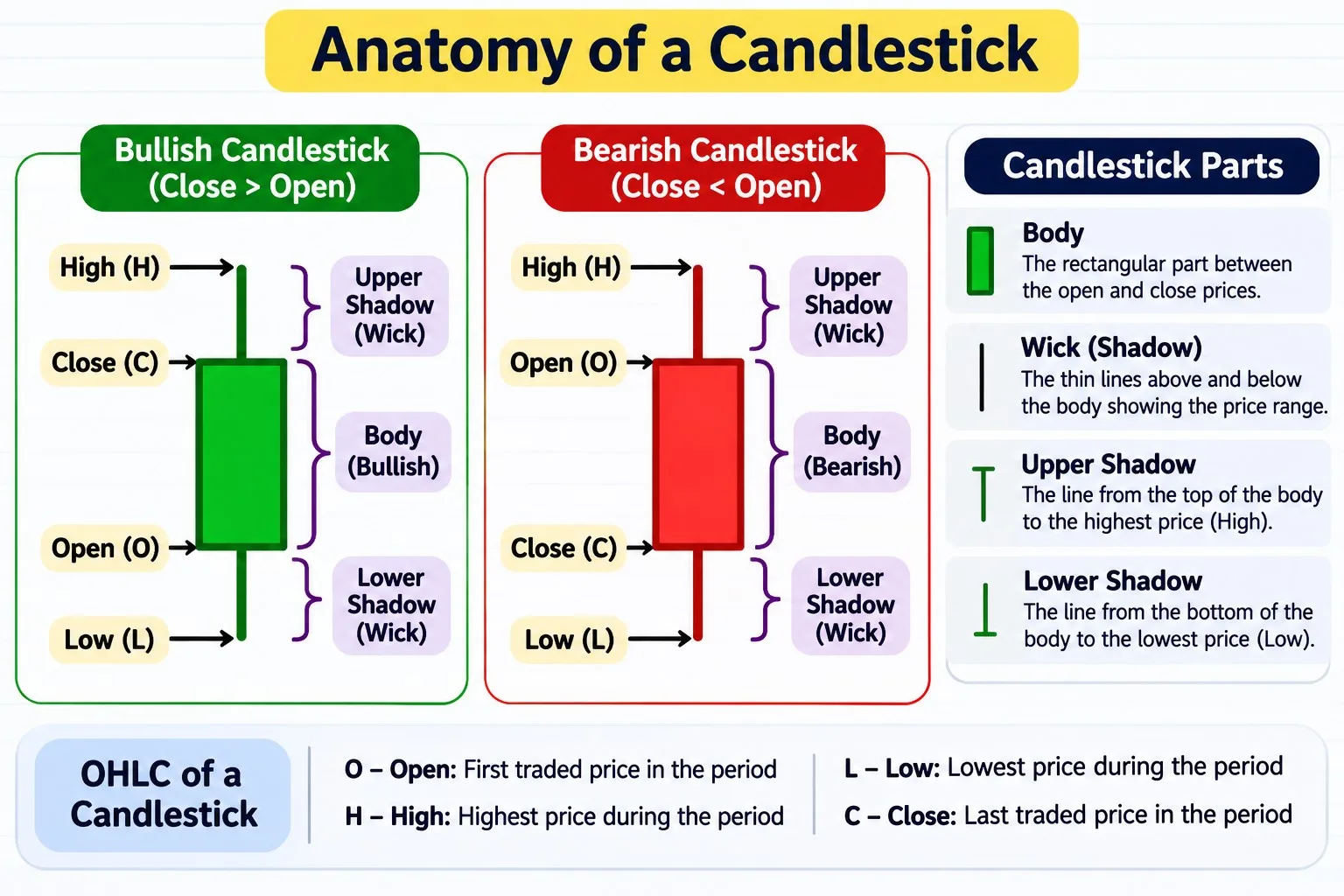
If the closing price is above the opening price, the candlestick is generally displayed in green or another bullish colour. If the closing price is below the opening price, it is generally displayed in red or another bearish colour. The actual colours can be customised in charting platforms, but the underlying OHLC values remain the same.
Traders often compare the opening price with the previous day's closing price, important support and resistance levels, and the stock's early trading volume. These comparisons help them understand whether the stock is showing an opening gap, moving above an important price level or facing selling pressure. However, the opening price alone cannot establish the direction of the entire trading session.
What Should Investors Watch During the Pre-Open Session?
The pre-open session provides information about how market participants are positioning themselves before regular trading begins. Investors who follow individual stocks can monitor the indicative equilibrium price and changes in the order book to understand how the expected opening price is developing. These figures provide useful information, but they should not be treated as guaranteed predictions.
Indicative Equilibrium Price: This shows the estimated price at which the maximum executable quantity can potentially be matched using the available orders. A changing indicative price may indicate that buying or selling interest is changing during the order-entry period.
Indicative Equilibrium Quantity: This represents the estimated number of shares that can be traded at the indicative equilibrium price. A higher quantity indicates that more shares can potentially be matched, although the final executable quantity depends on the orders remaining when matching takes place.
Cumulative Buy and Sell Quantity: These figures show the total buying demand and selling supply at the relevant price levels. Comparing them can help investors understand whether the order book has greater buying or selling interest, but the price levels at which orders are placed are equally important.
Order Imbalance: This indicates the difference between cumulative buying and selling quantities at the indicative equilibrium price. A significant imbalance can suggest that demand and supply are uneven, although it does not guarantee that the stock will open in a particular direction.
Frequently Asked Questions
1. Is the opening price always the same as the previous day's closing price?
No. The opening price is determined through the pre-open price-discovery mechanism, which considers the eligible buy and sell orders received by the exchange. Depending on the demand and supply situation, a stock can open above, below or at approximately the same price as its previous close.
2. Who decides the opening price of a share in India?
The stock exchange determines the opening price through its electronic order-matching system. The NSE and BSE independently conduct their respective pre-open price-discovery processes using the orders received on their platforms. Neither an individual trader nor the company decides the opening price.
3. Can retail investors participate in the pre-open session?
Yes. Retail investors can participate in the pre-open session by placing eligible buy and sell orders through their brokers. The orders are included in the exchange's price-discovery process, subject to the applicable order types, security eligibility and exchange rules.
4. Can the indicative equilibrium price change before 9:15 AM?
Yes. The indicative equilibrium price can change during the permitted order-entry period as investors place, modify or cancel eligible orders. The final opening price is established after the order-entry period closes and the exchange completes the matching process.
5. Does a higher pre-open buy quantity guarantee a gap-up opening?
No. A higher buy quantity does not automatically mean that a stock will open higher than its previous closing price. The exchange considers cumulative buying demand and selling supply at different price levels to calculate the equilibrium price. The prices at which orders are placed are therefore just as important as their quantities.
6. What happens if no trades take place during the pre-open session?
If the exchange cannot discover an equilibrium price, the first trade executed during the normal trading session becomes the opening price. This allows the stock to establish its initial traded price even when the pre-open auction does not produce a match.
7. What time does the Indian stock market open?
The regular equity trading session on the NSE and BSE begins at 9:15 AM and normally continues until 3:30 PM on trading days. The pre-open session takes place between 9:00 AM and 9:15 AM, allowing the exchange to collect orders and establish the opening price before continuous trading starts.
Understanding the Price Before the First Trade
The opening price of a share is established through a structured process that brings together the buying and selling orders submitted before regular trading begins. The pre-open call auction allows the exchange to evaluate demand and supply at different price levels and identify an equilibrium price that maximises the executable quantity. This mechanism provides an organised way to establish the initial trading price rather than depending entirely on the first individual order.
For investors studying stock price movements, understanding the opening-price calculation also helps explain why shares sometimes record large gaps between trading sessions. The indicative equilibrium price, executable quantity and order imbalance provide additional information about the orders entering the market before 9:15 AM. These figures can help explain the price-discovery process, although they cannot predict what will happen after regular trading begins.
Disclaimer: This article is intended for educational and informational purposes only. It explains the stock market opening-price mechanism and the pre-open auction process followed by Indian stock exchanges. The examples and calculations used are illustrative and may not represent actual market transactions. Readers should refer to the official NSE and BSE guidelines for the latest trading rules and procedures. Nothing in this article should be considered investment advice or a recommendation to buy or sell any security.