

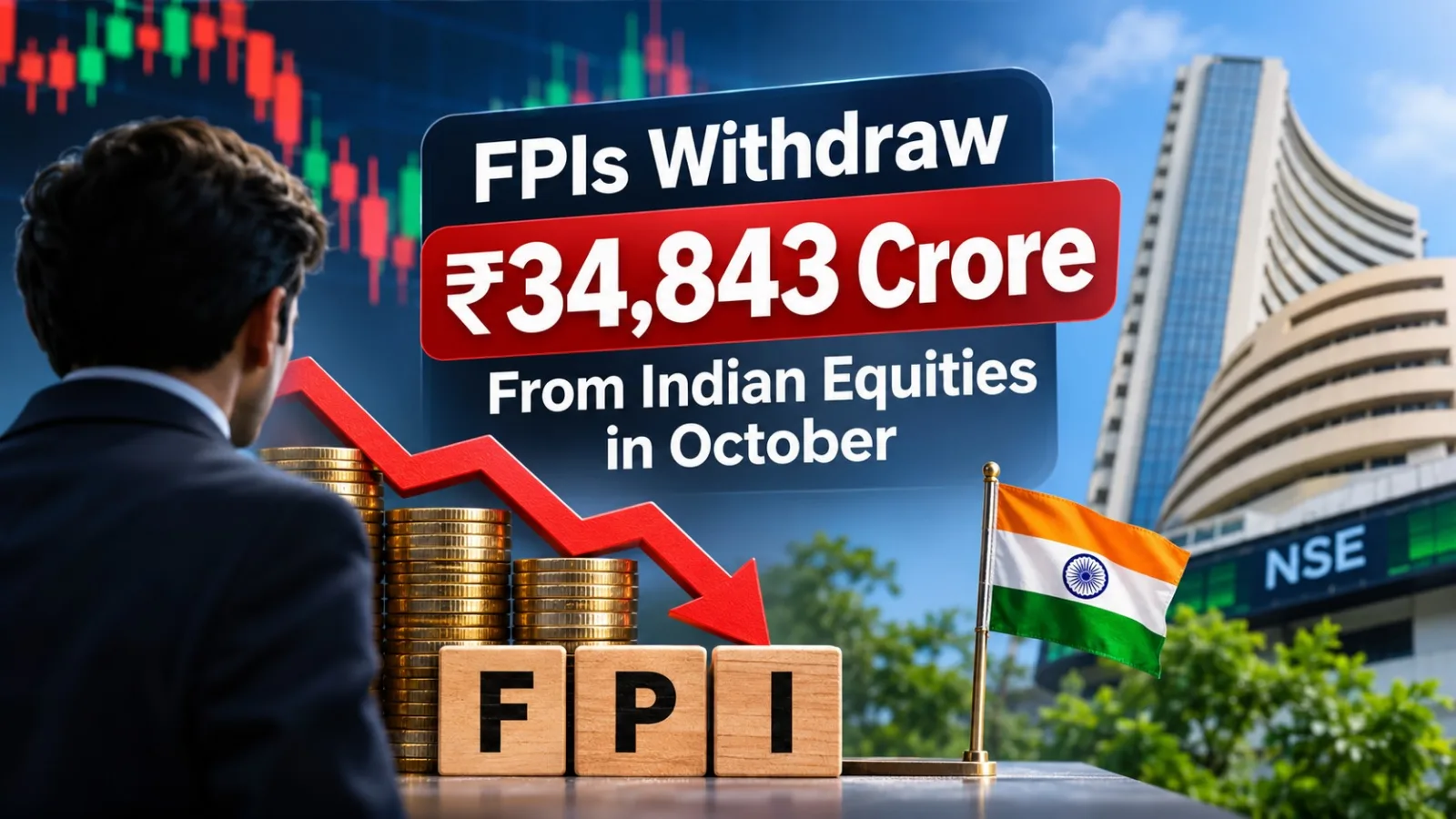
Foreign portfolio investors (FPIs) withdrew ₹34,843 crore from Indian equities in October 2026, marking the second consecutive month of substantial foreign fund outflows. However, the selling trend showed signs of easing towards the end of the month, with overseas investors returning as net buyers during the final week of October.
The latest withdrawal comes after FPIs pulled out ₹35,861 crore from Indian equities in September, highlighting continued pressure on foreign investment flows into the domestic stock market. Elevated crude oil prices, global interest rate conditions and concerns over corporate earnings have remained among the key factors influencing foreign investors' allocation decisions.
Despite the substantial monthly outflows, foreign investors infused approximately ₹6,300 crore into Indian equities between October 26 and October 30, indicating an improvement in buying activity during the final trading week.
FPI Outflows Continue for the Second Consecutive Month
October marked another month of significant foreign selling in the Indian equity market. According to data from the Central Depository Services Limited (CDSL), FPIs withdrew ₹34,843 crore during the month.
The latest outflows follow ₹35,861 crore in net selling recorded in September. Before the two consecutive months of withdrawals, foreign investors had returned to Indian equities in July and August.
The monthly investment figures highlight the changing pattern of foreign investor participation in 2026:
Month | FPI equity investment |
|---|---|
July 2026 | ₹20,200 crore |
August 2026 | ₹29,631 crore |
September 2026 | -₹35,861 crore |
October 2026 | -₹34,843 crore |
With the latest withdrawals, cumulative FPI outflows from Indian equities have reached approximately ₹2.95 lakh crore in 2026.
The continued selling has emerged as an important factor influencing domestic market sentiment, particularly in large-cap stocks that have significant foreign institutional ownership.
Foreign Investors Turn Net Buyers in October's Final Week
Although October recorded substantial net outflows, foreign investors changed their trading pattern towards the end of the month.
FPIs invested approximately ₹6,300 crore in Indian equities between October 26 and October 30. This marked a notable improvement compared with the nearly ₹2,700 crore in net outflows recorded during the week ended October 23.
Foreign investors were net buyers in three of the four trading sessions ending October 30 in the cash market.
The improvement in buying activity also coincided with the Nifty reclaiming the 23,000 mark.
Market experts have attributed the late-month buying interest to a combination of factors, including the US Federal Reserve's decision to maintain interest rates, more attractive valuations in Indian large-cap stocks and signs of sustained domestic economic growth.
However, the improvement in one week's investment activity does not necessarily indicate that foreign investors have completely reversed their broader selling strategy.
Why Are Foreign Investors Selling Indian Stocks?
Several global and domestic factors have influenced foreign portfolio investment decisions in recent months.
1. Elevated crude oil prices
Higher international crude oil prices remain a concern for the Indian economy, which depends heavily on imported crude oil to meet its energy requirements.
An increase in crude prices can raise India's import bill and put pressure on the country's current account balance. It can also contribute to inflationary pressures and increase operating costs for businesses across several sectors.
Companies with significant exposure to fuel, transportation and raw material expenses could face pressure on their operating margins if higher input costs cannot be passed on to customers.
2. Global interest rates and US bond yields
Interest rate conditions in the United States continue to influence international capital movements.
When US government bonds offer attractive yields, overseas investors may prefer relatively safer dollar-denominated assets over equities in emerging markets.
The difference between returns available in developed markets and the potential returns from emerging-market equities plays an important role in institutional asset allocation decisions.
3. Corporate earnings outlook
The outlook for corporate earnings is another important consideration for foreign investors.
Stock valuations depend partly on expectations of future earnings growth. If earnings growth does not support prevailing valuations, overseas funds may reduce their exposure to particular companies or markets.
Concerns surrounding the earnings outlook have therefore contributed to cautious foreign investment activity.
4. Investment opportunities in other Asian markets
Competition for international capital is another factor influencing India's foreign investment flows.
According to market commentary, the artificial intelligence-led rally in North Asian markets has attracted foreign capital, as investors assess opportunities across different regions.
Foreign portfolio investors regularly adjust their geographical allocations based on valuations, growth expectations, currency movements and expected returns.
Which Sectors Are Foreign Investors Buying and Selling?
Despite the broader selling trend, foreign investors have not withdrawn uniformly from every sector.
According to market commentary from Geojit Investments, FPIs continued to sell large-cap financial stocks while selectively accumulating shares in pharmaceutical and healthcare companies.
Select digital platform companies also witnessed buying interest.
This indicates that foreign investors are adjusting their sector allocations rather than necessarily withdrawing from the entire Indian market.
Financial stocks are particularly important because of their significant representation in benchmark indices and their influence on overall market performance.
Selective accumulation in healthcare and pharmaceutical stocks suggests that overseas investors continue to identify opportunities in specific business segments even during periods of broader market outflows.
Domestic Institutional Investors Provide Support
Domestic institutional investors (DIIs) have played an important role in absorbing foreign selling pressure.
When overseas investors sell Indian equities, domestic mutual funds, insurance companies and other institutional investors can provide demand on the opposite side of the market.
Domestic investment flows have become an important component of market liquidity and stability.
The participation of domestic investors can help reduce the immediate impact of foreign selling, although it does not eliminate the possibility of market volatility.
The ability of domestic institutions to sustain their buying activity will remain an important factor in determining how the market responds to changes in foreign investment flows.
What Could Influence FPI Flows in November 2026?
Foreign investment activity in November is expected to remain sensitive to developments in global financial markets and domestic corporate earnings.
Some of the important factors investors will monitor include:
US midterm elections: The outcome and its potential implications for US economic and trade policies could influence global investor sentiment.
Brent crude prices: Movements in international crude oil prices will remain important for India's inflation outlook and corporate cost structures.
US-Iran tensions: Developments in geopolitical tensions could affect energy markets and international risk appetite.
Russia-Ukraine conflict: Further developments could influence global commodity prices and financial market sentiment.
Quarterly corporate earnings: Results from listed companies will provide additional information about revenue growth, profitability and future business expectations.
Global interest rates: Changes in US monetary policy expectations and bond yields could influence the attractiveness of emerging-market investments.
The sustainability of foreign investors' late-October buying activity will depend on how these factors evolve.
Can Foreign Investors Return to Indian Equities?
The return of foreign buying during the final week of October provides an indication that overseas investors are finding selective opportunities in Indian equities.
However, the monthly withdrawal of ₹34,843 crore demonstrates that overall foreign investment sentiment remained cautious during October.
The broader trend will depend on whether crude oil prices moderate, global interest rate expectations become more favourable and corporate earnings provide support to prevailing stock valuations.
For the Indian market, the balance between foreign institutional selling and domestic institutional buying will remain an important factor influencing market movements in the coming weeks.
The latest data therefore presents two contrasting developments: substantial foreign withdrawals for the second consecutive month and a return of net buying during the final week of October.
Disclaimer: candlesticks.in is an educational and informational platform only. Nothing published on this website should be treated as a buy, sell, or hold recommendation. Investments in the securities market are subject to market risks; read all related documents carefully before investing. Please consult a SEBI-registered financial advisor before making any investment decisions. You can verify registered intermediaries on the official SEBI portal at sebi.gov.in