


Zero depreciation insurance is often marketed as one of the most useful add-ons available with a car insurance policy in India. It is commonly understood as protection against depreciation deductions on replaced vehicle parts after an accident. However, the term "zero depreciation" does not mean that the insurer will pay the entire repair bill.
Even with this add-on, policyholders may have to pay several expenses from their own pockets. Compulsory deductibles, consumables, certain exclusions, engine protection limitations and specific conditions relating to tyres and batteries can reduce the final claim amount. The difference becomes clear only when a vehicle owner receives the settlement calculation.
The confusion arises because many buyers assume zero depreciation insurance works like complete financial protection against accidental damage. In reality, it modifies how depreciation is calculated for eligible parts under an otherwise applicable own-damage claim. Other policy conditions, exclusions and deductibles generally continue to apply.
What Does Zero Depreciation Insurance Actually Cover?
A standard comprehensive car insurance policy generally considers depreciation when calculating compensation for damaged vehicle parts. Depreciation represents the reduction in a component's value due to age, usage and wear and tear. As a result, the insurer may deduct a portion of the replacement cost before approving the claim.
Zero depreciation cover, also called bumper-to-bumper insurance, helps eliminate or reduce depreciation deductions on eligible replaced parts. This can be particularly useful when expensive components such as plastic panels, fibre parts and other covered materials need replacement after an accident.
However, the add-on does not automatically remove every deduction from a claim. Compulsory deductibles, policy exclusions, repair-related expenses and costs that fall outside the add-on's coverage may still be payable by the vehicle owner. The exact protection depends on the insurer's policy wording and the selected add-ons.
Compulsory Deductibles: An Expense That Does Not Disappear
A compulsory deductible is the fixed amount that the policyholder must contribute towards an admissible motor insurance claim. It is generally determined by the vehicle's engine capacity under the applicable Indian motor insurance framework. Purchasing zero depreciation insurance does not normally remove this compulsory contribution.
For example, consider a private car with an engine capacity of 1,400 cc. Under the commonly applicable compulsory deductible structure, the owner contributes Rs. 1,000 towards an admissible own-damage claim. Even if the insurer approves the entire eligible repair cost after applying zero depreciation benefits, this amount may still be deducted from the settlement.
There may also be a voluntary deductible if the policyholder selected one while purchasing the policy. This is an additional amount the owner agrees to bear in exchange for a potentially lower premium. Therefore, both compulsory and voluntary deductibles should be checked before assuming that a zero depreciation policy will cover almost everything.
Consumables Exclusion: Small Parts Can Create a Large Bill
Consumables are materials used during vehicle repairs that are generally consumed, replaced or cannot be reused in the normal repair process. Examples include engine oil, lubricants, grease, coolant, brake oil, nuts, bolts, washers and certain other fluids or small components.
A zero depreciation add-on does not automatically cover these expenses. If the policy does not include a separate consumables add-on, the insurer may deduct their cost from the approved repair amount. This can happen even when the accident damage itself qualifies for zero depreciation benefits.
For instance, a repair involving a damaged bumper and radiator assembly may also require coolant, lubricants, clips and other small replacement materials. The insurer may approve the eligible replacement parts while excluding the consumables component. Individually, these expenses may appear small, but together they can increase the owner's final payment.
Engine Protection: Zero Depreciation Does Not Mean Engine Protection
Engine damage is one of the areas where car owners can misunderstand the scope of zero depreciation insurance. A zero depreciation add-on generally deals with depreciation deductions on eligible parts, not every type of mechanical or engine-related damage. The fact that an engine component is damaged does not automatically make its replacement fully payable.
Consider a vehicle that enters a waterlogged road during heavy rainfall. Water enters the engine through the air intake, resulting in internal damage. Depending on the circumstances, the insurer may treat this as consequential damage rather than direct accidental damage covered under the standard policy.
An engine protection add-on may provide coverage for specified engine-related expenses, including certain water-ingress damage and lubricant leakage-related damage. However, it is subject to conditions, exclusions and claim procedures. Some policies may require the owner to avoid starting the engine after water ingress and arrange immediate inspection.
Engine protection is therefore a separate consideration when purchasing motor insurance. Zero depreciation and engine protection serve different purposes, and one should not be treated as a substitute for the other.
Tyres and Batteries: Important Components With Separate Conditions
Tyres and batteries are often treated differently from other vehicle components because they naturally deteriorate through usage. A zero depreciation add-on does not necessarily mean that the insurer will replace a damaged tyre or battery at its full new replacement cost without deductions.
For example, if a tyre is damaged in an accident, the insurer may apply specific policy conditions relating to tyre depreciation, damage eligibility or the extent of coverage. Some policies may cover tyre damage only under particular circumstances, while others may require a separate tyre protection add-on.
Battery-related claims can also involve restrictions. Normal battery deterioration, loss of capacity and failure due to age are generally not the same as accidental damage. A policy may cover certain accident-related battery damage but exclude ordinary wear and tear or mechanical and electrical breakdown.
Car owners should therefore check the insurer's specific treatment of tyres and batteries rather than relying entirely on the zero depreciation label. These exclusions can become particularly relevant for expensive tyres, premium vehicles and electric cars with specialised battery components.
Comprehensive Insurance and Zero Depreciation Are Not the Same
One of the most important distinctions in motor insurance is the difference between a comprehensive policy and a zero depreciation add-on. A comprehensive policy provides a combination of third-party liability protection and own-damage coverage, subject to policy terms. It covers specified accidental damage, theft, fire and other insured events.
Zero depreciation is an additional benefit that can be attached to an eligible motor insurance policy. It changes how depreciation is considered when calculating admissible claims for covered parts. It does not independently provide comprehensive insurance or expand every aspect of the underlying policy.
A vehicle owner with comprehensive insurance but without zero depreciation may receive a claim settlement after depreciation deductions. Another owner with comprehensive insurance and zero depreciation may receive a higher settlement for the same eligible repair, but compulsory deductibles and other exclusions can remain.
The distinction is important when comparing premiums. A comprehensive policy with multiple add-ons may cost more than a basic comprehensive policy, but the additional premium should be evaluated against the specific financial risks those add-ons address.
A Practical Calculation: Standard Comprehensive vs Zero Depreciation
Consider a hypothetical accident in which a car sustains damage to its front bumper, headlight, bonnet and radiator assembly. The authorised workshop prepares an estimated repair bill of Rs. 80,000. For this example, assume the insurer approves all listed repairs, the claim is admissible, and there are no policy-specific limits or additional exclusions beyond the deductions shown below.
The calculation uses illustrative depreciation rates and repair costs. Actual depreciation depends on the applicable policy wording, component classification, vehicle age and insurer assessment. The example is intended to demonstrate how two policies can produce different out-of-pocket expenses.
Hypothetical accident repair bill
Repair component | Amount |
|---|---|
Plastic bumper replacement | Rs. 18,000 |
Headlight assembly | Rs. 22,000 |
Bonnet replacement | Rs. 25,000 |
Radiator assembly | Rs. 10,000 |
Consumables and fluids | Rs. 5,000 |
Total repair bill | Rs. 80,000 |
For calculation purposes, assume depreciation deductions under the standard comprehensive policy are Rs. 9,000. Also assume that the Rs. 5,000 consumables expense is excluded because the owner has not purchased a consumables add-on. The compulsory deductible is Rs. 1,000.
Scenario A: Standard comprehensive insurance without zero depreciation
Particulars | Amount |
|---|---|
Total repair bill | Rs. 80,000 |
Depreciation deduction | Rs. 9,000 |
Consumables exclusion | Rs. 5,000 |
Compulsory deductible | Rs. 1,000 |
Insurer's payment | Rs. 65,000 |
Owner's payment | Rs. 15,000 |
Under this example, the owner pays Rs. 15,000 from personal funds. The amount includes depreciation, consumables and the compulsory deductible. The insurer settles the remaining admissible amount of Rs. 65,000.
Scenario B: Comprehensive insurance with zero depreciation
Particulars | Amount |
|---|---|
Total repair bill | Rs. 80,000 |
Depreciation deduction | Rs. 0 |
Consumables exclusion | Rs. 5,000 |
Compulsory deductible | Rs. 1,000 |
Insurer's payment | Rs. 74,000 |
Owner's payment | Rs. 6,000 |
In this scenario, zero depreciation removes the assumed Rs. 9,000 depreciation deduction. However, the consumables exclusion and compulsory deductible remain. The owner still pays Rs. 6,000 despite having zero depreciation coverage.
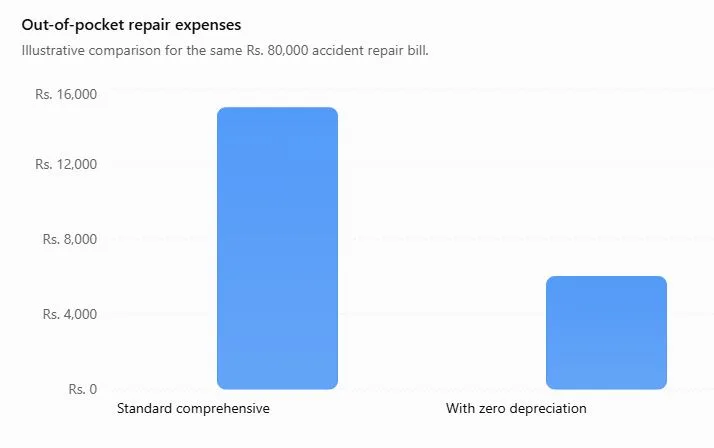
The comparison shows that zero depreciation reduces the owner's expense from Rs. 15,000 to Rs. 6,000 in this hypothetical claim. However, it does not eliminate the entire repair bill payable by the policyholder. The actual savings will depend on the damaged parts, applicable depreciation, exclusions and deductibles.
Other Conditions That Can Reduce a Zero Depreciation Claim
Apart from the commonly discussed deductions, policyholders should examine other conditions that may affect claim approval. These include the number of zero depreciation claims permitted during the policy period, vehicle age restrictions, mandatory inspection requirements and specified claim limits.
Some insurers restrict zero depreciation coverage to vehicles within a particular age range. Others may offer different terms depending on the vehicle category and selected policy variant. The number of claims permitted may also vary, so owners should not assume unlimited usage.
The choice of repair facility can matter as well. Cashless repair facilities are subject to the insurer's network arrangements and claim approval process. If a vehicle owner chooses a non-network garage, the settlement procedure may involve reimbursement and additional documentation requirements.
Another important point is that zero depreciation does not cover every form of vehicle damage. Normal wear and tear, mechanical breakdown, pre-existing damage and losses outside the insured events may remain excluded. Policyholders should read the exclusions instead of relying only on the add-on's marketing description.
8. Add-ons That Can Complement Zero Depreciation
Zero depreciation is only one component of a broader motor insurance protection strategy. Depending on the vehicle and its usage, other add-ons may address expenses that are not covered by zero depreciation. These benefits are separately priced and have their own terms and conditions.
Consumables cover: Helps cover eligible consumable items used during accident-related repairs, subject to policy conditions.
Engine protection cover: Provides specified protection against certain engine-related losses, including eligible water-ingress damage.
Tyre protection cover: May cover specified accidental tyre damage and related expenses.
Return to invoice cover: May help bridge the difference between the insured declared value and the applicable invoice-related amount in specified total-loss or theft situations.
Roadside assistance: Provides services such as towing, emergency assistance and certain roadside support.
Key replacement cover: May cover eligible expenses associated with lost or damaged vehicle keys.
Not every car owner needs all these add-ons. A vehicle regularly driven through flood-prone roads may require a different combination of protection from a car used mainly for short city commutes. The decision should be based on the vehicle's age, usage, location, replacement costs and the additional premium involved.
9. What Car Owners Should Check Before Buying Zero Depreciation Insurance
Comparing policies only on the basis of the zero depreciation premium can lead to an incomplete assessment. Two insurers may offer similarly named add-ons but have different exclusions, claim limits and eligibility conditions. The policy wording is therefore more important than the marketing label.
Before purchasing or renewing a policy, car owners should examine the following details:
Compulsory deductible: Check the amount applicable to the vehicle and whether a voluntary deductible has been selected.
Consumables coverage: Confirm whether consumables are included or require a separate add-on.
Engine protection: Read the conditions covering water ingress, lubricant leakage and consequential damage.
Tyre and battery exclusions: Understand how accidental damage and normal deterioration are treated.
Claim limits: Check the permitted number of zero depreciation claims and any financial restrictions.
Vehicle age eligibility: Verify whether the add-on is available for the vehicle's current age.
Garage arrangements: Check cashless garage availability and the insurer's reimbursement process.
Exclusions: Review conditions relating to negligence, wear and tear, mechanical failure and pre-existing damage.
It is also useful to request a sample claim calculation from the insurer before purchasing the policy. This helps the buyer understand which expenses would be paid, which would be deducted and what amount might remain payable after an accident.
Why the Term Zero Depreciation Can Be Misleading
The biggest misunderstanding surrounding zero depreciation insurance comes from interpreting the product name literally. The add-on primarily addresses depreciation deductions on eligible replaced parts, rather than guaranteeing reimbursement of every rupee spent on accident repairs. Its benefits operate within the conditions of the underlying motor insurance policy.
For Indian car owners, the real question should not be whether a policy offers zero depreciation, but what expenses remain excluded after applying the add-on. A policy with zero depreciation but without consumables or engine protection may leave certain repair expenses uncovered. Understanding these differences before an accident is much easier than discovering them during claim settlement.
A car insurance policy should therefore be evaluated as a combination of base coverage, selected add-ons, deductibles and exclusions. The premium alone does not reveal how much financial protection a vehicle owner will actually receive. Reading the policy wording and understanding a hypothetical claim calculation can help buyers make a more informed decision.
Disclaimer
This article is intended for general educational and informational purposes. Insurance coverage, exclusions, deductibles and claim settlement conditions vary between insurers and policy products. The hypothetical calculations are illustrative and do not represent an actual insurance settlement or a guaranteed claim outcome. Readers should verify the latest policy wording, applicable IRDAI regulations and insurer-specific terms before purchasing or renewing motor insurance. For claim-related disputes, policyholders may refer to the insurer's official grievance redressal process and the Insurance Ombudsman framework.