

A health insurance claim dispute does not necessarily end when an insurer rejects a hospitalisation claim or approves only part of the amount submitted. Policyholders in India have several escalation channels available to challenge claim decisions, seek clarification and request a review of deductions or rejection grounds.
The process generally begins with the insurance company's internal grievance redressal mechanism. If the dispute remains unresolved, the policyholder can approach the Insurance Regulatory and Development Authority of India (IRDAI) through its Bima Bharosa platform and, where eligible, take the matter to the Insurance Ombudsman.
Understanding the difference between a claim rejection and a claim deduction is important because the documents, explanations and arguments required to challenge these decisions can differ considerably.
Claim Rejection and Claim Deduction: Understanding the Difference
Before starting a complaint, the policyholder should identify exactly what the insurance company has disputed. A complete rejection and a partial settlement involve different financial consequences and may require different supporting evidence.
Complete Claim Rejection
A claim rejection occurs when the insurer refuses to pay the claim, either fully or on the basis of a specific exclusion, policy condition or alleged breach of the insurance contract.
Common reasons cited by insurers include:
Alleged non-disclosure of pre-existing medical conditions.
Treatment falling under a policy exclusion.
Waiting-period restrictions.
Policy lapse or non-payment of premium.
Alleged misrepresentation in the proposal form.
Medical treatment or hospitalisation not meeting policy conditions.
A rejection should not be treated as automatically justified simply because the insurer has mentioned a policy exclusion. The policyholder can question whether the relevant exclusion applies to the actual medical circumstances and whether the insurer has provided adequate grounds for its decision.
Partial Claim Settlement or Deduction
A partial settlement occurs when the insurer accepts the claim but pays less than the amount claimed by the hospital or policyholder.
Consider a hospital bill of ₹2,00,000 where the insurer approves only ₹1,45,000.
Particulars | Amount |
|---|---|
Total hospital bill | ₹2,00,000 |
Amount approved | ₹1,45,000 |
Amount deducted | ₹55,000 |
The ₹55,000 difference could include room-rent-related deductions, non-payable consumables, co-payment, deductibles, sub-limits or expenses considered outside the policy coverage.
The policyholder should request an itemised settlement statement explaining every deduction and the corresponding policy clause.
Not every deduction is an unfair settlement. Some deductions may be contractually permitted. A dispute arises when the insurer applies an incorrect clause, calculates the deduction incorrectly or fails to provide a reasonable explanation.
The Health Insurance Claim Escalation Timeline
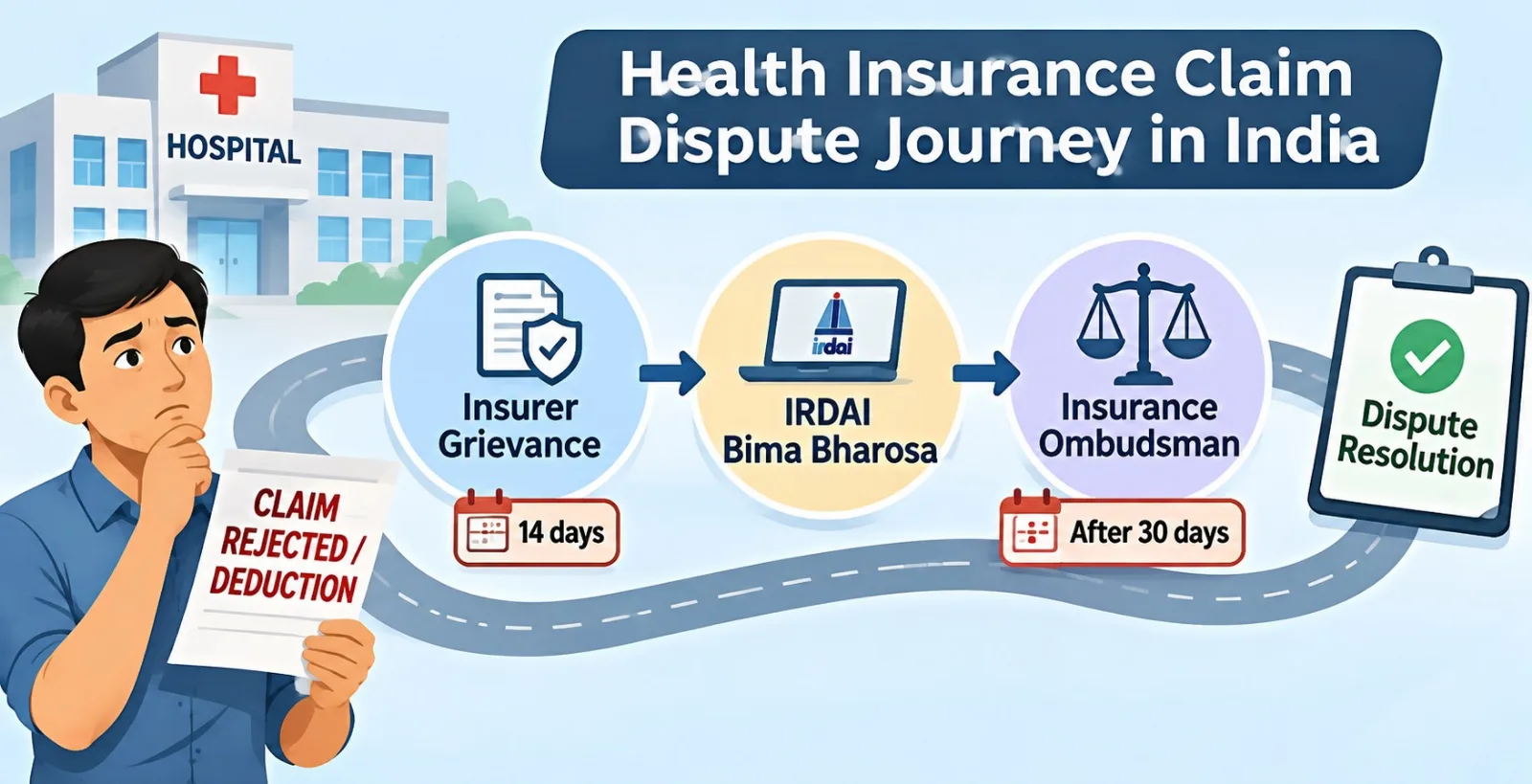
The escalation process involves three primary stages: the insurer's grievance department, IRDAI's Bima Bharosa platform and the Insurance Ombudsman.
From claim rejection to dispute resolution
Day 0 – Obtain the claim decision
Collect the rejection letter or partial settlement statement. Request the exact policy clauses and medical grounds used by the insurer.
Day 1 – Submit an internal grievance
Send a written complaint to the insurer's Grievance Redressal Officer (GRO), with supporting documents and a clear explanation of the disputed decision.
Within 14 days – Insurer's response
The insurer should resolve the grievance within 14 days of receipt.
After an unsatisfactory response – Approach IRDAI
Register the grievance through Bima Bharosa and retain the complaint token number.
After 30 days without resolution – Insurance Ombudsman
Subject to eligibility, submit a formal complaint to the appropriate Insurance Ombudsman. An earlier unsatisfactory final decision may also permit escalation.
Ombudsman proceedings – Obtain a decision
The Ombudsman examines the complaint and supporting evidence and may facilitate settlement or issue an award.
The 14-day insurer grievance resolution period and the 30-day Ombudsman eligibility condition serve different purposes.
Raising a Complaint with the Insurance Company
The first formal step is to challenge the claim decision directly with the insurer.
A policyholder should not rely entirely on conversations with hospital billing staff, insurance agents or third-party administrators (TPAs). The complaint should be registered with the insurance company so that there is a formal record of the dispute.
Where Should the Complaint Be Submitted?
Policyholders can use any of the following channels:
The insurer's official grievance redressal portal.
Email to the company's Grievance Redressal Officer.
Written complaint submitted at a branch.
The insurer's designated customer service or grievance helpline.
The GRO's contact information is generally available on the insurer's website.
Official GRO directory: https://irdai.gov.in/list-of-gros
What Should the Complaint Contain?
A properly structured grievance should include:
Policy number and claim reference number.
Patient's name and hospitalisation details.
Total hospital bill and amount approved.
Date of rejection or partial settlement.
Exact reason mentioned by the insurer.
Relevant policy clauses supporting the policyholder's position.
Explanation of why the rejection or deduction is being disputed.
Requested remedy, such as reconsideration or payment of the disputed amount.
The insurer is required to acknowledge the grievance immediately and resolve it within 14 days under the applicable IRDAI policyholder protection framework.
If the insurer refuses the complaint, its response should identify the relevant policy terms and explain the reasons for not accepting the grievance.
Escalating the Dispute Through IRDAI's Bima Bharosa Platform
https://bimabharosa.irdai.gov.in/
Bima Bharosa is IRDAI's integrated grievance management platform. It provides a channel for policyholders to register insurance-related complaints and monitor their progress.
When a policyholder submits a complaint, the information is routed to the insurer and recorded in IRDAI's grievance management system. A token number is generated, allowing the complainant to track the complaint.
How to Register a Complaint on Bima Bharosa
Step 1: Visit the official Bima Bharosa website and select the complaint registration option.
Step 2: Enter the complainant's personal details, contact information and address.
Step 3: Select the insurance company against which the complaint is being raised.
Step 4: Choose the relevant policy type and complaint category.
Step 5: Enter the policy number or claim number, depending on the nature of the complaint.
Step 6: Explain the dispute clearly. Mention whether the issue concerns complete claim rejection, partial settlement, deductions or delayed reimbursement.
Step 7: Upload the supporting documents in the accepted format and complete the registration process.
Step 8: Save the generated complaint token number and use it to track subsequent updates.
Other Official IRDAI Complaint Channels
Policyholders who cannot use the online portal can also contact IRDAI through the following channels.
Channel | Contact details |
|---|---|
Toll-free helpline | 155255 |
Alternative helpline | 1800-4254-732 |
Online portal |
IRDAI's grievance cell can facilitate the complaint process and monitor the insurer's response. However, Bima Bharosa should not be confused with a judicial or quasi-judicial forum that independently awards disputed claim amounts.
Policyholders should also be careful about fraudulent individuals claiming to expedite insurance claim refunds. Registering a grievance through Bima Bharosa does not require paying an agent or intermediary.
Approaching the Insurance Ombudsman
If the insurer's response does not resolve the dispute, the policyholder may approach the Insurance Ombudsman.
The Ombudsman is an alternative grievance redressal mechanism established under the Insurance Ombudsman Rules, 2017, as amended. It provides a formal mechanism to examine eligible insurance disputes without charging a complaint filing fee.
The Ombudsman can consider matters involving:
Complete or partial rejection of health insurance claims.
Delay in claim settlement.
Disputes regarding interpretation of policy conditions.
Incorrect representation of policy terms.
Deficiencies in insurance company services.
Other eligible grievances arising from non-compliance with applicable insurance regulations or policy terms.
Eligibility Conditions for Filing a Complaint
Before approaching the Ombudsman, policyholders should check the following requirements.
Requirement | Applicable condition |
|---|---|
First approach | The insurer must have been approached in writing |
Insurer response | Unsatisfactory resolution or no response within 30 days |
Claim value | Up to ₹50 lakh, including expenses |
Filing deadline | Within one year of the relevant rejection, repudiation or partial settlement |
Other proceedings | The same subject matter should not already be pending before or decided by another court, consumer forum or arbitrator |
Filing fee | No fee |
The one-year filing period and other eligibility conditions should be checked against the applicable Ombudsman rules before submission.
How to File an Insurance Ombudsman Complaint
Identify the correct Ombudsman office
The complaint must be submitted to the Ombudsman having jurisdiction over the matter. The relevant office can be identified through the Council for Insurance Ombudsmen website.
Prepare a written complaint
Explain the complete sequence of events, starting from the hospitalisation and claim submission to the insurer's rejection or partial settlement and subsequent grievance proceedings.
Attach supporting documents
Include the policy, rejection letter, settlement statement, medical records and copies of earlier complaints.
Submit the complaint
Complaints can be filed online, through email or by post, subject to the prescribed procedure.
Participate in the proceedings
The Ombudsman may seek additional explanations, documents or responses from the insurer. The policyholder should respond to requests within the specified time.
Official complaint registration: https://cioins.co.in/Complaint/Online
Official website: https://www.cioins.co.in/
What Happens After an Ombudsman Complaint?
The Ombudsman examines the policy wording, medical records, claim documents and explanations provided by both parties.
Depending on the facts, the matter may be resolved through settlement or an award may be issued.
An insurer is required to comply with an Ombudsman award within the prescribed 30-day period after receiving it.
Documents Required to Challenge a Health Insurance Claim
Documentation can determine how effectively a policyholder presents a claim dispute. Missing medical records or incomplete correspondence can make it difficult to establish why the insurer's decision should be reconsidered.
The following checklist covers the principal documents that may be required.
Document | Why it matters |
|---|---|
Health insurance policy | Establishes coverage, exclusions and limits |
Policy schedule | Confirms sum insured and policy period |
Customer Information Sheet | Provides a summary of coverage and exclusions |
Proposal form | Helps examine alleged non-disclosure |
Previous policy documents | Relevant to continuity and waiting-period disputes |
Hospital admission records | Establishes the reason for hospitalisation |
Discharge summary | Provides diagnosis and treatment details |
Doctor's prescriptions | Supports medical necessity |
Investigation reports | Provides clinical evidence |
Itemised hospital bill | Helps challenge individual deductions |
Payment receipts | Establishes actual expenditure |
Claim submission acknowledgement | Establishes the submission date |
Rejection or deduction letter | Identifies the insurer's grounds |
GRO complaint and response | Establishes the internal grievance history |
Bima Bharosa token number | Helps establish IRDAI grievance registration |
ID and contact details | Supports formal complaint registration |
The policyholder should arrange the documents chronologically. This makes it easier for the insurer or Ombudsman to understand the sequence of events and identify where the disagreement originated.
Important Health Insurance Claim Timelines
The grievance escalation process is not the only area where timelines matter. IRDAI's policyholder protection framework also specifies service standards for health insurance claims.
Activity | Prescribed timeline |
|---|---|
Initial cashless authorisation decision | Within 1 hour |
Final cashless discharge authorisation | Within 3 hours |
Non-cashless claim settlement | Within 15 days of claim submission |
Grievance acknowledgement | Immediately |
Grievance resolution by insurer | Within 14 days |
Ombudsman eligibility where no insurer response | After 30 days |
Ombudsman complaint filing | Within 1 year of the relevant decision |
These are regulatory service standards, not a guarantee that every disputed claim will be approved. The applicable circumstances and policy conditions still matter.
For cashless discharge authorisation, the insurer is also responsible for additional hospital charges arising from a delay beyond three hours, in accordance with the applicable IRDAI requirements.
Example: Challenging a ₹1.5 Lakh Health Insurance Deduction
Consider a hypothetical situation involving a policyholder who undergoes surgery and receives a hospital bill of ₹3.5 lakh.
The insurer approves ₹2 lakh and deducts ₹1.5 lakh, citing room-related deductions, consumables and other non-payable expenses.
Instead of accepting the settlement without clarification, the policyholder can follow a documented escalation process.
Stage | Action |
|---|---|
Initial claim | Hospital bill of ₹3,50,000 submitted |
Settlement | Insurer approves ₹2,00,000 |
Dispute | Policyholder challenges ₹1,50,000 deductions |
Internal grievance | Requests itemised deductions and policy clause references |
Bima Bharosa | Registers an unresolved grievance |
Insurance Ombudsman | Files an eligible complaint seeking reconsideration |
The policyholder should examine each deduction separately. For example, if the insurer has applied a room-rent proportionate deduction, the policyholder should verify whether the policy actually contains such a restriction and whether it applies to the hospitalisation.
Similarly, consumables deductions should be checked against the policy's non-payable expenses provisions and any applicable add-on coverage.
The Ombudsman would consider the contractual terms and supporting evidence rather than automatically ordering payment of the entire disputed amount.
Common Mistakes That Can Weaken a Health Insurance Complaint
Even when a policyholder has a reasonable basis to challenge an insurance decision, procedural mistakes can complicate the dispute.
Relying only on verbal assurances: Conversations with hospital staff, agents or customer service representatives do not replace a formal written grievance.
Not requesting an itemised deduction statement: Without a breakdown, it becomes difficult to identify which deductions are being challenged and why.
Ignoring the policy wording: A complaint should refer to the relevant coverage provisions, exclusions, waiting periods and applicable limits.
Missing the Ombudsman deadline: The published procedure specifies a one-year filing period. Delaying escalation can affect eligibility.
Submitting incomplete medical records: Diagnosis reports, prescriptions, investigation results and discharge summaries can be important when the insurer questions medical necessity or treatment eligibility.
Approaching multiple forums simultaneously: The Ombudsman procedure restricts complaints where the same subject matter has already been taken to another forum, court or arbitrator. Policyholders should understand this restriction before choosing their next legal route.
Official Resources for Health Insurance Claim Disputes
The following official resources provide registration facilities, contact information and procedural guidance.
Authority | Purpose | Website | |
|---|---|---|---|
IRDAI | Insurance regulator and grievance escalation | ||
Bima Bharosa | Register and track insurance grievances | ||
Council for Insurance Ombudsmen | Ombudsman complaint registration | ||
Insurance Ombudsman | Office locations and jurisdiction | ||
Department of Financial Services | Government information on Ombudsman mechanism |
Understanding Consumer Rights in Health Insurance Disputes
A health insurance claim dispute is easier to present when every communication is documented. Policyholders should preserve claim acknowledgements, insurer responses, hospital bills, medical reports and grievance registration numbers throughout the process.
The escalation mechanism gives consumers an opportunity to question claim decisions rather than treating every rejection or deduction as final. Understanding the insurer's contractual obligations, following the prescribed complaint channels and meeting the relevant deadlines can help policyholders pursue eligible claims through India's insurance grievance redressal system.
Disclaimer: This article is intended for general consumer awareness and educational purposes. Insurance claim outcomes depend on individual policy terms, applicable regulations and the facts of each case. Readers should verify current procedures and eligibility requirements through IRDAI and the Council for Insurance Ombudsmen.