

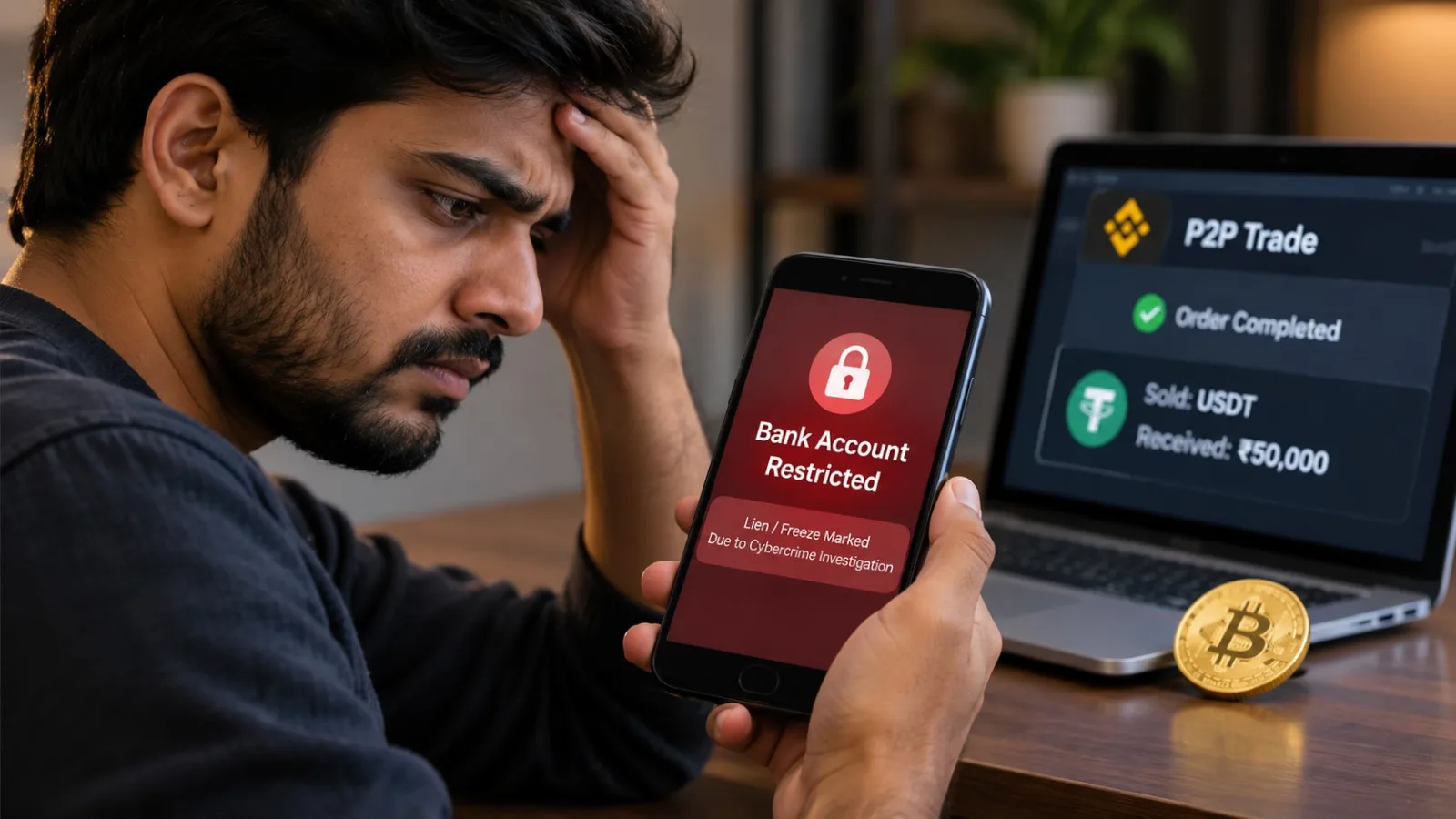
A bank account freeze after selling cryptocurrency through peer-to-peer (P2P) platforms can create serious financial difficulties for traders in India. Even when a person receives money after completing a genuine crypto transaction, the incoming payment may later be linked to a cybercrime complaint. Understanding why banks mark liens, how the transaction trail is investigated and which grievance mechanisms are available can help account holders pursue the release of their funds.
Cryptocurrency P2P trading has become a popular way for Indian users to buy and sell digital assets through platforms such as Binance, Bybit and KuCoin. Unlike a conventional exchange transaction, P2P trading involves a buyer transferring money directly to the seller's bank account.
This arrangement creates a potential problem when the buyer uses money obtained through an unrelated cyber fraud. The seller may receive the payment, release the cryptocurrency and complete the transaction without knowing that the funds originated from a victim of online fraud.
Days, weeks or even months later, the seller may discover that the bank account has been marked with a lien or restricted following a cybercrime complaint.
The situation can become more complicated when the disputed money has passed through several bank accounts before reaching the crypto seller. Investigators may examine the entire transaction chain to identify where the money moved.
For affected account holders, the immediate questions are usually the same: Why has the bank frozen the account? Can the remaining balance be used? How can the lien be removed? Is it necessary to approach the police or a court?
Why Do Bank Accounts Get Frozen After Crypto P2P Transactions?
The main reason is the movement of money connected to a reported cyber financial fraud.
Consider a hypothetical transaction involving three individuals.
A person loses ₹50,000 in an online investment scam and transfers the money to a fraudster's bank account. The fraudster subsequently transfers ₹50,000 to a cryptocurrency buyer. That buyer uses the money to purchase USDT from a P2P seller.
The cryptocurrency seller receives the bank transfer and releases USDT after confirming payment.
At this stage, the seller may believe that the transaction is complete. However, when the original fraud victim reports the incident to the National Cyber Crime Reporting Portal, investigators may trace the transfer through the banking system.
The seller's account could then appear in the transaction trail.
This is one reason why legitimate crypto traders can face banking restrictions even when they did not directly participate in the original fraud.
The situation can become more complicated when money moves through several intermediary accounts. These accounts are sometimes described as first-layer, second-layer or subsequent-layer accounts in the investigation.
An account appearing in a transaction trail does not automatically establish criminal involvement. Investigators must examine the circumstances, transaction records and available evidence.
What Is a Lien Marked on a Bank Account?
A lien is a restriction placed on a specified amount of money in a bank account. The bank may prevent the account holder from withdrawing or transferring the amount while the restriction remains in force.
For example, suppose a person has ₹1,50,000 in a savings account and the bank receives an instruction to mark a lien of ₹20,000.
The bank may restrict access to the disputed ₹20,000 while allowing the remaining balance to be used, subject to other account restrictions.
However, not every case is limited to a specific lien amount. Depending on the legal instruction and the bank's independent compliance action, customers may encounter more extensive restrictions.
It is important to understand the difference between the following situations:
1. Lien marking: A specified amount is blocked in the account.
2. Debit freeze: Outgoing transactions may be restricted, preventing withdrawals and transfers.
3. Complete account freeze: The account may become unavailable for normal banking operations.
4. Digital banking restriction: Internet banking, UPI, debit cards or other digital services may be suspended while the bank or investigating agency verifies the account.
These restrictions are not interchangeable. An account holder should obtain written clarification from the bank rather than assuming that every restriction is a lien.
How Does a Crypto P2P Transaction Lead to a Cybercrime Complaint?
P2P cryptocurrency trading involves direct payment between buyers and sellers.
A typical transaction works as follows:
A buyer places an order to purchase USDT from a seller on a cryptocurrency platform.
The platform displays the seller's payment details.
The buyer transfers Indian rupees from a bank account or payment service.
The seller confirms receipt of the money.
The seller releases USDT to the buyer through the platform's escrow process.
The problem arises when the buyer's payment comes from a bank account involved in an unrelated fraud.
For example, a fraudster may use money obtained through an investment scam, phishing incident or impersonation fraud to purchase cryptocurrency.
The original victim reports the transaction. The investigating agency follows the banking trail and may identify the account that received the disputed amount.
If the cryptocurrency seller received that transfer, the seller's account can become part of the investigation.
The seller may therefore have to establish the commercial context of the payment, including the P2P order, payment confirmation and release of cryptocurrency.
What Should You Do If Your Bank Account Is Frozen After Selling Crypto?
The first step is to identify the authority responsible for the restriction and obtain the details of the disputed transaction.
Repeatedly visiting the bank without obtaining written information may not resolve the issue.
Step 1: Contact the bank and obtain the lien details
Visit the branch where the account is maintained and submit a written request.
Ask the bank to provide the following information, to the extent it can lawfully disclose it:
Whether the account has a lien, debit freeze or complete freeze.
The exact amount under lien, if applicable.
The date on which the restriction was imposed.
The complaint or acknowledgement reference number.
The name and contact details of the investigating police station or agency.
The investigating officer's details, where disclosure is permitted.
The relevant transaction reference or UTR number.
Ask for an acknowledgement of your written application.
The bank may not disclose the original complainant's identity or every detail of an ongoing investigation. However, you should seek enough information to identify the authority and transaction involved.
Step 2: Obtain the cybercrime complaint information
The restriction may originate from a cybercrime complaint registered in a state different from your place of residence.
For example, a trader living in Hyderabad may discover that a transaction in their account has been linked to a complaint investigated by police in Maharashtra, Delhi, Rajasthan or another state.
Contact the investigating agency using independently verified official contact details.
Request clarification about:
The cybercrime complaint or FIR number.
The transaction associated with your account.
The disputed amount.
Your account's position in the transaction chain.
The legal basis for the restriction.
The procedure for submitting documents and requesting release of the lien.
Do not assume that the police station nearest to your residence is responsible for the case.
Step 3: Collect cryptocurrency transaction evidence
Documentation is particularly important when the account holder claims that the incoming payment came from a genuine P2P transaction.
Collect the following records:
Cryptocurrency exchange records
P2P order ID.
Transaction date and time.
Amount received in Indian rupees.
Cryptocurrency quantity released.
Buyer's exchange username or available transaction details.
P2P chat history.
Order completion confirmation.
Relevant exchange account statements.
Banking records
Bank statement showing the incoming payment.
UTR or transaction reference number.
Sender details displayed in the bank statement.
Relevant SMS or email transaction notifications.
Bank lien or freeze notification.
Previous correspondence with the bank.
Identity and supporting documents
PAN card.
Address proof.
Bank account ownership proof.
Relevant income or transaction records, where available.
Any other documents requested by the investigating officer.
Preserve the original exchange records and downloaded statements. Screenshots alone may not be sufficient to establish the complete transaction history.
Step 4: Submit a written representation to the investigating officer
Once the relevant complaint details are available, submit a written representation explaining the transaction.
The representation should include:
Your identity and bank account details.
The date and amount of the disputed credit.
The UTR number.
The associated P2P order ID.
The cryptocurrency transaction details.
An explanation of how the transaction was completed.
Copies of supporting documents.
A request for examination of the transaction records and reconsideration of the restriction.
If you did not know that the buyer's funds were allegedly connected to a cybercrime, explain the circumstances truthfully.
Request a written acknowledgement of your submission.
The investigating officer may require additional information or your statement during the investigation.
Step 5: Use the 2026 Grievance Redressal Mechanism
An important development for people affected by cybercrime-related bank restrictions is the Standard Operating Procedure (SOP) introduced by the Ministry of Home Affairs for the National Cyber Crime Reporting Portal and Citizen Financial Cyber Fraud Reporting and Management System (NCRP-CFCFRMS).
The SOP, approved on 2 January 2026, establishes a framework for handling complaints, bank coordination, grievance redressal, removal of lien markings and restoration of money to rightful claimants.
The Ministry of Home Affairs subsequently confirmed that the Grievance Redressal Module and Money Restoration Module became functional in April 2026.
The Grievance Redressal Module is particularly relevant to account holders whose bank accounts have been frozen or whose funds have been marked under lien following cybercrime-related action.
Affected account holders can raise grievances through their respective banks or financial institutions under the prescribed process.
The grievance mechanism is intended to provide a structured route for examining restrictions and seeking a response from the concerned authorities. It does not automatically guarantee that every lien will be removed.
Account holders should ask their bank how to register a grievance under the CFCFRMS process and obtain a reference number for tracking the request.
The concerned state or Union Territory law enforcement agency remains responsible for investigating the underlying complaint.
Step 6: Escalate the matter if the restriction continues
If the bank does not provide an appropriate response, the account holder can escalate the matter through the bank's grievance redressal hierarchy.
This may include:
Branch manager.
Bank's regional or zonal grievance department.
Bank's nodal officer.
Principal nodal officer.
Applicable cybercrime grievance mechanism.
If the restriction originates from a police investigation, the account holder should also pursue the matter with the investigating officer and the appropriate supervisory authority.
Where the grievance remains unresolved, an advocate can examine whether an application before the jurisdictional Magistrate or a petition before the appropriate High Court is warranted.
The appropriate legal forum depends on the nature of the restriction, the authority that issued it and the facts of the investigation.
Can Police Freeze the Entire Bank Account for a Crypto P2P Transaction?
This is an important legal question for cryptocurrency traders.
Section 106 of the Bharatiya Nagarik Suraksha Sanhita (BNSS), 2023, provides police with powers relating to the seizure of property in specified circumstances.
However, the exercise of these powers must follow the applicable legal procedure.
In a September 2026 judgment, the Allahabad High Court in Ram Singh Yadav v. RBI examined the procedure for freezing bank accounts in cybercrime investigations.
The court discussed the need for a reasonable basis for the action, identification of the disputed amount, communication of relevant case information and intimation to the jurisdictional Judicial Magistrate.
The judgment also addressed the distinction between marking a lien on a specific amount and blocking an entire financial account.
The legal position is important because an investigation involving one disputed transaction does not automatically establish that every rupee in the account is connected to an offence.
However, the scope of the order and applicable statutory provisions must be examined in each case. A bank may also have separate regulatory reasons for restricting an account.
Account holders should not independently assume that a freeze is invalid merely because the disputed transaction is smaller than the account balance.
They should obtain the relevant order and seek legal advice before challenging it.
Can You Get Your Money Back After a Crypto P2P Lien?
Yes, removal of a lien or release of restricted funds may be possible, but the outcome depends on the investigation and the legal basis for the restriction.
The investigating agency may examine whether:
The account holder was involved in the original fraud.
The payment was received against a genuine cryptocurrency sale.
The transaction records match the disputed bank credit.
The account holder knew or had reason to know about the suspicious source of funds.
The disputed money is still required for investigation.
The restriction can be limited to a specific amount.
If the investigation establishes that the account holder has no connection with the alleged offence and the money is no longer required to be retained, the appropriate authority may issue instructions for removing the restriction.
However, merely showing a completed P2P order does not automatically establish that the incoming funds were legitimate. The underlying bank transfer must also be examined.
In some cases, the original fraud victim may have a claim to the disputed funds. The release or restoration of such money must follow the applicable investigation and legal process.
What If the Bank Account Is Frozen by Another State's Police?
Interstate cybercrime complaints can make the process more complicated.
A person may reside in Telangana, maintain a bank account in Karnataka and receive a P2P payment that is subsequently connected to a cybercrime complaint registered in Maharashtra.
The bank may act on instructions received from the investigating agency handling the complaint.
In such situations, the account holder should not restrict communication to the local bank branch.
The person should:
Obtain the investigating agency's details from the bank.
Contact the concerned police station through verified official channels.
Submit the P2P transaction records and bank statement.
Request details of the disputed amount and the basis for the restriction.
Preserve acknowledgements of all submissions.
Use the prescribed grievance redressal process.
Consult a lawyer if the matter remains unresolved.
The National Cyber Crime Reporting Portal is managed by the Indian Cyber Crime Coordination Centre (I4C), but investigations are conducted by the relevant state and Union Territory law enforcement agencies.
I4C provides the technical platform and coordination infrastructure; it does not independently investigate every complaint or issue all bank-freeze instructions.
How Can Crypto P2P Traders Avoid Bank Account Freezes?
No precaution can completely eliminate the risk of receiving funds connected to an unrelated fraud. However, traders can reduce their exposure by following careful transaction practices.
1. Trade only through established platforms
Use platforms with transaction records, user verification and P2P escrow arrangements. A platform's escrow service does not guarantee that the buyer's bank funds are legitimate.
2. Verify the sender's bank account name
Where the platform's rules permit, check whether the payment comes from the buyer's own bank account. Avoid third-party payments and requests to accept money from unrelated individuals.
3. Avoid splitting payments across multiple accounts
Requests to receive funds from several unrelated bank accounts for one P2P order should be treated cautiously.
4. Preserve every transaction record
Keep exchange order details, payment confirmations, UTR numbers and chat history. Do not delete completed orders or relevant communications.
5. Avoid taking transactions outside the platform
Direct arrangements through Telegram, WhatsApp or other channels may leave traders without the transaction records and dispute-resolution mechanisms provided by the exchange.
6. Do not release cryptocurrency before confirming payment
A payment screenshot or SMS notification is not sufficient proof of receipt. Verify the credit in your own bank account before releasing cryptocurrency.
7. Maintain proper transaction records
Frequent traders should maintain a separate record of transaction dates, amounts, counterparties, exchange order IDs and bank references.
8. Be careful with unusually attractive offers
A buyer offering an unusually favourable rate or asking for a transaction outside the platform's normal process may expose the seller to additional risk.
Frequently Asked Questions
1. Can my bank account be frozen if I receive money from Binance P2P?
Yes. If the incoming payment is subsequently identified as connected to a reported cybercrime, the receiving bank account may be subject to a lien, debit restriction or other lawful action. This does not automatically establish that the cryptocurrency seller committed an offence.
2. Can police freeze my account for receiving just ₹500 or ₹1,000?
A small transaction can still appear in a cybercrime investigation. The amount alone does not determine whether an investigating agency can take action. The legal basis, transaction trail and circumstances must be considered.
3. How long does it take to remove a crypto P2P bank lien?
There is no universal guaranteed period for releasing every crypto-related lien. The timeline depends on the investigating agency, the number of transaction layers, the documents submitted and whether a judicial order is required.
4. Can I withdraw the remaining balance if only one transaction is under lien?
It depends on the actual restriction. If only a specific amount is marked under lien, the remaining balance may remain available. However, a debit freeze or complete account restriction can prevent withdrawals and transfers.
Ask the bank to clarify the precise nature and scope of the restriction.
5. Can I approach the High Court to remove a bank account freeze?
An affected account holder may explore appropriate judicial remedies, including proceedings before the High Court, depending on the facts and legal basis of the restriction. An advocate experienced in cybercrime and banking matters can examine the police communication, bank action and available alternatives.
6. Is an NOC from the police necessary to remove a bank lien?
The requirement depends on the nature of the restriction and the authority responsible for it. In some cases, banks require written instructions from the investigating agency or a competent court before releasing the restricted amount. There is no single NOC requirement applicable to every case.
7. Can I file a grievance if my account is frozen due to a cybercrime complaint?
Yes. The Ministry of Home Affairs' NCRP-CFCFRMS grievance redressal framework, functional from April 2026, provides a mechanism for grievances concerning bank account restrictions and lien marking. Contact your bank to understand how to register the grievance and track its progress.
8. Does completing a Binance P2P order prove that the seller is innocent?
No. A completed exchange order can help establish the commercial context of a payment, but it does not independently prove the source of the buyer's money or determine criminal liability. Bank records, exchange records and the wider transaction trail may all be examined.
Important Official Resources
National Cyber Crime Reporting Portal: https://cybercrime.gov.in/
Cybercrime helpline: 1930
Ministry of Home Affairs: https://www.mha.gov.in/
Indian Cyber Crime Coordination Centre: https://i4c.mha.gov.in/
Reserve Bank of India: https://www.rbi.org.in/
The most important step for anyone facing a crypto P2P-related bank restriction is to obtain the exact lien or freeze details, identify the investigating agency and preserve the complete transaction trail. The 2026 grievance redressal framework provides an additional route for affected account holders, while appropriate judicial remedies may be considered when restrictions remain unresolved or their legality is disputed.
Disclaimer: This article is for general financial and legal awareness. It does not constitute legal advice or establish that any particular bank freeze or lien is unlawful. The outcome of an individual case depends on the applicable law, investigation records, police instructions and judicial orders. Consult a qualified advocate for advice on a specific matter.