

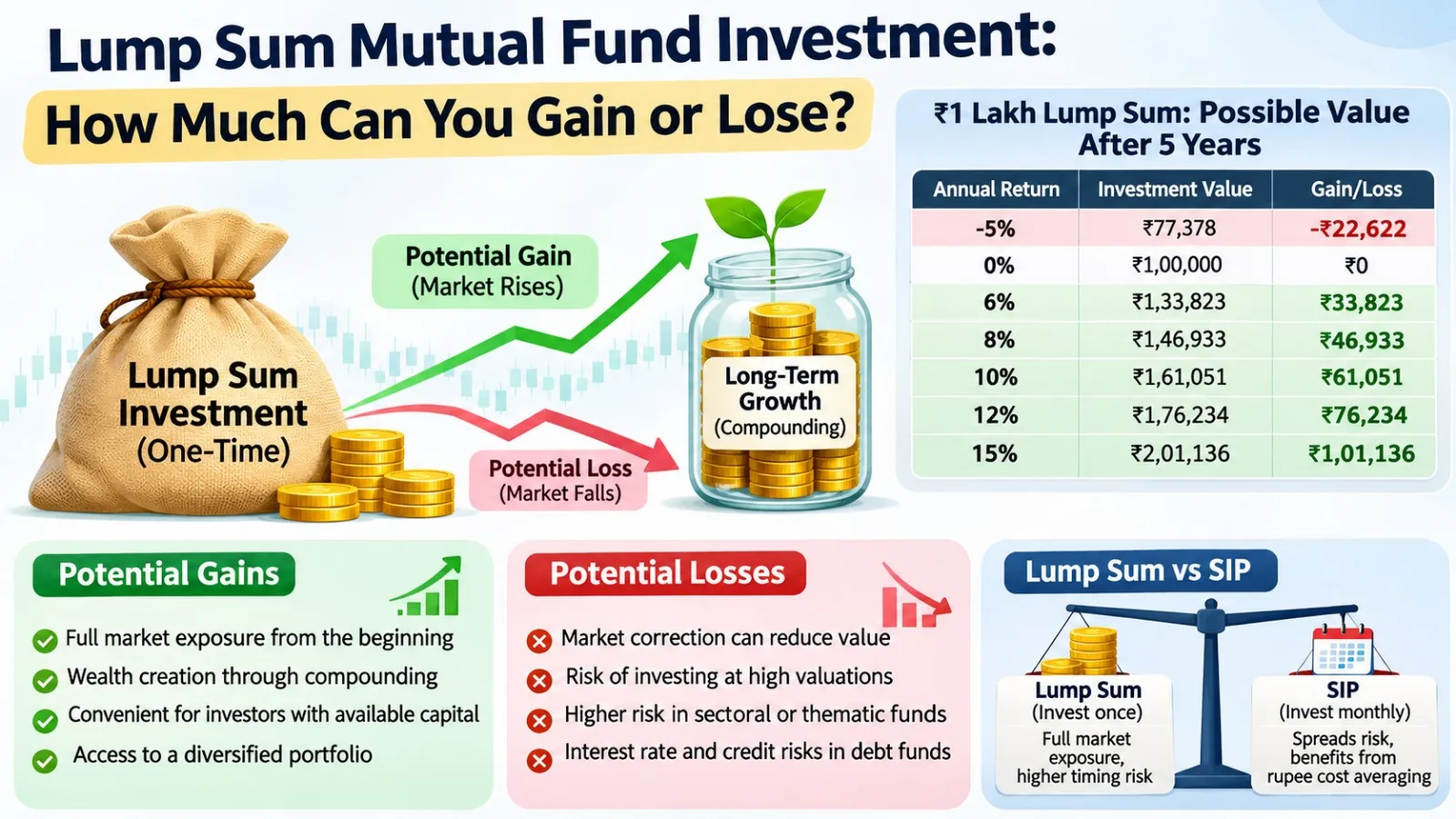
A lump sum investment in a mutual fund allows investors to invest a large amount of money in a single transaction rather than spreading contributions across multiple months through a Systematic Investment Plan (SIP). This approach is commonly considered by individuals who receive annual bonuses, inheritances, business profits or proceeds from selling an asset.
While investing a large amount at once can provide greater exposure to market growth, it also carries the risk of losses if the market declines after the investment is made. Unlike an SIP, where investments are spread across different market levels, a lump sum investment exposes the entire amount to market movements from the beginning.
The potential gains or losses depend on several factors, including the mutual fund category, investment timing, market conditions, investment duration and the performance of the underlying securities.
What Is a Lump Sum Mutual Fund Investment?
A lump sum investment means putting money into a mutual fund scheme through a single transaction.
For example, an investor with ₹5 lakh in savings may decide to invest the entire amount in an equity mutual fund instead of investing ₹10,000 or ₹20,000 every month.
Mutual funds allot units based on the applicable Net Asset Value (NAV).
NAV represents the per-unit value of a mutual fund scheme and changes according to the market value of its underlying investments.
Consider an investor who puts ₹1 lakh into a mutual fund with an applicable NAV of ₹50.
Initial investment: ₹1,00,000
NAV: ₹50
Units allotted: 2,000
If the NAV increases to ₹60, the investment value becomes ₹1.20 lakh. If the NAV falls to ₹40, the investment value declines to ₹80,000.
This illustrates how changes in NAV directly affect the value of a lump sum investment.
How Much Can ₹1 Lakh Grow in Five Years?
The potential value of a lump sum mutual fund investment depends on the returns generated by the scheme.
Consider an investment of ₹1 lakh held for five years under different hypothetical annualised return scenarios.
Annual return | Investment value | Gain/Loss |
|---|---|---|
-5% | ₹77,378 | -₹22,622 |
0% | ₹1,00,000 | ₹0 |
6% | ₹1,33,823 | ₹33,823 |
8% | ₹1,46,933 | ₹46,933 |
10% | ₹1,61,051 | ₹61,051 |
12% | ₹1,76,234 | ₹76,234 |
15% | ₹2,01,136 | ₹1,01,136 |
These figures assume a constant annual compound return. Actual mutual fund returns fluctuate, and the figures should not be treated as expected or guaranteed returns.
The calculation also demonstrates that investors can lose part of their original capital when the investment performs poorly.
Potential Gains from Lump Sum Investments
1. Immediate market exposure
When investors put the entire amount into a mutual fund, the complete investment starts participating in market performance from the applicable investment date.
If the market rises after the investment, the entire amount benefits from that growth.
For example, an investor who puts ₹5 lakh into an equity mutual fund before a sustained market rally gets exposure to the full investment rather than gradually deploying the money.
However, the same exposure can increase losses during a market correction.
2. Benefits of compounding
Compounding allows investment gains to generate additional returns when they remain invested.
For example, an initial investment of ₹5 lakh growing at a hypothetical annualised rate of 12% for 10 years would become approximately ₹15.53 lakh.
The estimated gain would be around ₹10.53 lakh.
This calculation assumes a constant annual growth rate. Actual mutual fund returns are not fixed.
3. Convenient for investors with available capital
People receiving bonuses, business profits, inheritance money or proceeds from selling property may have a substantial amount available for investment.
A lump sum investment allows them to deploy that capital without waiting to accumulate smaller monthly contributions.
4. Access to diversified portfolios
Mutual funds invest in a collection of securities according to their investment objectives.
Depending on the scheme, the portfolio may include shares, government securities, corporate bonds or money market instruments.
This provides investors with exposure to multiple securities through a single investment.
However, diversification does not eliminate market risk.
Potential Losses from Lump Sum Investments
1. Market correction after investment
One of the biggest risks is investing a large amount shortly before a market correction.
Suppose an investor puts ₹10 lakh into an equity mutual fund. If the fund's NAV declines by 15%, the investment value falls to ₹8.50 lakh.
The investor faces an unrealised loss of ₹1.50 lakh.
If the investor needs the money during this period, redeeming the investment could convert the paper loss into an actual loss.
2. Unfavourable investment timing
The timing of a lump sum investment can influence short-term returns.
Investing during an expensive market valuation period may expose investors to a correction shortly afterwards.
However, predicting the exact market peak or bottom is difficult. Waiting for the perfect entry point can also result in missed investment opportunities.
3. Sector concentration
Investors choosing sectoral or thematic mutual funds may face higher concentration risk.
For example, a banking sector fund depends heavily on the performance of banking and financial companies.
If the underlying sector experiences difficulties, the fund's NAV may decline significantly.
4. Interest rate and credit risks
Debt mutual funds also carry risks.
Changes in interest rates can affect bond prices, while deterioration in the credit quality of securities can negatively affect the portfolio.
Debt mutual funds do not guarantee capital protection or assured returns.
Which Mutual Fund Categories Can Investors Consider?
The appropriate mutual fund category depends on investment objectives, risk tolerance and the period for which the investor can remain invested.
Equity mutual funds: These funds invest primarily in shares of companies. They aim for long-term capital appreciation but can experience significant market fluctuations.
Debt mutual funds: These schemes invest in government securities, corporate bonds and other fixed-income instruments. Their risks depend on interest rate movements, credit quality and liquidity.
Hybrid mutual funds: These schemes combine equity and debt investments. The allocation between the two asset classes varies across categories.
Index mutual funds: These funds aim to replicate a particular market index, subject to tracking error and expenses.
Investors should examine the scheme's investment objective, portfolio, Riskometer and expense ratio before selecting a fund.
Lump Sum vs SIP: Which Is Better?
Lump sum and SIP are two different methods of investing in mutual funds.
In a lump sum investment, the entire amount is invested at once. In an SIP, investors contribute a fixed amount at regular intervals.
Consider someone who has ₹6 lakh available for investment.
They can either:
Invest ₹6 lakh immediately.
Invest ₹50,000 every month for 12 months through an SIP.
The lump sum approach provides immediate exposure to the market. The SIP approach spreads purchases across different market levels.
When markets decline, an SIP may purchase more units with the same monthly contribution. When markets rise, the same contribution purchases fewer units.
This is known as rupee cost averaging.
However, SIPs do not guarantee profits or eliminate market risk. If markets rise consistently, investing the entire amount earlier may produce better results.
There is no universally superior method. The choice depends on the investor's financial circumstances and market exposure preferences.
Can Investors Use an STP Instead of Investing Everything at Once?
Investors who are uncomfortable putting their entire capital into an equity mutual fund immediately may consider a Systematic Transfer Plan (STP).
An STP allows investors to transfer money periodically from one mutual fund scheme to another within the same fund house, subject to the schemes' terms.
For example, an investor with ₹6 lakh could initially invest the amount in a suitable liquid-oriented scheme and transfer ₹50,000 every month into an equity mutual fund over 12 months.
This spreads the entry into the equity scheme across multiple dates.
However, an STP does not guarantee better returns. The source scheme also carries investment risks, and transfers generally involve redemptions and purchases that may have tax and exit-load implications.
Important Factors to Check Before Investing
Before making a lump sum mutual fund investment, investors should consider the following:
Investment horizon: Money required in the near future should not generally be exposed to highly volatile investments.
Riskometer: Check the scheme's disclosed risk level before investing.
Expense ratio: Compare the annual expenses charged by similar mutual fund schemes.
Past performance: Historical returns can provide useful information but do not guarantee future performance.
Portfolio composition: Understand the sectors, companies and securities in which the fund invests.
Exit load: Check whether redemption within a specified period attracts additional charges.
Taxation: Understand the applicable capital gains tax rules before investing or redeeming units.
Should Investors Make a Lump Sum Investment During a Market Correction?
A market correction may provide opportunities to purchase mutual fund units at lower NAVs. However, a decline does not necessarily mean that the market has reached its bottom.
Equity markets can continue falling because of weak corporate earnings, global economic uncertainty, interest rate changes or other developments.
Investors should not make investment decisions solely because an index has declined by a particular percentage.
Instead, they should evaluate the scheme's underlying portfolio, investment objective, risk level and their ability to remain invested through market fluctuations.
Frequently Asked Questions
Can I lose money in a lump sum mutual fund investment?
Yes. Mutual funds are subject to market risks. If the NAV declines after investment, the portfolio value can fall below the original amount.
Is lump sum investment better than SIP?
Neither method is always better. Lump sum investments provide immediate market exposure, while SIPs spread investments across multiple dates. Actual results depend on market movements and the investment period.
Can I invest ₹10 lakh in one mutual fund?
Yes, subject to the scheme's investment terms. However, investors should assess concentration risk, asset allocation and their ability to tolerate potential losses.
Can I withdraw a lump sum mutual fund investment anytime?
Open-ended mutual funds generally allow redemption on business days, subject to applicable scheme terms, cut-off rules, exit loads and any restrictions.
Are mutual fund returns guaranteed?
No. Mutual fund investments are market-linked. Their NAVs can increase or decrease depending on the performance of the underlying investments.
Understanding the Risks Before Investing
A lump sum mutual fund investment allows investors to put available capital to work immediately. When markets perform well over the investment period, the entire amount can benefit from market appreciation and compounding.
However, investing a large amount at once also exposes the investor to the possibility of entering the market before a decline.
Investors should maintain adequate emergency savings and avoid investing money required for immediate expenses in volatile schemes. The decision between lump sum and SIP should depend on financial goals, investment horizon and risk tolerance rather than predictions about short-term market movements.
A suitable asset allocation and a realistic investment horizon are important when deciding how to invest a large amount in mutual funds.Disclaimer: candlesticks.in is an educational and informational platform only. Nothing published on this website should be treated as a buy, sell, or hold recommendation. Investments in the securities market are subject to market risks; read all related documents carefully before investing. Please consult a SEBI-registered financial advisor before making any investment decisions. You can verify registered intermediaries on the official SEBI portal at sebi.gov.in