


A mutual fund investment made 15 or 20 years ago can easily disappear from an investor's financial records without actually disappearing from the financial system. Someone might have invested a few thousand rupees through a bank, financial adviser or offline mutual fund distributor and subsequently changed jobs, relocated to another city or stopped receiving investment statements.
Over time, the registered email address may become inactive, the mobile number may change and the bank account linked to the investment may be closed. The investor might remember purchasing a mutual fund but have no idea which asset management company issued it or where the original documents are stored.
This creates an unusual financial problem: an investor may own money but no longer know where to find it. Forgotten investments are not necessarily limited to old physical statements. Even people who started investing through online platforms can lose track of folios after changing investment applications or discontinuing their relationship with a financial intermediary.
India has introduced mechanisms to help investors identify inactive and unclaimed mutual fund investments. Through the Mutual Fund Investment Tracing and Retrieval Assistant (MITRA), along with services offered by CAMS, KFintech and the mutual fund industry, investors can investigate old holdings and begin the recovery process.
What Are Forgotten Mutual Fund Folios?
A mutual fund folio is an account maintained by an asset management company to record an investor's holdings in its schemes. It contains information about units purchased, transactions, registered bank accounts, nomination and other investor details.
An investor can have multiple folios across different mutual fund houses. Depending on the fund house's practices and the combination of holders, multiple investments may also be maintained under a common folio.
A forgotten folio is an investment account that an investor has lost track of, even though units or unpaid amounts may still be associated with it. The investor may no longer receive statements, remember the scheme name or know which registrar maintains the account.
Consider someone who purchased ₹20,000 worth of mutual fund units in 2008 through a local distributor. The investor received a physical statement, stored it with other financial documents and eventually moved to another city. The investment may have continued to exist even though the investor had not checked its value for several years.
Forgotten folios can contain different types of financial assets, including:
Existing mutual fund units that have never been redeemed.
Units accumulated through old systematic investment plans.
Investments made through physical application forms and cheques.
Unclaimed dividends or IDCW distributions.
Redemption proceeds that could not be credited to the registered bank account.
Investments inherited from deceased family members that have not been transmitted to legal heirs.
It is important to distinguish between an inactive folio and an unclaimed amount. An inactive folio can still contain mutual fund units, whereas an unclaimed amount generally refers to money payable to an investor that could not be successfully delivered.
Why Do Investors Lose Track of Their Mutual Fund Investments?
Forgotten investments are often the result of ordinary life changes rather than deliberate financial decisions. Several small changes over the years can disconnect an investor from an investment account, particularly when the original purchase was made through offline channels.
Old Physical Mutual Fund Statements
Before online investment platforms became common, many investors purchased mutual funds using paper application forms. They received account statements through postal mail containing the folio number, scheme name, purchase date and number of units allotted.
These documents were frequently stored in cupboards, old files or bank document folders. When families moved houses or reorganised their financial records, some statements were misplaced or discarded.
An investor might remember the fund house but not the scheme name or folio number. In other cases, the person may not remember the investment at all, particularly when the purchase was made through an employer, financial adviser or family member.
The absence of a physical statement does not automatically mean that the investment cannot be recovered. The fund house and its registrar may still maintain the relevant account records.
Inactive or Discontinued Email Addresses
Email addresses are frequently used by mutual funds to send transaction confirmations, account statements, annual reports and important investor communications. An investor who registered an office email address many years ago may lose access after changing employers.
Similarly, an old personal email account may be deleted, forgotten or become inaccessible because of lost passwords. When the registered email address is no longer available, investors may not receive information about their holdings, dividend payments or other account activity.
This can also make it difficult to obtain an electronic Consolidated Account Statement (CAS), particularly when the statement service requires an email address already registered in the relevant folios.
Changed Mobile Numbers
Mobile numbers are another important part of mutual fund account records. They are used for transaction alerts, OTP verification and certain investor service requests.
An investor who changes mobile operators or discontinues an old number may find that the previous number remains registered with multiple fund houses. This becomes inconvenient when trying to access online services that require mobile verification.
Updating a mobile number may require an authenticated service request and supporting documents, depending on the registrar's process and the investor's existing KYC status.
Closed or Changed Bank Accounts
A mutual fund redemption or dividend payment may fail when the registered bank account has been closed, changed or recorded incorrectly. For example, an investor might have purchased units using a salary account in 2009 and subsequently moved to another bank.
If the old bank account remains registered with the mutual fund, a later redemption payment could fail. Similar problems can occur when bank accounts are merged, account details change or the investor has not completed the required bank mandate update.
An unsuccessful payment does not necessarily cancel the investor's entitlement. The unpaid amount may be treated as an unclaimed amount and handled under the applicable mutual fund rules.
Investments Made by Parents or Grandparents
A particularly overlooked category involves investments made by older family members. Parents and grandparents may have purchased mutual funds for children, grandchildren or other family members without regularly discussing those investments.
The original investor may later pass away, leaving family members unaware of the existence of the folios. Even when the family discovers an old statement, claiming the investment can involve additional procedures relating to transmission, nomination, succession documents and verification of legal entitlement.
This is why family financial records should include details of mutual fund holdings, folio numbers and nominees wherever possible.
MITRA: India's Platform for Finding Forgotten Mutual Fund Investments
One of the most important developments for investors trying to locate forgotten mutual fund investments is MITRA, which stands for Mutual Fund Investment Tracing and Retrieval Assistant.
SEBI introduced the framework through its circular dated February 12, 2025. The platform was developed by the two Qualified Registrar and Transfer Agents (QRTAs), CAMS and KFintech, and is accessible through the MF Central website.
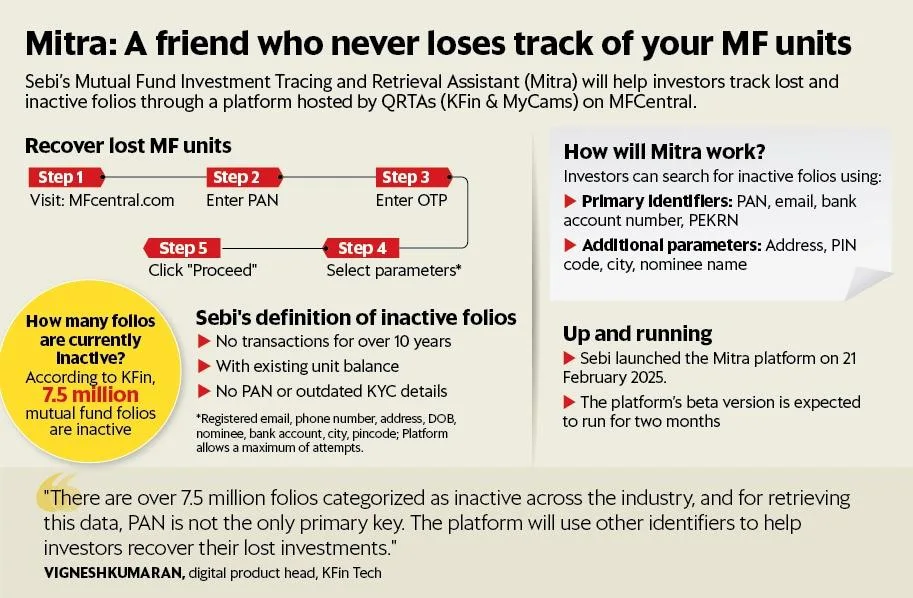
MITRA is intended to help investors and eligible claimants identify inactive and unclaimed mutual fund folios across the industry. This is particularly useful when someone remembers making an investment but cannot recall the name of the asset management company.
What Makes a Mutual Fund Folio Inactive?
Under the MITRA framework, an inactive folio generally refers to an account that has an existing unit balance but has not recorded an investor-initiated financial or non-financial transaction during the previous 10 years.
This means an investment can remain in the system even when the investor has not purchased additional units, redeemed money or updated the folio for a decade.
For example, an individual who purchased ₹20,000 worth of mutual fund units in 2010 and never touched the investment could have an inactive folio if the balance remains and the prescribed inactivity conditions are met.
The investment does not automatically become worthless simply because the investor has stopped monitoring it. Its current value depends on the applicable scheme NAV and the number of units held.
How Does MITRA Help Investors?
MITRA provides a searchable industry-level facility for identifying inactive and unclaimed mutual fund folios. An investor or eligible legal claimant can enter the information requested by the platform and check whether it identifies a matching investment.
When the submitted information matches the available records, the platform helps identify the mutual fund house associated with the potential investment. This removes the need to remember every AMC in which an old investment might have been made.
However, MITRA is primarily a tracing facility. It does not automatically transfer money to the investor's bank account. Once a potential investment is identified, the investor must contact the relevant AMC or registrar and complete the applicable verification and recovery procedure.
How to Search for Forgotten Investments Through MITRA
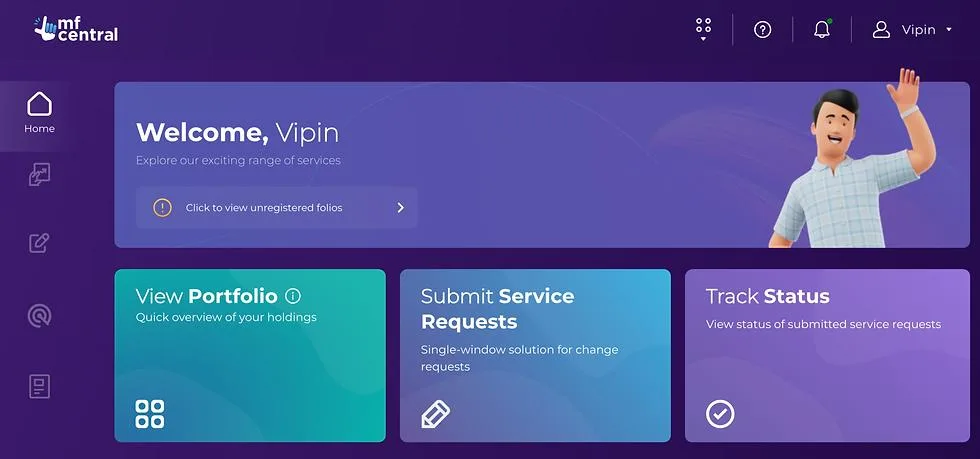
Investors can begin the search through the official MF Central website. The tracing facility is intended to help identify old investments using the information requested by the platform.
The practical procedure is:
Visit the official MF Central website.
Locate the MITRA service available through the website.
Open the mutual fund tracing facility.
Enter the identification details and other search parameters requested.
Review the results for matching inactive or unclaimed folios.
Identify the mutual fund house associated with the result.
Contact the respective AMC or registrar for account verification and recovery instructions.
Investors should use official websites and avoid sharing PAN, Aadhaar, OTPs or bank information with unofficial recovery agents.
How to Find Old Mutual Fund Investments Through CAMS
Computer Age Management Services (CAMS) is one of India's major mutual fund registrar and transfer agents. It maintains investor servicing and transaction records for the mutual fund houses it services.
Investors who purchased funds through older offline channels may find their investment information through CAMS even if they no longer possess their original account statements. Its consolidated statement services are particularly useful for investors who have accounts across multiple fund houses.
Obtaining a Consolidated Statement Through CAMS
CAMS offers a Consolidated Account Statement facility in collaboration with KFintech. It allows investors to request a combined view of eligible holdings across mutual funds serviced by both registrars.
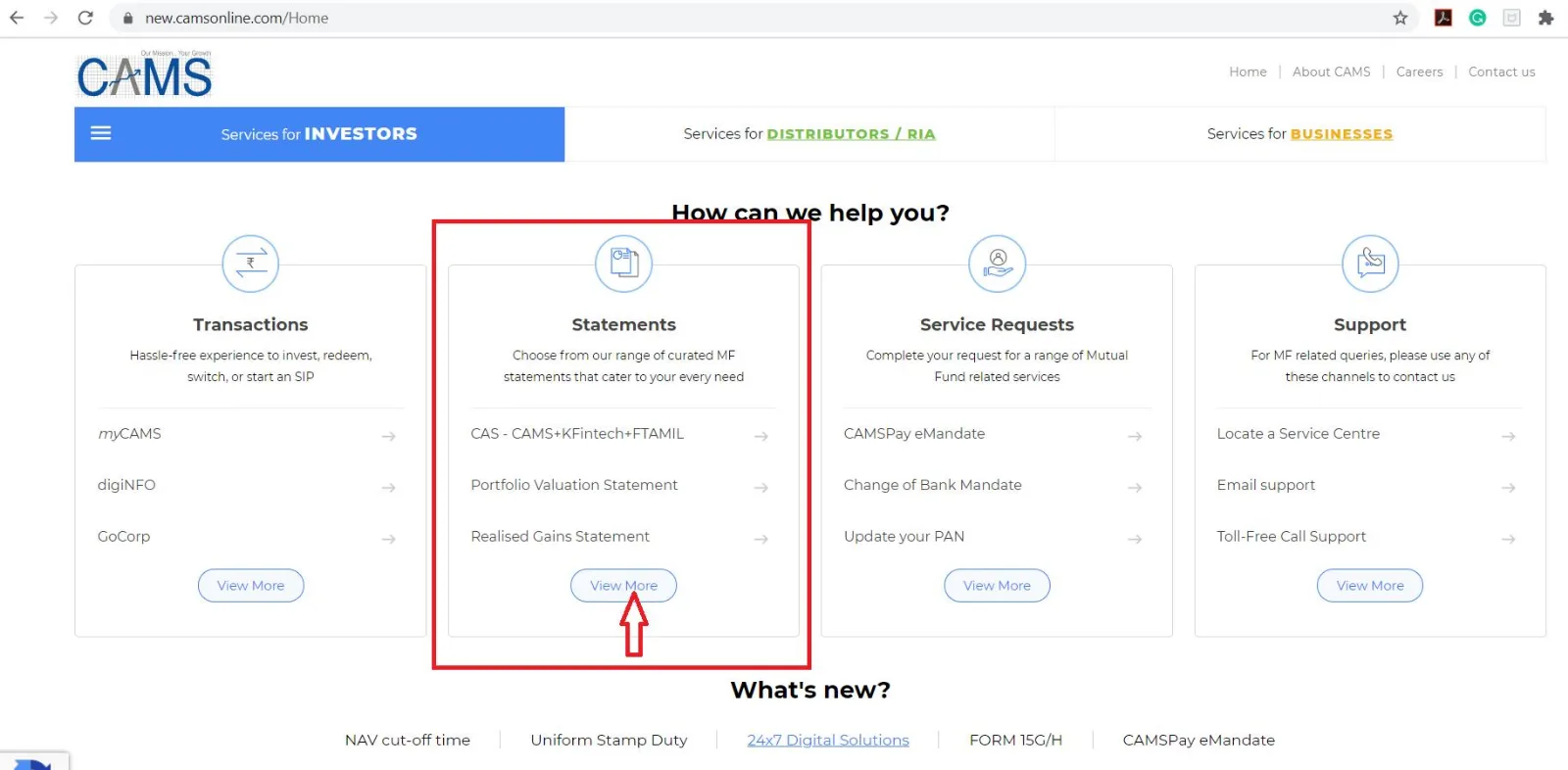
The investor can request a summary statement or a detailed statement, depending on the information required. The detailed version is useful when investigating old transactions, while the summary version provides a more compact portfolio overview.
Official facility: CAMS Consolidated Account Statement.
The facility generally uses the email address registered in the relevant folios. If that email address is no longer accessible, investors may need to approach the relevant registrar or AMC to update their contact information before requesting a statement.
What If the Old Email Address Is No Longer Accessible?
This is a common difficulty for investors who made their first mutual fund investments many years ago. If the registered email account is unavailable, the first step is to approach CAMS or the relevant AMC through its official service channels.
CAMS provides contact-detail update services for eligible folios. Its service request process allows investors to request changes to registered email addresses and mobile numbers across applicable CAMS-serviced folios.
Depending on the investor's records and verification requirements, supporting documents may include PAN details, a self-attested PAN card copy, the updated email address and new mobile number.
The availability of a PAN-based update depends on the investor's folio details, holder status and verification requirements. Investors should check the current procedure before submitting a request.
Official facility: CAMS Email and Mobile Update.
How to Find Forgotten Investments Through KFintech
KFintech is another major registrar that maintains investor records and provides services for the mutual fund houses it services. Investors who cannot locate old investment statements can use its account statement and investor service facilities.

The KFintech investor portal provides options to request consolidated account statements, individual folio statements, transaction statements and other portfolio-related information.
Requesting an Account Statement
Investors can begin by visiting the official KFintech mutual fund investor portal and selecting the relevant statement service.
Official facility: KFintech Consolidated Account Statement.
Depending on the selected service, investors may be able to request statements using registered email information or other supported identification details. A PAN-based portfolio search may also help identify investments associated with the investor in KFintech-serviced fund houses.
If the old contact information prevents online access, investors should use the registrar's official service request process to update their details after verification.
When Should Investors Approach CAMS and KFintech Separately?
Both registrars service different groups of mutual fund houses. An investor's entire portfolio may not be maintained by just one registrar.
For example, someone who invested in five different mutual fund houses might have holdings serviced by both CAMS and KFintech. Checking only one registrar's individual portfolio statement may therefore leave some investments unidentified.
The combined CAS facility is generally a more useful starting point. If a specific old investment is missing, checking the individual registrar and AMC records can help identify the reason.
Can AMFI Help Investors Locate Old Mutual Fund Folios?
The Association of Mutual Funds in India (AMFI) is the industry association representing mutual funds in India. It provides investor education, industry information, mutual fund resources and guidance about investor servicing.
AMFI is not a central bank account or a direct recovery agency holding investors' forgotten money. Investors should understand the difference between AMFI's information services and the actual records maintained by AMCs and registrars.
AMFI provides information about folio numbers, account statements, Consolidated Account Statements, unclaimed dividend and redemption payments, investor service procedures and mutual fund registrar details.
Its investor FAQs also explain where unclaimed dividend and redemption amounts can be located and how investors can approach the relevant mutual fund.
Useful official resources:
How a Consolidated Account Statement Can Reveal Forgotten Investments
A Consolidated Account Statement (CAS) is one of the most practical documents for investigating old mutual fund investments. Instead of requesting separate statements from every mutual fund house, investors can obtain a consolidated view of eligible holdings and transactions.
Depending on the statement type and reporting period, a CAS can provide information about mutual fund houses, scheme names, folio numbers, units held, purchase and redemption transactions, registered investor details and other available account information.
The detailed CAS is especially useful when an investor wants to understand how an old investment developed over time rather than simply check its current value.
How to Request a CAS
Investors can use the combined statement facilities offered through CAMS and KFintech. They can generally select between summary and detailed statements and choose the available reporting period.
The registered email address and holder details play an important role in retrieving consolidated information. Investors who cannot access the old email address should first investigate the contact-detail update procedure.
Why Might an Old Investment Not Appear in a CAS?
A CAS is useful, but it should not be treated as a guarantee that every investment ever made by an individual will appear in one report. There are several possible reasons for missing information.
Different PAN records: An old folio may have been created before PAN details were correctly recorded or may contain a different PAN.
Joint holding differences: The PAN and identity details of all holders can affect consolidation. Folios with different combinations of joint holders may not be combined in the same way.
Minor investments: A minor's folios may not be consolidated with a guardian's investments simply because the guardian's PAN is used elsewhere.
Demat investments: Mutual fund units held in dematerialised form may be reflected through depository information. Investors may need to check their depository participant records as well.
Zero-balance folios: A folio may have no remaining units but could still be relevant when investigating old transactions or unpaid amounts. Statement options that exclude zero-balance folios may omit it.
Missing or outdated records: Some old folios may require individual verification with the relevant AMC or registrar.
Investors should therefore treat CAS as an important starting point rather than the only method of locating forgotten investments.
Unclaimed Mutual Fund Dividends and Redemption Proceeds: Where Does the Money Go?
Finding an old folio is only one part of the problem. Investors may also have money that was declared payable but never successfully reached their bank accounts.
Mutual fund companies make payments for redemptions and Income Distribution cum Capital Withdrawal (IDCW) distributions. These payments may be sent electronically to registered bank accounts or through physical instruments, depending on the applicable payment arrangements.
When a payment cannot be completed, the amount may become unclaimed. This can happen because the registered bank account has been closed, an old address is no longer valid or a cheque was never deposited.
Why Does Mutual Fund Money Become Unclaimed?
Some common situations include:
Situation | What Can Happen |
|---|---|
Bank account closed | Redemption payment fails |
Old bank details | Payment cannot be credited |
Incorrect IFSC or account number | Electronic transfer fails |
Old postal address | Physical cheque is not received |
Cheque never deposited | Payment remains unrealised |
KYC incomplete | Payment cannot be processed |
Investor unaware of IDCW | Distribution remains unclaimed |
An investor may not even realise that a payment was attempted, particularly when the registered email address and mobile number have been inactive for several years.
Does the Money Disappear After Several Years?
An unpaid mutual fund redemption or IDCW amount is not automatically forfeited simply because the investor has not claimed it. Under the applicable framework, mutual funds deploy eligible unclaimed redemption and IDCW amounts in designated arrangements, including Unclaimed Dividend and Redemption Schemes (UDRS).
These arrangements generally use overnight, liquid or money market investments, subject to SEBI requirements. The investor can subsequently submit a claim through the relevant AMC or registrar after completing the required verification.
What Happens to the Appreciation on Unclaimed Amounts?
This is an important detail that investors should understand before assuming that the original unpaid amount and all subsequent investment returns will remain available indefinitely.
Under the applicable framework, the treatment of appreciation depends on when the claim is made:
For claims made within three years from the creation of units in the unclaimed scheme, the applicable appreciation is passed on to the investor.
Beyond three years, appreciation earned after that period is transferred to the investor education fund.
The investor can still claim the eligible amount, with valuation based on the applicable value at the end of the three-year period.
The payment is processed using the applicable NAV and prescribed claim procedure. Therefore, someone discovering an unpaid redemption amount after 10 or 15 years should not assume that it has continued earning returns at the rate of the original mutual fund scheme.
Practical Recovery Process: How to Get Your Forgotten Mutual Fund Money Back
Identifying an old folio is the discovery stage. Recovering the money requires establishing ownership, updating investor information and completing the AMC's verification process.
The following procedure can help investors approach the process systematically without making unnecessary visits to multiple fund houses.
Collect Whatever Old Investment Information Is Available
Start by searching old financial documents, emails and bank records. Even an incomplete statement containing the fund house name or folio number can make the investigation easier.
Look for old mutual fund account statements, investment application forms, cheque counterfoils, bank statements showing mutual fund payments, transaction confirmation emails and SMS messages from mutual fund companies.
Investors should also search old email accounts for terms such as mutual fund, folio, CAMS, KFintech, dividend, redemption, SIP and account statement.
Search for Inactive Investments Using MITRA
Visit MF Central and access the MITRA facility. Provide the requested information and examine the results for matching inactive or unclaimed investments.
This step is particularly useful when the investor does not remember the AMC or has lost the original folio statement. If MITRA identifies a potential match, note the mutual fund house and proceed to its investor service department or registrar.
Request a Consolidated Account Statement
Use the CAMS and KFintech consolidated statement facility to obtain a combined view of eligible investments. Try obtaining both summary and detailed statements, where available.
If the old registered email address is still accessible, the process may be straightforward. If it is not accessible, contact the relevant registrar and request the procedure for updating the email address after identity verification.
Identify the AMC and Registrar
Once the fund house is identified, determine whether the relevant folio is serviced by CAMS or KFintech. Approach the registrar or AMC with the available details and request folio identification, a current account statement and details of any unpaid dividend or redemption proceeds.
The investor should also ask for the applicable KYC update procedure and the required recovery or transmission forms. For an old folio that does not appear in an online statement, the AMC may need to investigate its records individually.
Complete KYC and Update Contact Details
Investors may need to complete or update their Know Your Customer (KYC) information before the AMC can process certain transactions or payments. Check whether the PAN, name, address and other identity details match the folio records.
If the registered mobile number or email address is outdated, submit the relevant contact-detail update request. The registrar may require additional verification if the old signature does not match the signature submitted with the new application.
Update Bank Account Details
Before requesting redemption or an unpaid payment, ensure that the correct bank account is registered. Depending on the AMC's requirements, investors may need to provide a cancelled cheque, bank passbook copy, recent bank statement or prescribed bank mandate form.
The bank account should satisfy the applicable holder-name requirements. In joint folios, the first mutual fund holder must generally be one of the joint holders in the registered bank account.
If the account cannot be validated electronically, the AMC may request additional documentary evidence.
Submit the Recovery Request
Once ownership, KYC and bank details are verified, submit the relevant request. The procedure depends on what the investor is trying to recover.
For existing mutual fund units: Submit a redemption request if the intention is to withdraw the investment. The investor may alternatively continue holding the units after updating the required records.
For unclaimed dividends or redemption proceeds: Download and submit the appropriate unclaimed amount claim form from the AMC's website or through its registrar.
For deceased investors: Follow the transmission process rather than attempting to redeem the units using the deceased investor's credentials.
Keep the acknowledgement or service request reference number for future communication.
Track the Payment and Retain the Confirmation
After submitting the application, monitor its status through the AMC or registrar. Check whether the request has been accepted, whether additional documents are required and whether the payment has been processed.
Investors should retain copies of submitted documents, acknowledgement receipts and payment confirmations. These records can help resolve delays or discrepancies if the recovery process requires additional communication.
Documents Required to Recover Forgotten Mutual Fund Investments
The documents required depend on the age of the folio, the investor's KYC status, the type of claim and whether the original investor is alive. Investors should check the current document checklist of the relevant AMC or registrar before submitting originals or attested copies.
Document | Why It May Be Required |
|---|---|
PAN card | Investor identification and KYC |
Aadhaar or other accepted identity proof | Identity verification, where applicable |
Address proof | Updating old address details |
Old mutual fund statement | Folio and scheme identification |
Registered mobile/email details | Contact verification |
Cancelled cheque | Bank account verification |
Bank passbook or statement | Additional bank proof |
Updated KYC information | Compliance requirements |
Signature verification | Matching existing folio records |
Claim form | Requesting unpaid amounts |
Nomination or transmission documents | Claims involving deceased investors |
Investors should not send original PAN cards, bank passbooks or other sensitive documents to an unofficial agent claiming to recover old mutual fund money. Use only the official submission channels specified by the AMC or registrar.
What Happens When the Original Mutual Fund Investor Has Died?
One of the most complicated forgotten-investment situations occurs when the person who purchased the mutual fund is no longer alive. The family may discover an old statement in a cupboard or among the deceased person's bank documents, but cannot simply redeem the units using the deceased investor's credentials.
The claim must be handled through the mutual fund transmission process. The procedure depends on whether a valid nominee was registered and what succession documents are available.
When a Nominee Is Registered
If the deceased investor had registered a valid nominee, the nominee can approach the AMC or registrar with the prescribed transmission application and supporting documents.
These may include the death certificate, nominee's PAN, KYC documents, bank account proof and prescribed transmission form. The AMC may request additional documentation depending on the folio and the circumstances of the claim.
After verification, the units can be transmitted to the nominee according to the applicable procedure.
When No Nominee Is Registered
If there is no registered nominee, the legal heirs may need to establish their entitlement through the applicable succession documentation. Depending on the circumstances and value of the investment, the AMC may request a legal heir certificate, succession certificate, probate, letters of administration, indemnity or other prescribed documents.
The exact requirements can differ depending on the applicable transmission thresholds and the legal circumstances of the deceased investor.
When Family Members Do Not Know Which Fund House Holds the Investment
This is where MITRA can be particularly useful. An eligible legal claimant can use the tracing facility to identify potential inactive or unclaimed folios and then contact the relevant AMC or registrar.
However, finding the fund house does not establish legal ownership by itself. The claimant must still complete the required succession and transmission verification before the investment can be transferred.
What If the Investor Cannot Find the Folio Number?
A folio number is useful, but not having it should not automatically stop an investor from investigating an old investment. The AMC or registrar may be able to identify the account using other information available in its records.
PAN-based identification: Ask the relevant AMC or registrar whether the investor's PAN can be used to locate folios.
MITRA search: Use the tracing platform to identify inactive and unclaimed investments.
Old bank statements: Search for transactions made to mutual fund companies or their collection accounts.
Old tax returns: Review available investment-related records, capital gains information and supporting documents.
Distributor records: If the investment was made through an intermediary, ask whether historical transaction or folio information is available.
Physical application copies: Search for old purchase applications, allotment confirmations or cheque records.
If the investment was made before PAN became mandatory or the old records contain inconsistent investor information, the AMC may require additional identity and ownership evidence.
How Long Does It Take to Recover Forgotten Mutual Fund Money?
There is no single recovery timeline applicable to every forgotten investment. The time required depends on the quality of the original records, the investor's KYC status, whether the signature matches, the availability of bank details and the type of claim.
Situation | What May Affect Processing |
|---|---|
Existing folio with valid KYC | Verification and normal transaction processing |
Old email or mobile number | Contact-detail verification |
Missing bank details | Bank mandate registration |
Signature mismatch | Additional verification |
Unclaimed redemption amount | Claim form and AMC verification |
Deceased investor | Transmission and succession documents |
Missing PAN or inconsistent records | Additional identity verification |
Investors should request an acknowledgement number and ask the AMC for an expected processing timeline. AMFI's guidance describes a payment process that generally takes 2–5 days after an unclaimed amount claim is accepted and processed, subject to applicable requirements.
This should not be confused with the total time required to resolve an old or incomplete folio, which may take longer when additional verification is necessary.
How Investors Can Prevent Mutual Fund Investments From Becoming Forgotten
Locating an old investment can take considerably more effort than maintaining a few basic financial records. Investors can reduce the possibility of losing track of their holdings by following a few simple practices.
Maintain One Primary Email Address
Use an email address that is likely to remain active for many years. Avoid using temporary office email addresses for personal investments, as access may be discontinued after changing employers.
Update the address with all relevant AMCs and registrars whenever it changes. Keeping a primary personal email address linked to investments also makes it easier to retrieve statements and transaction confirmations.
Keep Mobile Numbers Updated
A mobile number is frequently required for investor authentication and transaction alerts. Whenever a number changes, update the registered details instead of assuming that the new number will automatically replace the old one.
Investors should also verify that the correct number is registered across their different mutual fund folios.
Maintain a Central Investment Record
Keep a digital record containing the AMC name, scheme name, folio number, investment date, number of units, registered bank account, nominee details and registrar information.
The record should be stored securely rather than shared through unsecured messaging platforms. Family members should know where the records are maintained and how to access them when necessary.
Review the Portfolio at Least Once a Year
An annual review can reveal old investments, duplicate folios, outdated contact details and unpaid amounts. Investors should also check whether all eligible folios are correctly linked to their PAN and KYC information.
A periodic review of bank mandates and nominee details can help prevent avoidable complications when a redemption or transmission request is made.
Inform Family Members About Investments
Family members should know where investment records are maintained and how to contact the relevant fund houses. This becomes particularly important for older investors who have accumulated investments across several mutual fund companies.
Keeping an updated record of nominees and other important financial details can make it easier for legal claimants to identify and recover investments when required.
Frequently Asked Questions
Can I Find All My Old Mutual Fund Investments Using My PAN?
PAN-based identification and consolidated statements can help locate many mutual fund investments. However, they may not reveal every historical folio, particularly when old records have missing PAN information or inconsistent holder details.
MITRA and individual AMC or registrar enquiries can help investigate missing investments. Investors should also check whether any old folios were opened using different identity details.
Can I Recover Mutual Fund Investments Made 15 or 20 Years Ago?
Yes, potentially. The age of an investment alone does not mean that the units have disappeared. If the folio still has an outstanding unit balance, the investor can approach the relevant AMC or registrar to establish ownership and obtain the current account details.
The value of the investment will depend on the applicable scheme NAV and the units held, subject to the scheme's history and any transactions.
What Happens If I Have Lost My Original Mutual Fund Statement?
The original physical statement is not necessarily required in every case. The AMC or registrar may be able to identify the investment using PAN, investor details and other available records.
Additional verification may be required, particularly when the folio is old or the registered contact information is no longer available.
Can I Find Forgotten Mutual Funds Without Knowing the AMC Name?
Yes. MITRA is intended to help investors and eligible legal claimants identify inactive and unclaimed folios across the mutual fund industry.
A consolidated account statement can also help locate holdings when the registered information is available. If neither method identifies the investment, investors can investigate using old bank records and tax documents.
Is MITRA the Same as CAMS or KFintech?
No. MITRA is an industry-level tracing facility developed by the QRTAs. CAMS and KFintech are registrar and transfer agent organisations that maintain investor servicing records and facilitate account-related transactions for the mutual fund houses they service.
MITRA helps identify potential forgotten investments, while the relevant AMC and registrar handle verification and recovery.
Can I Claim an Old Mutual Fund Dividend That Was Never Credited?
Yes, subject to verification of the entitlement and the applicable claim procedure. Investors should approach the relevant AMC or registrar, obtain the unclaimed amount details and submit the prescribed claim form.
The amount payable may depend on the applicable unclaimed scheme valuation and the period for which the amount remained unclaimed.
Does Unclaimed Mutual Fund Money Earn Interest?
Unclaimed redemption and IDCW amounts are deployed under the applicable SEBI framework. They may earn investment appreciation through designated unclaimed schemes.
However, the appreciation passed on to investors depends on the applicable three-year rules and the date of claim. Investors should not assume that an unpaid amount has continued earning returns at the rate of the original mutual fund scheme.
Can I Recover Mutual Fund Investments Made by My Deceased Parents?
An eligible nominee or legal claimant can approach the relevant AMC or registrar to initiate transmission. The claimant must submit the required death certificate, identity documents and other applicable legal or succession documents.
The exact requirements depend on whether a nominee was registered and the circumstances of the claim.
Is There a Central Government Website That Holds All Forgotten Mutual Fund Money?
MITRA helps investors identify inactive and unclaimed mutual fund folios. It is a tracing platform, not a central account that directly holds or releases every investor's money.
The actual recovery process is completed through the relevant AMC or registrar after the investor's identity and entitlement have been verified.
What Should I Do If CAMS or KFintech Cannot Locate My Investment?
Approach the suspected AMC directly with your PAN, old investment documents, bank transaction evidence and other available details. Request a formal investigation of the old folio or transaction records.
If the issue remains unresolved, raise a formal grievance with the AMC and escalate it through SEBI's SCORES platform where appropriate.
The Forgotten Money Problem Is Bigger Than Missing Statements
An old mutual fund investment can remain outside an investor's financial awareness for years, particularly when the original purchase was made offline and the investor subsequently changed addresses, bank accounts or contact details.
The challenge is not always the absence of money. Sometimes it is the absence of a connection between the money and its rightful owner. An investor may have accumulated units over many years without realising that the folio still exists.
MITRA represents an important development because it gives investors and eligible legal claimants a dedicated mechanism to search for inactive and unclaimed mutual fund folios. CAMS, KFintech, AMFI and Consolidated Account Statements provide additional ways to identify holdings, verify records and initiate recovery.
For investors, the practical lesson is to treat old financial records as important assets rather than disposable paperwork. A forgotten folio may contain an investment that has remained untouched for decades, and a simple search could reveal something the family did not know it owned.
Official Sources and Investor Resources
These are useful primary sources for readers who want to verify the procedures or begin searching for their investments.
SEBI – MITRA circular: SEBI circular dated February 12, 2025.
MF Central: MITRA, portfolio and investor services.
KFintech: Mutual fund investor portal.
AMFI unclaimed mutual fund FAQ: Unclaimed amount and recovery procedure.
SEBI SCORES: Investor grievance redressal platform.
Disclaimer: This article is intended for investor education and general information. Investors should independently verify all website addresses, contact details and recovery procedures through the official websites of SEBI, AMFI, MF Central, CAMS, KFintech and the concerned asset management company. Do not trust unsolicited recovery offers, unofficial agents or websites claiming to represent financial institutions without verification. Never share OTPs, passwords, UPI PINs or banking credentials. Recovery eligibility, documentation and payment procedures are subject to applicable regulations and the requirements of the concerned AMC or registrar.