

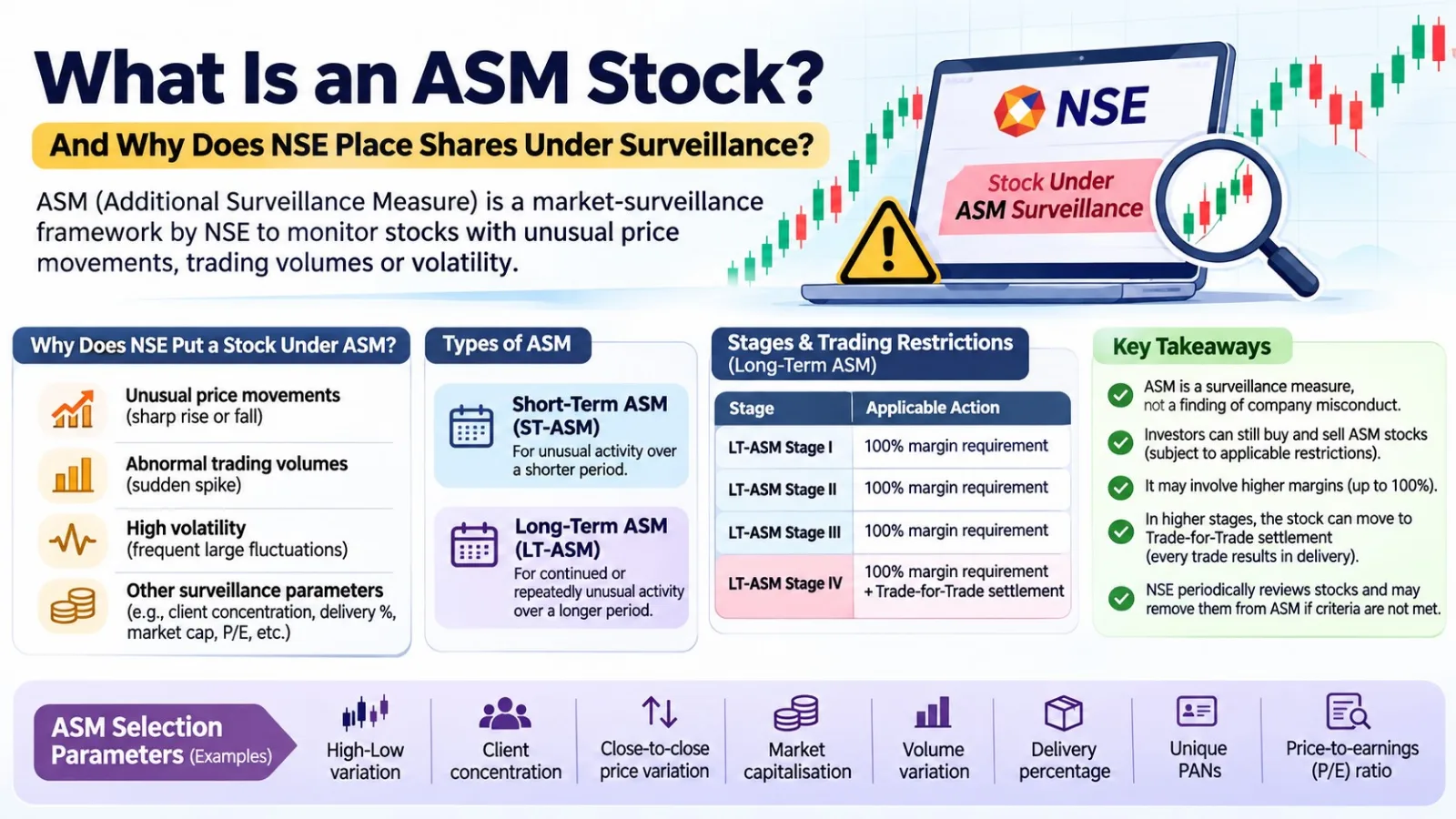
When a stock suddenly attracts unusual trading activity, sharp price movements or a significant increase in trading volumes, investors may notice a notification stating that the security has been placed under the Additional Surveillance Measure (ASM) framework.
The term ASM stock is frequently used in the Indian stock market to describe a share that has been placed under additional monitoring by the stock exchanges. The National Stock Exchange (NSE) and BSE use surveillance mechanisms to monitor unusual trading patterns and identify securities that may require closer examination.
For retail investors, an ASM notification can raise several questions. Does it mean the company is in financial trouble? Is the stock suspected of manipulation? Can investors still buy and sell the shares? Does an ASM classification affect the share price or trading limits?
The answer is not always straightforward. ASM is primarily a market-surveillance mechanism, not a declaration that a company has violated any regulation.
Understanding how the framework works can help investors interpret exchange notices and recognise the trading restrictions that may apply to a stock.
What Does ASM Mean in the Stock Market?
ASM stands for Additional Surveillance Measure. It is a surveillance framework introduced by Indian stock exchanges to monitor securities displaying unusual market behaviour.
Under this framework, exchanges identify stocks that meet specified surveillance criteria and place them under additional monitoring. Depending on the applicable stage and framework, these securities may face additional trading requirements, including higher margin requirements and restrictions on intraday trading.
The objective is to discourage excessive speculative activity and ensure that investors are aware of unusual trading conditions.
An important distinction is that an ASM classification does not automatically mean that the underlying company is financially weak, involved in fraud or under investigation.
A company with sound financial statements can also have its shares placed under ASM if the stock exhibits market activity that meets the exchange's surveillance parameters.
Why Does NSE Put a Stock Under ASM?
The NSE does not place a stock under surveillance simply because its share price increases. The exchange uses defined quantitative parameters to identify securities that exhibit unusual trading characteristics.
Some of the factors associated with surveillance selection include:
1. Unusual Price Movements
A stock that experiences significant price movements over a relatively short period may attract additional monitoring.
For example, a share trading at ₹100 may rise to ₹160 within a few weeks without any corresponding corporate announcement or publicly available development that explains the movement.
Such price behaviour may warrant closer examination by the exchange.
However, a price increase alone does not establish manipulation or wrongdoing.
2. Abnormal Trading Volumes
A sudden increase in trading volume is another important market indicator.
For instance, a stock that normally records daily trading volumes of 50,000 shares may suddenly witness transactions involving 10 lakh shares.
When trading activity changes substantially compared with historical levels, exchanges may examine the security more closely.
Unusual volumes can occur for several reasons, including increased investor interest, news announcements, speculative activity or concentrated trading.
3. High Volatility
Frequent and substantial price fluctuations can also attract surveillance attention.
A stock that repeatedly moves sharply between upper and lower price bands may exhibit a trading pattern that requires closer monitoring.
Volatility is not necessarily evidence of manipulation. However, unusually high volatility can increase the risk faced by investors, particularly those entering positions without understanding the stock's liquidity and trading conditions.
4. Market Capitalisation and Liquidity-Related Parameters
Surveillance frameworks may also consider characteristics such as market capitalisation, trading activity and liquidity.
Smaller companies and relatively low-liquidity stocks can sometimes experience substantial price movements following a comparatively small number of transactions.
These characteristics can make certain securities more susceptible to sharp price fluctuations.
The exchange applies its notified surveillance criteria rather than relying on a single indicator.
What Are the Parameters Used to Select ASM Stocks?
NSE and other exchanges use a combination of market-based parameters rather than one fixed condition.
According to NSE's published ASM framework, the parameters include:
Parameter | What the exchange examines |
|---|---|
High-Low Variation | Difference between the highest and lowest traded prices over a specified period |
Client Concentration | Concentration of trading activity among a limited number of clients |
Close-to-Close Price Variation | Changes in closing prices over a specified period |
Market Capitalisation | Market value of the company's outstanding shares |
Volume Variation | Changes in trading volumes |
Delivery Percentage | Proportion of traded shares resulting in delivery |
Unique PANs | Number of distinct PAN-linked market participants |
Price-to-Earnings Ratio | Valuation multiple compared with earnings |
These parameters help exchanges identify securities that display unusual trading patterns. The exact eligibility conditions, calculation periods and thresholds differ across the applicable ASM criteria and are periodically reviewed.
Types of ASM in the Indian Stock Market
The ASM framework has two primary categories: Short-Term ASM and Long-Term ASM.
1. Short-Term ASM (ST-ASM)
Short-Term ASM is designed to monitor securities that exhibit unusual market activity over a shorter period.
Stocks can enter this framework when their trading behaviour meets the applicable short-term surveillance criteria.
The exchange can move a security through different stages depending on its market activity and the applicable surveillance rules.
The primary objective is to alert investors and introduce additional trading safeguards where required.
2. Long-Term ASM (LT-ASM)
Long-Term ASM applies to securities that meet the specified long-term surveillance criteria.
Unlike short-term monitoring, this framework examines certain market characteristics over longer observation periods.
Stocks placed under Long-Term ASM can move through multiple stages. Each stage can introduce additional trading restrictions.
A stock's movement into a higher stage generally indicates that additional surveillance measures have become applicable.
What Are the Different Stages of ASM?
ASM classification is not limited to simply marking a stock as being under surveillance. The framework has multiple stages, and the applicable trading conditions depend on the stage.
The restrictions are particularly important because they can affect the margin requirements and settlement mechanism for investors.
Long-Term ASM stages
Stage | General surveillance action |
|---|---|
LT-ASM Stage I | 100% margin requirement |
LT-ASM Stage II | 100% margin requirement |
LT-ASM Stage III | 100% margin requirement |
LT-ASM Stage IV | 100% margin and transfer to Trade-for-Trade settlement |
The 100% margin requirement means that the applicable margin on open positions and new positions is increased to 100%.
In Stage IV, securities are additionally transferred from the regular rolling settlement segment (EQ) to the Trade-for-Trade segment (BE), subject to the applicable exchange rules.
Important: The table describes the broad Long-Term ASM stage structure. Investors should check the latest exchange circular for the exact conditions applicable to a particular security. Short-Term ASM has its own stage-wise surveillance actions.
What Does 100% Margin Mean for Investors?
One of the most important consequences of ASM classification is the possibility of a 100% margin requirement.
Under normal market conditions, brokers may provide margin-based trading facilities for eligible securities, subject to regulatory and broker-specific requirements.
However, when a stock enters an ASM stage carrying a 100% margin requirement, investors must provide the full applicable trade value as margin.
Example:
Suppose an investor wants to purchase 1,000 shares of a company trading at ₹200 per share.
Particulars | Amount |
|---|---|
Number of shares | 1,000 |
Share price | ₹200 |
Total purchase value | ₹2,00,000 |
Margin requirement | 100% |
Required margin | ₹2,00,000 |
The investor needs to arrange the full ₹2 lakh for the transaction, excluding applicable charges.
This can reduce the availability of leveraged trading and make speculative positions more expensive to maintain.
For traders who frequently use intraday or margin-based facilities, an ASM classification can therefore change their trading strategy.
What Is Trade-for-Trade Settlement in ASM?
Trade-for-Trade settlement is another important restriction that investors may encounter when a stock moves into a higher surveillance stage.
Under normal rolling settlement, eligible securities are settled according to the regular market settlement mechanism. Intraday traders can buy and sell shares during the same trading session without necessarily taking delivery.
Under Trade-for-Trade settlement, every executed transaction must result in delivery.
For example:
An investor purchases 100 shares of a stock.
The investor must take delivery of those shares.
The shares cannot simply be bought and sold repeatedly within the same trading session to settle only the net difference.
This restriction is intended to discourage excessive speculative activity.
For investors, it is important to understand that Trade-for-Trade settlement can affect liquidity, execution flexibility and the ability to exit positions quickly.
It does not mean that investors are permanently prohibited from buying or selling the stock.
Does an ASM Stock Mean the Company Is in Trouble?
No. This is one of the most common misunderstandings among retail investors.
An ASM classification is a surveillance action based on market-related parameters. It is not automatically a finding of financial misconduct, corporate fraud or regulatory violations.
Consider two hypothetical situations:
Company A: A profitable company announces strong quarterly results. Its share price rises sharply, trading volumes increase and the stock meets the applicable surveillance criteria.
Company B: A small company experiences substantial price fluctuations, concentrated trading activity and unusual delivery patterns.
Both securities could potentially meet surveillance criteria, even though their underlying business circumstances are very different.
The exchange's decision to place a security under ASM should therefore not be treated as an assessment of the company's business quality.
NSE has specifically clarified in its surveillance communications that shortlisting under ASM is purely on account of market surveillance and should not be construed as an adverse action against the company.
How Does a Stock Get Removed From ASM?
A stock does not remain under ASM permanently.
Exchanges periodically review securities placed under surveillance. If a security no longer satisfies the applicable selection criteria and meets the relevant exit conditions, it may be removed from the framework.
For Long-Term ASM, securities undergo stage-wise reviews. The NSE FAQ also specifies a minimum 90-calendar-day retention period in Stage IV for securities placed there under a particular selection criterion before they become eligible for the applicable stage-wise exit review. This is not a blanket 90-day exit rule for every ASM stock.
The removal process generally depends on:
Whether the stock continues to meet the surveillance criteria.
Its price and volume behaviour.
The applicable stage-wise review requirements.
Whether any additional conditions for continued surveillance remain applicable.
Investors should not assume that a stock will automatically exit ASM after a fixed number of days.
How to Check Whether a Stock Is Under ASM on NSE?
Investors can check the latest ASM list directly on the NSE website.
Investors can follow these steps:
Open the NSE ASM reports page.
Check the Long-Term ASM section.
Check the Short-Term ASM section separately.
Search for the company name or stock symbol.
Identify the applicable ASM stage.
Refer to the relevant exchange circular to understand the trading restrictions.
It is also useful to check the BSE surveillance list if the stock is listed on both exchanges.
ASM vs GSM: What Is the Difference?
ASM and GSM are two different surveillance frameworks used by Indian stock exchanges.
Although both are intended to protect market integrity and alert investors to unusual trading conditions, their selection criteria and surveillance actions differ.
Particulars | ASM | GSM |
|---|---|---|
Full form | Additional Surveillance Measure | Graded Surveillance Measure |
Primary purpose | Monitor securities with unusual market activity | Monitor securities exhibiting specific surveillance concerns |
Selection | Based on multiple market-related parameters | Based on specified graded surveillance criteria |
Restrictions | Stage-dependent margin and settlement measures | May include higher margins, trading restrictions and other measures |
Financial distress declaration | No | No |
GSM should not be confused with ASM. A stock can be subject to different surveillance measures depending on the exchange's applicable criteria.
Investors should check the actual surveillance category rather than assuming that all restrictions are identical.
What Should Investors Check Before Buying an ASM Stock?
An ASM notification should encourage investors to examine the stock more carefully instead of making an immediate buying or selling decision.
The following checks can help provide a clearer picture of the security.
1. Examine the Company's Financial Results
Check the latest quarterly results, revenue growth, operating margins, net profit and debt levels.
A sharp increase in the share price does not necessarily indicate that the company's financial performance has improved.
2. Compare Price Movement With Business Developments
Look at recent corporate announcements, exchange filings, acquisitions, orders and other material developments.
This helps investors understand whether publicly available business information accompanies the stock's price movement.
3. Examine Trading Volumes
Compare the current trading volume with historical averages.
A sudden increase in volume, particularly when accompanied by sharp price fluctuations, deserves closer examination.
4. Check Promoter Shareholding and Pledging
Review promoter holding, changes in promoter ownership and pledged shares.
These details can be found in the company's quarterly shareholding pattern and exchange disclosures.
5. Understand the Applicable ASM Restrictions
Not all ASM stocks have identical trading conditions.
Check whether the stock is under Short-Term ASM or Long-Term ASM and identify its current stage.
Pay particular attention to margin requirements and whether the security has moved to Trade-for-Trade settlement.
6. Check Liquidity and Exit Conditions
A stock may have limited buyers or sellers during certain trading sessions.
If the share price falls sharply or the stock reaches its lower circuit, investors may find it difficult to execute a sell order.
This is particularly important for low-liquidity securities.
Frequently Asked Questions About ASM Stocks
1. Can I Buy ASM Stocks?
Yes. ASM classification does not automatically prohibit investors from purchasing a stock.
However, the applicable margin requirements, settlement mechanism and other exchange restrictions must be followed.
2. Can I Sell ASM Stocks?
Yes. Investors can generally sell shares under ASM, subject to the applicable trading and settlement restrictions.
For stocks under Trade-for-Trade settlement, transactions must result in delivery.
3. Can I Do Intraday Trading in ASM Stocks?
It depends on the applicable ASM stage and other exchange restrictions.
Where a security is placed under Trade-for-Trade settlement, regular intraday square-off trading is not permitted. Other ASM stages can also carry restrictions that investors should verify before placing orders.
4. Does ASM Affect the Share Price?
ASM does not directly determine whether a stock's price will increase or decrease.
However, higher margin requirements and settlement restrictions can influence trading participation, liquidity and market behaviour.
The actual price movement continues to depend on buying and selling activity, company developments and broader market conditions.
5. Is an ASM Stock Safe to Invest In?
ASM classification alone cannot establish whether a stock is safe or unsafe.
Investors should independently examine the company's financial position, valuation, disclosures, liquidity and the reason for unusual trading activity.
6. Can a Fundamentally Strong Company Be Placed Under ASM?
Yes. ASM selection is based on market surveillance parameters. A company does not have to report losses or financial difficulties for its shares to meet the applicable surveillance criteria.
7. Is ASM the Same as a Stock Being Banned by SEBI?
No. ASM is an additional surveillance framework operated by stock exchanges in coordination with SEBI.
It is not equivalent to a trading ban or a regulatory finding against a company.
8. How Long Does a Stock Remain Under ASM?
There is no single fixed duration applicable to every ASM security. The duration depends on the framework, selection criteria, applicable retention conditions and periodic exchange reviews.
Understanding ASM Before Making a Trading Decision
ASM classification is an important part of India's stock market surveillance system. It allows NSE and other exchanges to monitor securities displaying unusual price movements, trading volumes, volatility and other market characteristics.
For retail investors, the most important point is to distinguish between a surveillance classification and the financial condition of the underlying company.
An ASM notification does not automatically indicate that a company is involved in wrongdoing or that its shares are unsuitable for investment. At the same time, investors should not ignore the additional restrictions that may accompany the classification.
Checking the applicable ASM stage, margin requirements, settlement conditions, company disclosures and trading liquidity can help investors understand the risks associated with a security before placing an order.
Note: Surveillance criteria and restrictions may change through exchange circulars. Investors should refer to the latest applicable NSE or BSE notification before trading.
Disclaimer:
This article is intended solely for educational and informational purposes and should not be considered investment advice or a recommendation to buy, sell or hold any security. GSM OR ASM classification and associated trading restrictions are determined by stock exchanges under the applicable regulatory framework and may change periodically. Readers should verify the latest circulars and announcements published by NSE, BSE and SEBI before making any investment or trading decisions. Candlesticks.in does not guarantee investment returns or accept responsibility for losses arising from decisions made based on the information presented in this article. Investors should consult a SEBI-registered investment advisor for personalised investment guidance.