


When a company launches an Initial Public Offering (IPO), investors often focus on the issue price, subscription numbers, valuation, and the expected listing performance. However, one important detail in the offer document deserves equal attention: whether the IPO consists of a fresh issue of shares, an Offer for Sale (OFS), or a combination of both.
Although both structures allow a company to list its shares on the stock exchange and bring in public shareholders, they serve different financial purposes. A fresh issue brings additional capital into the company, whereas an OFS allows existing shareholders, such as promoters, private equity investors, and venture capital funds, to sell part of their holdings.
This distinction can influence the company's post-listing balance sheet, debt position, ownership structure, and future capital allocation. Understanding where the IPO proceeds go helps investors distinguish between a company raising money to finance its operations and existing shareholders monetising their investments.
1. Understanding Fresh Issue and Offer for Sale in an IPO
An IPO can contain two principal components: a fresh issue of equity shares and an Offer for Sale by existing shareholders. Both involve shares being offered to public investors, but the destination of the money received is different.
What Is a Fresh Issue of Shares?
A fresh issue occurs when a company creates and issues additional equity shares to public investors. The money collected from investors goes directly to the company, increasing its share capital and securities premium.
The company can use these proceeds for business-related requirements, including:
Repayment or prepayment of outstanding borrowings.
Capital expenditure and expansion projects.
Setting up new manufacturing facilities.
Funding working capital requirements.
Research and development activities.
Acquisitions and strategic investments.
General corporate purposes.
For example, suppose a manufacturing company raises ₹500 crore through a fresh issue. The entire amount, after applicable issue expenses and adjustments, is available to the company for the purposes disclosed in its offer document.
If ₹200 crore is allocated towards debt repayment, ₹150 crore towards a new manufacturing facility, ₹100 crore towards working capital and ₹50 crore towards general corporate purposes, the proceeds are intended to support the company's financial and operational requirements.
However, the actual benefits depend on how efficiently the company deploys the funds and whether the proposed expenditure generates adequate returns.
What Is an Offer for Sale (OFS)?
An Offer for Sale is a component of an IPO in which existing shareholders sell their shares to public investors. Unlike a fresh issue, the company does not receive the proceeds from these transactions.
The selling shareholders may include:
Promoters and promoter group entities.
Private equity investors.
Venture capital funds.
Early-stage institutional investors.
Other existing shareholders.
Consider a company in which a private equity investor owns 20% of the equity. During the IPO, the investor decides to sell shares worth ₹300 crore through an OFS.
Public investors purchase those shares, and the proceeds go to the selling investor rather than the company. The company's existing share capital does not increase because of the OFS transaction.
An OFS does not automatically indicate financial weakness or a lack of confidence among promoters. Early investors may sell shares to realise returns after supporting the business for several years. Promoters may also reduce their holdings to meet regulatory requirements or diversify their personal investments.
The important consideration is the extent of the stake being sold, the identity of the selling shareholders and their ownership position after the IPO.
Fresh Issue vs. OFS: Structural Differences
Parameter | Fresh Issue | Offer for Sale |
|---|---|---|
Shares offered | Newly issued shares | Existing shares |
Money received by | Company | Selling shareholders |
Share capital | Increases | No increase |
Share dilution | Yes | No new-share dilution |
Debt repayment potential | Can directly fund repayment | Does not directly fund repayment |
Business expansion funding | Available | Not available |
Existing shareholder ownership | Diluted proportionately, subject to participation | Reduced for selling shareholders |
Primary purpose | Raise growth capital | Provide liquidity to existing shareholders |
The distinction is particularly important when evaluating IPO valuations. Two companies may raise the same amount from public investors, but their financial positions after listing can be very different depending on how much of the proceeds enters the business.
2. How Fresh Issue Proceeds Can Reduce Corporate Debt
One of the most direct financial benefits of a fresh issue is the potential reduction in outstanding borrowings.
Companies frequently borrow money to finance manufacturing facilities, infrastructure, acquisitions, working capital and other business activities. While debt can support expansion, excessive borrowing increases interest expenses and financial obligations.
When a company uses IPO proceeds to repay outstanding loans, its total debt can decline. This can reduce interest costs, improve leverage ratios and provide additional financial flexibility.
Understanding the Impact on the Balance Sheet
Consider a hypothetical company preparing to launch its IPO.
Before the IPO, its financial position is as follows:
Total Debt: Rs. 600 crore
Shareholders' Equity: Rs. 400 crore
Annual Interest Rate: 10%
Annual Interest Expense: Rs. 60 crore
Proposed Fresh Issue: Rs. 300 crore
The entire fresh issue amount is assumed to be allocated towards debt repayment.
Position After Debt Repayment
Remaining Debt: Rs. 300 crore
Annual Interest Expense: Rs. 30 crore
In this example, the company uses ₹300 crore from its fresh issue to repay part of its outstanding borrowings. Assuming the repaid loans carry an annual interest rate of 10%, the company could save approximately ₹30 crore in annual interest expenses.
The reduction in interest costs can improve profit before tax and, consequently, profit after tax, depending on the applicable tax treatment and other financial factors.
How Debt Repayment Changes Financial Ratios
Investors can examine several financial ratios to understand the impact of fresh issue proceeds on the company's balance sheet.
1. Debt-to-Equity Ratio
This ratio measures the relationship between a company's total borrowings and shareholders' equity.
Debt-to-Equity Ratio = Total Debt / Shareholders' EquityUsing the illustrative figures:Before IPO:Debt-to-Equity Ratio = 600 / 400 = 1.5After IPO and debt repayment, assuming Rs. 300 crore is added to shareholders' equity:Debt-to-Equity Ratio = 300 / 700 = 0.43
The reduction from 1.5 to approximately 0.43 indicates a lower debt burden relative to shareholders' equity.
2. Interest Coverage Ratio
The interest coverage ratio indicates how comfortably a company can meet its interest obligations using operating earnings.
Interest Coverage Ratio = EBIT / Interest ExpenseIf the company's annual EBIT is ₹120 crore, the ratio changes as follows:
Particulars | Before IPO | After IPO |
|---|---|---|
EBIT | ₹120 Cr | ₹120 Cr |
Interest expense | ₹60 Cr | ₹30 Cr |
Interest coverage | 2 times | 4 times |
A higher interest coverage ratio generally indicates a stronger ability to service debt.
3. Return on Equity (ROE)
Investors should also examine how fresh equity affects return on equity. When a company raises additional equity, its shareholders' funds increase. If profits remain unchanged immediately after the issue, ROE may decline because the earnings are being measured against a larger equity base.
ROE = (Profit After Tax / Average Shareholders' Equity) × 100Therefore, debt repayment can improve profitability through lower interest expenses, but the additional equity capital must also be considered when evaluating returns.
A lower debt burden does not automatically translate into higher shareholder returns. The long-term outcome depends on the company's ability to use its improved financial position productively.
3. Analysing Historical IPO Performance: Fresh Issue-Dominant vs. OFS-Heavy Offerings
Investors sometimes associate fresh issue IPOs with business expansion and OFS-heavy IPOs with promoter or investor exits. However, the structure of an IPO alone does not determine its listing performance or long-term returns.
An OFS-heavy IPO can belong to a profitable, cash-generating company with strong market positioning. Similarly, a fresh issue-heavy IPO may involve a company with high debt, uncertain expansion plans or an expensive valuation.
A useful comparison requires examining the IPO structure alongside the company's financial performance, valuation and subsequent business developments.
Examples of Different IPO Structures
The following Indian IPOs illustrate how public offerings can have different capital structures.
The following Indian IPOs illustrate how public offerings can have different capital structures.
Life Insurance Corporation of India (LIC) IPO – 2022
LIC's ₹21,008.48 crore IPO was entirely an Offer for Sale. The government sold part of its shareholding, and the proceeds went to the Government of India rather than LIC.
Hyundai Motor India IPO – 2024
Hyundai Motor India's approximately ₹27,870 crore IPO was entirely an OFS. Its parent company, Hyundai Motor Company, sold shares, and the Indian subsidiary did not receive fresh equity proceeds from the offering.
NTPC Green Energy IPO – 2024
The ₹10,000 crore IPO comprised a fresh issue, with no OFS component. The proceeds were intended to support the company's investment requirements, including repayment or prepayment of borrowings of its subsidiary and investment in that subsidiary.
Swiggy IPO – 2024
Swiggy's ₹11,327.43 crore IPO included a fresh issue of approximately ₹4,499 crore and an OFS of approximately ₹6,828 crore. The offering therefore combined capital raising for the company with partial exits for existing shareholders.
These examples demonstrate that an IPO can be structured entirely around existing shareholder sales, entirely around fresh capital or through a combination of both.
Does a Fresh Issue Lead to Better Listing Performance?
Not necessarily. Listing gains are influenced by several factors, including:
IPO valuation compared with listed industry peers.
Investor demand and subscription levels.
Overall stock market conditions.
Business growth expectations.
Profitability and cash flow.
Institutional investor participation.
The number of shares available for trading after listing.
A company raising fresh capital may have a clear expansion strategy, but the market may already have factored its future growth into the IPO price.
Similarly, an OFS-heavy company may attract investors because of its established business model, consistent profitability and strong competitive position.
How Investors Should Compare Post-Listing Performance
Rather than classifying IPOs simply as successful or unsuccessful based on their issue structure, investors can compare their performance across multiple periods.
Evaluation parameter | What investors should examine |
|---|---|
Listing performance | Listing price against IPO issue price |
Six-month performance | Share price movement after six months |
One-year performance | Return relative to the issue price and benchmark |
Revenue growth | Whether business revenue has expanded |
Profitability | Changes in operating margins and net profit |
Debt position | Whether borrowings have declined |
Capital efficiency | Returns generated from newly invested capital |
Cash flow | Whether operating cash flows support reported earnings |
Historical performance comparisons should also account for market conditions during the respective listing periods. A stock market rally or correction can affect IPO returns independently of the company's capital structure.
4. Evaluating General Corporate Purposes (GCP) in an IPO
One of the important sections investors should examine in an IPO prospectus is the proposed utilisation of issue proceeds under General Corporate Purposes (GCP).
Companies sometimes allocate a portion of fresh issue proceeds to GCP rather than assigning the entire amount to specific projects or debt repayment.
General Corporate Purposes provide companies with flexibility to meet various business requirements. These may include operational expenses, strategic initiatives, business development, administrative requirements and other corporate needs, subject to the disclosures and applicable regulatory conditions.
However, GCP allocations can be less specific than funds earmarked for identifiable projects.
Why GCP Allocation Matters
Consider a hypothetical company planning to raise ₹1,000 crore through a fresh issue.
Its proposed utilisation may look like this:
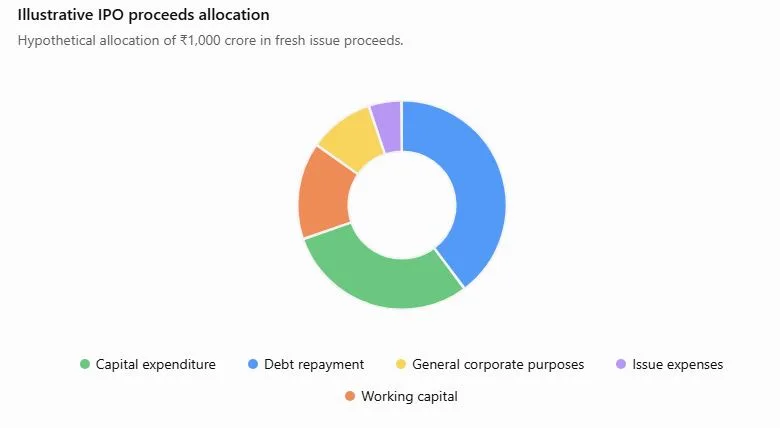
In this example, ₹100 crore, or 10% of the fresh issue proceeds, is allocated to general corporate purposes.
The allocation is not automatically problematic. A growing company may need flexibility to manage changing operational requirements. However, investors should understand how much of the IPO proceeds is allocated to specific purposes and how much remains available for broader corporate use.
Questions Investors Should Ask About GCP
1. What percentage of the fresh issue is allocated to GCP?
A higher GCP allocation means a larger portion of the proceeds is not tied to a narrowly defined project or financial obligation. Investors should examine this alongside the company's business requirements and overall fundraising objectives.
2. Are the specific business requirements clearly explained?
The prospectus should provide information about the intended utilisation of proceeds. Investors should look for explanations of the company's funding requirements rather than relying only on broad descriptions.
3. Does the company have a history of generating positive operating cash flow?
A company with consistently positive operating cash flows may have greater flexibility in managing routine expenses. A business with recurring cash flow deficits may require closer examination of how the additional funds will be used.
4. Is the company raising capital despite having substantial cash reserves?
If a company has significant cash and bank balances but is still raising a large amount through an IPO, investors should examine its liquidity requirements, debt maturity profile, expansion plans and other financial commitments.
5. How will the utilisation be monitored?
Investors can examine subsequent annual reports and company disclosures to understand whether the proceeds have been deployed according to the stated objectives.
Tracking IPO Proceeds After Listing
The examination of IPO proceeds should not stop once the shares are listed.
Companies are required to provide disclosures regarding the utilisation of issue proceeds under applicable SEBI regulations. Investors can examine these disclosures and the statutory auditor's reports on the utilisation of IPO funds.
Where applicable, the monitoring agency's reports also provide information about the deployment of proceeds, deviations from the stated objectives and the status of utilisation.
These documents can help investors identify delays in project execution, changes in capital allocation and unutilised IPO proceeds.
5. An Analytical Framework for IPO Investor Due Diligence
Understanding whether an IPO consists of a fresh issue or an OFS is only the starting point. Investors should examine the company's financial statements, ownership structure, valuation and proposed use of funds before assessing the offering.
The following framework can help organise this evaluation.
Step 1: Calculate the Fresh Issue and OFS Proportion
Start by identifying the total IPO size and separating the fresh issue component from the OFS component.
For example, consider an IPO with the following structure:
Total IPO size: ₹2,000 crore.
Fresh issue: ₹800 crore.
Offer for Sale: ₹1,200 crore.
The fresh issue and OFS percentages can be calculated as follows:
Fresh Issue Percentage = (Fresh Issue Amount / Total IPO Size) × 100Fresh Issue Percentage = (800 / 2,000) × 100 = 40%OFS Percentage = (OFS Amount / Total IPO Size) × 100OFS Percentage = (1,200 / 2,000) × 100 = 60%This means 40% of the IPO proceeds will go to the company, while 60% will go to existing shareholders selling their shares.
Step 2: Identify Who Is Selling Shares
The identity of selling shareholders provides additional context about the IPO.
Investors should examine:
Whether promoters are selling their shares.
Whether private equity or venture capital investors are reducing their holdings.
Whether early-stage investors are making a partial or complete exit.
How much ownership promoters retain after the IPO.
Whether significant shareholders remain subject to applicable lock-in requirements.
A private equity investor selling part of its holding after several years may be realising investment returns. A promoter reducing ownership may have different implications depending on the remaining stake, management involvement and corporate governance structure.
Neither transaction should be interpreted in isolation.
Step 3: Examine the Company's Debt Position
If the fresh issue proceeds are intended for debt repayment, investors should examine the company's existing borrowings.
Important parameters include:
Total borrowings.
Short-term and long-term debt.
Interest expenses.
Debt repayment schedules.
Secured and unsecured loans.
Debt-to-equity ratio.
Interest coverage ratio.
Investors should also check whether the proceeds are being used to repay loans of the issuer itself or its subsidiaries.
This distinction matters because the financial benefits may arise at different levels of the corporate structure.
Step 4: Evaluate the Proposed Capital Expenditure
When a company raises funds for expansion, investors should examine the commercial justification behind the proposed expenditure.
For a manufacturing company, this may include:
Proposed production capacity.
Estimated project cost.
Expected completion timeline.
Machinery and equipment requirements.
Land and infrastructure expenditure.
Expected utilisation levels.
Potential impact on revenue and operating margins.
Capital expenditure does not immediately guarantee higher earnings. New facilities may take several years to reach commercial production, and delays or cost overruns can affect the expected financial returns.
Step 5: Examine Valuation and Earnings Dilution
A fresh issue increases the number of outstanding shares, which can affect earnings per share.
EPS = Profit After Tax / Weighted Average Number of SharesFor example, if a company earns ₹100 crore and has 10 crore shares outstanding, its EPS is ₹10.
If a fresh issue increases the weighted average number of shares to 12 crore, while profit remains unchanged, EPS becomes approximately ₹8.33.
Particulars | Before fresh issue | After fresh issue |
|---|---|---|
Profit after tax | ₹100 Cr | ₹100 Cr |
Shares outstanding | 10 Cr | 12 Cr |
EPS | ₹10 | ₹8.33 |
This is an illustrative example that assumes no change in profit and a full-period share count. Actual post-issue EPS calculations depend on the timing of the issue and weighted average shares.
Investors should compare the post-issue valuation with listed peers using metrics such as price-to-earnings ratio, price-to-book ratio and enterprise value to EBITDA, where appropriate.
Step 6: Review Post-Listing Capital Utilisation
Once the company is listed, investors should track whether it deploys the proceeds as disclosed in the prospectus.
The following documents can help:
Annual reports.
Quarterly financial results.
IPO proceeds utilisation statements.
Monitoring agency reports, where applicable.
Stock exchange disclosures.
Corporate announcements.
Credit rating reports.
A company that raises capital for expansion but repeatedly delays its projects may require closer examination. Similarly, a company that repays debt should demonstrate the expected improvement in its financial position over subsequent reporting periods.
6. Why OFS-Heavy IPOs Are Not Necessarily Negative for Investors
An important distinction in IPO analysis is the difference between capital raising and shareholder liquidity.
An OFS does not add money to the company's balance sheet, but it can help existing shareholders realise their investments while allowing the company to enter the public markets.
There are several reasons why an OFS-heavy IPO may still represent an established and financially attractive business.
Institutional investors may be realising investment returns: Private equity and venture capital funds generally invest with an eventual exit strategy. An IPO provides an opportunity to sell part of their holdings through the public market.
The company may not require additional capital: A mature company with established operations, sufficient liquidity and manageable debt may not need a fresh equity infusion.
Public shareholders gain access to an established business: An OFS-heavy offering can provide an opportunity to invest in a company with an existing operating history rather than a business raising capital primarily for future expansion.
Promoter ownership may remain substantial: An OFS does not necessarily mean promoters are exiting completely. Investors should examine the remaining ownership percentage and management's continued involvement.
However, a large shareholder exit deserves careful examination when accompanied by weak financial performance, governance concerns, declining profitability or an expensive IPO valuation.
The selling shareholder's identity, the proportion of shares being sold and the company's financial condition should be evaluated together.
7. Fresh Issue and OFS: What Matters More for Long-Term Shareholders?
The distinction between fresh issue and OFS becomes particularly important when assessing the long-term financial impact of an IPO.
A fresh issue can strengthen a company's balance sheet, finance expansion and provide working capital. However, these benefits depend on capital allocation efficiency and the returns generated from the additional funds.
An OFS does not provide additional capital to the company, but it can allow early investors to exit without requiring the company to issue additional shares. Its effect on the company's financial position is different from that of a fresh issue.
Investors should therefore avoid using the fresh issue or OFS percentage as a standalone indicator of IPO quality.
A more meaningful evaluation combines the offering structure with the company's earnings, debt, cash flow, management track record, ownership structure and valuation.
Frequently Asked Questions
1. Does a company receive money from an Offer for Sale in an IPO?
No. In an Offer for Sale, existing shareholders sell their shares to public investors. The proceeds go to the shareholders selling those shares, not to the company.
2. Does a fresh issue increase the total number of shares?
Yes. A fresh issue involves the creation and allotment of additional equity shares. This increases the company's outstanding share count and can dilute the ownership percentage of existing shareholders.
3. Is an OFS-heavy IPO bad for investors?
Not necessarily. An OFS-heavy IPO may involve a financially strong and established company whose existing investors are reducing their holdings. Investors should examine the reason for the sale, the remaining promoter stake, financial performance and valuation.
4. Can a company use fresh issue proceeds to repay existing loans?
Yes. A company can allocate fresh issue proceeds towards repayment or prepayment of borrowings, provided the purpose is disclosed in the offer document and complies with applicable regulations.
5. What does General Corporate Purposes mean in an IPO?
General Corporate Purposes refers to a category of disclosed uses for IPO proceeds that allows a company to meet broader business requirements. Investors should examine the amount allocated to GCP and compare it with the company's specific funding needs.
6. Where can investors find the fresh issue and OFS details?
Investors can find these details in the IPO's Draft Red Herring Prospectus (DRHP), Red Herring Prospectus (RHP) and final prospectus. These documents are generally available through the company's website, SEBI's website and the websites of the stock exchanges.
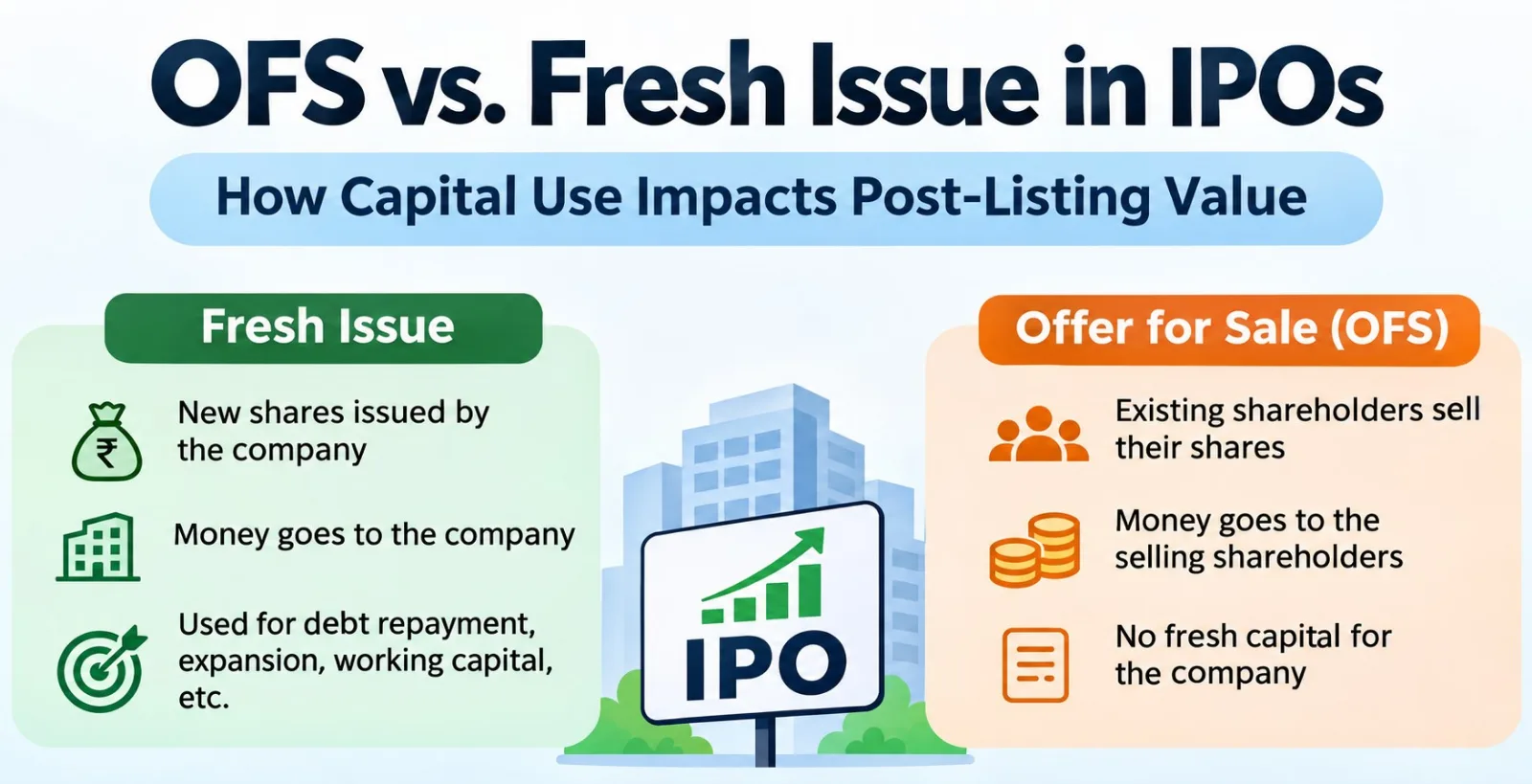
The difference between an Offer for Sale and a fresh issue goes beyond the technical structure of an IPO. It determines whether the money raised from public investors enters the company's balance sheet or goes to existing shareholders.
A fresh issue can support debt reduction, expansion and operational funding, while an OFS primarily provides liquidity to existing investors. Neither structure independently establishes whether an IPO is attractively priced or suitable for long-term investment.
For investors evaluating an IPO, the more important exercise is to understand the purpose of the fundraising, the financial condition of the company, the identity of selling shareholders and the expected benefits of the proposed capital allocation. Examining these factors together provides a clearer picture of what public investors are actually funding when they subscribe to an IPO.
Disclaimer: This article is intended for educational and informational purposes only. It does not constitute investment advice or a recommendation to subscribe to or avoid any IPO. Investors should read the relevant offer documents and evaluate the risks before making investment decisions.