


An investor applying for ₹1 crore worth of shares in an IPO may not necessarily have ₹1 crore sitting in a bank account. Some high-net-worth individuals (HNIs) use short-term financing from Non-Banking Financial Companies (NBFCs) to submit larger applications in the Non-Institutional Investor (NII) category. The arrangement allows them to borrow a substantial portion of the application amount while contributing the remaining money themselves.
At first glance, the strategy may appear straightforward. Borrow money for a few days, apply for a large IPO allocation and sell the shares after listing. If the stock opens at a premium, the investor can potentially earn a return on a much larger application than their personal contribution would otherwise allow.
But there is another side to this calculation. Interest starts accumulating on the borrowed amount, and the lender may also charge processing fees and applicable taxes. If the allotment is small, these expenses can consume a significant portion of the listing gain. In some cases, even a stock that lists in positive territory may not generate enough money to cover the cost of financing.
The Borrowing Behind a Large IPO Application
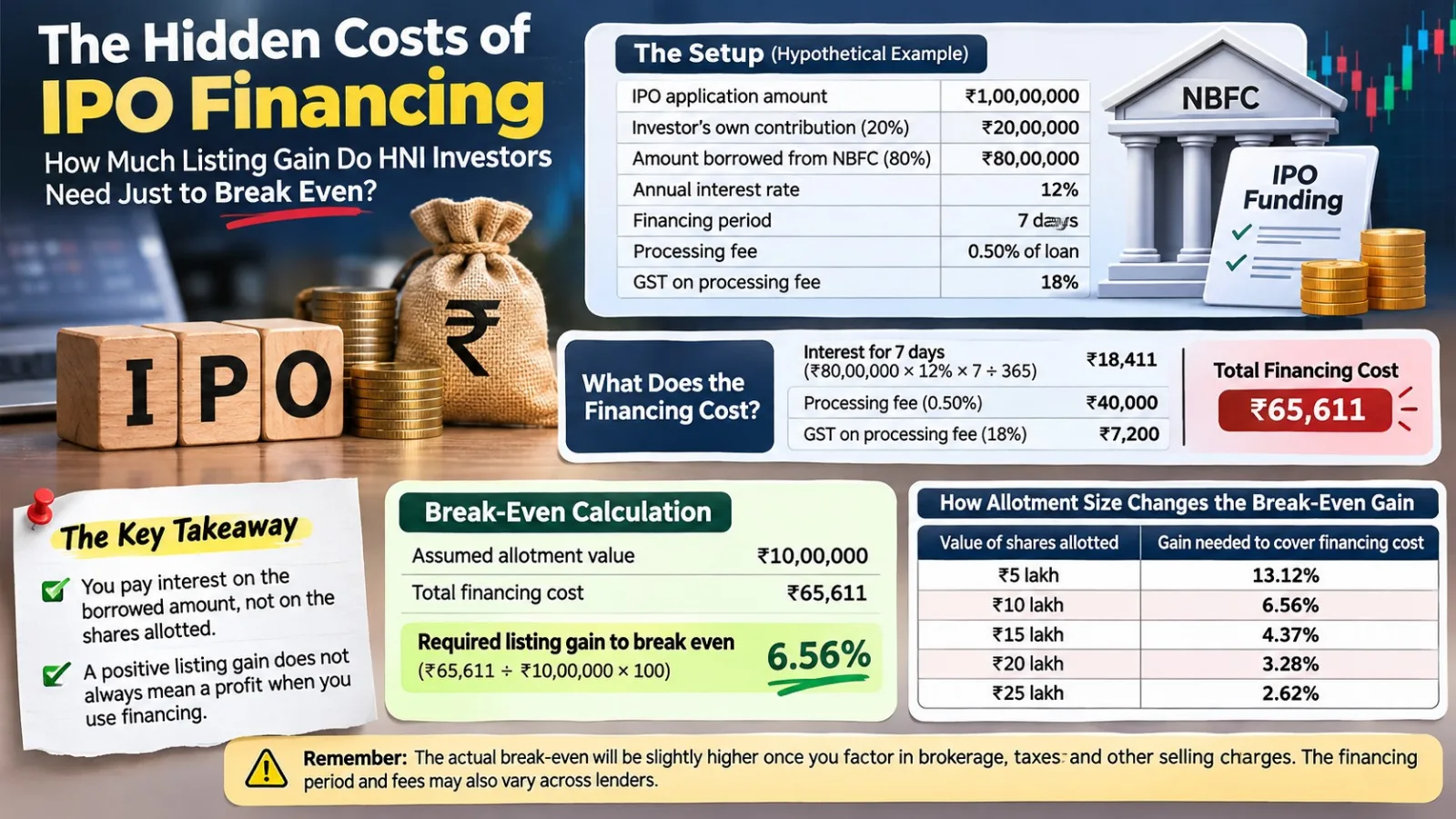
Consider an investor who wants to submit a ₹1 crore application in an IPO but does not want to use the entire amount from personal savings. The investor approaches an NBFC offering IPO financing and receives funding for 80% of the application value.
The arrangement in this hypothetical example looks like this:
Particulars | Amount |
|---|---|
IPO application amount | ₹1 crore |
Investor contribution | ₹20 lakh |
Amount borrowed from NBFC | ₹80 lakh |
Annual interest rate | 12% |
Assumed financing period | 7 days |
The investor contributes ₹20 lakh and borrows the remaining ₹80 lakh. The application is submitted through the applicable IPO application process, with funds blocked as required.
The important point is that the investor is paying interest on ₹80 lakh, not on the value of shares that might eventually be allotted. This distinction becomes particularly important in heavily subscribed IPOs, where a large application does not necessarily result in a proportionately large allotment.
Seven Days of Borrowing Can Add Up
A 12% annual interest rate may not sound particularly expensive when viewed over an entire year. However, the amount borrowed for IPO applications can be substantial, and even a short financing period creates a cost.
Using simple interest and a 365-day year, the daily interest on an ₹80 lakh loan works out to approximately ₹2,630.
Daily interest = ₹80,00,000 × 12% / 365
For seven days, the calculation becomes:
Seven-day interest = ₹80,00,000 × 12% × 7 / 365
Total interest = approximately ₹18,411.
This is the interest expense alone. It does not include the charges that the lender may collect for arranging the financing.
The actual interest period depends on the lender's agreement and the dates on which the funds are disbursed and repaid. Seven days is used here only to illustrate the calculation.
The Processing Fee Is Another Expense Investors Need to Consider
NBFC financing arrangements may include processing fees in addition to interest. The fee structure differs between lenders, so investors should check the actual quotation rather than assume that every financing facility has the same charges.
For this example, assume the NBFC charges a processing fee of 0.50% on the ₹80 lakh borrowed amount.
That works out to ₹40,000. If GST at 18% applies to the processing fee, another ₹7,200 is added to the bill.
The total cost now looks considerably different:
Financing expense | Amount |
|---|---|
Interest for seven days | ₹18,411 |
Processing fee (0.50%) | ₹40,000 |
GST on processing fee | ₹7,200 |
Total financing expense | ₹65,611 |
The investor has already incurred approximately ₹65,611 before accounting for any brokerage or share-selling expenses.
This is where the economics of IPO financing become interesting. The investor's borrowing cost is calculated on ₹80 lakh, but the eventual allotment could be worth a much smaller amount.
A ₹10 Lakh Allotment Changes the Entire Calculation
Suppose the investor receives shares worth ₹10 lakh from the ₹1 crore application. The investor has borrowed ₹80 lakh, paid ₹65,611 in financing expenses and received an allotment worth just 10% of the original application.
Now consider the listing price.
If the shares list at a 5% premium, their market value becomes ₹10.5 lakh. The investor has made a gross gain of ₹50,000.
However, the financing expense is ₹65,611.
Despite receiving a positive listing gain, the investor is still short by approximately ₹15,611, even before other transaction costs.
This illustrates why looking at the listing premium alone can give an incomplete picture of the actual return from a leveraged IPO application.
The Listing Gain Required to Recover the Financing Cost
The break-even calculation becomes easier when the total financing expense is compared with the value of shares actually allotted.
In this example:
Total financing expense = ₹65,611
Value of shares allotted = ₹10,00,000
Required listing gain = (₹65,611 / ₹10,00,000) × 100
Required listing gain = approximately 6.56%.
The shares therefore need to appreciate approximately 6.56% above their issue price just to recover the assumed financing expenses.
This is a financing-cost break-even point, not a complete net-profit calculation. Brokerage, applicable taxes and other selling charges would push the actual break-even level slightly higher.
A Smaller Allotment Can Make the Borrowing More Expensive
The same ₹65,611 financing expense produces a very different result depending on how many shares the investor receives.
Value of shares allotted | Gain needed to recover financing cost |
|---|---|
₹5 lakh | 13.12% |
₹10 lakh | 6.56% |
₹15 lakh | 4.37% |
₹20 lakh | 3.28% |
₹25 lakh | 2.62% |
Consider two investors who borrow the same amount at the same interest rate. Both pay the same financing charges, but one receives shares worth ₹5 lakh while the other receives ₹20 lakh.
The first investor needs a listing gain of more than 13% just to recover the assumed financing expense. The second needs approximately 3.28%.
The difference comes entirely from the allotment value. This is why the cost of financing should never be evaluated independently of the likely allotment size.
What If the IPO Lists Flat or Below the Issue Price?
IPO financing becomes particularly challenging when the stock fails to deliver the expected listing premium.
Suppose shares are allotted at ₹100 each. If the stock lists at ₹105, the investor gets a 5% gross price gain. But as the earlier calculation shows, a 5% gain is insufficient to cover the financing expense when the allotment is worth ₹10 lakh.
If the stock lists at ₹100, there is no price appreciation to offset the borrowing cost. The investor still has to account for the interest and processing fee.
A listing at ₹95 creates an additional loss from the fall in share price, on top of the financing expense.
There is also the possibility of receiving no allotment at all. In that situation, the application funds may be released or unblocked according to the applicable process, but any interest or contractual fees already incurred under the financing arrangement may still remain payable.
Borrowing therefore creates an expense that does not disappear simply because an IPO performs poorly or an investor receives no shares.
Why the Actual Financing Period Matters
Seven days is a convenient period for understanding IPO funding costs, but it should not be treated as a fixed rule for every public issue.
The actual period depends on when the financing is arranged, when the lender releases the funds, when allotment is finalised and when the borrowed amount is repaid. Changes in the IPO timetable can also affect the number of days for which interest is charged.
For example, extending the borrowing period from seven to ten days increases interest in the above illustration from approximately ₹18,411 to ₹26,301. The processing fee may remain unchanged, depending on the lender's terms.
That additional three-day period increases the financing expense by nearly ₹7,890 without changing the number of shares allotted.
Investors should therefore check whether the lender calculates interest on actual calendar days, whether there are minimum interest charges and whether any additional repayment or processing fees apply.
The Difference Between ASBA and IPO Financing
Another point worth understanding is the difference between the IPO application mechanism and the source of funds used to support the application.
Under Application Supported by Blocked Amount (ASBA), the application money is blocked in the investor's bank account rather than immediately transferred to the issuer. The amount corresponding to shares allotted is debited, while the remaining blocked amount is released according to the applicable process.
ASBA itself is not a loan facility. When an investor uses NBFC financing, the borrowing arrangement is separate from the IPO application mechanism. The investor must meet the lender's repayment obligations regardless of the eventual listing performance.
This distinction is important because the application amount, borrowed amount and actual allotment value are three different figures. Treating them as the same can lead to an incorrect estimate of the investment's real cost.
What HNI Investors Should Examine Before Using IPO Funding
The annual interest rate is only one part of the financing decision. An investor considering an NBFC facility should examine the processing fee, applicable GST, interest calculation method, minimum financing period and repayment conditions.
The allotment assumption also deserves attention. A ₹1 crore application does not mean the investor will receive ₹1 crore worth of shares. The amount actually allotted determines how much listing appreciation is available to absorb the financing expense.
Most importantly, the calculation should include an unfavourable outcome. A flat listing, a fall in the share price or no allotment can leave the investor paying borrowing costs without receiving the expected benefit.
IPO financing can increase the size of an application, but it also introduces a separate layer of expenses and repayment obligations. For HNI investors, the relevant question is not simply whether an IPO is expected to list at a premium. It is whether the potential gain on the shares actually allotted is sufficient to cover the complete cost of obtaining the funds.
Disclaimer: This article is for educational and informational purposes only and should not be considered investment or borrowing advice. IPO financing involves financial risks, including interest expenses and possible losses. Interest rates, fees, eligibility and repayment conditions vary by lender. Investors should verify the applicable terms and consult a SEBI-registered investment adviser before making investment decisions.