

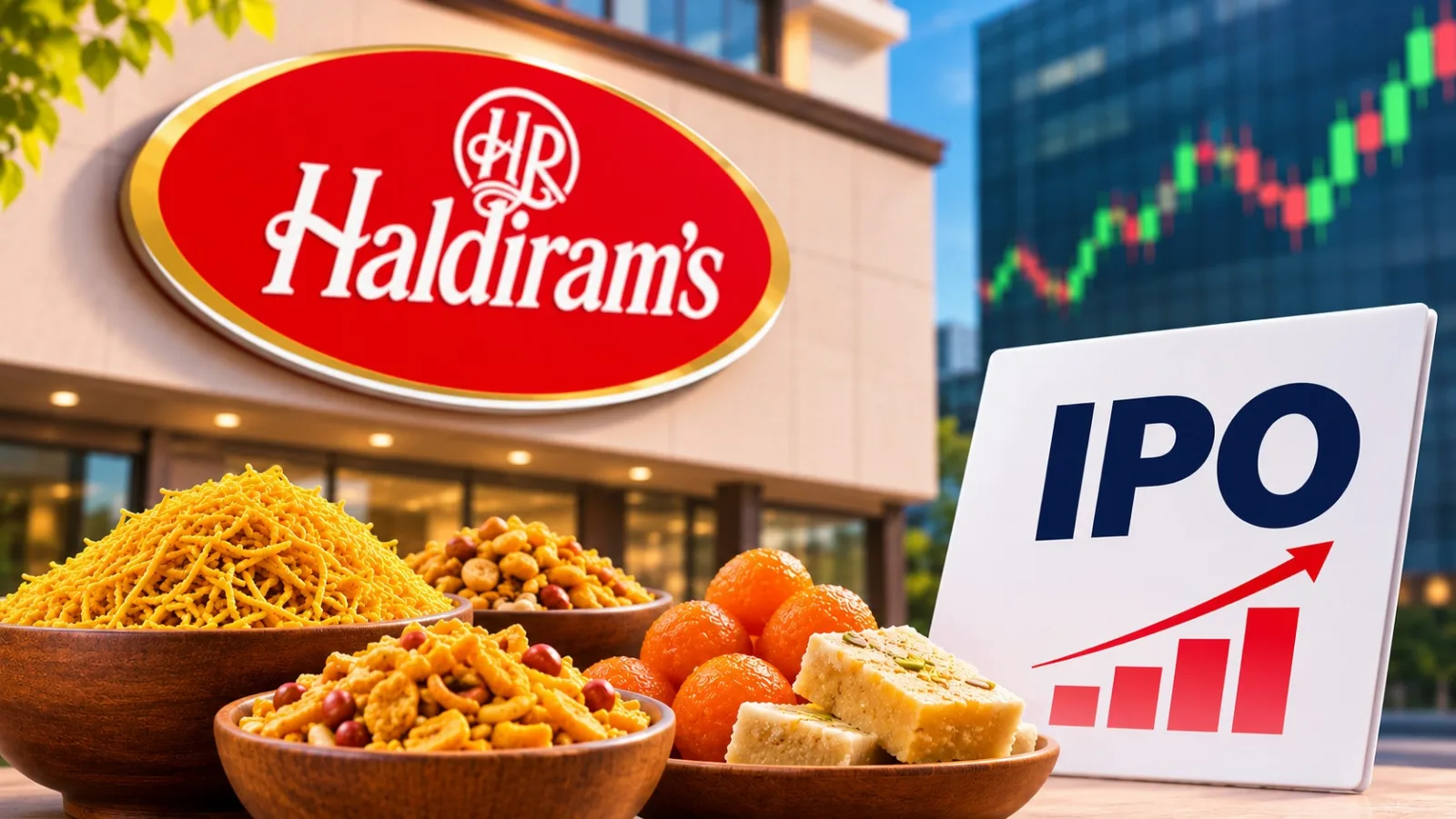
India's packaged snacks market could see one of its biggest stock market listings in 2027, with Haldiram Snacks Food beginning preparations for a proposed ₹10,000 crore initial public offering (IPO). The company is reportedly targeting a listing in the second half of 2027, with an expected valuation of more than ₹1 lakh crore.
The proposed public issue could attract considerable attention from institutional and retail investors because of Haldiram's established presence in namkeen, sweets and packaged foods. Its financial scale, international expansion and investments from global private equity investors have also placed the company among the most closely watched potential IPO candidates in India's consumer sector.
The proposed listing also creates an interesting comparison with Bikaji Foods International, one of Haldiram's closest listed competitors. While Haldiram operates at a substantially larger revenue scale, Bikaji offers investors an existing market valuation against which Haldiram's proposed IPO pricing can be assessed.
Haldiram IPO Latest News: Company Begins Preparations for 2027 Listing
Haldiram Snacks Food has formally initiated preparations for its proposed public issue and appointed professional services firm EY for the project management office (PMO). The mandate reportedly involves coordinating compliance requirements and different business functions ahead of the planned listing.
The company is considering a late-2027 market debut, with an estimated issue size of approximately ₹10,000 crore, equivalent to around $1 billion. The proposed IPO is expected to include a combination of a fresh issue of shares and an offer for sale (OFS) by existing shareholders.
The preparation process is expected to involve corporate restructuring, financial reporting, governance requirements and regulatory coordination. The final issue structure and listing timeline will depend on the completion of these preparations and applicable regulatory procedures.
Haldiram IPO: Important Details
Particulars | Details |
|---|---|
Company | Haldiram Snacks Food Pvt Ltd |
Proposed IPO Year | 2027 |
Expected Listing | Second half of 2027 |
Estimated Issue Size | Around ₹10,000 crore |
Reported Valuation Target | More than ₹1 lakh crore |
Proposed Issue Structure | Fresh Issue and OFS |
Project Management | EY |
Price Band | Not announced |
Lot Size | Not announced |
IPO Opening Date | Not announced |
Stock Exchange | Not announced |
These figures represent reported plans rather than final IPO terms. Investors will receive confirmed details through the company's formal disclosures and draft red herring prospectus (DRHP).
Temasek, IHC and Alpha Wave Enter Haldiram Ahead of IPO
Haldiram attracted major international institutional investors in 2025, establishing an important private-market valuation benchmark ahead of its proposed public listing.
In March 2025, Singapore-based investment firm Temasek acquired an approximately 10% stake in Haldiram's snacks business for around $1 billion. The transaction valued the business at approximately $10 billion, or ₹84,000–85,000 crore at the prevailing exchange rate.
Abu Dhabi-based International Holding Company (IHC) and Alpha Wave Global subsequently joined the company's ongoing equity financing round. However, the individual investment amounts and exact stake allocations for these two investors were not publicly disclosed in the announcement.
Reports indicated that Temasek, IHC and Alpha Wave Global together acquired approximately 15% of the company during the investment round. The promoter family retained the remaining majority ownership at that stage.
US-based private equity investor L Catterton also invested in Haldiram in December 2025. The entry of these international investors strengthened the company's institutional investor base ahead of its proposed stock market debut.
The earlier $10 billion valuation provides an important reference point for understanding Haldiram's private-market pricing. However, the reported IPO valuation of more than ₹1 lakh crore would represent a further increase over the 2025 investment benchmark.
Haldiram's Business: From Traditional Namkeen to a Global Packaged Food Portfolio
Haldiram's business has expanded considerably beyond its original focus on traditional Indian namkeen and sweets. Its product portfolio includes bhujia, mixtures, chips, extruded snacks, packaged sweets, frozen foods, ready-to-eat meals, baked products and other packaged food categories.
The company's international business portfolio covers more than 500 export products across nine product categories, with a presence in over 80 countries, according to its official international business information.
The wider Haldiram brand is also associated with branded restaurants, food outlets and retail formats. However, investors should distinguish these businesses from the merged packaged-food operations of Haldiram Snacks Food, as the precise corporate structure and assets included in the proposed IPO will need to be established through the offer documents.
The merger of the Delhi and Nagpur FMCG businesses created a larger operating entity with a wider geographical footprint. The combined business now has a presence across more than 33 states and union territories and operates 26 manufacturing units.
International expansion is another part of its business strategy. Nevertheless, exports contributed approximately 8% of total revenue in FY25, according to CRISIL Ratings. This indicates that the company's overseas distribution network is considerably larger than its current contribution from international sales.
Haldiram Financial Performance: ₹12,977 Crore Revenue in FY25
Haldiram Snacks Food reported operating revenue of ₹12,977 crore in FY25, its first full financial year following the consolidation of the Delhi and Nagpur FMCG operations.
The company reported a profit after tax (PAT) of ₹1,195 crore during the year, representing a net profit margin of approximately 9.2%. CRISIL Ratings also reported operating margins of around 18–19%, supported by its brand strength, distribution network and cost-management practices.
During the first half of FY26, the company recorded revenue of ₹7,762 crore, with operating margins remaining close to 19%. CRISIL expected revenue to grow by around 9–10% in FY26, partly reflecting initial operational challenges following consolidation and lower exports affected by US tariffs.
Haldiram Financial Performance
Financial Metric | Reported Figure |
|---|---|
FY25 Revenue | ₹12,977 crore |
FY25 Profit After Tax | ₹1,195 crore |
FY25 PAT Margin | 9.2% |
FY25 Operating Margin | 18–19% |
H1 FY26 Revenue | ₹7,762 crore |
H1 FY26 Operating Margin | Approximately 19% |
FY25 Return on Capital Employed | Above 24% |
The company's profitability is supported by its established sourcing network and operating scale. However, raw materials such as palm oil, pulses, sugar, gram flour and packaging materials account for approximately 60–62% of production costs, making margins sensitive to commodity price movements.
Haldiram vs Bikaji Foods: Revenue and Profitability Comparison
Haldiram's proposed IPO will also bring greater investor attention to Bikaji Foods International, which is already listed on Indian stock exchanges.
Both companies have strong positions in India's ethnic snacks market and have built their businesses around traditional Indian food products. However, their revenue scale, product positioning, geographical reach and operating structures are different.
Haldiram's FY25 revenue of ₹12,977 crore was approximately 4.3 times Bikaji's FY26 revenue of ₹2,993.86 crore. This is an indicative scale comparison using the latest full-year figures available for each company, rather than a same-period comparison.
Bikaji reported consolidated revenue growth of approximately 14.4% in FY26, while its profit after tax increased by nearly 31% to ₹254.41 crore. The company also expanded its ethnic snacks, packaged sweets and western snacks businesses.
Haldiram vs Bikaji: Financial Comparison
Financial Metric | Haldiram Snacks Food | Bikaji Foods International |
|---|---|---|
Latest Annual Financial Year | FY25 | FY26 |
Revenue | ₹12,977 crore | ₹2,993.86 crore |
Profit After Tax | ₹1,195 crore | ₹254.41 crore |
PAT Margin | 9.2% | 8.5% |
Operating Profitability Indicator | 18–19% operating margin | ₹410.59 crore EBITDA |
Return on Capital Employed | Above 24% | 21.62% |
Market Status | Unlisted | Listed |
Reported Private Valuation / Market Capitalisation | Approximately ₹85,000 crore in 2025 | Approximately ₹12,208 crore on November 11, 2026 |
Note: The companies' annual financial periods differ. Haldiram's operating margin and Bikaji's reported EBITDA are different profitability measures and should not be treated as directly interchangeable.
Haldiram has a substantial advantage in absolute revenue and profit generation. Its consolidated operations provide greater manufacturing and distribution scale, while its reported operating margins indicate strong profitability.
Bikaji, on the other hand, has demonstrated that a smaller packaged-food business can generate healthy growth and expand its product categories. Its FY26 revenue increased by approximately 14.4%, while PAT rose from ₹194.24 crore in FY25 to ₹254.41 crore in FY26.
For IPO investors, the difference between these companies is not simply revenue size. The sustainability of margins, capital efficiency, distribution expansion and the valuation investors are prepared to pay for future growth will also matter.
Bikaji Foods Q2 FY27 Results: Revenue Grows, Profit Declines
Bikaji's latest quarterly performance provides another useful reference point for investors evaluating the packaged snacks sector.
For the September 2026 quarter, Bikaji Foods reported consolidated revenue of ₹938.53 crore, compared with ₹830.30 crore in the corresponding quarter of the previous year. This represented year-on-year revenue growth of approximately 13%.
However, the company's operating profit and net profit declined during the quarter. Operating profit stood at ₹118.71 crore, down approximately 4.2% year-on-year, while net profit fell 11.2% to ₹68.96 crore.
The contrasting movement between revenue and profitability highlights the importance of monitoring input costs, operating expenses and product mix. Revenue expansion alone does not necessarily translate into proportionate profit growth.
For Haldiram, the ability to maintain its higher reported operating margin while expanding manufacturing capacity and distribution will be an important factor in sustaining its valuation.
Haldiram IPO Valuation: Can It Command a Premium Over Bikaji Foods?
Valuation could become one of the most closely examined aspects of Haldiram's public issue.
The 2025 investment round involving Temasek valued Haldiram at approximately ₹85,000 crore. Its reported IPO valuation target of more than ₹1 lakh crore would represent a higher valuation benchmark ahead of the proposed listing.
Bikaji Foods provides an existing listed-market comparison. Its market capitalisation stood at approximately ₹12,208 crore on November 11, 2026, following a share price close to ₹487.
Based on Bikaji's FY26 revenue of ₹2,993.86 crore, its market-capitalisation-to-sales ratio works out to approximately 4.1 times. This provides a reference point for understanding how the market currently values an established listed ethnic snacks manufacturer.
For Haldiram, the corresponding indicative calculation looks different.
At the reported private valuation of ₹85,000 crore, its valuation-to-FY25-revenue ratio works out to approximately 6.6 times. At a proposed valuation of ₹1 lakh crore, the implied ratio would exceed 7.7 times FY25 revenue.
Indicative Valuation Comparison
Particulars | Haldiram | Bikaji |
|---|---|---|
Valuation / Market Capitalisation | ₹85,000 crore (2025 private benchmark) | ₹12,208 crore (November 11, 2026) |
Revenue Used | ₹12,977 crore (FY25) | ₹2,993.86 crore (FY26) |
Implied Market Value-to-Sales | Approximately 6.6x | Approximately 4.1x |
Proposed IPO Valuation Scenario | More than ₹1 lakh crore | Not applicable |
At the proposed Haldiram valuation of more than ₹1 lakh crore, the implied valuation-to-sales multiple would be above 7.7 times based on FY25 revenue.
This indicates that investors may be asked to pay a meaningful premium over Bikaji's prevailing market valuation. However, these are indicative calculations using different valuation dates and financial years. The eventual Haldiram IPO valuation, shareholding structure and earnings base could change the comparison.
The premium, if realised, would need to be supported by Haldiram's larger operating scale, profitability, brand recognition, category position and future growth prospects. A larger business does not automatically justify a higher valuation multiple.
Market Position: Haldiram Has the Scale, While Bikaji Has a Listed Track Record
Haldiram and Bikaji operate across several overlapping categories, particularly namkeen, bhujia, traditional snacks and packaged sweets. Both companies benefit from consumer familiarity with regional Indian food products, but their distribution strategies and geographical strengths have developed differently.
Haldiram's combined Delhi and Nagpur operations provide a broad manufacturing and distribution platform across India. Its presence in international markets also gives it access to consumers beyond the domestic packaged snacks industry.
Bikaji has built a substantial presence through its Bikaneri Bhujia, namkeen, packaged sweets, papad and western snacks businesses. Its listed status also provides investors with regular financial disclosures, quarterly results and market-based valuation information.
The comparison is particularly relevant because Haldiram's proposed listing could create a new valuation reference for the organised ethnic snacks industry. However, it would be premature to assume that Bikaji's valuation will automatically rise following Haldiram's IPO.
What Could Support Haldiram's Premium Valuation?
Several factors could influence the valuation investors assign to Haldiram when it enters the public market.
1. Larger revenue base: Haldiram's FY25 revenue of ₹12,977 crore places it well ahead of Bikaji's FY26 revenue of ₹2,993.86 crore. This operating scale can support procurement efficiencies, manufacturing investments and wider distribution.
2. Established brand presence: The Haldiram name has been associated with Indian snacks and sweets for decades. Its product portfolio extends across multiple packaged-food categories, reducing dependence on a single product segment.
3. International distribution: Its presence in more than 80 countries provides a platform for international expansion. However, the current 8% export contribution to FY25 sales indicates that overseas markets have not yet become a major revenue contributor.
4. Institutional investor participation: Investments from Temasek, IHC, Alpha Wave Global and L Catterton have brought international institutional capital into the business. These transactions provide useful private-market valuation references, although they do not guarantee the valuation of a future public issue.
5. Profitability and capital efficiency: CRISIL reported operating margins of 18–19% and return on capital employed above 24% for FY25. Sustaining these levels while expanding the business will be important for supporting the proposed valuation.
Risks Investors Should Examine Before the Haldiram IPO
Despite its established brand and financial scale, Haldiram faces several challenges that prospective shareholders will need to evaluate.
Raw material price volatility remains a significant concern. Palm oil, gram flour, pulses, sugar and packaging materials influence production costs, while intense competition can limit the company's ability to pass on cost increases through higher product prices.
The organised snacks market also faces competition from large FMCG companies and regional manufacturers. Maintaining market share will require continuing product innovation, distribution investments and pricing discipline.
International expansion presents opportunities but also requires investments in manufacturing, supply chains and regulatory compliance. Changes in tariffs and international trade conditions can affect export profitability.
Corporate structure will be another important consideration. Investors will need to examine the exact businesses, subsidiaries, assets and related-party arrangements included in Haldiram Snacks Food's proposed listing.
The offer documents will also need to clarify the fresh issue and OFS components. Fresh issue proceeds can provide capital to the company, whereas OFS proceeds go to the selling shareholders.
What Investors Should Watch Before the Haldiram IPO
The next major developments will involve the company's progress towards restructuring, compliance preparations and the eventual filing of its draft red herring prospectus.
The DRHP will provide a clearer picture of the company's consolidated financial position, business segments, promoter shareholding, institutional investors, related-party transactions and proposed use of IPO proceeds.
The issue's valuation will also need to be assessed against Haldiram's earnings growth and the multiples commanded by listed FMCG and packaged-food companies, including Bikaji Foods.
Haldiram's proposed IPO could become an important event for India's packaged snacks industry. Its reported revenue, established product portfolio and international institutional backing make it a sizeable potential listing. However, the price at which shares are offered will ultimately determine whether its scale and growth prospects are adequately reflected in the valuation.
Disclaimer: This article is intended for informational and educational purposes only. The information provided about Haldiram's proposed IPO, financial performance and valuation is based on publicly available reports and estimates, which may change. This article does not constitute investment advice, stock recommendations or an offer to buy or sell securities. Investors should independently evaluate the risks and review official disclosures, including the DRHP and RHP, before making any investment decision.