BLS Polymers Limited is entering the primary market with a ₹255-crore IPO, seeking funds to expand its manufacturing capacity and meet working capital requirements. The company reported higher revenue and profitability in FY26, while its EBITDA margin increased to 13.33% from 7.10% in FY24.
However, the financial improvement comes alongside a changing business mix. Revenue from trading activities has increased, while sales from the company's manufacturing division have declined over the same period. The proposed expansion of its Goa facility is intended to increase capacity for selected polymer compounds.
At the upper end of the ₹142–₹150 price band, BLS Polymers is valued at approximately ₹930.48 crore on a post-issue basis. Swastika Investmart's IPO note describes the pricing as fair to slightly aggressive compared with selected domestic peers, while highlighting the company's return ratios and improving operating margins.
The key factors in assessing the issue include the sustainability of profitability, the contribution from manufacturing versus trading, customer concentration, working capital requirements and the execution of the proposed capacity expansion.
BLS Polymers IPO: Key Details
Particulars | Details |
|---|---|
Company | BLS Polymers Limited |
IPO opening date | October 27, 2026 |
IPO closing date | October 29, 2026 |
Price band | ₹142–₹150 per share |
Face value | ₹10 per share |
Total issue size | ₹255 crore |
Fresh issue | 1.70 crore shares |
Offer for sale | Nil |
Lot size | 100 shares |
Minimum retail investment | ₹15,000 at the upper price band |
Pre-issue market capitalisation | Approximately ₹676 crore |
Post-issue market capitalisation | Approximately ₹930.48 crore |
Expected allotment date | October 30, 2026 |
Tentative listing date | November 3, 2026 |
Proposed listing exchanges | BSE and NSE |
Book-running lead manager | Unistone Capital |
Registrar | KFin Technologies |
The IPO consists entirely of a fresh issue of equity shares. The company will receive the proceeds from the fresh issue, subject to issue expenses and the terms specified in the offer documents.
At the upper price band, a retail application for one lot of 100 shares requires ₹15,000.
1. Understanding BLS Polymers' Business Model
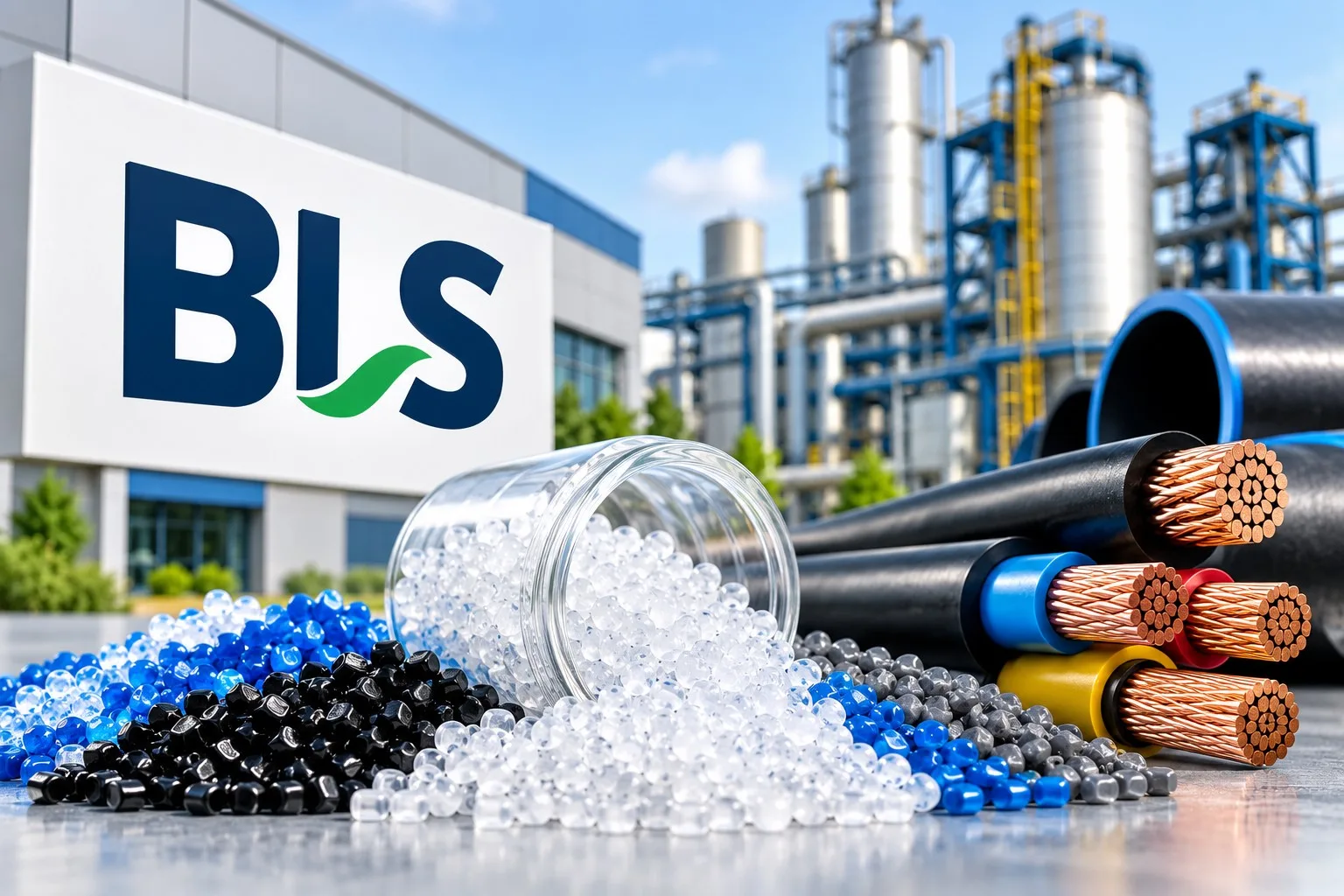
BLS Polymers manufactures specialised polymer compounds used in industrial applications, particularly in wires, cables and underground pipelines.
Its products include different grades of polyethylene compounds, cross-linked polyethylene (XLPE), cable insulation materials, pipeline coatings and specialised adhesives used in three-layer polyethylene (3LPE) pipeline protection systems.
These materials are used by customers operating in sectors such as:
Power transmission and distribution
Telecommunications infrastructure
Railways
Water distribution
Oil and gas pipelines
The company operates a manufacturing facility in Goa and serves domestic customers as well as export markets.
Its business model has two principal components: manufacturing polymer compounds and trading in primary raw materials. The distinction is important because revenue generated through trading does not necessarily carry the same value addition or margin profile as revenue from manufacturing.
Manufacturing versus trading revenue
According to the company's offer-document disclosures, revenue from its manufacturing division declined between FY24 and FY26, while trading revenue increased.
Business segment | FY24 | FY25 | FY26 |
|---|---|---|---|
Polymer manufacturing division | ₹254.4 crore | ₹241.6 crore | ₹237.0 crore |
Trading division | ₹41.9 crore | ₹86.8 crore | ₹112.4 crore |
Total revenue from operations | ₹296.4 crore | ₹328.4 crore | ₹349.4 crore |
Figures are rounded; segment values are based on the company's offer-document disclosures.
The manufacturing division's revenue declined from approximately ₹254.4 crore in FY24 to ₹237 crore in FY26. Over the same period, trading revenue increased from approximately ₹41.9 crore to ₹112.4 crore.
Trading consequently accounted for about 32% of FY26 revenue, compared with approximately 14% in FY24.
This shift in business mix is an important consideration when evaluating the company's revenue growth. Consolidated revenue has increased, but the contribution from the manufacturing division has moved in the opposite direction.
The planned expansion is intended to increase production capacity for selected manufactured products.
2. BLS Polymers Financial Performance
BLS Polymers reported higher revenue and profit in FY25 and FY26, alongside an increase in its EBITDA margin.
Revenue, EBITDA and net profit
Financial metric | FY24 | FY25 | FY26 |
|---|---|---|---|
Revenue from operations | ₹296.35 crore | ₹328.43 crore | ₹349.42 crore |
EBITDA | ₹21.05 crore | ₹39.66 crore | ₹46.60 crore |
EBITDA margin | 7.10% | 12.09% | 13.33% |
Profit after tax | ₹7.52 crore | ₹21.14 crore | ₹27.01 crore |
Net profit margin | 2.54% | 6.44% | 7.73% |
Net worth | ₹46.83 crore | ₹67.94 crore | ₹94.93 crore |
Source: Restated consolidated financial information in the IPO note and company offer documents. Figures are rounded.
Revenue increased by approximately 17.9% between FY24 and FY26. Profit after tax rose from ₹7.52 crore to ₹27.01 crore over the same period.
EBITDA increased by more than twofold, while the EBITDA margin expanded by approximately 6.23 percentage points.
The improvement in profitability was substantially faster than revenue growth. The company's disclosures indicate that lower material costs as a proportion of revenue contributed to the margin expansion. Vendor trade discounts also formed part of its reported financial performance.
The sustainability of these factors is relevant because the recent profit growth rate may not continue if input costs, supplier terms or product mix change.
What the June 2026 quarter shows
For the three months ended June 30, 2026, BLS Polymers reported:
Particulars | Q1 FY27 |
|---|---|
Revenue from operations | ₹107.03 crore |
EBITDA | ₹16.21 crore |
EBITDA margin | 15.15% |
Profit after tax | ₹10.23 crore |
The reported EBITDA margin for the quarter was higher than the FY26 margin of 13.33%.
However, quarterly results represent a shorter period and may be affected by product mix, raw material prices, customer orders and other operating factors. The figures should not be treated as a guarantee of the company's full-year performance.
3. A Closer Look at Profitability and Vendor Discounts
The improvement in BLS Polymers' margins is one of the central elements of its financial performance.
According to the offer-document disclosures, material and traded-goods costs declined as a percentage of revenue between FY24 and FY26. The company also disclosed vendor trade discounts of approximately ₹7.1 crore in FY24, ₹16.8 crore in FY25 and ₹16.3 crore in FY26.
These discounts represented a material contribution relative to reported profit before tax. The company's risk disclosures state that vendor discounts may be discretionary and may not continue at the same level.
This creates an important distinction between reported earnings growth and the factors supporting that growth.
If supplier discounts remain available and the company maintains its cost efficiency, they can continue to support margins. If those benefits decline, the company may need stronger manufacturing volumes, improved product mix or higher selling prices to maintain profitability.
Investors examining the IPO can track future gross margins, EBITDA margins and supplier terms to understand how much of the recent profitability improvement is recurring.
4. BLS Polymers IPO Objects: Where Will the Money Go?
BLS Polymers plans to use the net proceeds from the IPO for manufacturing capacity expansion, working capital and general corporate purposes.
Purpose | Amount |
|---|---|
Expansion of the Goa manufacturing facility | ₹77.56 crore |
Working capital requirements | ₹89.50 crore |
General corporate purposes | Balance amount |
Manufacturing capacity expansion
The company plans to add production capacity for selected polyethylene and cross-linked polyethylene compounds at its existing Goa facility.
The expansion includes approximately 29,192 metric tonnes per annum of additional polyethylene capacity and 22,858 metric tonnes per annum of additional XLPE capacity, taking the total proposed additional capacity to 52,050 metric tonnes per annum.
The project is intended to support the company's manufacturing operations and broaden the range of products it can supply.
The expansion also involves execution risks, including machinery installation, project costs, production commissioning and the time required to secure sufficient orders for the additional output.
The commercial production timeline and actual utilisation of the expanded facility will be important indicators in subsequent financial results.
Working capital requirements
The company has earmarked ₹89.50 crore for working capital, making it the largest individual allocation among the stated uses of proceeds.
Working capital supports inventory purchases, supplier payments and the period between supplying goods and collecting customer payments.
BLS Polymers reported trade receivables of approximately ₹72.71 crore as of March 31, 2026. The figure increased to approximately ₹95.15 crore as of June 30, 2026.
An increase in receivables does not by itself establish that collections have deteriorated, since sales volumes and timing also influence the balance. However, the movement is relevant given the size of the proposed working capital allocation.
The company's future operating cash flow and collection cycle will help show how effectively it converts reported earnings into cash.
5. BLS Polymers IPO Valuation
At the upper price band of ₹150 per share, BLS Polymers has a post-issue market capitalisation of approximately ₹930.48 crore.
The valuation can be examined using earnings, book value and selected listed peers.
Earnings-based valuation
Valuation metric | Figure |
|---|---|
Upper price band | ₹150 |
FY26 profit after tax | ₹27.01 crore |
Pre-issue diluted EPS | Approximately ₹5.99 |
Pre-issue P/E | Approximately 25.0 times |
Post-issue shares | Approximately 6.20 crore |
Post-issue P/E on FY26 earnings | Approximately 34.4 times |
Pre-issue book value per share | Approximately ₹21.08 |
The pre-issue P/E uses FY26 earnings per share before the fresh shares are added. The post-issue P/E uses the same annual profit against the larger post-issue share count.
This distinction matters because the company is issuing new shares to raise capital. The fresh issue increases the number of shares outstanding, so earnings per share based on FY26 profit would be lower if earnings remained unchanged.
The post-issue ratio is therefore a useful measure when comparing the proposed market capitalisation with the company's historical annual profit.
The valuation also depends on the company's ability to deploy the IPO proceeds effectively and generate additional earnings from its planned expansion.
6. BLS Polymers IPO Peer Comparison
The IPO note identifies Kingfa Science & Technology (India), DDev Plastiks Industries and Plastiblends India as listed peers.
These companies operate in related plastics and polymer markets, although their products, scale and end-market exposure differ.
Company | FY26 revenue | FY26 EPS | P/E in IPO comparison data | Return on net worth |
|---|---|---|---|---|
BLS Polymers | ₹349.42 crore | ₹5.99 | 25.0x pre-issue | 28.45% |
Kingfa Science & Technology (India) | ₹1,995.55 crore | ₹144.10 | 46.25x | 13.24% |
DDev Plastiks Industries | ₹2,947.87 crore | ₹19.50 | 12.97x | 19.92% |
Plastiblends India | ₹788.65 crore | ₹14.12 | 14.53x | 8.17% |
Peer metrics are taken from the IPO note's comparison data. Market-based valuation multiples depend on the reference share-price date and may change. BLS Polymers' 25.0x figure is the pre-issue P/E, so it is not directly equivalent to a post-issue P/E calculated on the enlarged share count.
BLS Polymers is smaller than all three selected peers in terms of FY26 revenue. Its reported return on net worth is higher than the figures shown for the peer group.
However, differences in scale and business mix matter when comparing the companies. Kingfa, DDev Plastiks and Plastiblends operate across different product categories and may have different customer concentrations, manufacturing requirements and profitability drivers.
The peer comparison shows that BLS Polymers' proposed valuation needs to be considered alongside its higher reported return ratios, recent margin expansion and the risks associated with its changing revenue mix.
7. What Does Swastika Investmart Say About BLS Polymers IPO?
Swastika Investmart published an IPO note on BLS Polymers ahead of the issue. The report assigns a “Subscribe” rating and describes the issue's pricing as fair to slightly aggressive relative to selected domestic peers, including DDev Plastiks and Plastiblends India.
The report identifies the company's return ratios, which exceed 30% on the return-on-equity measure cited in its analysis, and the expansion in EBITDA margins over the preceding three years as factors supporting the valuation.
At the same time, the note highlights the changing contribution from trading activities. Trading accounted for approximately 32% of FY26 revenue, compared with 14% in FY24, while revenue from manufactured products declined over the same period.
The report also identifies execution risks associated with the proposed expansion and limited valuation comfort relative to selected peers.
Swastika's assessment is an attributed research opinion, not a guarantee of listing gains or future returns. It represents one research firm's view and should be read alongside the company's offer documents and financial disclosures.
8. Key Risks in the BLS Polymers IPO
Customer concentration
A significant portion of the company's revenue comes from a limited number of customers. The offer documents identify concentration among the top customers as a business risk.
The loss of a major customer, lower order volumes or changes in purchasing arrangements could affect revenue and manufacturing utilisation.
Dependence on wire and cable compounds
Wire and cable applications form the core of BLS Polymers' business. Demand is linked to industries such as power, telecommunications and railways.
Changes in infrastructure spending, customer procurement or competitive conditions could affect orders for the company's products.
Raw material prices and supplier terms
The company's manufacturing and trading operations depend on polymer raw materials. Changes in input prices can affect costs and margins, particularly if selling prices cannot be adjusted at the same pace.
The disclosed contribution from vendor trade discounts also makes supplier terms relevant to the sustainability of recent earnings.
Dependence on a single manufacturing facility
BLS Polymers operates its manufacturing facility in Goa. A disruption caused by equipment failure, an operational incident or another interruption could affect production across the business.
Working capital requirements
Trade receivables, inventory and supplier payments influence the amount of cash tied up in operations. The company's working capital allocation is substantial relative to the total IPO size.
Future results will show whether the company can maintain sales growth while managing collections and operating cash flow.
Capacity expansion and execution
The proposed additional capacity requires investment, machinery deployment and operational execution. Delays or higher project costs could affect the timing of the expansion and the expected contribution from new capacity.
The company will also need sufficient customer demand to utilise the added production capacity.
9. BLS Polymers IPO: Important Dates
Event | Date |
|---|---|
IPO opens | October 27, 2026 |
IPO closes | October 29, 2026 |
Expected basis of allotment | October 30, 2026 |
Expected refunds or ASBA unblocking | November 2, 2026 |
Expected credit of shares to demat accounts | November 2, 2026 |
Tentative listing date | November 3, 2026 |
These dates are indicative and may be revised by the company or the exchanges.
10. BLS Polymers IPO Review: What the Numbers Indicate
BLS Polymers reported revenue growth and higher profitability between FY24 and FY26. Its EBITDA margin expanded during the period, and its reported return ratios are higher than those of the selected listed peers in the IPO comparison data.
However, the financial picture also includes a change in the revenue mix. Trading has become a larger part of the business, while revenue from manufacturing has declined. Vendor trade discounts and lower material costs contributed to the improvement in profitability, making their sustainability relevant to future earnings.
The IPO proceeds are intended to fund manufacturing capacity expansion and working capital requirements. The outcome will depend partly on project execution, customer demand, capacity utilisation and cash-flow management.
Swastika Investmart's published note gives the issue a Subscribe rating while describing its pricing as fair to slightly aggressive relative to selected peers. The report also highlights margin expansion and return ratios, alongside valuation and execution risks.
The company's subsequent financial results will provide further information about whether manufacturing revenue recovers, operating margins remain sustainable and the expanded capacity contributes to earnings.
Disclaimer: This article is for informational purposes only and does not constitute investment advice. IPO valuations, analyst opinions and historical financial performance do not guarantee future returns. Investors should read the company's red herring prospectus and assess the disclosed risks before making investment decisions and and consult a SEBI-registered investment adviser where appropriate before making investment decisions.