

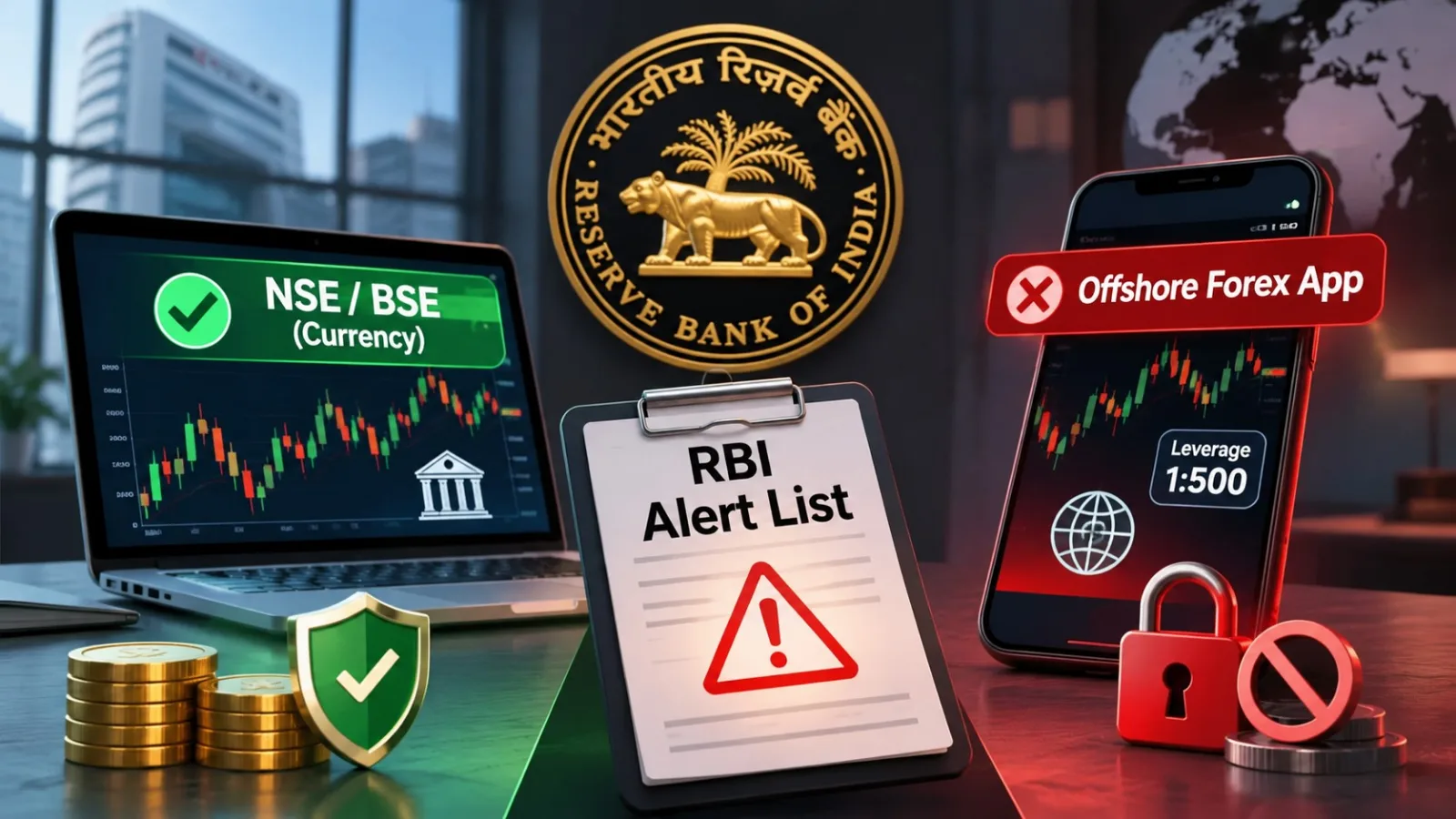
India's forex trading market has two very different operating environments. On one side are regulated domestic exchanges such as NSE and BSE, where currency derivatives are traded through authorised brokers. On the other are offshore trading applications that allow Indian users to access leveraged currency pairs, often through international websites, mobile apps and payment gateways.
The difference is not simply about where a trading platform is headquartered or how much leverage it offers. It comes down to the legal authority under which the platform operates, the rules governing foreign exchange transactions and the channels through which money moves across India's financial system.
The Reserve Bank of India's Alert List is an important part of this regulatory framework. It identifies entities that are neither authorised to deal in foreign exchange under the Foreign Exchange Management Act (FEMA), 1999, nor authorised to operate Electronic Trading Platforms (ETPs) for forex transactions in India.
What Exactly Does the RBI Alert List Mean?
The Alert List is not a conventional blacklist of companies accused of fraud. Its primary purpose is to identify entities that do not have the regulatory authorisation required to offer forex trading services to Indian residents. It also includes websites, platforms and entities that appear to promote unauthorised forex operators.
This distinction matters because an offshore platform can be a legally established business in another country and still lack permission to offer its services to Indian residents. Registration with an overseas financial regulator does not automatically provide authorisation under Indian foreign exchange regulations.
Another important detail is that the RBI's Alert List is not exhaustive. The absence of a platform's name does not mean that the RBI has approved it. Users must separately verify whether the entity is an authorised person or whether its trading platform appears on the RBI's list of authorised ETPs.
Why Do Popular Offshore Forex Apps Appear on the List?
Many offshore trading applications attract Indian users through features that are appealing to retail traders. These include access to EUR/USD, GBP/USD and other international currency pairs, high leverage, low minimum deposits, demo accounts and relatively simple mobile-based onboarding.
Some platforms also allow users to deposit Indian rupees through payment gateways, local bank transfers or third-party payment intermediaries. The trading interface may display international currency prices, profit and loss calculations and instant withdrawal options, creating the impression that the service operates like a conventional Indian brokerage.
However, the RBI's regulatory assessment is not based on how sophisticated an application looks or how many international customers it has. The central question is whether the platform has the required Indian authorisation and whether the underlying forex transaction is permitted under FEMA.
The Legal Framework: FEMA and Electronic Trading Platforms
Two regulatory frameworks are particularly important when examining unauthorised forex trading in India.
1. Foreign Exchange Management Act, 1999 (FEMA)
Section 3 of FEMA restricts dealing in or transferring foreign exchange or foreign securities to a person who is not an authorised person, except where permitted by the Act or with the RBI's permission. This provision is central to the regulatory treatment of unauthorised forex transactions involving Indian residents.
The law focuses on the actual transaction and the parties involved, not merely the location of the mobile application or website. Therefore, routing a payment through an intermediary or using an offshore account does not automatically make an otherwise prohibited transaction permissible.
2. RBI's Electronic Trading Platforms Directions
An Electronic Trading Platform is an electronic system on which transactions in eligible financial instruments, including foreign exchange instruments and derivatives, are contracted. Under the RBI's regulatory framework, an entity operating an ETP covered by the directions must obtain prior RBI authorisation unless a specific exemption applies.
The RBI issued the Master Direction – Electronic Trading Platforms Directions, 2025, replacing the earlier 2018 directions. The framework establishes requirements covering operator eligibility, technology infrastructure, risk management, transparency, surveillance and reporting.
For a retail trader, the practical implication is straightforward: an attractive trading interface or an overseas licence is not a substitute for the authorisation required under Indian law.
Domestic Currency Exchanges vs Offshore Forex Margin Apps
The structural difference between domestic currency derivatives and offshore forex applications is much larger than the difference between their trading screens.
Both may display currency prices, allow users to place orders and calculate trading profits or losses. However, their regulatory arrangements, execution mechanisms, settlement structures and payment channels are fundamentally different.
1. Domestic Exchanges: NSE and BSE
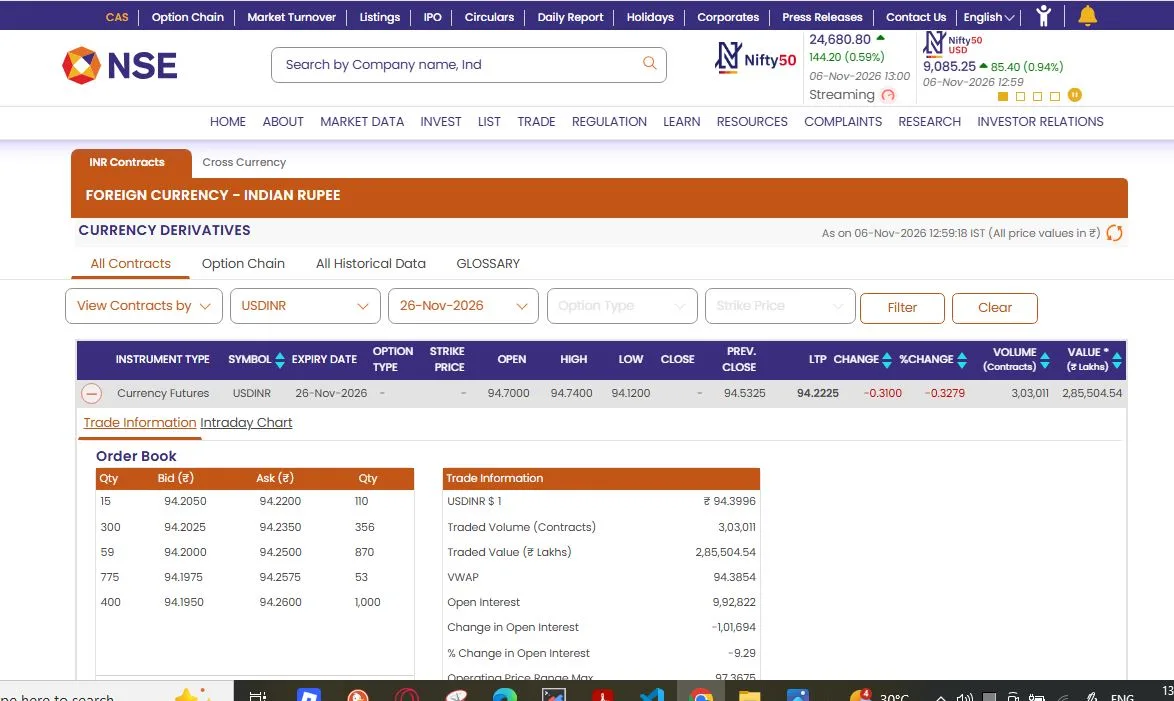
In India, retail investors can access permitted currency derivatives through recognised stock exchanges such as the National Stock Exchange (NSE) and BSE. They generally access these markets through brokers registered with the Securities and Exchange Board of India (SEBI), subject to the applicable RBI and exchange requirements.
These transactions operate within an established regulatory structure. Brokers are subject to regulatory obligations, exchanges maintain trading and risk-management systems, and clearing and settlement take place through recognised market infrastructure.
The currency derivatives segment also has restrictions on the instruments and currency pairs that can be traded. These are not unrestricted international forex markets where every available global currency pair can automatically be accessed by an Indian resident.
2. Offshore Forex Margin Applications
An offshore margin trading application may offer dozens of currency pairs, including EUR/USD, GBP/USD, USD/JPY and other international combinations. Customers typically open an account directly with the overseas platform or an entity associated with it.
Instead of routing orders through a recognised Indian stock exchange, the platform may execute or internally match trades through its own overseas infrastructure or counterparties. The customer may be exposed to the contractual terms of the offshore operator rather than the protections and procedures of India's recognised exchange framework.
Leverage is another major difference. Some offshore platforms advertise leverage many times greater than the amount deposited by the customer. While this can magnify potential trading gains, it can also accelerate losses and create additional risks involving margin calls, forced liquidation and withdrawal restrictions.
A Structural Comparison
Feature | NSE/BSE currency segment | Unauthorised offshore margin app |
|---|---|---|
Regulatory framework | Indian exchange and securities regulations, alongside RBI rules | Offshore framework; may lack required Indian authorisation |
Broker | SEBI-registered broker | Offshore platform or intermediary |
Trading access | Through recognised exchanges | Through offshore trading infrastructure |
Instruments | RBI-permitted currency derivatives | May advertise a wider range of global pairs |
Leverage | Exchange and regulatory risk limits | Platform-defined leverage, subject to applicable foreign law |
Settlement | Recognised clearing and settlement framework | Depends on offshore contractual arrangements |
Investor protection | Indian regulatory grievance and oversight mechanisms | Recovery may involve foreign entities and jurisdictions |
Funding | Permitted domestic banking channels | May involve overseas transfers or domestic intermediaries |
The key distinction is not that every offshore platform is necessarily fraudulent. It is that an offshore operator without the necessary Indian authorisation does not become a lawful option for an Indian resident simply because it is regulated somewhere else.
Why RBI Is Also Watching the Payment Trail
The regulatory concern extends beyond the trading platform itself. The movement of money between Indian bank accounts, local payment intermediaries and offshore trading operators is an important part of the enforcement framework.
In its April 24, 2024 circular on unauthorised foreign exchange transactions, the RBI highlighted instances where offshore operators used local agents to collect funds from Indian residents. These agents reportedly opened bank accounts in the names of individuals, proprietorships and trading firms to collect money for trading margins, investments and other charges.
The RBI also identified the use of domestic payment systems, including online transfers and payment gateways, to collect rupee deposits for unauthorised forex trading. Banks were advised to exercise greater vigilance and report accounts found to be facilitating such activities to the Directorate of Enforcement.
This is significant because a payment made in Indian rupees does not automatically make the underlying transaction compliant with FEMA. The purpose of the payment and the ultimate beneficiary can matter just as much as the payment method.
The LRS Restriction: Why You Cannot Simply Send Margin Money Overseas
The Liberalised Remittance Scheme (LRS) allows resident individuals to remit money abroad for permitted transactions, subject to the applicable conditions and limits. However, it is not a general-purpose facility for funding every type of overseas investment or trading activity.
The RBI has explicitly clarified that remittances under LRS for margin or margin calls to overseas exchanges or overseas counterparties are not permitted. This is particularly relevant to Indian residents who believe they can legally fund an offshore forex trading account by sending money through an international bank transfer.
The restriction is not limited to the amount transferred. Even if an individual has sufficient LRS limits available, that does not make an otherwise prohibited margin remittance permissible.
What Happens When Money Gets Stuck in an Offshore Forex Account?
This is one of the most important practical issues for retail traders. An investor may deposit money, execute several trades and see a positive account balance, only to discover that withdrawals are delayed, rejected or blocked.
There are several possible reasons for this situation. The payment may have been flagged by a bank or payment intermediary, the receiving account may have been identified as being associated with unauthorised forex activity, or the offshore operator may have imposed withdrawal conditions under its own contractual terms.
The legal position also depends on where the money is held and how it was transferred. A payment that is still pending with a bank or payment gateway is different from money that has already reached an offshore trading company's account.
Scenario 1: Money Is Still Pending With the Bank or Payment Gateway
If the payment has not reached the final beneficiary, the customer should immediately contact the sending bank or payment provider and request a transaction trace. The bank can examine whether the payment is pending, rejected, under review or already settled.
The customer should retain the UTR number, transaction reference, beneficiary details, bank statements and payment confirmation. These records can help establish where the funds were transferred and whether the transaction can still be recalled or reversed.
However, a payment recall is not guaranteed. Once a transfer has been completed, the bank may need the cooperation of the receiving institution or other authorities to recover the money.
Scenario 2: Money Has Reached the Offshore Trading Platform
The situation becomes more complicated when the money has already been credited to an offshore account. The Indian bank may not have direct control over funds held by a foreign company or financial institution.
The customer may have to communicate with the platform, its payment intermediary and the relevant foreign financial institution. If the platform refuses to process a withdrawal, the investor may also need to approach the appropriate law-enforcement authorities.
There is no automatic RBI reimbursement mechanism for money lost or blocked on an unauthorised offshore forex platform. The possibility of recovery depends on the payment trail, available records, the legal status of the funds and cooperation from the relevant institutions.
Scenario 3: The Platform Demands Additional Money for Withdrawal
A particularly concerning situation arises when a platform asks customers to deposit additional money under labels such as withdrawal tax, account activation fees, security deposits or compliance charges before releasing an existing balance.
Customers should not assume these demands are legitimate simply because they appear inside a trading dashboard. Additional payments can increase the financial loss, particularly when the platform's identity and regulatory status have not been independently verified.
The safer approach is to stop further transfers, preserve all communications and payment records, contact the bank and report suspected cyber fraud through the appropriate Indian authorities.
Can an Indian Trader Face Legal Action Under FEMA?
Yes. The RBI has repeatedly clarified that resident persons undertaking forex transactions with unauthorised persons or on unauthorised ETPs may be liable for penal action under FEMA.
Section 13 of FEMA provides for penalties for contraventions. Where the amount involved is quantifiable, the penalty can extend to three times the sum involved. Where it is not quantifiable, the penalty can extend to ₹2 lakh. A continuing contravention may attract an additional penalty of up to ₹5,000 for every day after the first day during which it continues.
However, the existence of a potential FEMA contravention does not mean every customer automatically receives the maximum penalty. The facts, nature of the transaction, amount involved and applicable legal proceedings are relevant to determining liability.
There is also an important distinction between an individual who uses an offshore platform to trade and an operator or local agent who actively facilitates unauthorised forex transactions. The latter may face additional regulatory and enforcement scrutiny depending on their role and conduct.
How Should Retail Traders Verify a Forex Platform?
Before opening an account with any forex trading application, Indian residents should verify its regulatory status rather than relying on advertisements, social media recommendations or claims made by influencers.
The RBI provides separate lists of authorised persons, authorised ETPs and entities appearing on its Alert List. These lists serve different purposes and should be checked together when evaluating a platform's authorisation status.
A few important checks include:
Check the RBI Alert List: Search for the platform's name, website and associated entities.
Verify authorised ETP status: Confirm whether the platform is listed among RBI-authorised electronic trading platforms.
Check the broker's registration: For domestic exchange trading, verify the broker's registration through SEBI and the relevant exchange.
Examine the payment beneficiary: Be cautious if deposits are requested into unrelated personal accounts or accounts belonging to unknown intermediaries.
Avoid misleading regulatory claims: An overseas licence, foreign company registration or international customer base does not establish permission to serve Indian residents.
The RBI's Alert List should not be treated as the only verification tool. Its absence from the list is not proof of authorisation, and traders should independently establish whether the relevant entity and transaction are permitted.
Where Can Customers Report Unauthorised Forex Trading?
Customers who have transferred money to suspected unauthorised forex platforms can approach the appropriate authorities with supporting transaction records.
The RBI's guidance identifies the following reporting channels:
National Cyber Crime Reporting Portal: Customers can submit complaints at https://cybercrime.gov.in.
Local police authorities: Complaints can be submitted to the police in the relevant jurisdiction.
Enforcement Directorate: Complaints concerning suspected FEMA violations can be sent to [email protected].
Banking institution: Customers should immediately notify their bank about suspicious transactions and request a review of the payment trail.
It is important to distinguish between reporting suspected unauthorised trading and recovering money. Filing a complaint does not guarantee that the deposited amount will be returned, but it creates an official record and allows the relevant authorities to examine the transactions.
The Regulatory Boundary Between Global Forex Access and Indian Retail Trading
The popularity of international forex applications reflects the demand among Indian retail traders for access to global currency markets. However, access to international financial products is governed by the regulations applicable to Indian residents, not simply by the availability of an application in an app store.
The domestic currency derivatives market provides a recognised route for participating in permitted currency contracts through NSE, BSE and authorised brokers. Offshore applications may offer a wider selection of currency pairs and higher leverage, but those features do not override India's foreign exchange regulations.
For retail traders, the RBI Alert List is therefore more than a directory of questionable websites. It highlights the regulatory boundary between permitted forex transactions and unauthorised trading arrangements, including the payment channels used to fund them.