

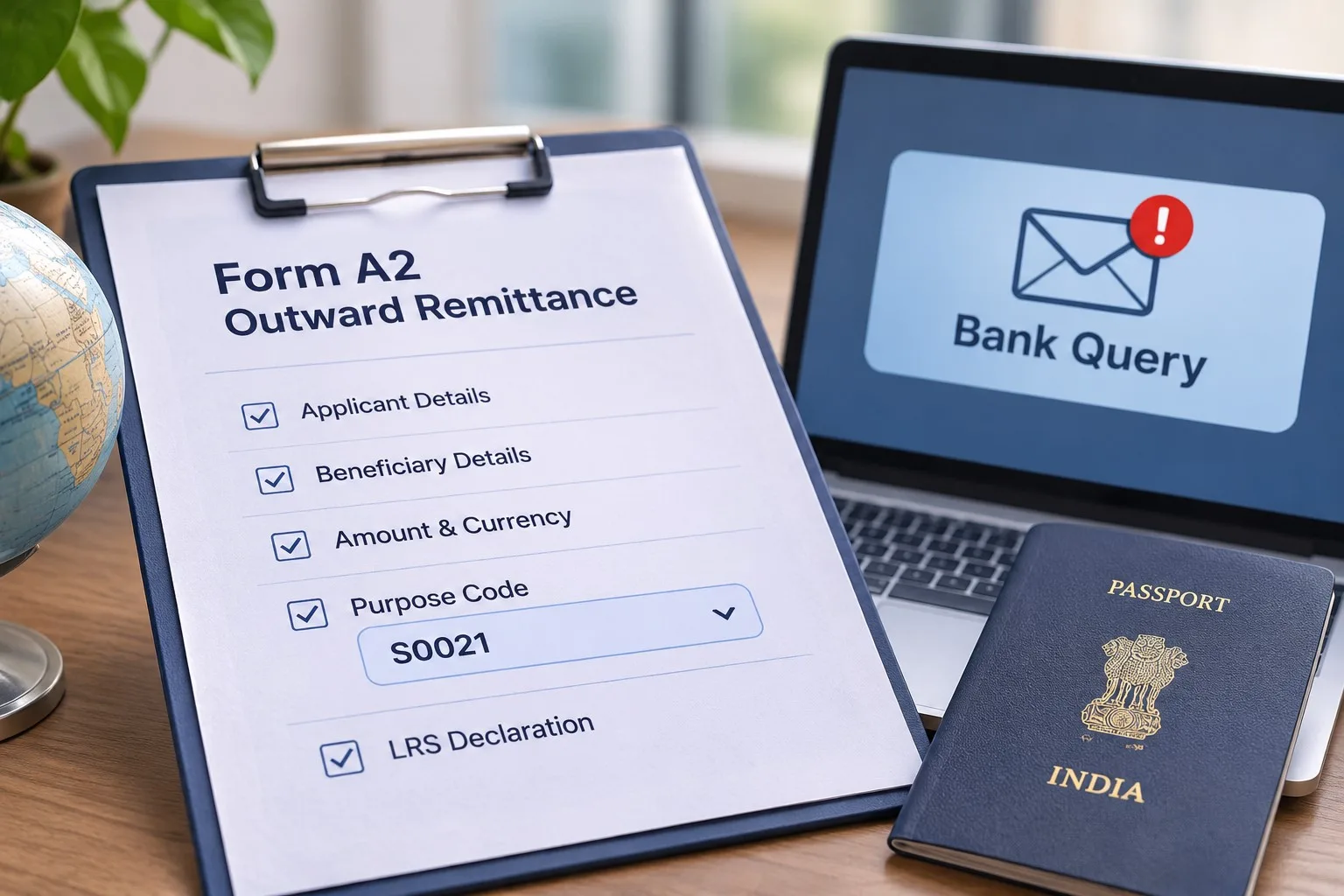
Sending money from India to another country involves more than entering an overseas bank account number and selecting a payment purpose. Every outward foreign exchange remittance must be supported by the information required by the authorised dealer (AD) bank under India's foreign exchange regulations.
A customer may submit a transfer request for overseas education, international investments, family maintenance or personal gifts. The bank must understand why the money is being transferred, who will receive it and whether the transaction is permitted under the applicable rules.
This is where Form A2 and RBI purpose codes become important. Even when a remittance is within the permitted Liberalised Remittance Scheme (LRS) limit, differences between the declared purpose and supporting documents can result in additional verification or a delay in processing.
What Is Form A2 and Why Does Your Bank Need It?
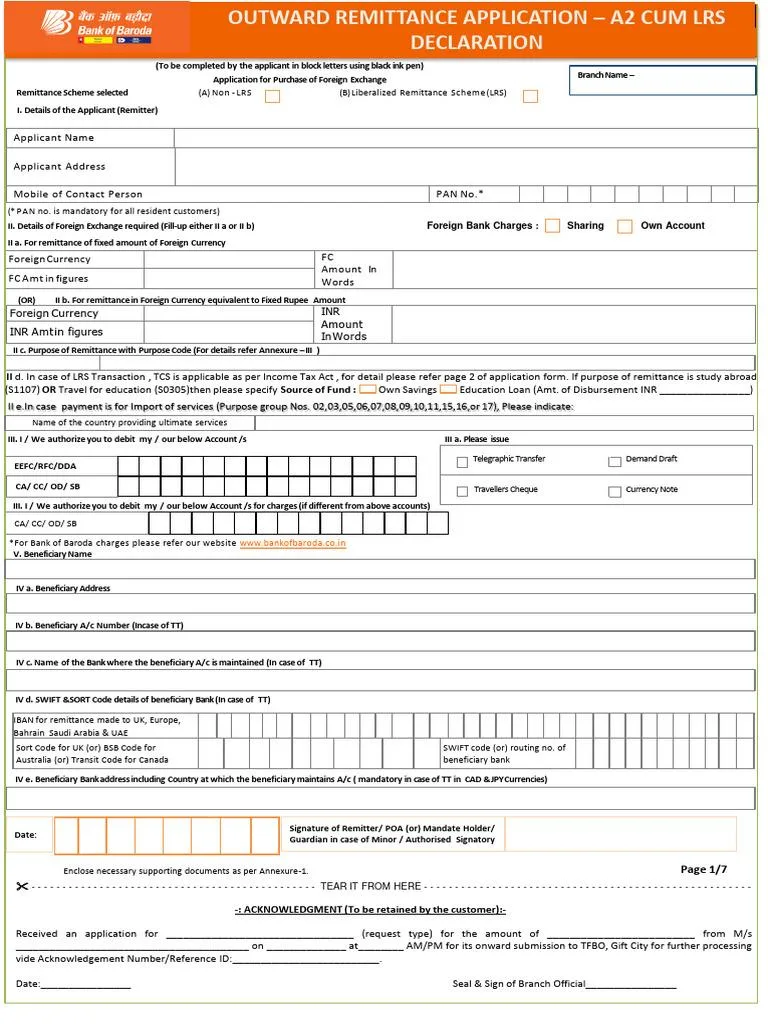
Form A2 is an application-cum-declaration used for outward foreign exchange remittances. It captures the applicant's information, the amount being transferred, the beneficiary details and the purpose for which foreign exchange is required.
The form also contains declarations relating to the transaction and its compliance with applicable foreign exchange regulations. Authorised dealer banks use this information to examine the remittance and maintain the necessary records for regulatory reporting.
Form A2 is not simply an additional banking document. It creates a formal record of the customer's declared purpose for transferring money outside India, making the accuracy of the information particularly important.
What Information Does Form A2 Contain?
Although banks may present the application differently through their internet banking portals, the underlying information generally covers several important areas.
1. Applicant Information
The application identifies the person making the remittance through details such as name, PAN, address and relevant bank account information. These details help the bank establish the identity of the remitter and verify the transaction against its customer records.
2. Overseas Beneficiary Details
The applicant provides information about the recipient, including the beneficiary's name, overseas bank, account number or IBAN, SWIFT/BIC details and destination country. Incorrect beneficiary information can result in payment rejection or additional verification.
3. Foreign Exchange Amount
The form records the amount of foreign currency required and its equivalent value in Indian rupees. The bank may also communicate applicable conversion rates, transfer charges and tax-related deductions separately.
4. Purpose of Remittance
This section explains why the applicant is sending money overseas. The purpose could involve education fees, medical treatment, personal gifts, travel, investment or payment for an international service.
5. RBI Purpose Code
The transaction is classified using the relevant RBI purpose code. The classification should reflect the actual economic activity behind the transfer rather than simply the name of the overseas beneficiary.
6. LRS Declaration
Where applicable, the applicant must identify the transaction as an LRS remittance and provide the required declarations. The bank may also consider the individual's previous remittances during the relevant financial year.
7. Authorisation and Declaration
The applicant authorises the bank to debit the relevant account and confirms that the information supplied is accurate. The declaration is important because the applicant is responsible for providing correct transaction details.
RBI Purpose Codes: Why One Wrong Selection Can Create a Banking Problem
RBI purpose codes are classifications used to identify the nature of foreign exchange transactions. They help authorised dealers report cross-border payments under the appropriate categories through the applicable RBI reporting framework.
For customers, these codes may look like ordinary options in a bank's forex transfer portal. However, selecting a code that does not match the actual transaction can create inconsistencies between the application, beneficiary details and supporting documents.
Consider someone transferring money to an overseas individual as a personal gift. Another customer sends money abroad for an eligible investment-related transaction. Both payments involve foreign exchange, but their underlying purposes are different and must be classified accordingly.
Understanding S1302 and S0021
S1302 is associated with remittances towards personal gifts and donations. It is relevant when the actual transaction falls within that classification and should not be selected merely because the recipient is an individual.
S0021 appears in the RBI's LRS reporting mapping for certain investment-related transactions, including categories involving ESOPs and Indian Depository Receipts. It is not a general-purpose code for every overseas investment or international brokerage transfer.
The distinction matters because different investment activities have different purpose classifications. For example, the RBI's purpose-code framework also identifies S0001 for investment abroad in equity capital and S0002 for investment abroad in debt securities.
A customer transferring money to an overseas brokerage account should therefore not automatically select S0021. The correct classification depends on the underlying investment, the transaction structure and the applicable reporting instructions.
An important point: Purpose codes should be verified against the latest RBI classification and the authorised dealer's instructions. The customer should ask the bank to confirm the correct code if the transaction does not clearly fit the available descriptions.
How a Bank Examines an Overseas Remittance
A bank does not necessarily process every outward remittance immediately after receiving the application. Its foreign exchange operations and compliance teams may examine the transaction before releasing the payment, depending on the nature of the transfer and the bank's internal procedures.
The checks are intended to establish whether the transaction is genuine, properly documented and permitted under applicable regulations. A query may arise even when the remittance amount is relatively small.
What Happens After You Submit a Forex Transfer Request?
Step 1: Customer and Account Verification
The bank checks the applicant's identity, PAN details, account information and KYC status. It may also verify whether the remittance is being initiated by the account holder and whether the transaction is consistent with the available customer information.
Step 2: Beneficiary and Payment Verification
The beneficiary's name, overseas bank details and destination country may be examined. If the payment is being made to a university, investment platform or service provider, the bank may compare these details with the relevant supporting documents.
Step 3: Purpose Code Examination
The bank checks whether the selected purpose code is appropriate for the declared transaction. If the customer selects a personal gift code but submits an investment agreement, the difference may require clarification.
Step 4: LRS and Regulatory Checks
Where LRS applies, the bank examines the applicable annual limit and the nature of the proposed remittance. It may also consider whether the transaction is permitted under FEMA and whether additional conditions apply to the particular activity.
Step 5: Supporting Document Verification
Depending on the transaction, the bank may request an invoice, admission letter, investment statement, agreement or other documentary evidence. The documents help establish the purpose and beneficiary of the payment.
Step 6: Additional Clarification, If Required
If the information is incomplete or inconsistent, the bank may contact the applicant for an explanation. The remittance may remain pending until the required clarification and documents have been reviewed.
Step 7: Processing or Rejection
After completing its checks, the bank may process the transfer if the transaction meets the applicable requirements. If the customer does not provide satisfactory information or the transaction is not permissible, the bank may decline the request.
Why Does Your Bank Ask for Additional Documents?
A compliance query does not automatically mean that the customer has violated FEMA regulations. In many situations, the bank simply needs more information to establish the purpose of the transaction.
The following examples explain why an otherwise ordinary remittance may require additional verification.
Overseas Investment: A customer transfers money to an international brokerage account but provides no information about the investment or beneficiary. The bank may ask for brokerage account details, the nature of the proposed investment and relevant supporting documents.
Education Payment: A student sends money to an overseas university but selects a purpose code that does not match the fee invoice. The bank may request the admission letter, fee statement and an explanation of the selected remittance category.
Personal Gift: An individual transfers money to a relative abroad but the beneficiary details or payment explanation do not clearly establish the nature of the transaction. The bank may ask for a relationship declaration or other relevant information.
Third-Party Funding: A customer requests an outward remittance using money received from another person's bank account. The bank may ask about the source of funds, relationship with the third party and the reason for the funding arrangement.
Unclear Payment Description: A customer describes a transaction as a personal transfer, but the attached invoice identifies a commercial service. The bank may need to establish the actual nature of the payment before assigning the appropriate classification.
What Happens When a Forex Remittance Is Placed on Hold?
When a bank identifies an inconsistency or requires further information, it may temporarily stop processing the particular remittance. The customer may receive an email, internet banking notification or communication from the bank's foreign exchange department.
The bank may request a revised declaration, additional documents or an explanation of the transaction. The processing timeline will depend on the nature of the query, the customer's response and the bank's verification requirements.
It is important to distinguish between a transaction being placed on hold and a bank account being frozen. A pending outward remittance does not automatically mean that the customer's entire bank account has been frozen or restricted.
If the required clarification is satisfactory and the transaction is permitted, the bank may proceed with the transfer. If the bank cannot establish compliance, it may refuse the transaction in accordance with applicable requirements.
How Should You Respond When a Bank Questions Your Remittance?
The first step is to read the bank's communication carefully and identify exactly what information is missing. If the issue concerns the purpose code, explain the actual transaction instead of simply repeating the code selected in the original application.
For example, someone transferring money for an eligible overseas investment should explain the nature of the investment, identify the beneficiary and provide relevant account or investment documents. If the original purpose code was incorrect, the customer should disclose the discrepancy and ask the bank how to correct the application.
A clear response supported by genuine documents is generally more useful than a lengthy explanation containing unrelated information. Customers should also retain copies of the original application and all subsequent communication.
Documents That May Be Requested by the Bank
The documents depend on the nature of the transaction. Common examples include:
PAN and identity details, where required.
Recent bank statements or evidence of the source of funds.
Overseas university admission letters and fee invoices.
Brokerage account statements or investment-related documents.
Beneficiary bank details and payment instructions.
Gift or relationship declarations, where applicable.
Agreements, invoices or contracts relating to overseas services.
Not every customer will be asked to submit all these documents. The authorised dealer determines the documentation required based on the transaction and its internal compliance procedures.
Sample Response to a Bank's Forex Clarification Request
Suppose a bank asks a customer to explain the purpose of an overseas remittance and provide supporting documents. The customer should answer the specific questions raised rather than sending a generic declaration.
The following is an illustrative response for an eligible overseas investment transaction.
Subject: Clarification Regarding Outward Remittance Application
Dear Forex Operations Team,
With reference to your request for additional information regarding my outward remittance application, I would like to clarify that the proposed transfer of USD [Amount] is intended for [Specific Investment Purpose].
The overseas beneficiary is [Beneficiary Name], and the payment is being made towards [Brief Description of Transaction].
The funds are sourced from my personal bank account through [Applicable Source of Funds]. I have attached the relevant supporting documents, including the investment account details and beneficiary information.
I request you to review the clarification and advise whether any additional information or correction to the original remittance declaration is required.
Regards,
[Applicant Name]
[Application Reference Number]
This is only a sample response. Customers should modify it according to the actual transaction and the bank's questions. They should never describe a gift as an investment or use an investment explanation to justify a different category of payment.
Five Mistakes to Avoid Before Making an International Transfer
1. Selecting a Purpose Code Based on Convenience
Some customers select whichever purpose code is accepted by the banking portal without checking its description. This can create a mismatch between the declared purpose and the actual payment.
2. Providing Incomplete Beneficiary Details
A missing account number, incorrect SWIFT code or beneficiary name that differs from the supporting documents may delay processing. Verify the payment instructions before submitting the application.
3. Ignoring the Source of Funds
Customers should be prepared to explain where the money originated if the bank requests supporting evidence. Maintaining relevant bank statements and income records can make the verification process easier.
4. Assuming the LRS Limit Guarantees Approval
Being within the annual LRS limit does not automatically make every transaction permissible. The nature of the payment, applicable FEMA restrictions and other regulatory conditions remain relevant.
5. Responding Through Unverified Contacts
Customers should respond only through official bank email addresses, internet banking or verified branch channels. Never share OTPs, passwords or banking credentials with anyone claiming to resolve a forex compliance issue.
Where Should You Verify Form A2 and RBI Purpose Codes?
Foreign exchange classifications and reporting instructions can change. Customers should avoid relying entirely on old blog articles, social media posts or screenshots of bank remittance portals when deciding which purpose code to select.
The Reserve Bank of India's official website provides the relevant regulatory documents, including Form A2 and the purpose-code classification. Customers can also contact their authorised dealer bank's foreign exchange department for transaction-specific guidance.
It is particularly important to distinguish between the purpose code shown in a bank's customer-facing portal and the reporting classification used by the bank. The two may be presented differently depending on the bank's internal systems.
Why Form A2 Deserves More Attention Than the LRS Limit
The USD 250,000 LRS limit receives considerable attention whenever Indians discuss overseas money transfers. However, the limit is only one part of the regulatory framework governing eligible outward remittances by resident individuals.
Form A2 records the applicant's declaration, while the purpose code helps classify the underlying transaction. If these details do not match the actual payment, the bank may need additional information before proceeding.
For anyone planning an overseas transfer, checking the purpose, beneficiary information and supporting documents before submitting the application can prevent avoidable confusion. A properly documented remittance is easier for the bank to examine than one where the transaction details need to be reconstructed after a compliance query.