

India's banking sector recorded a sharp acceleration in credit growth in September 2026, with lending to businesses, agriculture and individual borrowers expanding at a faster pace compared with the previous year. The Reserve Bank of India (RBI) reported that non-food bank credit grew by 19.1% year-on-year (YoY) as of September 30, 2026, against 11.2% growth recorded during the corresponding period last year.
The latest data indicate a broad-based improvement in bank lending, with the services sector emerging as the fastest-growing segment. Credit to services expanded by 28.3%, while agriculture and industry both registered growth of 19.5%. Personal loans also witnessed stronger growth, reflecting continued demand for housing, vehicle financing and other retail credit products.
The RBI released the latest figures on October 30, 2026, as part of its monthly report on the sectoral deployment of bank credit.
RBI Reports 19.1% Growth in Non-Food Bank Credit
Non-food bank credit registered 19.1% annual growth as of the fortnight ended September 30, 2026. This represents a significant acceleration compared with the 11.2% growth reported during the corresponding period of the previous year.
Non-food credit broadly represents bank lending to sectors such as agriculture, industry, services and individual borrowers, excluding loans extended for food procurement operations.
The faster expansion suggests that credit demand across several segments of the Indian economy remained strong during September.
The RBI's sectoral deployment data were collected from 41 selected scheduled commercial banks (SCBs), which together account for approximately 95% of total non-food credit extended by all scheduled commercial banks.
Services Sector Records Highest Credit Growth at 28.3%
The services sector recorded the strongest expansion among the major categories, with bank credit growing by 28.3% year-on-year in September 2026. This was significantly higher than the 9.9% growth reported during the corresponding period last year.
Several segments contributed to the acceleration, including non-banking financial companies (NBFCs), trade, commercial real estate, transport operators and professional services.
According to additional sector-level figures reported alongside the RBI data, outstanding bank credit to the services sector stood at approximately ₹64.90 lakh crore as of September 30, compared with ₹50.58 lakh crore a year earlier.
NBFC lending remains a major contributor
Credit extended to NBFCs continued to account for a substantial portion of bank lending to the services sector. Bank credit to NBFCs increased by 41.8% year-on-year to approximately ₹22.53 lakh crore.
Lending to housing finance companies also expanded, while public financial institutions recorded particularly strong growth.
Other segments showing notable expansion included computer software, aviation, trade and commercial real estate.
The increase in lending to NBFCs is particularly significant because these institutions provide financing to businesses and individuals through products such as consumer loans, vehicle finance, business loans and housing finance.
However, higher bank lending to NBFCs does not necessarily translate into an equivalent increase in lending to end borrowers, as the funds may also support refinancing and other financing requirements.
Industrial Credit Growth Accelerates to 19.5%
Bank credit to the industrial sector increased by 19.5% year-on-year in September 2026, compared with 7.7% during the corresponding period of the previous year.
Outstanding bank credit to industry stood at approximately ₹49.77 lakh crore.
The RBI observed that lending to large and medium-sized industries accelerated, while micro and small industries continued to register steady growth.
Among the major industrial segments, infrastructure, basic metals and metal products, engineering, chemicals, food processing and textiles recorded buoyant credit growth.
The expansion in industrial lending indicates stronger demand for bank financing across several manufacturing and infrastructure-related activities.
Engineering, metals and infrastructure attract bank financing
Engineering companies and businesses involved in metal production were among the industrial segments reporting strong credit expansion.
Infrastructure-related businesses also recorded higher borrowing activity. These industries typically require substantial financing for capital expenditure, equipment purchases, project development and working capital requirements.
Chemical manufacturers, food processing companies and textile businesses also witnessed strong credit demand.
The distribution of lending across these industries is important because bank credit supports different stages of business activity, ranging from purchasing raw materials to expanding manufacturing capacity.
The RBI's figures also showed that micro and small enterprises continued to maintain steady credit growth, while medium and large industries recorded an acceleration in lending.
Agriculture Credit Rises 19.5%
Bank lending to agriculture and allied activities grew by 19.5% year-on-year in September 2026, compared with 8.9% during the corresponding period last year.
Outstanding credit to the agriculture and allied activities sector reached approximately ₹28.19 lakh crore.
Agricultural lending includes financing for crop production, farm equipment, agricultural infrastructure and other allied activities.
The faster expansion indicates increased utilisation of formal banking credit across agricultural activities.
Agriculture remains an important component of India's economy, and access to institutional financing is essential for farmers and agricultural businesses to manage cultivation expenses, purchase machinery and invest in productivity improvements.
The acceleration in agricultural credit growth also comes alongside stronger lending expansion in industry and services, indicating that the improvement was not restricted to a single economic segment.
Personal Loan Growth Accelerates to 17.3%
Credit to the personal loans segment increased by 17.3% year-on-year in September 2026, compared with 11.5% during the corresponding period last year.
Outstanding personal loans stood at approximately ₹74.27 lakh crore.
Housing and vehicle loans continued to demonstrate resilient credit growth, while advances against fixed deposits recorded an acceleration.
However, growth in loans against gold jewellery and education loans moderated compared with the previous year, although both segments continued to record strong growth.
Housing and vehicle loans maintain momentum
Housing finance remained an important component of personal lending. Home loans generally involve longer repayment periods and substantial borrowing amounts, making them a significant part of banks' retail credit portfolios.
Vehicle loans also maintained resilient growth, supported by continued financing demand for cars and other vehicles.
The acceleration in advances against fixed deposits indicates increased borrowing against existing financial assets.
Under this facility, deposit holders can obtain loans by pledging their fixed deposits rather than prematurely withdrawing them.
Gold loan growth moderates
Although loans against gold jewellery continued to expand, the pace of growth moderated compared with the previous year.
The moderation is worth observing because gold-backed lending had experienced particularly strong growth in the earlier period.
The RBI has also highlighted a classification-related factor affecting the gold loan category. Since May 2024, one bank has reclassified a category of agricultural loans under the retail segment as loans against gold jewellery.
Consequently, the growth figures for this segment should be interpreted with the relevant classification changes in mind.
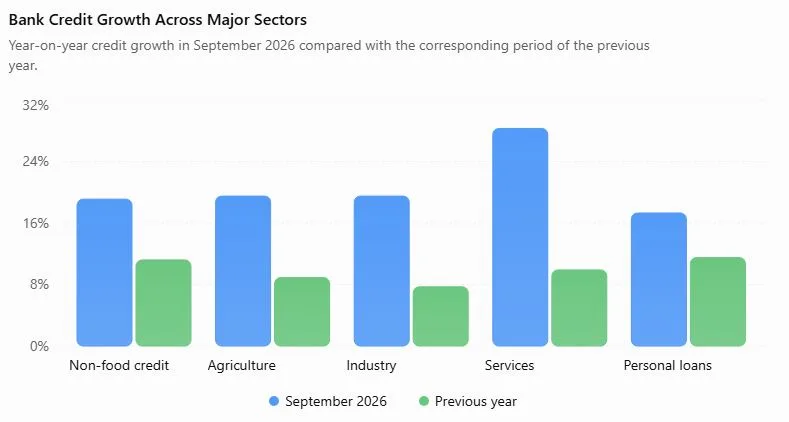
September 2026 Bank Credit Growth: Sector-Wise Comparison
The RBI's latest report highlights stronger lending growth across all four major categories compared with the corresponding period last year.
Sector | September 2026 Growth | Previous Year Growth |
|---|---|---|
Non-food bank credit | 19.1% | 11.2% |
Agriculture | 19.5% | 8.9% |
Industry | 19.5% | 7.7% |
Services | 28.3% | 9.9% |
Personal loans | 17.3% | 11.5% |
Source: RBI sectoral deployment of bank credit data. Year-on-year growth rates.
What the Latest RBI Data Indicate for the Banking Sector
The September credit figures highlight a broad acceleration in bank lending across India's major economic segments.
The services sector recorded the highest growth, supported by increased financing to NBFCs, trade, commercial real estate and professional services.
Industrial credit also expanded significantly, with large and medium-sized industries recording faster growth. Agriculture and personal loans registered improvements compared with their respective growth rates a year earlier.
For banks, faster credit expansion can create opportunities to increase interest-earning assets and lending activity. However, the pace of credit growth also needs to be assessed alongside deposit mobilisation, funding costs, asset quality and the overall cost of borrowing.
A sustained increase in credit demand requires banks to maintain adequate funding sources to support additional lending. The relationship between credit growth and deposit growth is therefore an important indicator for monitoring banking sector conditions.
It is also important to distinguish between credit growth and profitability. Higher loan growth does not automatically translate into higher profits, as banks must account for interest expenses, operating costs, credit provisions and potential loan defaults.
The September 2026 figures nevertheless show that bank lending expanded at a considerably faster pace across agriculture, industry, services and personal finance compared with the previous year.