

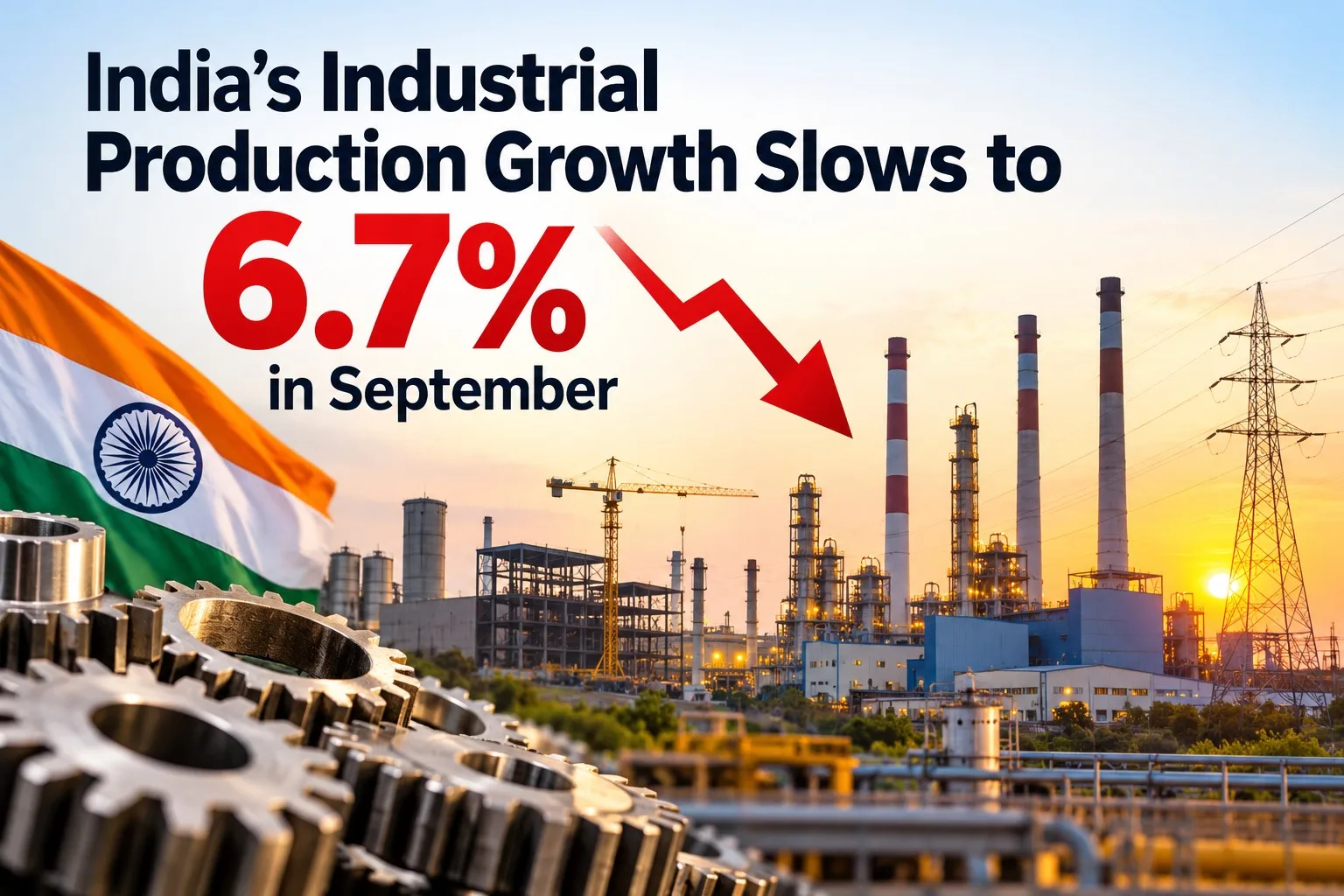
India’s industrial production growth slowed to 6.7% year-on-year in September 2026, compared with the initially reported 8.0% growth in August, according to the latest data released by the Ministry of Statistics and Programme Implementation (MoSPI) on Wednesday.
The Index of Industrial Production (IIP) recorded growth across manufacturing and electricity and gas supply, while mining and quarrying contracted during the month. Manufacturing output increased 7.6%, and electricity and gas supply rose 11.2%. Mining and quarrying declined 6.2%, while water supply, sewerage and waste management grew 5.8%.
The September quick estimate of the IIP stood at 124.3, compared with 116.5 in September 2025. The figures indicate that industrial output remained higher than a year earlier, although the annual growth rate moderated from August.
India IIP Growth: September 2026 Data
Indicator | September 2026 |
|---|---|
Overall IIP growth | 6.7% |
IIP index | 124.3 |
IIP index in September 2025 | 116.5 |
Manufacturing growth | 7.6% |
Electricity and gas supply growth | 11.2% |
Mining and quarrying growth | -6.2% |
Water supply, sewerage and waste management growth | 5.8% |
Source: Ministry of Statistics and Programme Implementation. September figures are quick estimates.
Industrial Growth Slows From August
India’s industrial production growth moderated in September after expanding at a faster pace in August. The August IIP growth rate was initially estimated at 8.0%, but the latest release revised it to 7.8%.
Manufacturing growth also eased from the revised 8.6% recorded in August to 7.6% in September. Electricity and gas supply growth moderated from 12.3% to 11.2% over the same period.
Mining and quarrying remained a weak spot. The sector contracted 6.2% in September, compared with a 4.6% decline in August. Water supply, sewerage and waste management grew 5.8%, against 6.3% in the previous month.
The moderation in the headline IIP growth rate reflected changes across the major industrial sectors, with manufacturing and electricity continuing to expand while mining output declined.
Manufacturing Sector Records 7.6% Growth
Manufacturing, which carries the largest weight in the IIP, expanded 7.6% year-on-year in September. The manufacturing index stood at 128.0, compared with 119.0 in September 2025.
Of the 23 manufacturing industry groups classified at the two-digit level, 17 recorded positive growth during the month.
Electrical equipment, motor vehicles, and rubber and plastics products were the three leading positive contributors to manufacturing growth.
Electrical Equipment Output Rises 33.9%
Manufacture of electrical equipment recorded growth of 33.9% in September compared with the same month a year earlier.
The increase was supported by production categories including electrical apparatus used for switching or protecting electrical circuits, uninterruptible power supply equipment, solid-state drives and connectors for optical fibres and cables.
The electrical equipment industry group's index rose to 172.7 in September 2026 from 129.0 in September 2025.
Motor Vehicle Manufacturing Grows 19%
Manufacture of motor vehicles, trailers and semi-trailers recorded year-on-year growth of 19.0% in September.
The government identified auto components, spares and accessories, passenger cars and commercial vehicles as important contributors within the industry group.
The sector's index increased to 147.1 from 123.6 a year earlier.
Rubber and Plastics Products Increase 19.9%
Manufacture of rubber and plastics products recorded growth of 19.9% in September, making it another major positive contributor to overall manufacturing performance.
The growth across these three industry groups helped support the manufacturing sector despite the moderation in the headline industrial production rate.
Electricity and Gas Supply Grows 11.2%
The electricity and gas supply sector recorded growth of 11.2% year-on-year in September. Its index stood at 128.6, compared with 115.7 in September 2025.
Although the sector continued to expand at a double-digit rate, its growth was lower than the revised 12.3% recorded in August.
Electricity and gas supply form part of the IIP's assessment of industrial activity alongside manufacturing and mining. The sector's performance contributed to the overall expansion in industrial production during September.
Mining and Quarrying Contracts 6.2%
Mining and quarrying was the only major industrial sector to record a contraction in September, with output declining 6.2% year-on-year.
The mining index stood at 90.4, compared with 96.4 in September 2025.
The sector's contraction was deeper than the revised 4.6% decline recorded in August. The decline contrasted with continued expansion in manufacturing and electricity and gas supply.
Water supply, sewerage and waste management, meanwhile, recorded growth of 5.8% in September. Its index stood at 146.4, compared with 138.4 a year earlier.
Capital Goods and Intermediate Goods Record Double-Digit Growth
The use-based classification of industrial production showed growth across several categories in September.
Intermediate goods recorded the strongest growth among the major use-based categories, increasing 12.2% year-on-year. Capital goods output grew 10.4%, while infrastructure and construction goods rose 7.2%.
Primary goods recorded growth of 4.0%. Consumer durables increased 6.0%, while consumer non-durables grew 1.4%.
IIP Growth by Use-Based Classification
Category | September 2026 growth |
|---|---|
Intermediate goods | 12.2% |
Capital goods | 10.4% |
Infrastructure and construction goods | 7.2% |
Consumer durables | 6.0% |
Primary goods | 4.0% |
Consumer non-durables | 1.4% |
The government identified intermediate goods, primary goods and capital goods as the three largest positive contributors to industrial production growth in September.
The use-based classification groups industrial products according to their economic purpose. Capital goods include equipment used in production, while intermediate goods are used as inputs in further manufacturing processes. Consumer goods are classified according to whether they are durable or non-durable.
Industrial Production Growth at 6.8% During April–September
India's industrial production increased 6.8% during April–September 2026 compared with the corresponding period of the previous financial year, according to the latest IIP release.
The cumulative growth rate was higher than the 4.4% recorded during April–September 2025.
Manufacturing recorded cumulative growth of 7.5% during the first six months of FY2026–27. Electricity and gas supply grew 9.7%, while mining and quarrying declined 2.4%. Water supply, sewerage and waste management expanded 6.3% during the period.
The cumulative figures show the performance of industrial production over the first half of the financial year, rather than the change recorded in September alone.
IIP Data May Be Revised
The September 2026 figures are quick estimates compiled using production data received from source agencies, which collect information from factories and other establishments.
The government said the September estimates were compiled using a weighted response rate of 86.5%. The August figures incorporated updated production data and had a weighted response rate of 92.0%.
The IIP estimates may be revised in subsequent releases as additional information becomes available. The next release, covering October 2026, is scheduled for November 30, 2026.
Disclaimer: candlesticks.in is an educational and informational platform only. Nothing published on this website should be treated as a buy, sell, or hold recommendation. Investments in the securities market are subject to market risks; read all related documents carefully before investing. Please consult a SEBI-registered financial advisor before making any investment decisions.