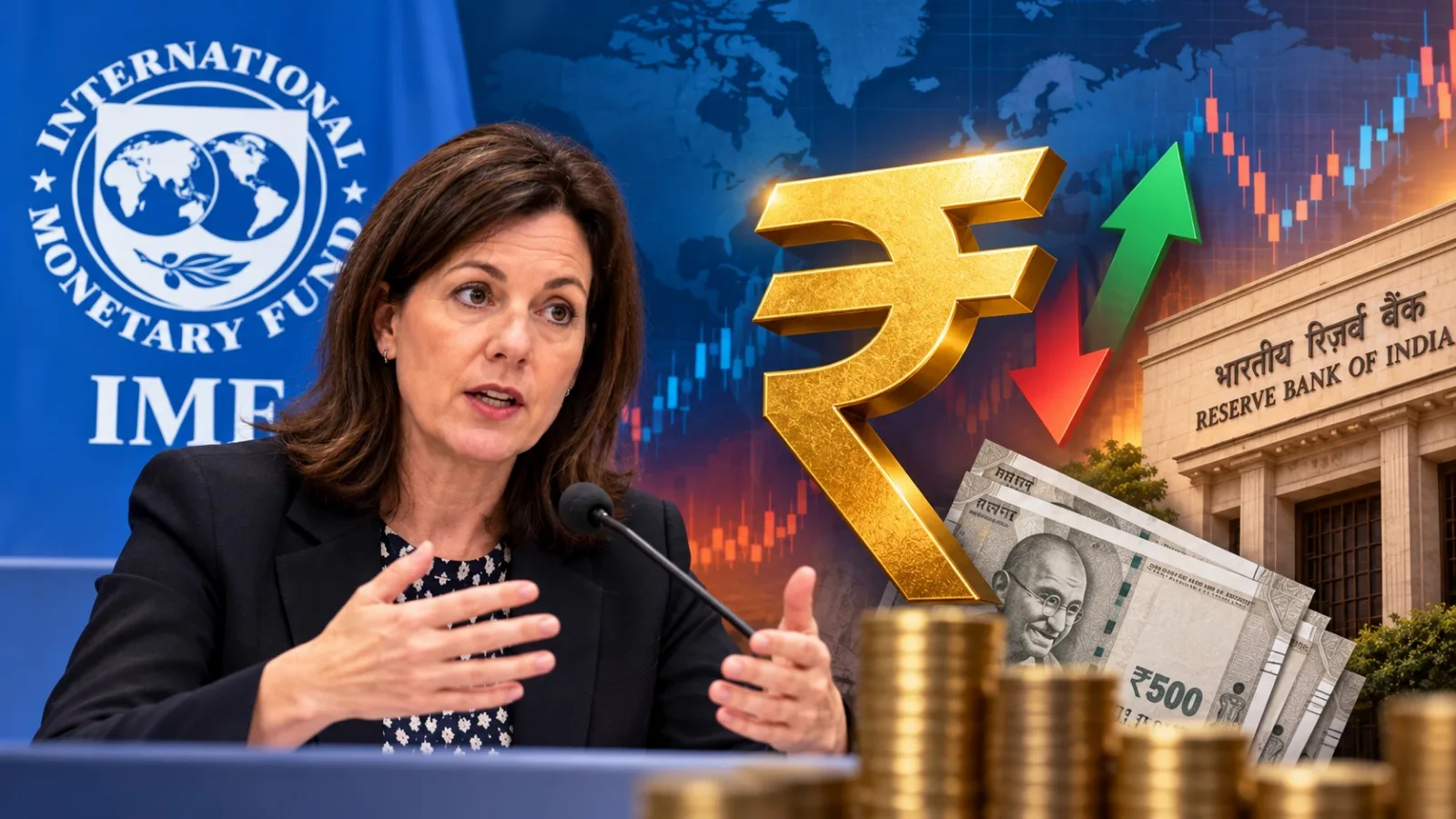
The International Monetary Fund (IMF) on Thursday said exchange rate flexibility should remain India's preferred response to external economic shocks, stating that the rupee should act as the first line of defence when the economy faces global financial pressures.
The remarks come amid reports of significant intervention by the Reserve Bank of India (RBI) in the foreign exchange market to support the rupee amid depreciation pressure.
IMF Communications Director Julie Kozack said allowing the rupee to move in response to external developments would help the Indian economy adjust to changing global economic conditions.
According to Kozack, exchange rate movements play an important role in absorbing external shocks, and allowing the currency to reflect these developments can support the broader economic adjustment process.
She emphasised that exchange rate flexibility remains the IMF's preferred policy response for India.
IMF Says Rupee Should Absorb External Economic Shocks
Kozack said the rupee should serve as the first line of defence when India faces external shocks, rather than relying primarily on foreign exchange market intervention to maintain a particular exchange rate level.
She explained that allowing the exchange rate to adjust to changing global conditions is important for helping the domestic economy respond to external pressures.
External shocks can arise from developments such as changes in global financial conditions, capital flows and international economic uncertainty. Exchange rate flexibility can help economies absorb some of the impact of these developments.
The IMF's position indicates that India should allow market forces to play a greater role in determining the rupee's value, while retaining the option of intervention when necessary to address disorderly market conditions.
IMF Flags Inflation Risks From Rupee Depreciation
Kozack also addressed the potential inflationary consequences of a significant depreciation in the Indian currency.
She said monetary policy tightening could be considered if a substantial decline in the rupee's value begins to translate into broad-based increases in domestic inflation.
A weaker rupee can increase the domestic cost of imported goods and commodities, potentially adding to inflationary pressures. The extent of the impact depends on how much currency depreciation passes through to domestic prices.
"If significant rupee depreciation leads to broad-based increases in inflation, then our advice would be that monetary policy tightening could be considered to preserve price stability," Kozack said.
She clarified that such a policy response would become relevant if currency depreciation starts feeding into broader inflation.
The IMF's comments indicate that the inflationary impact of rupee depreciation would be an important consideration in determining the appropriate monetary policy response.
Foreign Exchange Intervention Appropriate During Disorderly Market Conditions
While emphasising exchange rate flexibility, the IMF also acknowledged that foreign exchange intervention can be appropriate under certain circumstances.
Kozack said central bank intervention could be justified when market conditions become disorderly.
She noted that such intervention would be consistent with the IMF's Integrated Policy Framework (IPF), which provides guidance on the appropriate use of different policy instruments in response to economic and financial shocks.
The framework recognises that policymakers may need to use multiple tools depending on the nature of the shock, the condition of financial markets and the broader economic environment.
However, Kozack reiterated that India's preferred policy approach should remain exchange rate flexibility.
RBI's Currency Market Intervention in Focus
The IMF's remarks come at a time when reports have pointed to substantial RBI intervention in the foreign exchange market to support the rupee.
Central banks typically intervene in currency markets by buying or selling foreign currencies to address excessive volatility or disorderly market movements.
The RBI manages India's foreign exchange market with the objective of maintaining orderly market conditions. Its intervention can influence the demand and supply of foreign currencies and the movement of the rupee.
The IMF's comments distinguish between intervention to address disorderly market conditions and allowing the currency to adjust to underlying economic pressures.
Kozack's remarks suggest that while intervention remains an available policy instrument, it should not replace exchange rate flexibility as India's primary mechanism for absorbing external shocks.
Key Takeaways From the IMF's Remarks
The IMF considers the rupee the first line of defence against external economic shocks.
India should allow the exchange rate to adjust to changing global economic conditions.
Monetary policy tightening could be considered if significant rupee depreciation results in broad-based inflation.
Foreign exchange intervention can be appropriate when currency market conditions become disorderly.
The IMF reiterated that exchange rate flexibility remains the preferable policy response for India.
The IMF's position highlights the importance of exchange rate flexibility in India's response to external economic pressures, while recognising that monetary policy and foreign exchange intervention may have a role when specific economic conditions warrant their use.
Disclaimer: candlesticks.in is an educational and informational platform only. Nothing published on this website should be treated as a buy, sell, or hold recommendation. Investments in the securities market are subject to market risks; read all related documents carefully before investing. Please consult a SEBI-registered financial advisor before making any investment decisions.