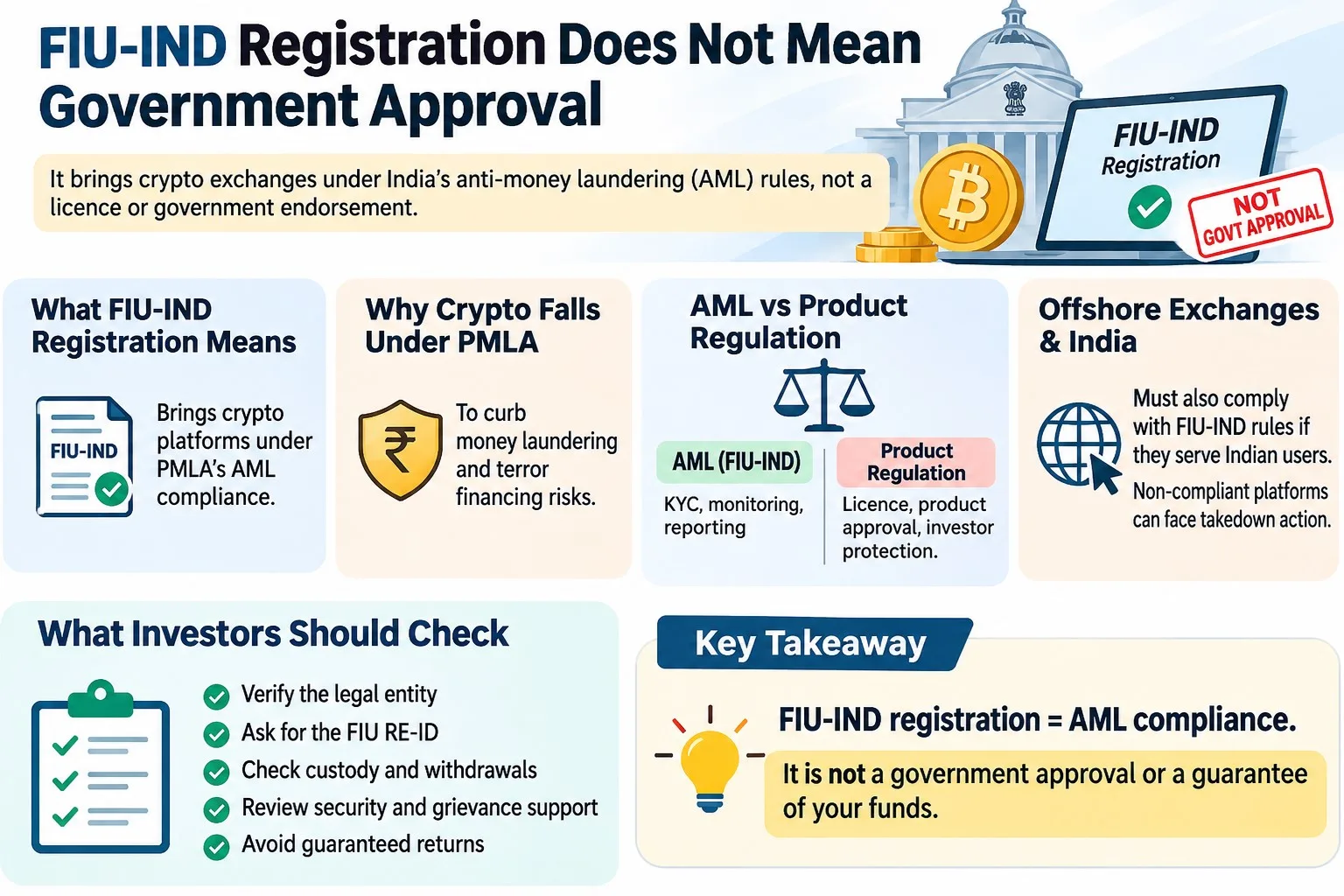
India's cryptocurrency market has witnessed a significant shift in regulatory oversight since March 2023, when the government brought Virtual Digital Asset Service Providers (VDA SPs), including crypto exchanges, under the Prevention of Money Laundering Act (PMLA). The move introduced mandatory registration with the Financial Intelligence Unit-India (FIU-IND) for platforms carrying out specified virtual digital asset activities.
However, an important distinction is often overlooked. An exchange registered with FIU-IND has entered India's anti-money laundering compliance framework, but this does not automatically mean that the government has approved its cryptocurrency products, endorsed its investment services or guaranteed the safety of customer funds.
This distinction matters for Indian investors who increasingly use domestic and offshore cryptocurrency platforms. A platform displaying an FIU-IND registration claim may appear to have government backing, but the actual scope of that registration is much narrower than a conventional financial-sector licence.
What Does FIU-IND Registration Actually Mean?
The Financial Intelligence Unit-India operates under the Ministry of Finance and plays a central role in India's efforts to combat money laundering and the financing of terrorism. Its primary functions include receiving, processing and analysing financial intelligence and sharing relevant information with law enforcement and other competent authorities.
Under the PMLA framework, certain businesses are classified as Reporting Entities. These entities must identify customers, maintain transaction records and report specified financial activities to FIU-IND. The government extended this framework to Virtual Digital Asset Service Providers through a notification dated March 7, 2023.
Consequently, crypto exchanges and other service providers carrying out specified activities are required to register with FIU-IND as Reporting Entities. This registration establishes their obligations under the anti-money laundering framework rather than granting them unrestricted permission to operate as investment or financial product providers.
The distinction is particularly important because the word 'registration' is frequently interpreted as a sign of government approval. In the case of crypto exchanges, FIU-IND registration primarily confirms that an entity has entered the prescribed AML compliance framework and is subject to its associated reporting and record-keeping requirements.
What activities require FIU-IND registration?
The March 2023 government notification covers five categories of virtual digital asset-related activities when conducted on behalf of another person in the course of business.
These include:
Exchange between virtual digital assets and fiat currencies.
Exchange between one or more forms of virtual digital assets.
Transfer of virtual digital assets.
Safekeeping or administration of virtual digital assets, including instruments that enable control over such assets.
Participation in or provision of financial services related to an issuer's offer or sale of virtual digital assets.
The framework therefore extends beyond conventional cryptocurrency exchanges. Businesses providing custody, transfer and certain other digital asset-related services may also fall within its scope.
Why Do Cryptocurrency Exchanges Fall Under PMLA?
Cryptocurrency transactions operate differently from conventional banking transactions. Digital assets can be transferred between wallets across geographical boundaries, while the identities behind certain wallet addresses may not be immediately apparent.
Although blockchain transactions can be publicly traceable on many networks, identifying the actual individuals or entities controlling particular wallets can require additional investigation. These characteristics can create money-laundering and terrorist-financing risks when digital assets are misused.
The government brought VDA service providers under the PMLA framework to improve transparency and establish mechanisms for identifying customers and monitoring suspicious transactions.
Under this system, exchanges must establish customer due diligence procedures, maintain transaction records and develop internal mechanisms to identify potentially suspicious activities. They must also report relevant information to FIU-IND when the reporting requirements are triggered.
The framework is not intended to certify the investment quality of cryptocurrencies. Its purpose is to ensure that businesses involved in specified digital asset activities comply with financial intelligence and anti-money laundering requirements.
KYC and customer due diligence obligations
Know Your Customer (KYC) verification is one of the most visible requirements introduced under the framework. Registered platforms must establish procedures to identify and verify customers using reliable and independent sources of information.
FIU-IND's updated guidelines dated January 8, 2026, specify additional requirements for customer verification, including PAN verification, identity documentation, contact details and other information necessary for customer due diligence.
The guidelines also require exchanges to establish appropriate transaction-monitoring systems. Unusual transaction patterns, complex transfers and activities involving higher-risk customers or geographical locations must receive appropriate attention under their risk assessment procedures.
Transaction monitoring and suspicious transaction reporting
Registration also brings reporting responsibilities. When an exchange identifies transactions that meet the criteria for suspicious activity, its designated compliance personnel must evaluate the circumstances and submit the required Suspicious Transaction Report (STR) to FIU-IND.
This does not mean every cryptocurrency transaction is suspicious or automatically reported as criminal activity. The purpose is to identify unusual or potentially illicit financial movements and provide relevant intelligence to the authorities.
The updated guidelines also address the transfer of digital assets between service providers through the Travel Rule framework. Exchanges involved in such transfers must obtain, maintain and transmit prescribed originator and beneficiary information.
For investors, these requirements explain why registered exchanges may request additional KYC documentation, ask questions about the source of funds or apply restrictions to certain wallet transfers.
FIU-IND Registration vs Government Approval: What Is the Difference?
The central misunderstanding in India's crypto market concerns the difference between anti-money laundering compliance and financial product regulation.
A cryptocurrency exchange may satisfy FIU-IND's registration requirements, but that does not establish that its tokens, trading products or investment schemes have been evaluated and approved by the government.
Financial-sector regulation generally involves a different set of responsibilities. Depending on the nature of the business and product, these may include licensing, authorisation, prudential requirements, market conduct supervision and investor protection mechanisms.
FIU-IND's role in the VDA sector is specifically connected to AML, countering the financing of terrorism and related compliance obligations under the PMLA framework.
Consider the distinction:
Particulars | FIU-IND registration |
|---|---|
Primary purpose | Anti-money laundering compliance |
Legal framework | PMLA, 2002 and associated rules |
Customer verification | Mandatory compliance requirement |
Transaction monitoring | Required |
Suspicious transaction reporting | Required |
Record maintenance | Required |
Cryptocurrency product approval | Not provided by registration |
Guarantee of customer deposits | Not provided |
Guarantee of exchange solvency | Not provided |
Government endorsement of investment products | Not provided |
This means an FIU-IND registered exchange should not advertise its registration as proof that the government has approved its cryptocurrency offerings or guaranteed its financial stability.
The distinction is also important when investors compare cryptocurrency platforms with entities operating in India's regulated securities market. Registration under one regulatory framework cannot automatically be treated as authorisation under another.
What Did the Finance Ministry Tell Parliament About FIU-IND Registration?
The government has directly addressed this confusion in a parliamentary reply.
In response to Lok Sabha Unstarred Question No. 5805, answered on March 30, 2026, the Ministry of Finance disclosed that 54 Virtual Digital Asset Service Providers had been registered with FIU-IND as Reporting Entities as of March 9, 2026.
The reply also clarified that FIU-IND had directed the takedown of applications and URLs belonging to 53 VDA service providers found to be operating in India without complying with the relevant PMLA requirements.
However, the most significant part of the parliamentary response concerned the availability of registration information to the public.
The government stated that FIU-IND had not established a public portal or published a general public registration list. It explained that the registration database was primarily intended for law enforcement agencies and supervisory purposes.
The Ministry also highlighted the risk of misleading investors. Publishing a public registration list could create the impression that registered entities were licensed, approved or endorsed by the government in the same way as financial-sector-regulated entities.
Such an impression could lead investors to assume that they had regulatory protection or financial recourse if an exchange failed or customers lost money.
This clarification is particularly important because it directly addresses the difference between being registered as a Reporting Entity and receiving government approval as a financial services provider.
Why the 54-provider figure needs context
The figure of 54 is a dated snapshot, not a continuously updated public register. It represents the number disclosed by the Finance Ministry for March 9, 2026.
The parliamentary reply included an annexure identifying the registered entities at that point in time. However, the government simultaneously clarified that FIU-IND does not operate a general public-facing registration directory.
Therefore, investors should not treat an old exchange list, a third-party website or an undated registration claim as definitive evidence of an exchange's current compliance status.
How Are Offshore Cryptocurrency Exchanges Serving Indian Users Treated?
One of the important features of India's FIU-IND framework is that registration requirements are activity-based rather than dependent entirely on where a company is incorporated.
This means an offshore cryptocurrency exchange cannot automatically avoid Indian PMLA obligations simply by registering its parent company in another country.
The framework covers VDA service providers operating in India, whether domestic or offshore, when they undertake the notified activities. The government's position is that these obligations apply irrespective of the entity's physical presence in India.
For example, an overseas platform offering cryptocurrency-to-fiat conversion, cryptocurrency transfers or digital asset custody to Indian users may fall within the registration requirements, depending on its activities.
The platform's foreign incorporation does not, by itself, remove the compliance obligation. It must assess its activities against the Indian notification and fulfil the applicable requirements.
Government action against non-compliant offshore platforms
India's enforcement actions demonstrate that offshore incorporation is not an automatic exemption from the country's AML framework.
In December 2023, FIU-IND issued show-cause notices to nine offshore VDA service providers over alleged non-compliance with the PMLA requirements. The action also involved requests to restrict access to their applications and website URLs.
Subsequent enforcement measures expanded the government's action against non-compliant service providers. The Lok Sabha reply in March 2026 referred to takedown directions involving 53 VDA service providers.
More recently, on September 9, 2026, the Finance Ministry announced that FIU-IND had issued notices to another 15 VDA service providers under Section 13 of the PMLA.
The named entities included Weex, Blofin, Bitunix, DigiFinex, Toobit, XT.com, WOO X, Pionex, ChangeNow and WhiteBIT, among others.
The government also stated that takedown notices had been issued concerning applications and URLs of these entities for operating without complying with the applicable Indian PMLA requirements.
These actions illustrate that FIU-IND registration is not merely an administrative formality. The government can initiate enforcement proceedings against entities that fail to comply with the applicable requirements.
Does FIU-IND Registration Guarantee the Safety of Investors' Money?
No. This is perhaps the most important distinction for cryptocurrency investors.
An exchange's AML compliance status does not establish whether it has sufficient financial reserves to meet customer withdrawal obligations. It also does not independently establish the quality of its cybersecurity, the reliability of its custody arrangements or the financial health of the company operating the platform.
Even a registered exchange can face operational difficulties, cyberattacks, liquidity problems or disputes involving customer assets.
FIU-IND registration is therefore only one part of the risk assessment that an investor should undertake before depositing money into a cryptocurrency platform.
The government has also cautioned that crypto products and NFTs are unregulated and can be highly risky, and that investors may have limited or no regulatory recourse for losses arising from such transactions.
What investors should check before using an exchange
1. Verify the actual legal entity
Investors should identify the company operating the exchange rather than relying only on its brand name. The legal entity mentioned in the platform's terms and conditions should match its corporate disclosures and other available records.
A cryptocurrency platform may operate under a familiar brand while the company responsible for customer funds is registered under a different name or in another jurisdiction.
2. Check its FIU-IND registration claim
An exchange claiming FIU-IND registration should be able to identify the exact legal entity registered as a Reporting Entity and provide its formal FIU Reporting Entity ID (FIU RE-ID).
Investors should be cautious about relying on screenshots, logos or general statements such as "government registered". A temporary application reference number is not equivalent to completed formal registration.
3. Examine the company's jurisdiction
An exchange incorporated outside India may be subject to the laws of its country of incorporation. Investors should understand which legal entity holds their assets and which jurisdiction governs disputes involving their accounts.
The availability of an application in India does not, by itself, establish that the overseas company has complied with all applicable Indian requirements.
4. Understand custody and withdrawal arrangements
Investors should examine how the exchange stores customer assets, whether it uses independent custody arrangements and what withdrawal conditions apply.
Proof-of-reserves disclosures may provide some information about blockchain-held assets, but they should not automatically be treated as proof of complete solvency. Investors should understand whether customer liabilities are also independently assessed.
5. Examine security and grievance mechanisms
Two-factor authentication, withdrawal controls, security audits, incident disclosures and clearly documented customer grievance procedures are important factors when evaluating a cryptocurrency platform.
Investors should also examine the exchange's history of withdrawal delays, service disruptions and security incidents rather than relying solely on promotional statements.
6. Be cautious about guaranteed returns
A platform's FIU registration does not validate high-return investment schemes, staking offers, leveraged products or promises of fixed profits.
Any investment offer should be assessed independently, particularly where the platform uses government registration claims to create an impression of guaranteed safety.
What Does FIU-IND's Updated January 2026 Framework Change?
The January 8, 2026, updated AML and CFT guidelines provide a more detailed compliance framework for VDA service providers.
Apart from customer identification and transaction monitoring, the guidelines cover governance arrangements, risk assessments, sanctions screening, record-keeping and reporting procedures.
They also prescribe responsibilities for two important compliance positions: the Designated Director and the Principal Officer. The Designated Director is responsible for overall compliance oversight, while the Principal Officer handles key monitoring and reporting responsibilities under the PMLA framework.
The updated framework also addresses transfers involving unhosted wallets, commonly known as self-custody wallets. Exchanges must collect relevant transaction information, assess risks and apply enhanced customer due diligence and other risk-based controls where necessary.
This is significant because cryptocurrency transfers do not always take place between two accounts maintained by centralised exchanges. Transfers involving privately controlled wallets can require additional checks, particularly when the originator or beneficiary information is not readily available.
The guidelines also require registration applicants to demonstrate operational readiness and their AML compliance capabilities. This includes systems for KYC, transaction monitoring, blockchain analytics, sanctions screening and compliance with the Travel Rule.
Formal registration is granted only after the prescribed documentation, an in-person meeting and approval by the Director, FIU-IND. A temporary reference number generated during the application process should not be confused with completed registration.
These requirements demonstrate that FIU-IND registration involves a structured compliance process. However, even successful completion of that process does not transform the registration into a comprehensive financial-sector licence.
The Difference Between Compliance and Endorsement Matters
India's cryptocurrency regulatory framework has developed along a specific path. The government has introduced AML obligations for VDA service providers without making FIU-IND registration equivalent to approval of the underlying cryptocurrency products or investment activities.
The distinction becomes particularly important as more investors enter the digital asset market and offshore exchanges compete for Indian customers. A registration claim may indicate compliance with an important legal requirement, but it cannot answer every question about the financial strength, operational reliability or legal protections offered by a platform.
For investors, the correct approach is to consider FIU-IND registration as one compliance parameter among several. Understanding the legal entity, custody arrangements, withdrawal policies, jurisdiction and applicable regulatory framework remains essential before choosing a cryptocurrency exchange.