

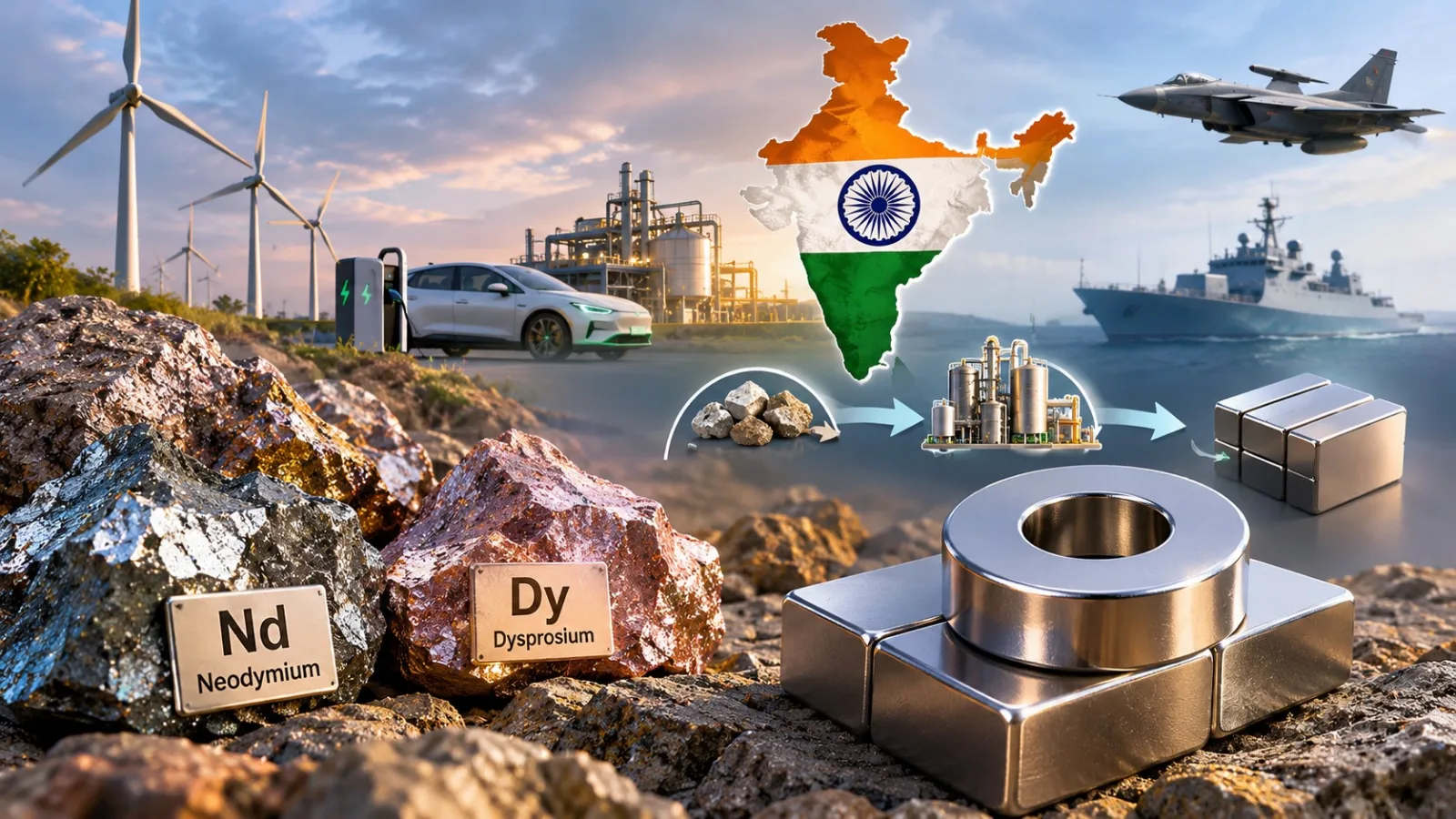
India's growing requirements for electric vehicles, renewable energy equipment, advanced electronics and defence systems have increased the importance of rare earth elements in its industrial supply chain. Among these materials, neodymium and dysprosium occupy an important position because of their use in high-performance permanent magnets. These materials are essential for manufacturing compact, powerful and energy-efficient motors used across several industrial sectors.
Although India has considerable geological resources of rare earth elements, the country continues to depend on overseas suppliers for critical intermediate materials and finished magnets. The gap between mineral availability and industrial manufacturing capacity has become an important part of India's critical mineral policy. The concentration of global processing and magnet manufacturing in China has added another dimension to the issue, particularly for industries requiring reliable long-term supplies.
What Are Rare Earth Elements and Why Are They Important?
Rare earth elements comprise a group of 17 chemically related elements, including the 15 lanthanides along with scandium and yttrium. Despite their name, these elements are not necessarily rare in the Earth's crust. However, economically recoverable deposits are less common, and separating individual elements from mineral concentrates involves technically demanding processes that require specialised infrastructure and chemical treatment.
Their magnetic, optical and chemical properties make them useful in several industrial applications, including electronics, renewable energy, transportation and defence equipment. Permanent magnets are among their most important applications by economic value. Neodymium-based magnets, in particular, are widely used in electric motors and generators because they provide strong magnetic performance relative to their size and weight.
Neodymium and Dysprosium: The Two Important Magnet Materials
Neodymium (Nd) is a principal material used in neodymium-iron-boron (NdFeB) permanent magnets. Its magnetic properties allow manufacturers to produce powerful magnets in relatively compact sizes, making it suitable for electric vehicle motors, wind turbine generators, industrial equipment and consumer electronics. Praseodymium is also commonly used alongside neodymium in magnet production, depending on the required composition and performance specifications.
Dysprosium (Dy) is a heavy rare earth element used in selected high-performance NdFeB magnet formulations. It improves resistance to demagnetisation at elevated temperatures, which is important for electric motors and other equipment operating under demanding thermal conditions. Manufacturers may also use terbium in certain magnet grades, although the exact quantities depend on the intended application and operating environment.
The distinction between these materials is important for understanding supply-chain requirements. Neodymium and praseodymium belong to the light rare earth group, whereas dysprosium and terbium are classified as heavy rare earth elements. Their geological distribution, availability and processing requirements differ, making it difficult for countries to secure the entire range through a single mining or processing operation.
China's Dominance in the Global Rare Earth Supply Chain
China occupies a dominant position in the global rare-earth industry, extending beyond mining into separation, refining and permanent magnet manufacturing. According to the International Energy Agency's 2026 rare-earth analysis, China accounted for approximately 60% of global mined production of magnet rare earths and 91% of refined output in 2024. Its share of global sintered permanent magnet production stood at approximately 94%.
China's position reflects the development of a vertically integrated industrial ecosystem over several decades. Mining operations, separation facilities, metal production, alloy manufacturing and magnet factories operate within an established supply network. This integration provides manufacturers with access to intermediate materials and specialised processing capabilities that are not yet available at comparable scale in many other countries.
Supply-chain segment | China's global share in 2024 |
|---|---|
Mined magnet rare earth production | 60% |
Refined magnet rare earth output | 91% |
Sintered permanent magnet production | 94% |
The concentration of processing and manufacturing capacity creates exposure for countries that possess mineral resources but lack comparable downstream infrastructure. A disruption at the refining or magnet manufacturing stage can affect industries even when alternative mining sources are available. This makes diversification of processing facilities as important as securing access to additional mineral deposits.
Export Controls and International Supply Disruptions
China introduced export controls on selected rare earth elements in April 2025, including dysprosium and terbium, alongside several other strategically important materials. Additional restrictions were announced in October 2025, expanding controls to more rare earth elements, processing technologies and certain industrial products. These measures increased the importance of export licences and regulatory approvals for companies sourcing materials from China.
A further development took place on November 9, 2026, when China announced a two-month extension of the suspension of certain export-control measures that were due to expire on November 10. The suspension now extends until January 10, 2027. However, the separate April 2025 controls covering seven elements, including dysprosium and terbium, remain in force, so the extension should not be interpreted as a complete removal of rare-earth export restrictions.
For manufacturers outside China, the availability of specific materials continues to depend on the applicable export-licensing framework and the origin of the products being purchased. Companies using high-performance magnets may need to account for regulatory requirements, supplier diversification and inventory availability when planning procurement for industrial production.
India's Rare Earth Resource Position
India has substantial geological resources of rare earth elements, particularly in coastal mineral deposits containing monazite. According to information provided by the Department of Atomic Energy in Parliament on April 2, 2026, the Atomic Minerals Directorate for Exploration and Research has established approximately 7.23 million tonnes of in-situ total rare earth oxide equivalent contained in 13.15 million tonnes of monazite resources. These deposits occur across several coastal and inland regions.
Resource category | Estimated resource |
|---|---|
Monazite resource | 13.15 million tonnes |
Rare-earth oxide equivalent contained in monazite | 7.23 million tonnes |
Rare-earth oxide resources in hard-rock areas | 1.29 million tonnes |
The monazite resources are found in coastal beach sands, teri sands and inland alluvium across states including Andhra Pradesh, Odisha, Tamil Nadu, Kerala, Gujarat, Maharashtra, West Bengal and Jharkhand. Additional hard-rock rare-earth resources have been identified in parts of Gujarat and Rajasthan. These deposits provide a foundation for domestic mineral exploration and processing, although their commercial utilisation depends on geological, environmental and technological conditions.
The Geological Survey of India has separately reported cumulative rare-earth ore resources of 767 million tonnes across the country, evaluated at different cut-off values and average grades. This figure represents the reported quantity of ore and should not be interpreted as the amount of recoverable rare-earth oxides or commercially available metal. Mineral resources, economically recoverable reserves and finished rare-earth products are different measures.
Why India's Mineral Resources Do Not Automatically Translate Into Magnet Production
India's resource base faces several geological and industrial constraints that affect its ability to convert mineral deposits into finished products. Government information indicates that the relevant Indian resources are relatively low in grade, with reported grades of approximately 0.056% to 0.058%. Monazite also contains thorium, a naturally occurring radioactive element, making extraction, separation and waste management more complicated than processing many conventional industrial minerals.
Another consideration is the availability of individual rare earth elements within domestic deposits. India's monazite resources are predominantly associated with light rare earth elements, while economically extractable quantities of certain heavy rare earth elements remain limited. Consequently, the availability of domestic mineral resources does not automatically ensure sufficient supplies of dysprosium and terbium for every category of high-performance magnet manufacturing.
India has established capabilities in mining, separation and refining rare earths into oxide form. However, the limited development of industrial-scale midstream and downstream facilities has restricted the creation of a complete domestic value chain. The conversion of refined oxides into metals, alloys and finished magnets remains an important industrial gap.
The Missing Link: From Rare Earth Oxides to Permanent Magnets
Rare-earth manufacturing involves several stages, each requiring specialised processing technology and industrial infrastructure. The process begins with the extraction and concentration of mineral-bearing material, followed by chemical treatment to separate rare earth elements. The resulting high-purity oxides are then converted into metals and alloys before being processed into finished permanent magnets.
The main stages of the rare-earth permanent magnet manufacturing chain include:
Mining and beneficiation: Rare-earth-bearing minerals are extracted and concentrated through physical separation processes.
Chemical processing: Concentrated minerals undergo chemical treatment and leaching to release rare earth elements into solution.
Separation and refining: Techniques such as solvent extraction separate individual rare earth elements into high-purity oxides.
Metal production: Rare-earth oxides are converted into metals through suitable reduction or electrochemical processes.
Alloy manufacturing: Rare-earth metals are combined with iron, boron and other materials to produce magnet alloys.
Magnet manufacturing: Alloy materials are processed into powders, aligned, pressed and sintered to produce permanent magnets.
The separation stage is particularly challenging because rare earth elements possess similar chemical properties. Industrial separation therefore requires carefully controlled processing systems and multiple extraction stages to obtain individual elements at the required purity. The quality of the resulting oxides directly influences the characteristics of the metals, alloys and magnets produced in subsequent stages.
Manufacturing sintered NdFeB magnets also requires specialised equipment and process knowledge, including alloy strip casting, powder production, magnetic-field alignment, pressing, sintering and finishing. These capabilities cannot be developed simply by increasing mining output. They require investment in industrial equipment, process engineering, specialised workers and quality-control systems.
India's Existing Magnet Manufacturing Capabilities
India has made progress in developing domestic rare-earth magnet technology, although pilot-scale and specialised production capabilities should be distinguished from large-scale commercial manufacturing. The Department of Science and Technology reported the establishment of a pilot plant for manufacturing NdFeB permanent magnets at the International Advanced Research Centre for Powder Metallurgy and New Materials (ARCI) in Hyderabad in March 2026.
The ARCI facility follows an integrated manufacturing process from strip-cast alloy to finished sintered magnets. It provides a platform for technology validation, process optimisation and collaboration with industrial manufacturers. The facility is an important development in domestic technology capability, but a pilot plant does not represent the same production scale as a large commercial magnet manufacturing facility.
Separately, the Department of Atomic Energy has established a rare-earth permanent magnet plant at Visakhapatnam, Andhra Pradesh, with an annual production capacity of approximately three tonnes of samarium-cobalt magnets. These magnets are used in strategic applications, including defence and atomic energy. However, samarium-cobalt and NdFeB magnets are different product categories, with different material compositions and performance characteristics.
India's ₹7,280 Crore Rare Earth Magnet Manufacturing Scheme
The Union Cabinet approved the Scheme to Promote Manufacturing of Sintered Rare Earth Permanent Magnets on November 26, 2025. The government notified the scheme on December 15, 2025, with a total financial outlay of ₹7,280 crore. The programme aims to establish 6,000 metric tonnes per annum (MTPA) of integrated sintered rare-earth permanent magnet manufacturing capacity in India.
The scheme is designed to support the development of domestic manufacturing capabilities across the value chain, from rare-earth oxide feedstock to metals, alloys and finished magnets. It includes ₹6,450 crore in sales-linked incentives over five years, along with capital support for establishing manufacturing facilities. The programme is intended to encourage private-sector participation and develop an integrated industrial ecosystem.
The main provisions of the scheme include:
A targeted manufacturing capacity of 6,000 MTPA.
Selection of up to five beneficiaries through global competitive bidding.
A maximum allocation of 1,200 MTPA to each beneficiary.
₹6,450 crore in sales-linked incentives over five years.
A two-year gestation period for establishing manufacturing facilities, followed by five years of incentive support.
The Ministry of Heavy Industries invited global bids for the programme in March 2026 and opened technical bids on August 13, 2026. The government reported receiving 20 bids under the programme. The proposed capacity represents a future manufacturing target and should not be treated as existing operational production.
India's Rare Earth Corridors Across Four States
The Union Budget 2026–27 announced dedicated rare-earth corridors in Odisha, Kerala, Andhra Pradesh and Tamil Nadu. These corridors are intended to promote mining, processing, research and manufacturing activities. The initiative is designed to connect mineral-resource regions with processing infrastructure, research institutions and downstream industrial facilities.
These states have relevance to India's coastal mineral resources and existing rare-earth processing infrastructure. IREL (India) Limited operates a rare-earth extraction plant in Odisha and a refining unit at Aluva in Kerala. Building on this existing industrial presence could support the development of additional processing and manufacturing facilities within the proposed corridors.
In an April 2026 parliamentary response, the government stated that a Joint Working Group was being constituted to formulate guidelines and standard operating procedures for establishing the corridors. The group is expected to examine the requirements for infrastructure, processing and industrial development. The initiative is intended to connect resource exploration with downstream manufacturing rather than limiting development to mineral extraction.
India's Rare Earth Demand Could Reach 8,220 Tonnes by 2030
An assessment conducted by IREL, the Defence Metallurgical Research Laboratory and Bhabha Atomic Research Centre estimated India's rare-earth permanent magnet requirement at 8,220 tonnes per annum by 2030. The projected requirement reflects demand from electric vehicles, industrial motors, renewable energy equipment, electronics and other manufacturing applications. The figures are estimates rather than confirmed future consumption.
Industry | Estimated 2030 demand |
|---|---|
Electric vehicles (two-, three- and four-wheelers) | 3,250 tonnes |
Industrial motors | 500 tonnes |
BLDC fans | 980 tonnes |
Smartphones and computers | 600 tonnes |
Solar-powered pumps | 170 tonnes |
Elevators and escalators | 100 tonnes |
Other consumer electronics | 820 tonnes |
Wind turbines | 1,800 tonnes |
Total | 8,220 tonnes |
The government's proposed 6,000 MTPA manufacturing capacity would represent approximately 73% of this estimated domestic demand if the entire capacity is established and utilised. The remaining requirement could continue to be met through imports or additional domestic manufacturing investments, depending on production and consumption trends.
The actual requirement will depend on manufacturing growth, technology choices, magnet efficiency and the development of downstream industries. Improvements in motor design and material efficiency could also influence the quantity of rare earth material required for each unit of production. The projected demand therefore provides an indication of potential industrial requirements rather than a fixed consumption target.
Rare Earth Elements and Defence Supply Chain Vulnerabilities
Rare earth permanent magnets are used in several high-performance defence and aerospace applications. Their magnetic strength and compact size make them useful in motors, actuators, generators, sensors and other precision electromechanical equipment. These components are used across different categories of equipment where performance, size and operating conditions are important design considerations.
The availability of these materials can affect more than consumer manufacturing. Supply disruptions may create procurement and production challenges for aerospace and defence manufacturers that require specialised magnet grades and materials. For India, the issue involves both access to mineral resources and the ability to convert them into products that meet industrial and strategic specifications.
A country may possess rare-earth deposits but remain dependent on imported refined oxides, metals, alloys or finished magnets. Dependence at any of these stages can create a supply-chain vulnerability, particularly when production is concentrated among a limited number of international suppliers. Domestic processing, diversified sourcing and manufacturing capabilities would address different parts of this exposure.
Strategic Stockpiling: How Countries Prepare for Supply Disruptions
Stockpiling is one of the mechanisms governments use to manage disruptions in critical mineral supply chains. Strategic inventories can provide manufacturers with temporary access to essential raw materials during export restrictions, geopolitical tensions, transportation interruptions or unexpected changes in international supply. The composition of these inventories depends on the country's industrial requirements and assessment of supply risks.
Japan provides an example through its national rare-metals stockpiling framework managed by the Japan Organization for Metals and Energy Security (JOGMEC). The country's approach forms part of a broader resource security strategy intended to reduce the impact of supply disruptions. Stockpiling is used alongside overseas resource development, supplier diversification and recycling initiatives.
For India, publicly announced initiatives have focused on exploration, mining, processing, recycling and domestic magnet manufacturing. The government has not published an element-by-element national rare-earth stockpile target for neodymium, dysprosium or finished permanent magnets in the policy announcements discussed here. A stockpiling framework would need to consider the different industrial uses of mineral concentrates, separated oxides, metals, alloys and finished magnets.
Holding processed materials and finished magnets could provide manufacturers with more immediate access to industrial inputs than relying exclusively on unprocessed mineral resources. The selection of materials for a strategic inventory would depend on their supply concentration, storage requirements, shelf life, procurement costs and importance to critical industries. These considerations would be relevant when designing a national critical mineral security framework.
Mineral Processing Technology and Environmental Considerations
Developing domestic rare-earth processing capacity also involves environmental and technological challenges. The extraction of rare earth elements from monazite requires careful treatment because of its association with thorium. Chemical processing can produce residues containing radioactive materials, requiring specialised handling, monitoring and disposal arrangements under applicable regulations.
Industrial separation facilities also require substantial chemical-processing infrastructure. Solvent extraction systems, water treatment, chemical management and waste handling are important parts of commercial production. The International Energy Agency has highlighted environmental pressures associated with rare-earth extraction and processing, including radioactive tailings, acidic effluents, air emissions and chemical waste.
For India, these considerations are particularly relevant because several identified deposits occur in coastal regions. Land-use requirements, coastal regulation, forest restrictions, environmental clearances and existing habitation can influence the development and expansion of mining operations. The availability of geological resources therefore needs to be assessed alongside the environmental and infrastructure requirements for commercially viable extraction.
The National Critical Mineral Mission also includes recovery from end-of-life products. Recycling discarded magnets from electric motors, electronics and industrial equipment could provide an additional source of rare-earth materials as these products reach the end of their useful lives. Building collection, dismantling, separation and recycling infrastructure would be necessary to recover materials at commercially useful quantities.
The Importance of Building a Complete Domestic Supply Chain
India's rare-earth strategy involves more than increasing mineral exploration or establishing additional mines. The development of separation technology, metal production, alloy manufacturing and sintered magnet facilities will determine how much value can be added domestically. Each stage requires different technical capabilities, investment and access to specialised equipment.
The ₹7,280 crore manufacturing scheme, the proposed rare-earth corridors and the National Critical Mineral Mission represent separate parts of this development programme. The 6,000 MTPA magnet manufacturing target, compared with the estimated domestic requirement of 8,220 MTPA by 2030, provides a measurable reference point for assessing the scale of proposed industrial capacity. The actual contribution to domestic supply will depend on project implementation and production utilisation.
As electric mobility, renewable energy, electronics and defence manufacturing expand, the availability of neodymium, dysprosium and high-performance permanent magnets will remain an important part of India's industrial supply-chain planning. The development of domestic processing and manufacturing capabilities, alongside diversified international sourcing and material recycling, will influence the country's ability to meet future requirements.
Disclaimer: This article is intended for informational and educational purposes. It does not constitute investment advice or a recommendation to buy or sell any security.