

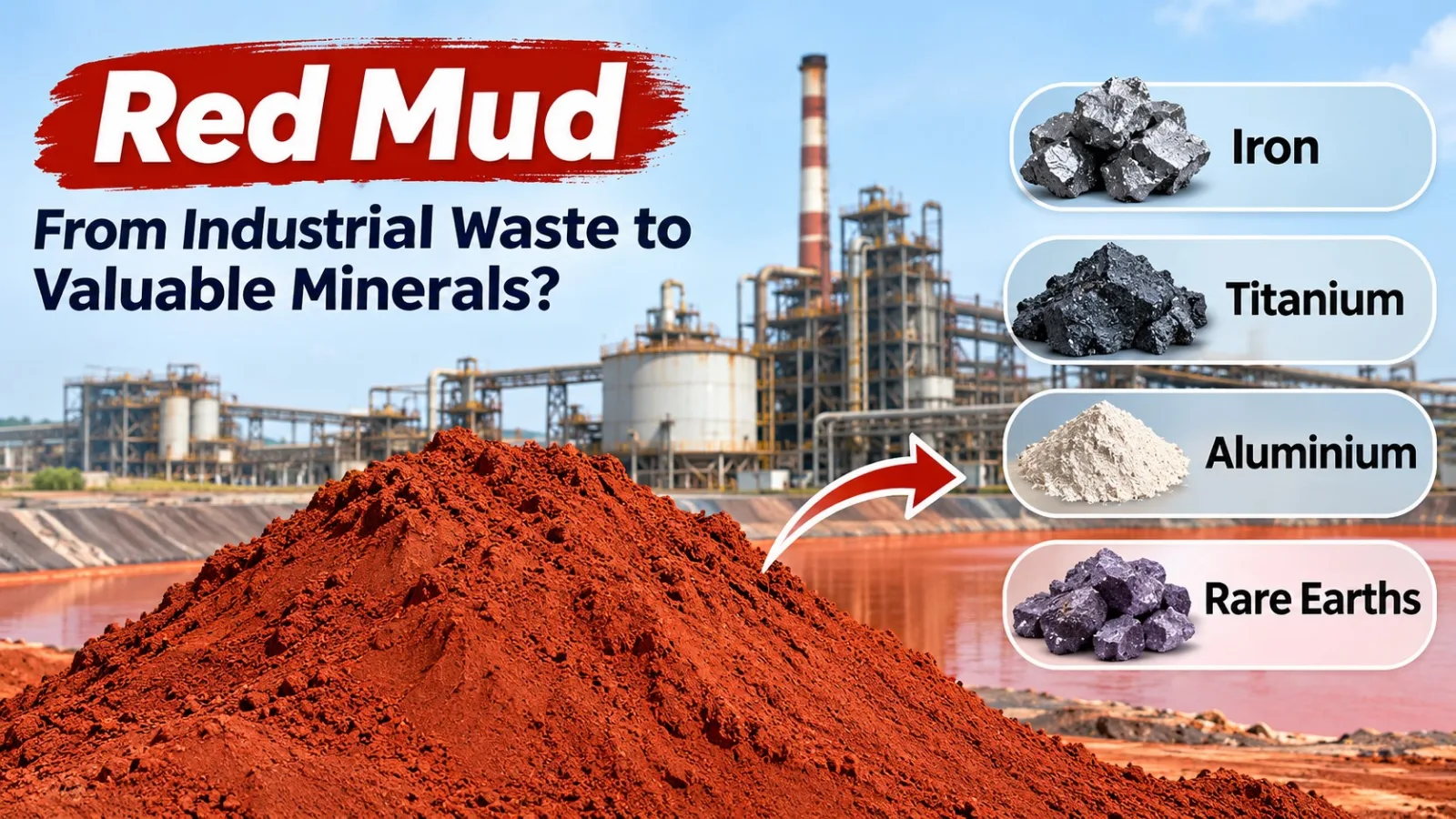
India's aluminium industry produces millions of tonnes of red mud every year, leaving companies with a difficult industrial waste management problem. However, this reddish residue contains several materials that could have value beyond conventional waste disposal, including iron, titanium, aluminium, silica and certain critical minerals.
The possibility of recovering these materials is attracting attention from research institutions, aluminium producers and mineral processing companies. What was once treated largely as an unwanted by-product is increasingly being examined as a potential source of secondary industrial raw materials.
The opportunity is particularly relevant for India, where the aluminium industry generates a substantial volume of bauxite residue and demand for critical minerals is receiving greater policy attention.
What Exactly Is Red Mud?
Red mud, also known as bauxite residue, is generated during the refining of bauxite into alumina. Alumina is the principal raw material used to manufacture aluminium metal, and red mud remains after the Bayer process separates alumina from the original bauxite ore.
The residue gets its reddish colour mainly from iron compounds. Its composition also includes aluminium, silicon, titanium, calcium and sodium compounds, along with smaller quantities of other metals and trace elements.
The quantity generated depends on the quality of bauxite and the refinery's operating conditions. Industry estimates commonly indicate that around 1–1.5 tonnes of red mud can be generated for every tonne of alumina produced, although actual quantities vary between refineries.
India is estimated to generate approximately 9 million tonnes of red mud annually. Much of this material has traditionally been stored in specially designed disposal areas near alumina refineries, requiring continuous attention to storage capacity and environmental safety.
Iron Could Be the First Major Commercial Opportunity
One of the most significant components of red mud is iron oxide. Depending on the source and processing conditions, published studies have reported iron oxide concentrations ranging from approximately 14% to 45%.
This makes red mud an interesting secondary raw material for the iron and steel value chain. Instead of relying entirely on freshly mined iron ore, processing companies could potentially recover iron-rich concentrates from existing industrial residue.
However, extracting iron is not as straightforward as separating ordinary iron ore. In red mud, iron is often chemically associated with other mineral phases, requiring processes such as reduction roasting, magnetic separation or high-temperature treatment.
The commercial opportunity will depend on the quality of the recovered material, energy consumption and its ability to meet the specifications required by steel manufacturers. A process that produces a usable iron-bearing feedstock at a competitive cost could create an additional revenue stream for alumina refineries.
Titanium Recovery Could Open Another Industrial Market
Titanium is another important element found in bauxite residue. Studies have reported titanium dioxide concentrations of around 2% to 12%, although the actual content varies considerably according to the bauxite source and refining process.
Titanium-bearing materials have applications in pigments, ceramics, specialised alloys and other industrial products. Titanium dioxide is widely used in the production of white pigments, while titanium-based alloys are important in aerospace, chemical processing and other specialised applications.
The challenge is that titanium in red mud is not necessarily available in a form that can be directly used by manufacturers. It must first be separated from iron, aluminium, silica and other compounds before it can become a commercially useful product.
One possible route is to recover iron and titanium together as a ferro-titanium alloy or intermediate material. This could be more practical than attempting to produce separate high-purity products at the first stage of processing.
Could Red Mud Supply Rare Earth and Critical Minerals?
The presence of rare earth elements and other critical minerals has added another dimension to red mud research. Certain residues contain small quantities of scandium, gallium and rare earth elements such as cerium and lanthanum.
Scandium is particularly interesting because it can be used in specialised aluminium alloys, solid oxide fuel cells and other advanced industrial applications. Even relatively small quantities can attract attention because of its specialised uses and limited supply chains.
However, the presence of a valuable element does not automatically make its recovery profitable. The concentration of these elements in red mud is often low, and they may be distributed across different mineral phases.
Recovering them requires selective chemical treatment, separation and purification. The cost of reagents, processing time and waste management can significantly influence the final economics.
For this reason, extracting rare earth elements from red mud is still a developing commercial opportunity rather than an established large-scale industry.
India Begins Moving Beyond Research
India has started taking steps towards testing the recovery of valuable materials from industrial residues.
In August 2026, the National Aluminium Company (NALCO) announced a collaboration involving research institutions, including CSIR-IMMT and KIIT, to advance industrial residue utilisation. Alongside the inauguration of a fly ash processing pilot plant, a groundbreaking ceremony was held for a proposed red mud valorisation pilot facility.
The proposed red mud facility is intended to focus on recovering ferro-titanium alloy, metallic iron and rare earth elements. This is an important development because it moves the discussion from laboratory research towards pilot-scale technology validation.
The distinction is important: the facility was announced as a proposed pilot plant, not as an already operational commercial recovery unit. Its performance will need to be evaluated before the technology can be considered ready for wider industrial deployment.
Separately, Canada's Enervoxa said in July 2026 that it was exploring a potential rare earth processing project in India. The company indicated that a commercial-scale facility could require an investment of approximately $250 million to $350 million and that it planned discussions with Indian aluminium producers, including NALCO, Hindalco and Vedanta.
The reported proposal highlights the growing interest in building a commercial value chain around red mud. However, the discussions and proposed investment should not be treated as confirmed partnerships or a final investment decision.
Cement, Bricks and Construction Materials Offer an Existing Market
Mineral recovery is not the only way to generate value from red mud. The construction industry provides another potential route for using large quantities of the material.
Red mud contains iron, aluminium and silica compounds that may be useful in cement manufacturing and certain building materials. After appropriate processing and quality testing, it can also be incorporated into bricks, blocks and other construction products.
Cement co-processing has been among the established utilisation routes in India. Research institutions and industrial companies have also explored red mud-based bricks and other construction applications.
The advantage of this approach is the possibility of using larger volumes of residue without having to extract every individual metal. However, product quality, transportation costs, chemical stability and environmental compliance remain important considerations.
For alumina producers, construction-material applications could complement mineral recovery by creating additional outlets for the residue left after valuable components have been extracted.
The Economics: Can Mineral Recovery Generate Profits?
The commercial potential of red mud depends on whether the value of recovered products can cover the cost of processing. Unlike conventional mining, the raw material is already available at alumina refineries, but converting it into marketable industrial materials requires additional investment in technology and infrastructure.
Iron recovery could offer a volume-driven business opportunity, while titanium and scandium may provide access to more specialised markets. The challenge is to recover multiple materials from the same residue rather than depending on a single product to support the entire operation.
A processing facility located close to an alumina refinery could have advantages in raw material availability and transportation costs. It could also establish supply arrangements with nearby steel manufacturers, cement companies, chemical producers and other industrial customers.
The economics will ultimately depend on recovery rates, product purity, electricity consumption, chemical requirements and the cost of managing the remaining treated residue. A high concentration of valuable metals on a laboratory analysis report does not necessarily translate into an attractive commercial business.
Why Red Mud Processing Is Difficult
The biggest obstacle is the complex chemical composition of the residue. Iron, titanium, aluminium and other elements are often present in interconnected mineral structures, making selective recovery difficult.
Red mud is also highly alkaline because of residual chemicals from the alumina refining process. Depending on its composition and treatment history, it may require washing, neutralisation and controlled handling before further processing.
Some recovery technologies require high temperatures, while others use acids or alkaline solutions to dissolve selected metals. These processes can increase operating costs and generate secondary waste streams that must also be treated safely.
There is another challenge: red mud from two different refineries may not have identical mineral compositions. A processing technology developed for one refinery may not deliver the same recovery rates when applied to another plant's residue.
This means commercial projects will need detailed testing of individual red mud sources before selecting the extraction technology.
What Could This Mean for India's Aluminium Industry?
India's aluminium producers already have access to a large and relatively concentrated supply of bauxite residue. This creates an opportunity to develop mineral recovery facilities alongside existing alumina operations rather than establishing entirely separate raw material supply chains.
The proposed NALCO pilot project is significant in this context because it is designed to examine the recovery of metallic iron, ferro-titanium alloy and rare earth elements from red mud. Successful pilot-scale results could provide useful information on processing costs, recovery efficiency and the suitability of recovered materials for industrial buyers.
The development could also create opportunities for specialised technology providers, engineering companies, chemical manufacturers and mineral processing equipment suppliers. Instead of treating red mud only as an environmental management obligation, aluminium producers could eventually examine it as part of a broader industrial resource strategy.
The National Critical Mineral Mission's support for pilot projects involving secondary resources such as red mud, mine waste, fly ash and tailings also provides a policy framework for testing recovery technologies.
From Industrial Waste to a Secondary Mineral Supply Chain
Red mud is unlikely to become a direct replacement for conventional iron ore, titanium minerals or primary rare earth deposits. Its commercial value will depend on the ability to recover usable materials consistently and at competitive costs.
The most practical model may involve recovering bulk materials such as iron and titanium first, followed by selective extraction of higher-value elements where the concentration justifies additional processing. Any remaining residue could then be assessed for suitable construction or industrial applications.
For India, the opportunity is not simply about finding metals inside an industrial waste stream. It is about developing an integrated processing system that connects aluminium refineries with steel, cement, chemicals and critical mineral industries.
As pilot projects move forward, red mud could gradually shift from being viewed primarily as a disposal challenge to becoming a potential source of secondary industrial raw materials. Whether that transition develops into a profitable business will depend on the results of industrial-scale testing and the ability to establish reliable markets for the recovered products.