

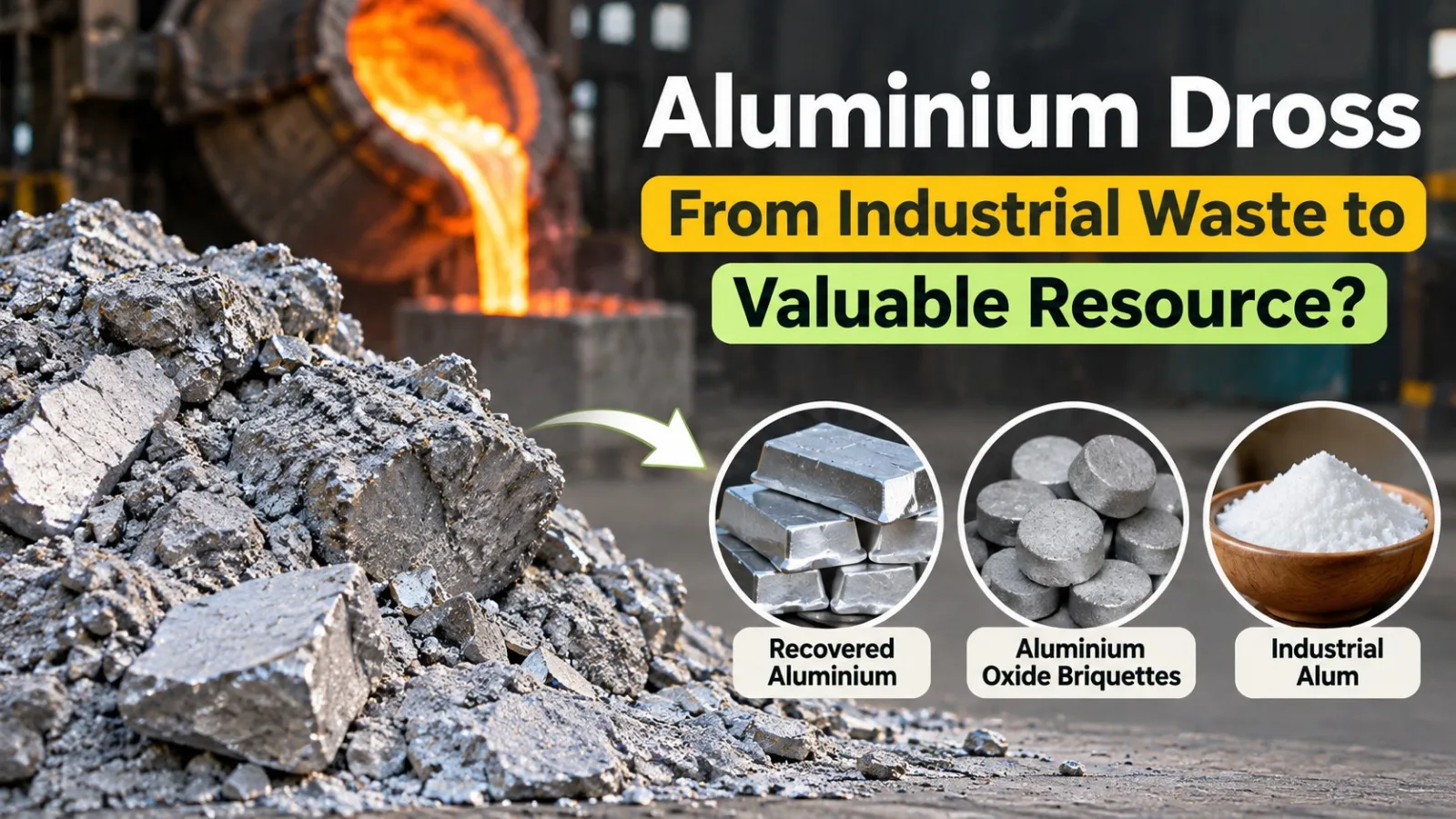
Aluminium production creates a lesser-known industrial residue that could support an entirely different business opportunity. Known as aluminium dross, this material forms on the surface of molten aluminium during melting, refining and casting. Although it is often treated as an industrial waste, the residue contains recoverable aluminium and other compounds that can be processed into useful industrial materials.
The commercial opportunity lies in separating the valuable metal from the residue and finding buyers for the remaining processed material. With the right technology, aluminium dross can become a source of secondary aluminium, aluminium oxide products and industrial chemicals. This creates an opportunity for recycling companies to generate revenue from material that would otherwise require specialised waste management.
What Exactly Is Aluminium Dross?
Aluminium dross forms when molten aluminium comes into contact with oxygen during industrial processing. The resulting surface material contains varying proportions of metallic aluminium, aluminium oxide and aluminium nitride, along with other impurities.
Its composition depends on the production process, temperature, metal grade and operating conditions. Fresh hot dross can contain substantial recoverable metallic aluminium, while material that has cooled and undergone further processing may contain a larger proportion of oxides and other compounds.
This difference is commercially important because not all aluminium dross carries the same recovery value. A recycling company purchasing the material without first understanding its composition could end up paying more for processing than the recovered products are worth.
India's Aluminium Industry Creates a Potential Feedstock Market
India is one of the world's largest aluminium producers, with production activity spread across major smelters, secondary aluminium manufacturers and metal foundries. According to provisional government figures, primary aluminium production reached approximately 42 lakh tonnes in FY2024-25, compared with 41.6 lakh tonnes in the previous financial year.
Every stage of aluminium processing creates opportunities for material recovery. Smelting operations, refining facilities, casting units and secondary aluminium manufacturers generate different grades of dross and related residues.
However, the quantity of recoverable dross cannot be calculated simply by applying a fixed percentage to national aluminium production. Generation rates and metallic content vary across facilities and production methods. This makes direct procurement arrangements with individual industrial units more important than relying on theoretical national waste estimates.
How Aluminium Dross Can Be Converted Into Marketable Products
The business opportunity does not end with extracting aluminium metal. Different processing methods can produce several commercially useful materials from the same industrial residue.
1. Recovering Aluminium Metal From Hot Dross
Freshly generated hot dross offers an opportunity to recover aluminium before the material loses additional heat and metallic content. Specialised rotary processing equipment can separate molten aluminium, which can subsequently be returned to the smelting operation.
The Central Pollution Control Board's operating procedure describes a hot-dross recovery process using specialised handling containers and rotary processing equipment. It specifies preheating when the incoming dross temperature falls below 660°C, the melting point of aluminium.
For recycling businesses, proximity to aluminium smelters is particularly important. Collecting hot dross quickly, maintaining suitable handling arrangements and reducing transportation time can influence the amount of metal recovered and the overall economics.
2. Recovering Metal From Cooled Dross
Once the material cools, additional processing is required to separate metallic aluminium particles from the remaining residue. Screening, crushing and mechanical separation can help recover metal that remains trapped in the dross.
Under the CPCB's specified process for primary aluminium dross, metallic particles larger than 2 mm are separated and collected, while the finer residue below 2 mm moves to further processing.
The recovered aluminium can be returned to authorised aluminium production facilities. Its value depends on metal purity, alloy composition and the buyer's acceptance specifications. Contamination and oxidation can reduce the price received compared with clean aluminium scrap.
3. Converting Dross Residue Into Aluminium Oxide Briquettes
One interesting part of the business is what happens after the metallic aluminium has been separated. The remaining fine residue does not necessarily have to become a disposal expense.
The CPCB has prescribed a process for converting specified aluminium dross residues into aluminium oxide briquettes. The material is mixed with an appropriate binder, processed through mixing equipment and compressed using a briquetting press.
These briquettes can be used as slag conditioners in steel manufacturing. This creates a potential industrial market beyond the aluminium sector and gives processors another opportunity to generate revenue from the original material.
4. Manufacturing Industrial Alum From Dross Residue
Another application involves converting certain aluminium dross residues into alum through hydrometallurgical processing. The process involves leaching, separation of solids and liquids, crystallisation and centrifugation.
A July 2019 CPCB operating procedure specifically recognises the utilisation of eligible dross residues from metal separation or dross-reprocessing units for alum manufacturing.
However, the product has restrictions. The prescribed utilisation is for industrial effluent treatment and other industrial applications, not drinking-water treatment or food and beverage applications. The process also requires chemical handling systems, pollution controls and authorised waste management arrangements.
How Much Aluminium Can Actually Be Recovered?
Recovery efficiency is one of the biggest factors determining whether an aluminium dross recycling operation becomes profitable.
A 2021 research study published in the journal Metals examined aluminium dross processing using a top-blown rotary converter. The experimental process achieved a metal yield of 75.7% relative to the quantity of dross charged, compared with an existing external processing yield of 61–62% at the Austrian facility studied.
The experiment used liquid salt to improve metal recovery, and the researchers cautioned that practical operating conditions can produce lower yields. The findings therefore should not be treated as a guaranteed recovery rate for Indian recycling facilities.
Nevertheless, the comparison illustrates the financial importance of processing efficiency. Even a relatively small improvement in recovered metal can make a meaningful difference when a facility handles large quantities of industrial residue.
For an operator, the most important starting point is laboratory testing of incoming dross. Metallic aluminium content, oxide composition, moisture, salt content and impurities must be understood before deciding the appropriate recovery technology.
Where Does the Profit Come From?
An aluminium dross recycling business can potentially generate revenue from multiple products rather than depending entirely on aluminium prices.
The first revenue stream comes from recovered aluminium metal. The second comes from processed residues converted into aluminium oxide briquettes for steelmaking. Eligible residue streams can also support alum production for industrial applications.
However, each product has a different buyer base and quality requirement. A steel manufacturer purchasing briquettes may evaluate their chemical composition and suitability for its production process, while aluminium producers will focus on the recovered metal's quality and alloy characteristics.
A simplified profitability calculation would look like this:
Operating Profit = Revenue From Recovered Aluminium + Revenue From Processed Residues − Total Processing and Operating Costs
The cost side includes dross procurement, transportation, electricity, fuel, labour, equipment maintenance, chemicals, pollution-control systems, residue treatment and regulatory compliance.
The quality of the incoming material is especially important. A low purchase price does not automatically make a particular dross batch profitable if it contains little recoverable metal or requires expensive treatment.
Why Location Could Decide the Economics
Unlike conventional scrap trading, aluminium dross processing is closely connected to the location of industrial production facilities. Transporting hot or cooled dross over long distances can increase costs and complicate handling requirements.
A processing facility located near an aluminium smelter or a cluster of metal foundries could benefit from a more consistent supply of raw material. Industrial buyers for recovered metal and processed residues would also need to be accessible within an economically viable transport distance.
This creates opportunities around major aluminium production and manufacturing centres. Gujarat, Odisha, Chhattisgarh and other industrial regions with established metal-production activity could be relevant locations for evaluating such businesses.
A company could also explore a toll-processing arrangement in which an aluminium producer supplies the dross and pays an authorised processor for recovery services. Such arrangements can reduce the need for a recycler to speculate on the purchase price of varying-quality material.
The Regulatory Challenge: Aluminium Dross Is Not Ordinary Scrap
The biggest barrier to entering this business is the regulatory and environmental responsibility associated with handling aluminium dross.
The CPCB's December 2021 operating procedure classifies the specified primary aluminium dross and its residues under Category 11.5 of Schedule I of the Hazardous and Other Wastes (Management and Transboundary Movement) Rules, 2016. Certain residues generated during metal separation or dross reprocessing are also covered under separate hazardous-waste classifications.
Processing facilities must obtain the applicable authorisations from their State Pollution Control Board or Pollution Control Committee. Transportation, storage, handling and utilisation must follow the relevant prescribed procedures.
The technical requirements are also significant. Covered storage, impervious flooring, enclosed processing arrangements, dust collection systems and appropriate emission-control equipment are among the requirements prescribed for applicable processing routes.
Aluminium nitride in the residue can also create ammonia-related hazards under certain conditions. The CPCB procedure therefore includes ammonia detection and scrubbing requirements for the specified processing stage.
These requirements increase the initial investment, but they also create a barrier against informal operators who cannot meet the necessary technical and environmental standards.
Can Small Recycling Companies Enter This Business?
A full-scale aluminium dross processing facility requires specialised equipment, environmental infrastructure and reliable industrial supply agreements. This makes it difficult for a small recycling trader to compete directly with established metal recovery operations.
However, the market offers different entry points. Companies could explore authorised collection and logistics services, specialised dross testing, contract processing or manufacturing downstream products using eligible processed residues.
A smaller operator may find it easier to establish a business around a specific stage rather than attempting the entire process. For instance, a company with access to industrial customers could evaluate the commercial feasibility of aluminium oxide briquette manufacturing, subject to the applicable regulatory authorisations and reliable residue supply.
The availability of suitable raw material and long-term purchase agreements would be critical before investing in machinery.
The Opportunity Is in Recovering More Value From Every Tonne
Aluminium dross represents an interesting intersection between metal recycling, industrial waste management and secondary commodity manufacturing. Its value comes from the possibility of recovering aluminium while converting selected residues into products that serve other industries.
India's growing aluminium production base provides a substantial industrial ecosystem in which these recovery activities can operate. However, the business case depends less on the headline volume of dross generated and more on its metallic content, processing efficiency, logistics and access to authorised industrial buyers.
As aluminium manufacturers face increasing pressure to improve material efficiency and manage production residues, specialised recovery facilities could become an important part of the industry's supply chain. The companies that can consistently recover metal and develop commercially acceptable uses for the remaining residue may be able to turn an industrial disposal problem into a secondary commodity business.