

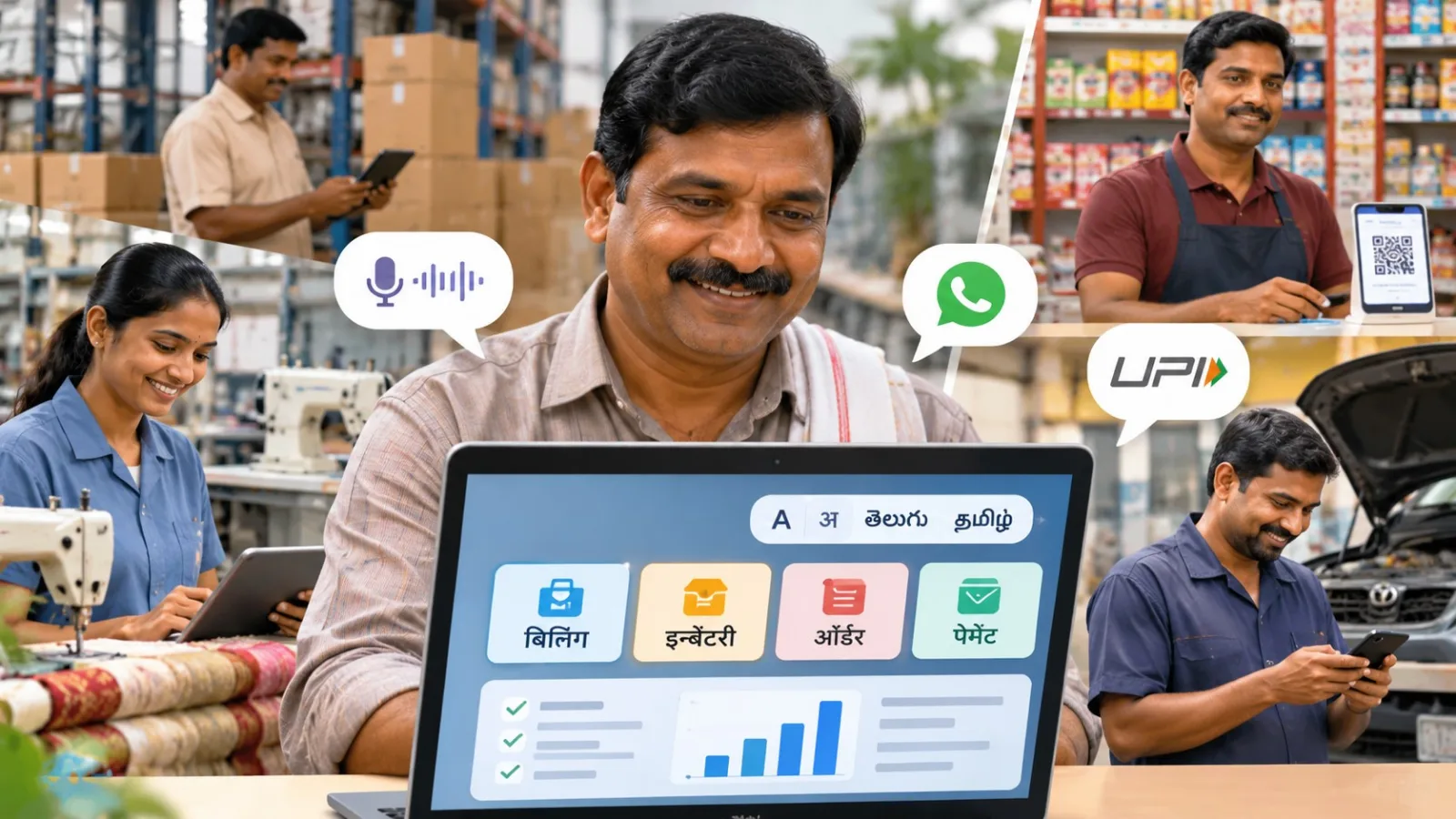
India's business software industry has largely developed around accounting packages, enterprise resource planning systems and billing applications designed for businesses comfortable with conventional digital interfaces. However, thousands of small distributors, manufacturers, retailers and service providers continue to depend on physical registers, spreadsheets, phone calls and messaging applications to manage daily operations.
The challenge is not necessarily an unwillingness to adopt technology. For many business owners, existing applications do not match the language they use, the way they communicate with employees or the processes followed in their particular industry. A wholesale distributor in a smaller city, for example, may handle hundreds of daily orders and maintain customer credit records in Telugu, while the accounting software used by the business operates primarily in English.
This creates an opportunity for a category of products often described as vernacular SaaS. These applications would combine regional-language interfaces with practical business workflows such as order management, inventory tracking, payment collection, billing and employee coordination. The opportunity is not simply to translate existing software, but to make business technology more accessible and relevant to the way Indian enterprises operate.
India's MSME Base Creates a Large Potential Market
India's micro, small and medium enterprise ecosystem offers a substantial addressable market for specialised software companies. According to the Ministry of MSME's official registration dashboard, combined registrations under the Udyam Registration and Udyam Assist Platform systems crossed approximately 10.09 crore as of November 10, 2026.
The combined figure includes approximately 5.57 crore Udyam registrations and 4.51 crore Udyam Assist Platform registrations. These numbers demonstrate the scale of the formalisation ecosystem, although they should not be interpreted as 10 crore active businesses ready to purchase software subscriptions. Enterprises differ significantly in their digital readiness, operating requirements and ability to pay.
Internet usage provides another important indicator. The IAMAI-Kantar Internet in India 2024 report estimated that 870 million internet users accessed content in Indic languages during 2024, representing approximately 98% of internet users. It also reported that 57% of urban internet users preferred accessing internet content in Indic languages.
However, consuming regional-language videos or reading news in a local language is different from operating accounting or inventory software. The commercial opportunity depends on whether language accessibility can improve business productivity, reduce errors and make daily operations easier.
Real Indian Products Are Already Exploring This Market
Regional-language business software is not an entirely new concept in India. Several Indian technology companies have already introduced applications that combine local-language accessibility with accounting, billing, payment collection and inventory management.
Khatabook is one example. Its digital ledger application allows merchants to record customer transactions, monitor outstanding amounts and send payment reminders. The company also promotes multiple supported languages and UPI-based payment collection. This addresses a familiar requirement among small traders who traditionally maintain customer credit records in physical notebooks.
Vyapar offers another example of how regional-language accessibility can be combined with operational features. Its billing and accounting application supports multiple Indian languages and targets retailers, wholesalers, distributors and manufacturers. Its product features include GST billing, inventory management and business reporting, bringing several everyday business functions into one application.
myBillBook has also introduced regional-language access in its mobile application. Its official product information lists English, Hinglish, Hindi, Gujarati and Tamil as supported languages. The application also includes inventory tracking, stock reports, wholesale pricing and invoice management.
These products demonstrate that language support can be integrated into established business workflows. They also indicate that a new entrant would face competition from existing applications rather than entering a completely unexplored market.
The next opportunity may lie in building deeper industry-specific functionality. A general billing application may work for many businesses, but a pharmaceutical distributor, textile wholesaler and automobile spare-parts retailer can have very different order-management and inventory requirements.
Why Translating Existing Software Is Not Enough
One of the common misconceptions among software developers is that regional-language localisation simply involves translating menus, buttons and notifications from English into Indian languages. Although translation improves accessibility, it does not necessarily make an application suitable for local business operations.
Consider a trader who regularly records customer credit, supplier payments and outstanding balances. The terminology used in daily conversations may include regional expressions such as Udhar, Jama and Baaki, alongside English accounting terms. A software application that uses unfamiliar formal translations may create confusion even when the underlying information is technically accurate.
Another important requirement is supporting different users within the same business. The owner may prefer viewing daily sales and cash-flow summaries in Kannada, while an accountant may need GST reports and financial statements in English. Both users should be able to access the same business records without maintaining separate databases.
There is also a need to understand industry-specific practices. A manufacturing unit requires raw material consumption records and production tracking, while a distributor needs customer credit limits and delivery management. Localisation should therefore include the terminology, screens, reports and operational steps relevant to each business category.
Four Business Segments Where Startups Could Find Opportunities
1. Regional-Language Software for Distributors and Wholesalers
Distributors and wholesalers handle large numbers of transactions involving retailers, suppliers, sales representatives and delivery personnel. Orders may arrive through telephone calls, WhatsApp messages and personal visits, while credit balances and stock movements are maintained separately.
A specialised regional-language application could combine order booking, inventory management, customer credit records, sales reports and delivery updates. Sales representatives could record orders in Telugu, Tamil, Kannada or Marathi, while the business owner could monitor pending payments and stock availability through a central dashboard.
There is also an opportunity to connect order management with customer communication. For example, a distributor could automatically generate an order confirmation, share an invoice through WhatsApp and send a payment reminder when a customer's balance becomes due.
The application could offer different access levels for owners, sales representatives, warehouse employees and accountants. This would make the software useful beyond the person responsible for maintaining the accounts.
2. Production Management Software for Small Manufacturers
Small manufacturing units often need more than conventional billing and accounting software. A textile workshop, food-processing unit, fabrication business or packaging manufacturer may have to track raw materials, production quantities, wastage, job work and finished goods.
An affordable application designed specifically for these activities could simplify production reporting. Workers could enter quantities produced, material consumed and pending work orders through simple regional-language screens, while managers could monitor production progress from a dashboard.
For example, a small packaging manufacturer could record the quantity of raw material received, the number of finished packaging units produced and the material rejected during production. This information could help the owner understand material consumption and identify differences between planned and actual production.
Existing applications such as Vyapar demonstrate that billing and inventory software already serves manufacturing businesses. A more specialised startup opportunity would be to extend beyond these functions into production planning, batch tracking, job-work management and wastage reporting.
3. Billing and Inventory Applications for Regional Retailers
Independent retail stores represent another potential customer segment. Grocery shops, electrical retailers, textile stores and automobile spare-parts dealers need to maintain product information, purchase records, selling prices and stock quantities.
Applications such as myBillBook and Vyapar already address several of these requirements through billing, GST invoices and inventory management. A new startup would therefore need to offer a more specific advantage rather than introducing another ordinary billing application.
One possible direction is voice-assisted inventory management. A retailer could ask the application to check the available stock of a particular product, record a purchase or generate a low-stock notification. The system could also support local product terminology and different units of measurement used by individual trades.
Integration with digital payment systems could add further convenience. A retailer could receive a payment confirmation, identify the corresponding customer transaction and update the relevant invoice or ledger after verification.
4. Software for Local Service Businesses
Automobile repair workshops, electrical contractors, equipment maintenance providers, plumbers and other service businesses frequently coordinate jobs through phone calls and messaging applications. Customer requests, employee assignments, repair status and payment details may be recorded in separate places.
A specialised application could provide digital job cards, appointment scheduling, service quotations, spare-parts records and employee assignment features. Technicians could update job progress from their phones, while business owners could monitor pending work and payments.
For example, an automobile workshop could create a service record when a vehicle arrives, attach photographs of damaged components, record spare parts used and generate an invoice after the repair is completed. Customers could receive updates through WhatsApp instead of repeatedly calling the workshop.
This category could also include small maintenance companies that manage multiple technicians and customer locations. Regional-language communication would make coordination easier for employees who may not regularly use conventional office software.
Voice Technology Could Change How Small Businesses Use Software
Voice-based interaction is an important area for developers exploring regional-language business applications. Many business owners are accustomed to giving instructions verbally, particularly when managing employees, customers and suppliers. Requiring them to navigate several screens for every transaction can make software less convenient.
The government's BHASHINI initiative provides an existing language technology infrastructure that developers can explore. Its ecosystem includes language services and AI capabilities for activities such as speech recognition, translation and text-to-speech conversion. These tools could help startups build multilingual applications without developing every underlying language technology independently.
Consider a distributor who wants to record an order while speaking to a retailer. Instead of entering every product manually, the employee could dictate the product name, quantity and customer details in a supported language. The application could convert the instruction into a structured order that can be reviewed before confirmation.
However, speech recognition in ordinary conversation is different from accurately recording financial transactions. Product names, local accents, quantities and mixed-language expressions can create errors. A reliable application should display the recognised information and require confirmation before updating stock, invoices or customer balances.
The product opportunity lies in combining voice convenience with accurate business records, rather than treating voice commands as a replacement for transaction controls.
UPI Soundboxes and Payment Integration Offer Another Opportunity
Digital payments have already changed the way many Indian retailers collect money. UPI QR codes and payment soundboxes are familiar features in a growing number of commercial establishments. This creates an opportunity to connect payment confirmation with accounting and inventory applications.
An interesting existing example is AlertPay by Khatabook. The product offers a mobile-based UPI soundbox experience with spoken payment alerts and regional-language support in Hindi, Tamil, Telugu, Bengali and Kannada. It demonstrates how a simple voice notification can address a practical requirement for businesses that receive frequent digital payments.
However, a payment announcement and an accounting entry are not the same thing. A business application must correctly identify the amount, transaction reference and relevant customer before marking an invoice as paid. A spoken confirmation alone should not automatically be treated as complete payment reconciliation.
A startup could build a more integrated product that connects supported payment data with invoices, customer accounts and daily collection reports. Retailers could see which bills have been paid, which payments remain outstanding and how much money was collected through digital channels.
This functionality could be especially relevant for distributors and retailers handling a large number of small transactions. The ability to reconcile payments with actual customer balances could provide more value than simply displaying another payment notification.
WhatsApp Could Become an Important Business Software Interface
Many small businesses already use WhatsApp to communicate with customers, share product photographs, receive orders and send payment details. Rather than forcing every customer and employee to adopt a completely new communication channel, business software companies can connect their applications with familiar messaging workflows.
There are existing examples of this approach. GoFrugal, an Indian retail and business software provider, documents WhatsApp integration for sending sales bills, order updates and stock-related notifications. Its integration demonstrates how business software can extend beyond the internal dashboard to communicate directly with customers.
A regional-language SaaS product could take this further by offering local-language invoice messages, order confirmations, payment reminders and service updates. A distributor could send a retailer an order summary, while a workshop could share a repair estimate and completion notification.
WhatsApp should function as a communication layer rather than the primary storage system for business records. Orders, invoices and customer balances should remain in the application's database, with messaging used to distribute relevant information. Developers must also account for customer consent, platform messaging rules and applicable template requirements.
Go-to-Market Strategy: Reaching Businesses Beyond Online Advertising
A software product can have useful features and still struggle to acquire customers. Small business owners often prefer demonstrations and recommendations from people they already trust, particularly when an application will contain important financial and customer information.
Partnerships with local accountants, GST practitioners, trade associations, computer retailers and billing-machine dealers could provide an effective distribution channel. These professionals already interact with business owners and understand their operational requirements.
For example, a startup developing software for electrical wholesalers could work with local electrical trade associations and suppliers to demonstrate its inventory and order-management features. A product designed for automobile workshops could reach customers through spare-parts dealers, mechanic networks and automotive service associations.
Onboarding assistance would also be important. Many small enterprises may need help importing existing customer records, setting up product catalogues and training employees. Local-language demonstrations and WhatsApp-based customer support could reduce the difficulties associated with switching software.
Founders should also consider starting with one city, one industry and one language instead of launching across the entire country. This approach would allow them to understand customer behaviour, improve the product and establish a local distribution network before expanding into additional markets.
Revenue Models for Regional-Language SaaS Startups
Subscription-based pricing is one possible revenue model for these applications. A basic plan could provide billing, customer records and simple inventory management, while higher-priced plans could include multiple users, warehouses, employee management and advanced reporting.
Pricing could also vary according to the size and operational requirements of the business. A small retailer may need only one billing system and a limited number of users, whereas a distributor with several warehouses may require additional inventory and sales-management features.
Another potential revenue stream is implementation and support. Startups could charge for data migration, customised setup, staff training and integration with existing accounting systems. For customers unfamiliar with software adoption, these services may be an important part of the overall product.
However, the subscription price must reflect the measurable value delivered. A business owner is more likely to continue paying when the application helps reduce stock discrepancies, improve collection tracking or save employee time. Regional-language accessibility can attract initial interest, but consistent operational value is more likely to determine long-term retention.
Challenges That Startups Need to Consider
Willingness to pay remains one of the biggest challenges. A business owner may prefer a regional-language interface but may not be willing to purchase another monthly subscription if existing notebooks or billing applications already meet basic requirements. Startups need to demonstrate a clear improvement in daily operations.
Language accuracy is another concern. Indian business conversations frequently combine English terminology with regional languages and local trade expressions. An application that misunderstands a product name, quantity or payment instruction could create financial and inventory discrepancies.
Customer retention will depend on reliability, ease of use and support quality. Business software becomes deeply connected with daily operations once customers start recording invoices, orders and balances. Data backups, access controls, accurate reporting and dependable customer support are therefore essential product requirements.
There is also a risk of building too many features for different industries at the same time. A startup attempting to serve retailers, manufacturers, distributors and service providers through one complicated application may struggle to deliver the specialised workflows each segment expects.
Where the Next Startup Opportunity Could Emerge
The opportunity in regional-language business software is not limited to creating translated versions of existing applications. India's small enterprises need technology that connects their everyday communication with business records, payments, inventory and customer management.
Existing products such as Khatabook, Vyapar and myBillBook show that local-language accounting and billing applications already have a presence in the market. Products such as AlertPay and GoFrugal also demonstrate how voice-based payment notifications and messaging integrations can address specific business requirements.
For a new startup, the opportunity may be to solve a narrower problem more effectively. A regional-language order-management application for distributors, production-tracking software for small manufacturers or job-management platform for local service businesses could be more useful than another generic accounting product.
The companies that understand both the language and the operating practices of their customers may find room to build sustainable software businesses. In this market, successful localisation will depend not just on what language an application speaks, but on how well it understands the business using it.