

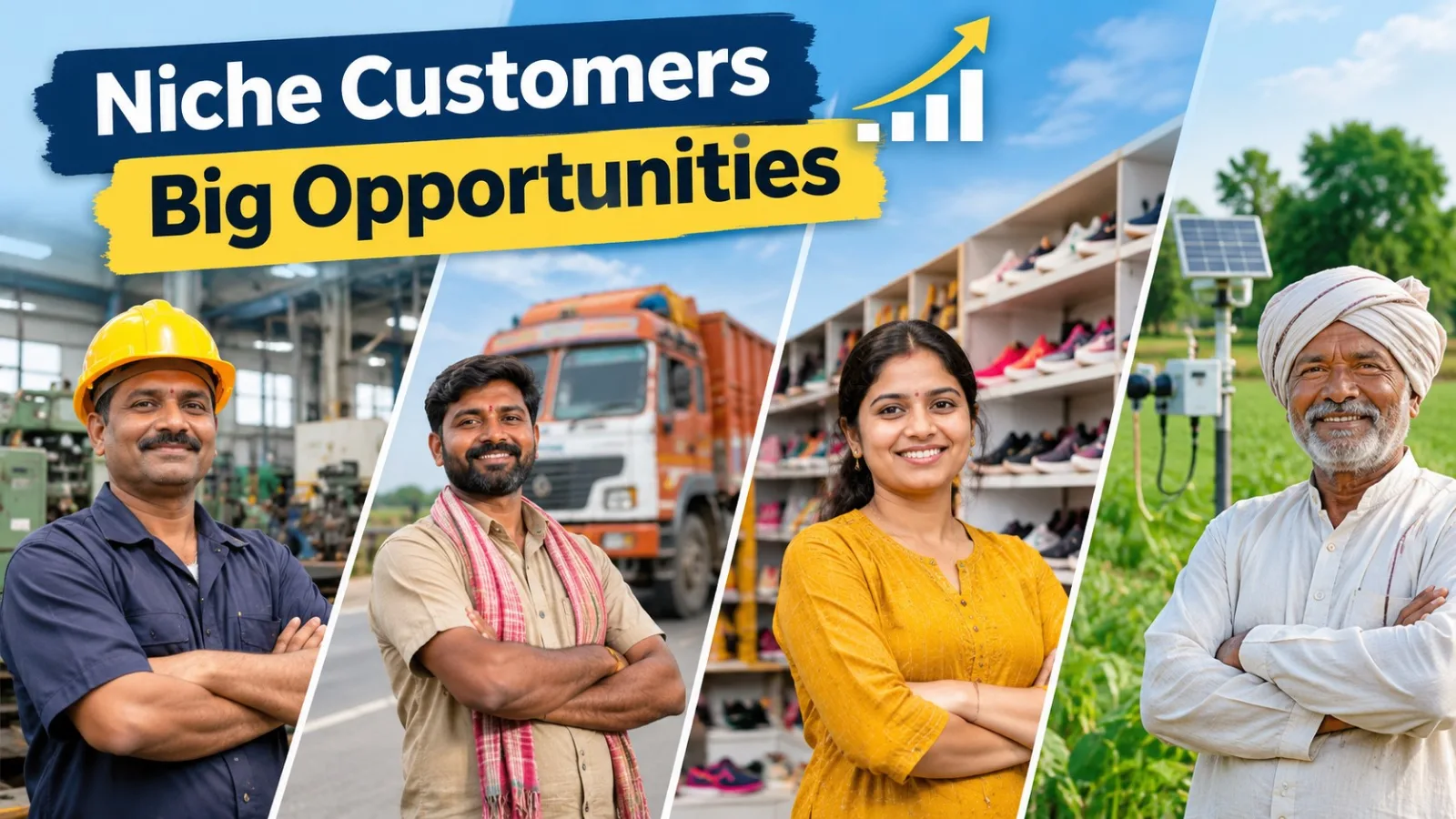
A small manufacturing unit may struggle to find the right industrial supplier. An independent truck owner may spend hours searching for return loads. A footwear retailer in a smaller town may have limited access to manufacturers offering affordable wholesale quantities. These are everyday business problems, but they rarely attract the attention given to consumer-facing technology platforms.
For many startups, however, such problems represent an opportunity to build a focused business. Rather than competing with established companies for millions of customers, founders are identifying specific groups that have been left out of existing digital solutions. Their products may not appeal to everyone, but they can become important tools for the businesses that depend on them.
This approach is gradually creating opportunities across industrial procurement, regional distribution, transportation, agriculture, manufacturing and specialised services. The underlying idea is simple: a startup does not always need a large audience if it can solve an expensive or recurring problem for a clearly defined customer group.
Why Small Industries Often Remain Outside the Startup Spotlight
Most consumer technology businesses are designed around large audiences and standardised requirements. Building an application for online shopping or digital payments allows companies to serve customers across different locations using largely similar products. The same approach is not always suitable for small industrial businesses.
A machine workshop, textile manufacturer, packaging unit and food processing company may all need technology, but their operational requirements are very different. One may need machinery maintenance records, another may need raw material procurement, while a third may require batch-level production tracking and quality documentation.
Developing separate solutions for these businesses requires industry knowledge, customer interaction and specialised product development. The market may appear smaller than consumer technology, but businesses can be willing to pay for tools that directly address production delays, inventory problems or procurement inefficiencies.
India's MSME ecosystem provides a substantial backdrop for this opportunity. The Ministry of MSME's dashboard reported approximately 10.09 crore combined registrations under the Udyam Registration and Udyam Assist Platform systems as of November 11, 2026. These records cover a highly diverse business ecosystem rather than a uniform group of technology customers.
Indian Startups Finding Customers in Overlooked Industries
Several Indian companies illustrate how a focused business model can develop around customers with specialised requirements. Their businesses are different, but they share an important feature: they are designed around a particular industry or operational problem.
Moglix: Bringing Industrial Procurement Online
Industrial procurement is an area where purchasing decisions involve considerably more than comparing product prices. Factories and workshops regularly require maintenance, repair and operations supplies, electrical equipment, safety products, industrial tools and other essential materials.
Moglix developed its business around this requirement by building a B2B procurement platform for industrial supplies. Instead of concentrating on ordinary consumer products, the company focuses on connecting business buyers with suppliers across industrial categories.
Its website reports more than 1.5 lakh SME clients, alongside over 250 enterprise and corporate customers. The platform also lists more than 4.5 lakh industrial products across over 30 categories. This demonstrates how a specialised procurement business can serve a sizeable customer network without operating as a conventional consumer marketplace.
bijnis: Connecting Small Retailers With Manufacturers
Traditional footwear and apparel wholesale markets involve manufacturers, distributors, local agents and retailers. Small shop owners may face difficulties accessing factory prices, comparing suppliers and purchasing inventory in quantities suited to their businesses.
bijnis focuses on this gap through a B2B wholesale platform that connects retailers directly with manufacturers. Its business model covers footwear and apparel sourcing, with features such as low minimum order quantities, GST billing and factory-direct purchasing.
The important aspect of this approach is its focus on the requirements of smaller retailers. A large retailer may have the purchasing capacity to negotiate directly with manufacturers, but an independent shop may need smaller orders and more accessible sourcing arrangements. By concentrating on this segment, bijnis addresses a specific problem within the traditional wholesale supply chain.
Vahak: Building a Digital Network for Truck Owners and Transporters
Road transportation involves a large number of independent truck owners, brokers and small logistics operators. Finding vehicles, identifying available loads and connecting with reliable transport partners can involve considerable manual coordination.
Vahak operates a B2B road transportation marketplace connecting transporters, truck owners and brokers. Its platform allows participants to find loads and vehicles online rather than depending entirely on traditional offline networks.
The company's website reports a transporter network of more than 10 lakh participants across over 850 cities. It also lists more than one lakh bookings. The business illustrates how a technology platform can focus on a specific group of industry participants instead of trying to build a general logistics application for every type of customer.
Fasal: Developing Technology for Specific Agricultural Requirements
Agriculture technology is another area where broad solutions may not address the needs of individual farming segments. A horticulture grower managing a plantation has different requirements from a farmer growing conventional field crops.
Fasal focuses on precision agriculture through sensors, crop intelligence and farm automation. Its technology provides farm-level information, including soil moisture conditions, crop-stage monitoring, irrigation recommendations and disease and pest forecasts.
The company also offers irrigation and fertigation automation products. This approach targets a specific operational requirement: helping growers make decisions using conditions measured on their own farms rather than relying only on general weather information or conventional farming practices.
How a Small Customer Base Can Support a Focused Startup
A startup serving a narrow industry does not necessarily have to generate revenue from millions of individual users. Its business model can be built around the value of each customer relationship and the frequency with which customers use the product or service.
Consider a hypothetical industrial software startup serving small packaging manufacturers. If it signs up 2,000 businesses and charges each customer an annual subscription of ₹25,000, the business would generate ₹5 crore in annual recurring revenue.
This is an illustrative calculation, not an estimate of any existing company's revenue. It also excludes employee costs, technology expenses, customer acquisition, support and other operating costs. However, it demonstrates why a focused business can generate meaningful revenue without reaching mass-market scale.
The opportunity becomes more attractive when customers use the product regularly. Software used for daily inventory management, procurement, production planning or compliance may become part of a company's normal operations. Businesses are more likely to continue paying when replacing the solution would create operational difficulties or require significant retraining.
Recurring Problems Can Create Recurring Revenue
Some niche startups earn through subscriptions, while others generate income through transactions, product sales, distribution margins or service contracts. The appropriate model depends on the customer's purchasing habits and the nature of the problem being addressed.
An industrial software company may charge a monthly or annual fee. A procurement marketplace may earn through transactions between buyers and suppliers. A specialised equipment provider may combine an upfront hardware sale with installation, maintenance and software services.
This creates multiple ways to build revenue around the same customer segment. A startup initially offering inventory software to small manufacturers, for example, may later introduce supplier discovery, order management and production reporting. Such expansion becomes possible because the company already understands the customer's business operations.
Why Industry Knowledge Can Become a Competitive Advantage
Serving a small industry often requires more than building a digital platform. Founders need to understand how customers operate, which decisions they make every day and where existing processes create delays or unnecessary expenses.
A startup working with textile manufacturers must understand fabric procurement, production stages, quality checks and order fulfilment. A company serving independent transporters needs to understand vehicle availability, load requirements, route economics and payment cycles.
This knowledge can become difficult for general-purpose technology companies to replicate quickly. Once a specialist startup builds relationships with customers and suppliers, it can develop products around industry-specific workflows. Customer feedback also becomes more useful because the company is working with a clearly defined group rather than a broad and unrelated audience.
Reaching Customers Without Depending Entirely on Digital Advertising
Another advantage of a focused market is that potential customers can often be identified through established industry networks. Manufacturers operate in industrial clusters, transporters participate in local associations, and specialised retailers source products through known wholesale markets.
Startups can use trade associations, distributor partnerships, industry exhibitions, supplier networks and local business communities to reach these customers. Demonstrations and direct sales may be more effective than mass advertising when a product requires explanation or integration with an existing business process.
Such customer acquisition may involve more fieldwork, but it can help startups build stronger relationships. In specialised B2B markets, trust, product reliability and after-sales service can influence purchasing decisions as much as the initial price.
The Risks of Building a Business Around a Very Small Market
A specialised market does not automatically translate into a successful startup. The number of businesses willing to pay for a solution may be much smaller than the total number of businesses operating in that industry.
Customer acquisition can also become expensive when founders need to visit individual customers, install equipment or provide continuous technical support. In industries with low profit margins, customers may recognise a problem but remain unwilling or unable to pay for a dedicated solution.
Startups therefore need to establish whether the problem occurs frequently, whether customers have a budget to address it and whether the product can be delivered profitably. They must also consider whether the business can expand into adjacent customer groups without losing its specialised focus.
The Opportunity Lies in Solving Problems That Are Too Specific for General Platforms
India's startup ecosystem is not limited to businesses targeting consumers or large enterprises. Small manufacturers, independent retailers, transport operators, specialised agricultural producers and regional service providers also have operational problems that can support technology-driven businesses.
The companies working in these segments show that market size should not be measured only by the number of potential users. The frequency of a problem, the economic value of solving it, the willingness of customers to pay and the possibility of repeat business are equally important considerations.
For founders, the opportunity may lie in understanding one industry more deeply than a general technology platform can. A business that becomes essential to a relatively small group of customers may find a more defensible position than one trying to attract a much larger audience without addressing a clearly defined need.