
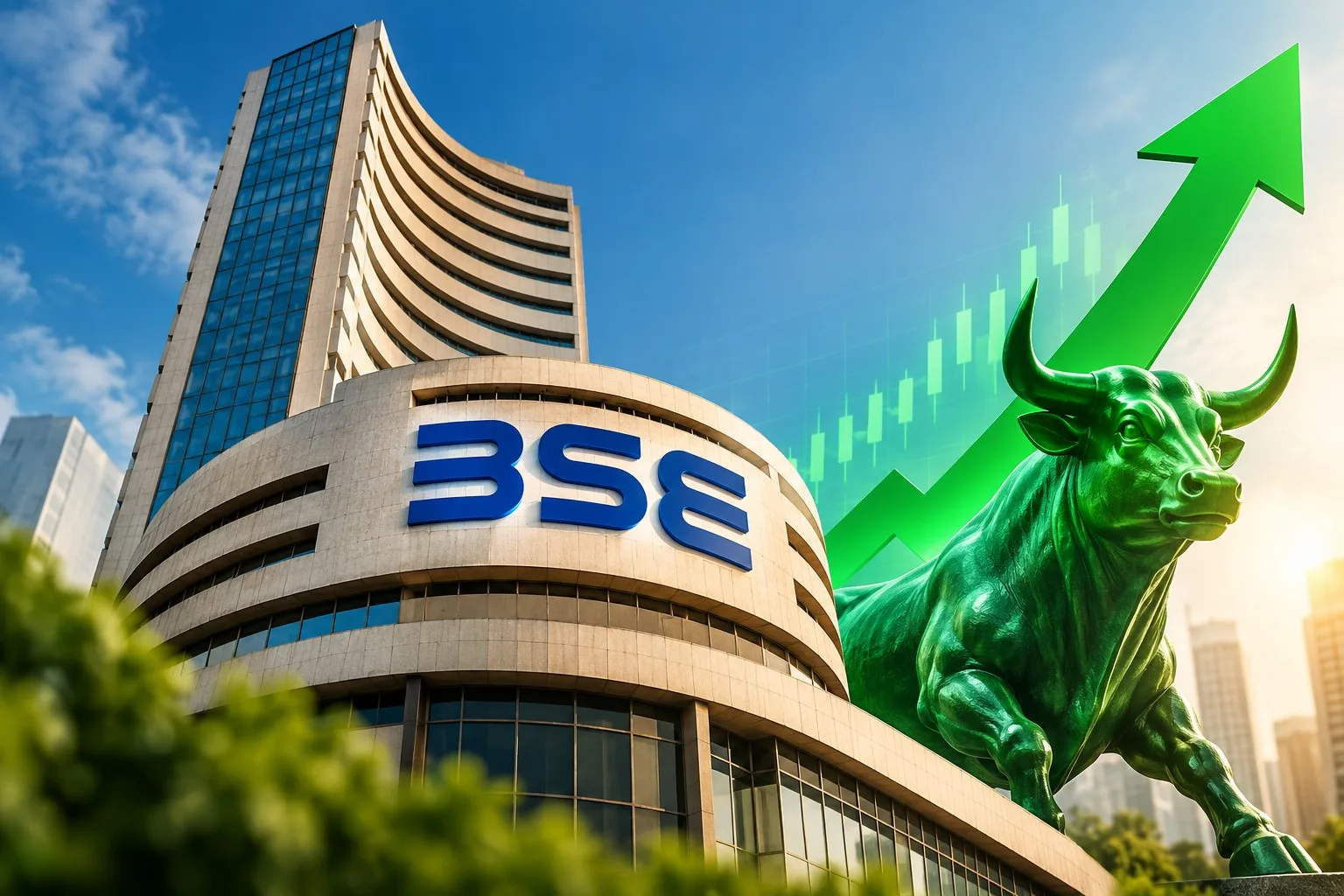
BSE Ltd shares climbed as much as 4.3% to ₹3,369 on Monday, October 26, after Motilal Oswal Financial Services upgraded the stock to Buy and raised its price target to ₹4,000. The revised target represents approximately 23% upside from Friday’s closing price.
The brokerage’s latest assessment comes as trading activity on BSE shows signs of recovering from the slowdown following regulatory changes in August. Its analysis also points to improving cash-market participation and the possibility of higher profitability as revenue expands.
The stock had touched ₹3,000 on October 1 before recovering to Monday’s intraday high. However, it remained below its 52-week high of ₹4,446.80, recorded on May 27, 2026.
Here are four developments behind the brokerage’s revised assessment.
1. Derivatives Turnover Recovers Sharply
BSE’s derivatives business has shown a significant recovery since the August slowdown.
The exchange’s notional average daily traded turnover (ADTO) in futures and options rose 85% in October so far compared with the lower levels recorded after the Closing Auction Session (CAS) changes in August, according to Motilal Oswal.
The recovery follows a difficult period in which notional derivatives turnover fell approximately 35% in August compared with the April–July average. September brought a modest improvement before activity accelerated in October.
Motilal Oswal estimates that BSE’s derivatives ADTO could reach ₹216 lakh crore in FY27, representing 16% year-on-year growth.
A partial reversal of the CAS framework, scheduled to take effect on December 7, 2026, is another factor the brokerage expects to support trading activity. The extent of the benefit will depend on how volumes respond to the revised framework and whether the recent recovery continues.
2. Premium Turnover Could Generate More Revenue
BSE has also expanded its share of the premium-turnover market, creating another potential source of revenue growth.
Motilal Oswal estimates that premium turnover accounts for around 60% of BSE’s revenue. The exchange has captured more than 30% market share in this segment, while its premium-to-notional turnover ratio has increased from approximately 6–7 basis points in FY24 to around 14 basis points currently.
For comparison, the corresponding ratio at NSE is above 20 basis points, according to the brokerage’s analysis.
The difference indicates potential for BSE to generate more premium turnover relative to the notional value of contracts traded. Greater institutional participation and increased activity in longer-dated contracts could contribute to further improvement.
This matters because an improvement in the ratio could support revenue and earnings even without a proportionate increase in overall notional turnover.
3. Cash-Market Share Climbs From 7% to 9%
BSE’s cash-market business is showing improvement alongside the recovery in derivatives.
Its cash-market share has increased from around 7% to 9% over the past two months. Average daily turnover in the segment reached ₹10,500 crore in the second quarter of FY27, a quarterly record cited in the brokerage report.
Participation has expanded as well. BSE had 829 cash-market members in September 2026, compared with 806 a year earlier. The number of unique client codes that traded during September reached 6.16 million.
The brokerage has identified improvements in trading access and order routing, along with the potential impact of NSE’s proposed listing and the opening of its shareholder lock-in period in March 2027, as factors that could influence future activity.
Motilal Oswal projects cash-market ADTO to grow at a compound annual growth rate of approximately 30% between FY26 and FY28.
The forecast represents a potential additional growth driver for BSE beyond its derivatives operations.
4. Profit Margins Could Expand to 70%
BSE’s operating performance provides another reason for the improved earnings outlook.
Its EBITDA margin expanded from 9% in FY21 to more than 65% in FY26. Motilal Oswal expects the margin to approach 70% as revenue increases and the exchange benefits from its scalable operating model.
The brokerage projects revenue to grow at a compound annual rate of 23% between FY26 and FY28. Profit after tax is forecast to grow faster, at approximately 27% annually over the same period.
One factor behind this difference is BSE’s cost structure. Around 55% of operating expenses are linked to business activity, according to the brokerage. These expenses can move with trading volumes, meaning the impact of a slowdown may be partly offset by lower activity-related costs.
However, the same structure means profitability remains sensitive to changes in trading activity and related expenses. The projected margin expansion will depend on revenue growth and costs developing broadly as anticipated.
Motilal Oswal Raises FY27 and FY28 Estimates
The brokerage has revised its forecasts to reflect the improvement in trading activity and the potential contribution from the cash market.
Financial metric | FY27 revision | FY28 revision |
|---|---|---|
Revenue estimate | Increased 8% | Increased 10% |
Profit after tax estimate | Increased 10% | Increased 12% |
The ₹4,000 target price accompanies the upgrade from Neutral to Buy. Motilal Oswal has also indicated that a sustained recovery in volumes, combined with further improvement in premium turnover relative to notional turnover, could provide additional earnings upside.
BSE’s Star MF platform and co-location services offer other sources of business activity. Star MF processed approximately 245 million transactions in Q2 FY27, compared with 12 million in Q1 FY20. The platform generated more than ₹80 crore in quarterly revenue, while the co-location business contributed approximately ₹45–48 crore per quarter, according to the brokerage analysis.
What the Numbers Indicate
The revised brokerage outlook rests on three measurable developments: a recovery in derivatives turnover, greater participation in the cash market and the potential for further margin expansion.
The immediate catalyst for Monday’s share-price movement was the rating upgrade and higher target price. Whether BSE can sustain the recovery will depend on subsequent trading volumes, the impact of regulatory changes and the company’s reported financial performance.
Disclaimer: This article reports brokerage estimates and market developments for informational purposes. Target prices and earnings projections are estimates and do not guarantee future share-price performance.